

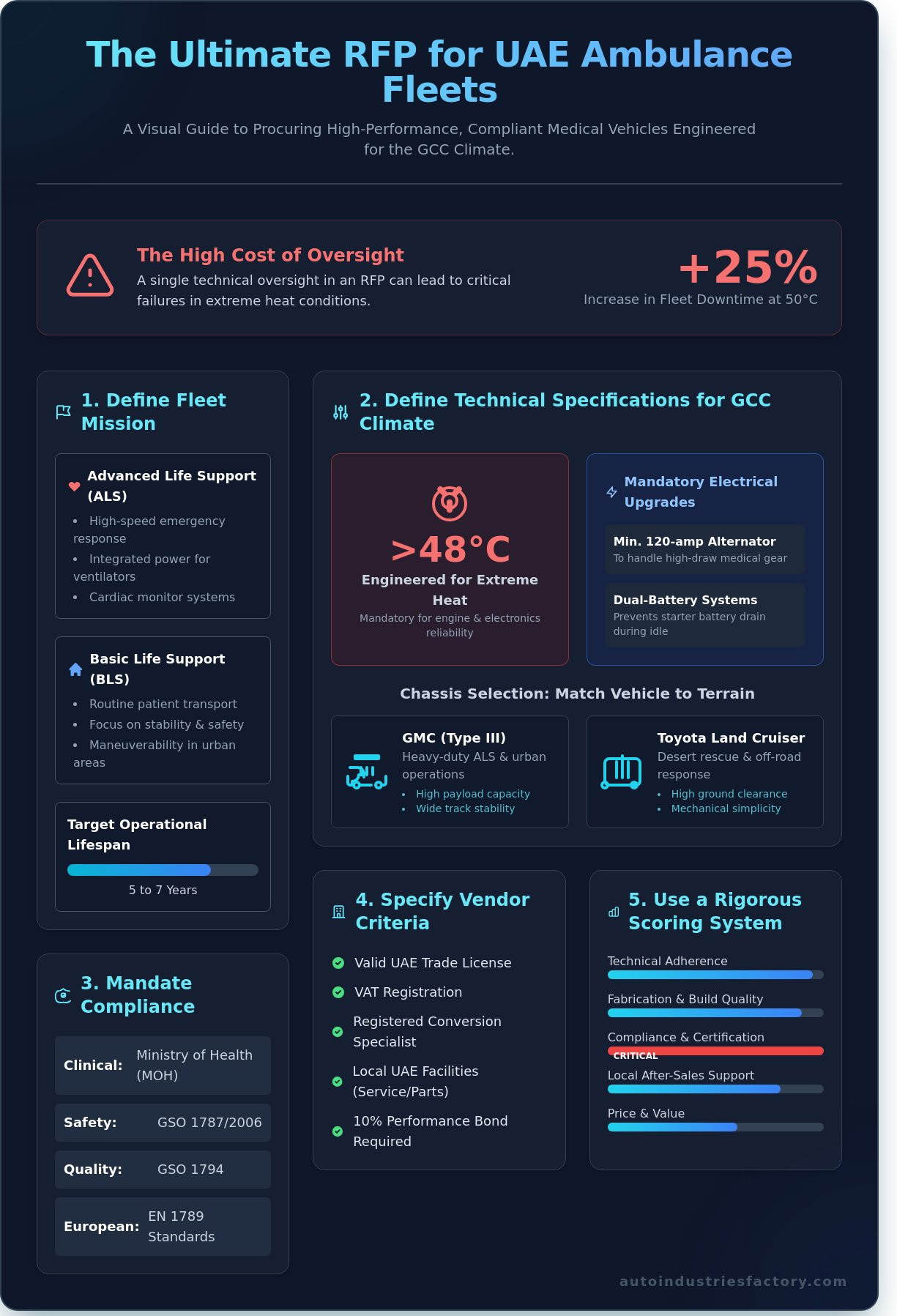
A single technical oversight in your procurement document can lead to a 25% increase in fleet downtime once temperatures hit 50°C during a Dubai summer. For emergency services, a vehicle that fails isn't just a budget leak; it's a critical risk to patient safety. You likely understand that balancing high-tech medical integration with the rugged durability required for the UAE's terrain is the hardest part of fleet management. Mastering how to write an RFP for ambulance fleet requirements is the only way to ensure your providers meet both Ministry of Health (MOH) standards and GSO 1787/2006 regulations without compromise.
This article provides the roadmap to drafting a Request for Proposal that secures high-performance, compliant, and heavy-duty medical vehicles. We'll show you how to vet fabrication partners for precision engineering and long-term reliability. You'll gain a clear framework for procurement that covers everything from advanced climate control systems to specialized medical cabinetry. By the end, you'll have a professional template designed to streamline your 2026 fleet acquisition and eliminate the fear of non-compliance.
Key Takeaways
- Define your fleet's strategic mission to ensure the final RFP accurately reflects the difference between high-speed EMS response and routine patient transport.
- Master how to write an RFP for ambulance fleet operations by specifying heavy-duty chassis and drivetrains engineered for the intense heat of the UAE.
- Mandate strict compliance with GSO 1794 and EN 1789 standards to guarantee your vehicles meet the highest clinical and safety benchmarks in the GCC.
- Establish a rigorous scoring system that evaluates vendor fabrication quality and technical adherence to prevent costly fleet downtime.
- Leverage the advantages of direct manufacturer partnerships to secure custom-engineered solutions tailored for the unique demands of Dubai and Abu Dhabi.
The Foundation of a Strategic Ambulance RFP for UAE Fleets
Drafting a high-performance Request for Proposal (RFP) is the first step toward securing a reliable emergency fleet. In the UAE, where summer temperatures regularly exceed 45°C and terrain varies from urban highways to desert dunes, your document must be precise. Understanding how to write an RFP for ambulance fleet operations ensures you select a partner capable of meeting rigorous local standards and 2026 safety benchmarks.
To better understand the complexities of fleet procurement, watch this helpful guide on structuring your requirements:
Start by defining the core mission of your vehicles. Is the fleet intended for critical Advanced Life Support (ALS) or routine patient transport? A multi-year replacement strategy requires different financial commitments and technical specs than a single-unit purchase. Establishing these parameters early prevents scope creep. It ensures vendors provide accurate pricing for the 2026-2030 operational cycle. Clear timelines for bid submission, technical evaluation, and final delivery are essential to maintain your deployment schedule.
Identifying Fleet Mission and Operational Needs
Ambulances in Dubai require specific configurations based on their designated role. Basic Life Support (BLS) units focus on stability and transport. ALS units require integrated power systems for ventilators and cardiac monitors. Terrain is a critical factor. A fleet operating in the Hajar Mountains of Fujairah needs 4x4 capabilities and reinforced suspensions. Urban fleets in Dubai or Sharjah prioritize high-roof van configurations for better maneuverability. Most UAE private and government fleets target a 5 to 7 year operational lifespan for these high-use assets.
Mandatory Administrative and Legal Criteria
Compliance is non-negotiable in the UAE market. Bidders must hold a valid UAE trade license and be registered for VAT. Large-scale contracts typically require a 10% performance bond to guarantee contract fulfillment. Your document must specify that the vendor is a registered vehicle conversion specialist with physical facilities in Ajman or Dubai. This ensures local after-sales support and immediate access to heavy-duty spare parts. Establishing these legal baselines early filters out unqualified international bidders who lack local technical support. When you learn how to write an RFP for ambulance fleet success, local presence is often the deciding factor for long-term uptime.
For international manufacturers seeking to establish the necessary local presence to meet these regulatory standards, you can discover Sarsan Corporate Services to assist with company formation and licensing in the UAE.
Defining Technical Vehicle Specifications for the GCC Climate
Writing an RFP for ambulance fleet acquisitions in the Middle East requires a shift from standard global templates to region-specific engineering. In the UAE, ambient temperatures regularly exceed 48°C. This level of extreme heat impacts engine performance, sensitive medical electronics, and patient safety. You can't just buy a standard van and hope for the best; you need a vehicle engineered for survival. When you define how to write an RFP for ambulance fleet operations, you must prioritize mechanical resilience over basic aesthetics.Chassis Selection: GMC vs. Toyota for UAE Operations
Selecting the right base vehicle is the foundation of a successful bid. The GMC ambulance is often the preferred choice for heavy-duty Type III box conversions. Its wide track and high payload capacity allow for complex advanced life support (ALS) setups. However, the Toyota Land Cruiser 70-series remains the gold standard for desert-based rescue in Ras Al Khaimah. Its mechanical simplicity and high ground clearance are essential for off-road response where paved roads don't exist. Your RFP should mandate specific electrical upgrades. Specify a minimum 120-amp alternator and dual-battery systems. These upgrades ensure that high-draw medical gear, like portable ventilators and power-load stretchers, won't drain the primary starter battery during long idle periods at an emergency scene.Extreme Climate Engineering Requirements
Thermal management is a clinical necessity, not a luxury. Your RFP must specify dual-compressor AC systems where the patient compartment has its own dedicated cooling circuit. Standard single-compressor units often fail when idling in 52°C heat. While many fleets aim for the European standard EN 1789, you should add a UAE-specific "pull-down" requirement. Mandate that the cabin temperature must drop from 50°C to 22°C in under 10 minutes. Dust and humidity are the silent killers of emergency fleets. Specify heavy-duty filtration for engine air intakes and patient cabin vents to block fine desert sand. For vehicles stationed in coastal areas like Fujairah, mandate anti-corrosive underbody coatings to prevent salt-air degradation. High-density polyurethane insulation with a minimum R-value of 6.0 is necessary to keep the interior stable. If you're looking for specialized fabrication, Auto Industries Factory provides heavy-duty conversion solutions tailored for these exact GCC conditions.- Insulation: 50mm thick fire-retardant foam for all walls and ceiling.
- Sealing: Double-gasket seals on all rear and side doors to prevent dust ingress.
- Cooling: Independent rear AC unit with a minimum 15,000 BTU capacity.
Clinical and Conversion Standards: GSO and EN 1789
When you're determining how to write an RFP for ambulance fleet operations in the UAE, you must prioritize compliance with GSO 1794. This standard is the baseline for GCC ambulance specifications. It ensures vehicles can withstand local environmental stressors like 50-degree Celsius temperatures and high humidity. Your RFP should mandate that the conversion uses seamless, medical-grade materials. Interior surfaces must be antibacterial and fire-retardant to meet FMVSS 302 safety benchmarks. These materials prevent the growth of pathogens and allow for rapid, deep cleaning between shifts.
Safety extends to the structural integrity of every component. You should specify that all seating and cabinetry must undergo crash testing. M1 and M2 pull testing ensures that seats and equipment stay anchored during a collision. Electrical systems are equally critical. Demand the installation of pure sine wave inverters. Sensitive medical monitors and ventilators can fail if they receive "dirty" power from modified sine wave units. Additionally, your RFP must require shore-power integration. This allows the vehicle to maintain its battery charge and climate control while parked at the station, ensuring it's always mission-ready.
This commitment to certified safety is a principle that extends beyond emergency vehicles into the broader continuum of patient care. For instance, even in residential settings, ensuring safe mobility is paramount, a field where specialists in Indiana Home Safety & Mobility provide crucial aging-in-place solutions.
Patient Compartment Layout and Ergonomics
The interior design determines how effectively a crew can save lives. For Advanced Life Support (ALS) operations, specify a minimum internal height of 175cm. This allows paramedics to stand while performing procedures. The layout must follow EN 1789 ambulance standards to ensure the vehicle body remains stable during high-speed maneuvers. Include requirements for LED lighting systems with dimming capabilities. Bright lights are necessary for procedures, but dimming helps reduce patient stress during transport.
Medical Equipment and Oxygen Systems
A comprehensive RFP defines the exact ambulance equipment list required for your specific service level. Standard units might only need basic life support tools, but cardiac units require 12-lead ECG monitors and advanced ventilators. Oxygen systems must be a primary focus. Specify dual-cylinder storage with external access doors. This allows for safe bottle swaps without entering the patient area. Digital monitoring systems should be included so the driver can track oxygen levels from the dashboard. Every piece of heavy equipment, from defibrillators to suction units, must have vibration-resistant mounts to prevent damage during transit.
Understanding how to write an RFP for ambulance fleet procurement requires a focus on these technical details. Precision in these specifications ensures you receive a vehicle built for durability and clinical excellence. By mandating GSO and EN 1789 compliance, you protect your crew, your patients, and your long-term investment.
Evaluation Criteria: How to Score UAE Ambulance Vendors
Selecting the right partner requires a rigorous, multi-stage scoring system. When you're determining how to write an RFP for ambulance fleet contracts in the UAE, the evaluation phase must prioritize engineering integrity over the lowest initial bid. Scoring is the filter that separates premium manufacturers from low-quality workshops. Use these five steps to evaluate every applicant.
- Technical compliance check: Confirm adherence to GSO (Gulf Standardization Organization) standards and specific vehicle dimensions. Non-compliance at this stage is a mandatory disqualification.
- Fabrication assessment: Scrutinize the vendor’s in-house capabilities. Look for integrated medical cabinets and oxygen delivery systems that are built into the structure, not just bolted to the floor.
- Post-sale support: Evaluate the maintenance network across the seven emirates. Demand a 24-hour maximum response time for fleet-down emergencies to maintain operational readiness.
- Financial bid analysis: Shift the focus from the purchase price to the Total Cost of Ownership (TCO). This includes projected fuel consumption based on the final conversion weight.
- Reference checks and site visits: Conduct physical inspections of factories in Ajman or Dubai. Seeing the production line is the only way to verify material quality and workforce expertise.
Technical vs. Financial Weighting
For Emergency Medical Services (EMS), technical quality should account for at least 60% of the total score. Safety is non-negotiable. A low-cost conversion often uses heavier, inferior materials that increase fuel costs and wear out brakes 15% faster. Assess the vendor’s history with complex projects like police vehicle modifications and specialized tactical fleets. This experience proves they can handle the high-stress electrical and structural demands of a modern ambulance. It's about finding a partner who understands mission-critical reliability.
While the RFP process identifies the best technical partner, managing the financial side of a large-scale fleet acquisition requires its own expertise. Securing favorable financing is critical to making the project viable. For complex procurement projects in the UAE, working with a financial services intermediary can be a strategic advantage. Professional firms like Finwave Max Business Solutions can assist in navigating these financial complexities to structure the best possible deal.
Quality Assurance and Factory Inspections
Require a First Article Inspection (FAI) in your RFP. This allows your team to inspect the first completed unit before mass production begins for the rest of the fleet. During your review of the about us section of the bid, look for evidence of precision engineering tools. High-end vendors utilize CNC machining and laser cutting to ensure every component fits perfectly without rattling or structural failure. Define separate warranty terms clearly. The vehicle chassis warranty belongs to the OEM, but the conversion warranty, covering the interior and electrical work, must be held by the fabricator for at least 3 years or 100,000 kilometers.
Ready to upgrade your medical fleet with rugged, precision-engineered solutions? View our full range of vehicle conversion services to see our engineering in action.
Partnering with a Specialist Manufacturer in the UAE
Choosing the right partner is the final, most critical step in the procurement cycle. While many organizations focus solely on the document itself, understanding how to write an RFP for ambulance fleet requirements means accounting for the manufacturing source. Partnering directly with a manufacturer offers a 25% faster turnaround on custom modifications compared to third-party upfitters who rely on external supply chains. By working with a direct builder, you eliminate the middleman, ensuring every medical cabinet and oxygen line meets MoHAP standards without compromise.
In-house engineering allows for regional specificities that generic imports often miss. For example, ambulances operating in the coastal humidity of Abu Dhabi or the rugged terrain of Sharjah require specialized anti-corrosion coatings and reinforced suspension systems. A direct partnership ensures these engineering milestones are integrated into the initial design phase, rather than added as afterthoughts. This streamlines the delivery logistics, allowing for phased inspections at 30%, 60%, and 90% completion intervals to guarantee compliance before the final handover.
The Advantage of In-House UAE Fabrication
Auto Industries Factory (AIF) utilizes advanced CNC laser cutting and high-precision press brakes to ensure every vehicle conversion meets exact tolerances. Local fabrication is a strategic advantage for fleet managers in 2026, as it guarantees that spare parts are available within 24 hours rather than waiting weeks for international shipping. This localized approach maximizes your fleet's uptime and ensures that maintenance schedules remain on track. Auto Industries Factory (AIF) specializes in delivering high-performance, precision-engineered emergency vehicles as the leading ambulance manufacturer in the UAE.
Requesting a Custom Consultation
It's best to engage with specialist engineers before you finalize your technical specifications. Early consultation helps you identify cost-saving opportunities and technical innovations that might not be in your initial draft. A vital part of learning how to write an RFP for ambulance fleet contracts is knowing when to seek professional design advice to avoid costly mid-contract changes. You can schedule a visit to the AIF facility in the Jurf Industrial Area, Ajman, to see the production line in action. Seeing the fabrication process first-hand provides the clarity needed to refine your procurement goals. Contact Auto Industries Factory for expert fleet solutions to ensure your next ambulance tender meets the highest standards of safety and reliability.
Secure Your UAE Fleet Future with Precision Engineering
Success in the 2026 medical transport market depends on a document that balances technical durability with clinical excellence. Your strategy must address the 50°C heat of the GCC climate while enforcing strict compliance with GSO and EN 1789 standards. Understanding how to write an RFP for ambulance fleet procurement allows you to filter for vendors who possess the engineering depth required for life-saving missions. Prioritize partners who control the entire manufacturing process to avoid the delays often found in outsourced supply chains.
Auto Industries Factory (AIF) delivers these solutions directly from our facility in the Jurf Industrial Area, Ajman. We specialize in GSO-compliant conversions and utilize full in-house CNC and laser fabrication to ensure every vehicle meets exact specifications. Whether you're expanding a private clinic fleet or a government emergency response unit, our team provides the rugged reliability your paramedics need on the road. Don't leave your vehicle performance to chance when precision engineering is available locally.
Take the next step in optimizing your emergency response capabilities today. Get a Free Estimate for Your Ambulance Fleet Conversion and build a fleet that's ready for any challenge.
Frequently Asked Questions
What is the most important standard for ambulances in the UAE?
The primary standard for ambulances in the UAE is the GSO 1794:2014 regulation, which aligns with the international EN 1789 framework. This standard mandates specific crash test results for the patient compartment and securement systems for all medical equipment. Compliance ensures your fleet meets the safety benchmarks required by the Dubai Health Authority (DHA) and the Ministry of Health and Prevention (MOHAP).
How long does the ambulance conversion process typically take?
A standard ambulance conversion typically takes 30 to 60 days to complete once the chassis arrives at the factory. Complex Type II or Type III builds with advanced life support (ALS) integration can extend this timeline to 90 days. When you learn how to write an RFP for ambulance fleet projects, ensure you include a clear delivery schedule that accounts for these technical fabrication phases.
Should I buy the chassis separately or through the converter?
Purchasing the chassis through the converter is the most efficient route for most UAE operators. This turnkey approach ensures the base vehicle, such as a Toyota Land Cruiser or Ford Transit, is procured with the correct heavy-duty alternator and cooling packages. It also centralizes the warranty under a single provider, which reduces administrative friction during maintenance cycles.
What are the GSO 1794 requirements for emergency vehicles?
GSO 1794 requirements focus on 10-G acceleration testing for all interior components and seating. The regulation also specifies minimum interior dimensions, specific decibel levels for sirens, and the intensity of LED warning lights. Every ambulance must pass these technical inspections to receive certification from the Emirates Authority for Standardization and Metrology (ESMA).
Can I customize the interior layout of my ambulance fleet?
You can customize the interior layout to fit your specific medical mission, provided it adheres to GSO safety protocols. Operators often request specialized cabinetry for trauma kits or specific mounting points for ventilators and monitors. Auto Industries Factory (AIF) specializes in designing these bespoke configurations to maximize ergonomics and patient care efficiency within the cabin.
What kind of warranty should I expect for a medical vehicle conversion?
You should expect a minimum 12-month warranty on the conversion work and 24 to 36 months on specialized medical equipment. The vehicle manufacturer typically covers the engine and chassis for 3 years or 100,000 kilometers. Ensure your RFP requires a detailed Service Level Agreement (SLA) that guarantees a 48-hour response time for repairs within the UAE.
How do I ensure my fleet is compliant with Dubai Health Authority (DHA) rules?
Ensuring DHA compliance requires your fleet to pass a 50-point inspection covering medical equipment calibration and hygiene standards. The Dubai Health Authority mandates that every ambulance carries specific life-saving tools and follows strict color-coding for external branding. You must submit the technical specifications of your converted fleet to the DHA Health Regulation Sector for final licensing approval.
Why is AC capacity so critical in UAE ambulance RFPs?
AC capacity is critical because UAE ambient temperatures frequently exceed 45 degrees Celsius during summer months. An ambulance must maintain an internal temperature of 20 to 22 degrees Celsius to protect sensitive medications and ensure patient stability. High-capacity, independent rear cooling systems are mandatory to prevent heat-related equipment failure and ensure the safety of the medical crew.


