

What if adding protection or equipment made a vehicle less dependable in the field? A military vehicle conversion is not simply a matter of armouring a platform or fitting it for troop transport. It starts with the mission, then balances protection, passenger and equipment needs, terrain, and vehicle reliability.
The scope can be difficult to define. Modifications may range from structural reinforcement and specialised storage to mission-specific equipment, and each addition affects how the vehicle is configured and used. A practical brief sets priorities before fabrication begins.
This guide explains the main decisions behind a military vehicle conversion and how to turn operational needs into vehicle requirements. You’ll learn how to distinguish mission-led modifications from armouring and troop transport, identify what belongs in a project brief, and keep reliability central as components are integrated. It also explains how in-house metal fabrication, including CNC laser cutting, bending, welding, machining, and painting, supports a coordinated conversion for demanding environments. Auto Industries Factory provides military modifications and troop vehicle conversions, bringing these capabilities together with precision and safety in the engineering process.
Key Takeaways
- Define a military vehicle conversion by its operational role, users, terrain, and base vehicle, not by a list of add-ons.
- Distinguish military modifications, troop transport, and armouring by the purpose each must serve.
- Understand how coordinated metal fabrication can support precise integration and vehicle reliability.
- Build a clear project brief by prioritising essential mission functions before secondary equipment.
- See how Auto Industries Factory brings in-house fabrication capabilities together to support military modifications from fabrication through final inspection.
What Does Military Vehicle Conversion Involve?
A military vehicle conversion adapts a vehicle to a defined operational role by changing its structure, layout, or equipment to meet practical mission requirements. The mission determines what the vehicle must do; individual modifications are the means of getting it there. A troop transport, a vehicle carrying specialised equipment, and a platform supporting remote operations can have very different conversion scopes, even when they start with similar vehicles.
The right scope depends on who will use the vehicle, where it will operate, what it must carry, and the capabilities of its existing platform. Terrain and climate can shape the operational brief alongside passenger or equipment needs. This differs from routine servicing, which maintains a vehicle, or adding an accessory that does not address its operational role.
This video shows one example of how a vehicle’s configuration can be adapted for a specific task:
Which operational needs shape a conversion?
Start by defining the vehicle’s primary role and its users. A government fleet may need vehicles configured for consistent duties across multiple units. Remote operations may require vehicles to carry people, supplies, or mission-specific equipment away from established infrastructure. Humanitarian work can call for a different balance of passenger space, storage, and access to equipment.
Then describe the operating conditions and base platform. Terrain, climate, expected loads, and the vehicle itself affect what can be integrated and how the conversion should be scoped. Specify what must be transported, where it needs to be secured, and which functions are essential. These details help separate core requirements from optional additions.
What can a military vehicle conversion include?
Depending on the vehicle and project requirements, the scope may include structural reinforcement, armouring, specialised storage, or mission-specific equipment. These are possible elements, not a standard package. The appropriate combination follows the operational brief and the vehicle’s intended use. The overview of military engineering vehicles illustrates how vehicle purpose can vary with the task.
- Structural reinforcement can support the structure required for the conversion.
- Armouring may form part of a protection-focused brief.
- Specialised storage can organise equipment around its intended use.
- Mission-specific equipment should be selected according to the vehicle’s role.
For a sound military vehicle conversion, define the required outcome before selecting modifications. This keeps the project focused on operational purpose, user needs, environment, and platform instead of accumulating additions without a clear mission benefit.
How Engineering and Fabrication Support Military Vehicle Reliability
A conversion is only as dependable as the way its structures and equipment work together. Metal fabrication supports the physical changes required by the project brief, while coordinated integration connects each modification to the vehicle’s intended role. For example, a storage structure needs to suit the equipment it carries and work within the wider layout, rather than being treated as an isolated addition.
Precision fabrication helps create vehicle structures and components that support dependable mission use by aligning the work with the conversion brief. This matters when a vehicle is intended for rugged terrain, desert environments, or other demanding conditions. The National Defense Industrial Association’s overview of military vehicle design fundamentals also reflects the value of connecting vehicle roles and operating environments to engineering decisions.
What role does in-house fabrication play?
Auto Industries Factory brings CNC laser cutting, bending, welding, machining, and painting together in-house. These capabilities support the fabrication of structures and components for military modifications, including work involving structural reinforcement, specialised storage, armouring, and mission-specific equipment. Each process has a different role: cutting shapes components, bending forms them, machining supports component work, welding joins fabricated parts, and painting completes the fabrication process.
Bringing these capabilities together under one roof helps coordinate fabrication with the wider conversion, from design through final inspection. Fabricated structures are considered as part of the vehicle modification, rather than as separate pieces to address independently. This supports precision and practical integration without assuming one configuration will suit every vehicle or mission.
How should safety and reliability guide integration?
Start with the relationship between the vehicle, the structures being added, and the equipment the mission requires. Structural work and mission equipment should be planned as a connected scope. Specialised storage, for instance, needs to fit the operational purpose and vehicle layout, while reinforcement should relate to the modification it supports. The right details depend on the project and platform.
Engineering for safety also means keeping the purpose of each change clear. A conversion brief should identify essential functions, explain what the vehicle needs to carry or support, and distinguish those needs from secondary additions. This gives fabrication and integration a practical reference point and helps avoid changes that do not contribute to the intended role.
- Cutting and bending shape metal components for the project scope.
- Machining and welding support component fabrication and assembly.
- Painting forms part of the in-house fabrication workflow.
For a military vehicle conversion, a coordinated approach connects fabrication choices to operational requirements and vehicle reliability. Explore military vehicle modification services to see how integrated capabilities support tailored projects.
Military Vehicle Conversion, Troop Transport, and Armouring Compared
These terms describe different dimensions of a project. Military modification is the broad category: adapting a vehicle to an operational role. Troop vehicle conversion focuses on transporting personnel, while armouring concerns protection and may form one part of a broader modification. The scopes can overlap, but the labels are not interchangeable. Define the project by its purpose to clarify what the vehicle must do and which changes belong in the brief.
| Project scope | Primary purpose | Typical scope | Question it answers |
|---|---|---|---|
| Military modification | Adapt a vehicle to an operational role | Role-led changes that may include structural reinforcement, specialised storage, or mission-specific equipment | What must this vehicle do for its users? |
| Troop vehicle conversion | Transport personnel in line with the intended role | Passenger transport needs, with storage or mission equipment considered as part of the configuration | Who needs to travel, and what must the vehicle support? |
| Armouring | Add a protection-focused element | Armouring as a defined component of the vehicle’s modification scope | What protection requirement is part of the brief? |
A military vehicle conversion may combine these scopes, but the brief should state the main operational purpose first. This prevents the project from being reduced to a single feature, such as passenger transport or armouring, when the vehicle’s wider role may require a coordinated set of changes.
When does a project focus on troop vehicle conversion?
A troop vehicle conversion centres on moving personnel as part of an operational role. The brief should describe who the vehicle is intended to carry, the conditions in which it will be used, and whether storage or mission-specific equipment must also be accommodated. Avoid assuming a particular seating layout or capacity: those details depend on the vehicle and project requirements. An Armoured Personnel Carrier guide provides further context on a specific type of personnel transport vehicle.
Transport is the defining purpose, but it does not describe every modification the vehicle may need. Storage and equipment should support the intended role rather than turn the vehicle into a collection of unrelated additions. AIF provides military modification services, including troop vehicle conversions tailored to project requirements.
When is armouring one part of a wider conversion?
Armouring may be included when protection is part of the operational brief, but it is not an automatic feature of every military conversion. A project may instead focus on personnel transport, specialised storage, structural reinforcement, or other mission-specific requirements. If armouring is included, describe it as one component of the full scope and distinguish its purpose from the vehicle’s other duties.
This distinction is useful for anyone seeking protection-focused information. A Car Armouring guide offers separate context on that subject, while the conversion brief should explain how any protection work relates to the vehicle’s wider role. Clear scope language helps align mission purpose, vehicle configuration, and planned work.
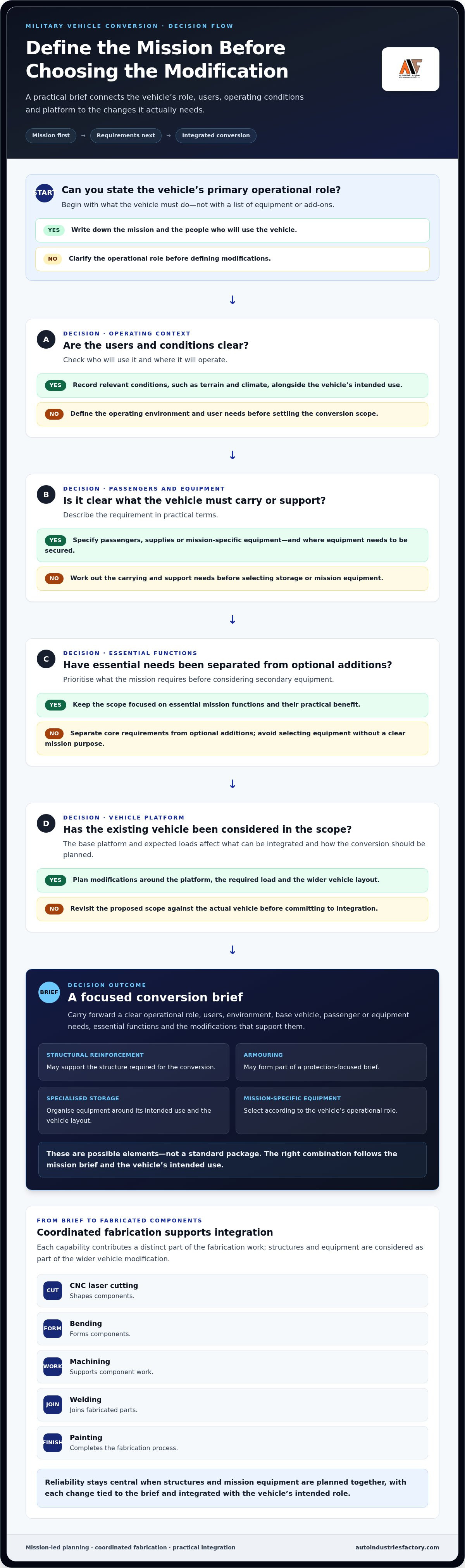
How to Define Requirements for a Military Vehicle Conversion
A useful project brief turns an operational need into clear, prioritised requirements. It gives fleet teams and fabrication specialists a shared reference for discussing the vehicle’s role, the work involved, and details that need resolution. For a military vehicle conversion, separate confirmed needs from assumptions so decisions reflect the mission rather than guesswork.
What should the project brief establish first?
Build the brief in sequence. Each step adds context for the next and helps keep essential functions ahead of optional equipment.
- Define the mission. State the vehicle’s primary role and the tasks it must support. Be specific about the expected outcome, such as transporting personnel or carrying mission-specific equipment.
- Identify the users. Describe the user group and how they will use the vehicle. Note relevant passenger, access, storage, or equipment needs without assuming a particular layout or capacity.
- Describe operating conditions. Explain where and how the vehicle will operate, including relevant terrain and environmental conditions. Note whether the brief must account for desert conditions or other demanding environments.
- Record the vehicle platform. Provide available details about the base vehicle and identify any information that still needs discussion. The platform is part of the conversion scope, not a blank slate.
Next, list required structural work, storage needs, and mission-specific equipment. Mark each item as essential, preferred, or an assumption to discuss. For example, a required storage function differs from a preferred arrangement that has not been agreed. This distinction keeps priorities visible and prevents optional additions from obscuring core operational needs.
How can fleet teams prepare for technical discussion?
Bring together the information held across operations, fleet management, and project approval. The operations team can describe how the vehicle will be used; fleet staff can provide available vehicle details; and decision-makers can clarify priorities and approval requirements. Assigning these roles early can reduce conflicting instructions and make the brief more useful.
Before a technical discussion, use this checklist:
- Have we stated the vehicle’s primary role and intended users?
- Have we described operating conditions and the tasks the vehicle must support?
- Have we listed required structural work, storage, and mission equipment?
- Have we ranked essential requirements separately from preferences?
- Have we labelled uncertain details as assumptions rather than settled requirements?
- Have we gathered the vehicle information currently available?
AIF’s Military Modifications work connects vehicle requirements with troop vehicle conversions and fabrication capabilities. Use the completed brief to start a focused discussion about the required scope through AIF’s military modification services.
How Auto Industries Factory Delivers Military Vehicle Modifications
A mission-ready conversion takes more than a list of modifications. Auto Industries Factory provides Military Modifications and Troop Vehicle Conversions, shaping the project scope around the vehicle, its intended role, and operational requirements. The aim is a coordinated solution, with fabrication and vehicle modifications considered together from the outset.
What makes AIF’s approach suited to conversion projects?
Metal fabrication is handled in-house, with CNC laser cutting, bending, welding, machining, and painting supporting the work. Bringing these capabilities together helps coordinate fabricated structures and components with the wider conversion, rather than treating each task as a separate addition. The project requirements guide how the work fits together.
This is important when a brief involves structural reinforcement, armouring, specialised storage, or mission-specific equipment. Each element needs to relate to the vehicle’s role and the requirements set for the project. The conversion scope is tailored accordingly, with precision and reliability guiding the work. AIF’s military modification services connect these capabilities with troop vehicle conversions.
Customised solutions are delivered under one roof from design through fabrication to final inspection. This integrated approach gives the project a connected path from its requirements to the completed vehicle. Work is engineered for safety, with attention to dependable performance in demanding environments. On-time delivery remains a priority.
What should readers do next?
Prepare a concise project brief before making an enquiry. Include the vehicle details available to your team, its intended mission, expected users, operating conditions, and essential requirements. List structural work, storage, or mission-specific equipment needs, then separate must-haves from preferences. If a detail is still an assumption, label it clearly so it can be discussed as part of the project scope.
This preparation connects operational priorities with fabrication and vehicle modification decisions. It also gives the project team a practical starting point for discussing how the vehicle and its requirements fit together. AIF’s fabrication-led approach brings metalworking capabilities and military vehicle modifications into a coordinated workflow, with a focus on precision, reliability, and safety.
Ready to discuss a military vehicle conversion? Share your vehicle and mission requirements with Auto Industries Factory to begin a focused project enquiry.
Turn Mission Requirements Into a Clear Next Step
A well-defined mission brief gives a military vehicle conversion a practical starting point. Focus on what the vehicle must do, who will use it, and the conditions in which it must operate. Then identify which requirements are essential and which can be refined as the project scope takes shape. Clear priorities help turn an operational need into a focused technical discussion.
Auto Industries Factory supports Military Modifications and Troop Vehicle Conversions with in-house CNC laser cutting, bending, welding, machining, and painting. These fabrication capabilities come together in customised solutions delivered from design through final inspection. The goal is to keep the work aligned with the vehicle and mission requirements, with precision, reliability, and engineered-for-safety thinking guiding the conversion.
Bring your vehicle details and mission priorities to the next step. A focused enquiry can start a discussion about a conversion tailored to your requirements, guided by on-time delivery.
GET FREE ESTIMATE and take the first step toward a mission-ready vehicle.
Frequently Asked Questions
Can a commercial vehicle be converted for military use?
Yes, a commercial vehicle can be adapted for a military role when its platform and project requirements support the intended use. AIF provides military vehicle modifications and troop vehicle conversions, transforming standard vehicles into specialised units. The brief should identify the operational purpose, users, environment, and required changes. This helps define a practical scope instead of assuming every base vehicle can support the same configuration.
Does every military vehicle conversion include armouring?
No. Armouring is a possible element, not an automatic feature of every conversion. A project may instead focus on troop transport, structural reinforcement, specialised storage, or mission-specific equipment. For example, a fleet vehicle intended to carry personnel and their equipment may have different priorities from one with a protection-focused role. The mission brief determines whether armouring belongs in the scope and how it relates to the vehicle’s other duties.
How long does a military vehicle conversion take?
Project duration depends on the vehicle, agreed scope, fabrication involved, and requirements being integrated. A focused modification and a project involving several structural and equipment changes are different jobs. Establishing the vehicle details and priorities early helps define the work clearly. AIF prioritises on-time delivery.
Are military vehicle conversion requirements the same for every fleet?
No. Requirements vary with fleet duties, user groups, operating environments, and the base vehicles involved. A government fleet assigned to transport personnel, for example, may need a different configuration from vehicles allocated to remote field operations. Even vehicles serving the same organisation can have distinct roles. Document the needs of each vehicle group, then identify shared requirements and role-specific differences before defining a common conversion scope.
Can troop vehicle conversions be tailored to a specific operational role?
Yes. A troop vehicle conversion can be shaped around its personnel-transport role and the operational tasks it must support. The brief can describe how passengers use the vehicle, what equipment needs to accompany them, and the conditions in which it will operate. These details help guide storage and mission-equipment choices without assuming a particular seating layout or capacity. AIF provides Troop Vehicle Conversions as part of its military modification work.
What information should I prepare before requesting a military vehicle conversion?
Prepare available details about the vehicle, its intended role, the user group, operating conditions, and the work you consider essential. Note any required structural changes, storage needs, or mission-specific equipment. Separate approved requirements from preferences or assumptions, and identify who is responsible for operational input and project approval. This gives the conversion discussion a useful starting point and makes it easier to identify where further technical detail is needed.
How does in-house metal fabrication support a military vehicle conversion?
In-house fabrication lets vehicle structures and components be made as part of a coordinated conversion workflow. AIF’s capabilities include CNC laser cutting, bending, welding, machining, and painting. These processes support project-specific fabrication alongside wider vehicle modifications, helping align the work with the brief. Fabrication alone does not determine vehicle reliability, but coordinated planning helps ensure each component serves the intended role and fits within the overall conversion scope.


