

Your ambulance chassis will likely fail years before your medical suite reaches its limit. While standard van conversions often struggle with high maintenance costs and cramped interiors, modular ambulance bodies offer a rugged, engineered solution built for the long haul. If you're tired of short vehicle lifespans in harsh environments, it's time to shift your focus to the structural integrity and superior volume of the box-type conversion.
We know that fleet managers need more than just a transport vehicle. You need a mobile ICU that protects your crew and your bottom line. In this guide, you'll discover why modular ambulance bodies are the gold standard for durability, space, and long-term fleet ROI. We'll break down how these systems allow for remounting to extend your investment, provide a superior ergonomic workspace for paramedics, and ensure full compliance with the latest safety standards, including CAAS GVS V4.0 and NFPA 1917. It's time to move beyond standard conversions and embrace a solution where precision engineering meets mission-critical reliability.
Key Takeaways
- Understand the fundamental design of modular ambulance bodies and how separating the patient compartment from the chassis maximizes long-term fleet ROI.
- Learn how heavy-duty sub-frames and precision metalwork provide superior protection for occupants during high-impact collisions and off-road operations.
- Compare interior volume and payload capacities to see why box-type conversions offer the necessary space and weight allowance for advanced life support equipment.
- Explore specialized engineering solutions, such as high-capacity HVAC and custom insulation, designed to maintain performance in extreme climates.
- Discover why in-house CAD design and expert fabrication are critical for ensuring every weld meets international safety and durability standards.
What are Modular Ambulance Bodies?
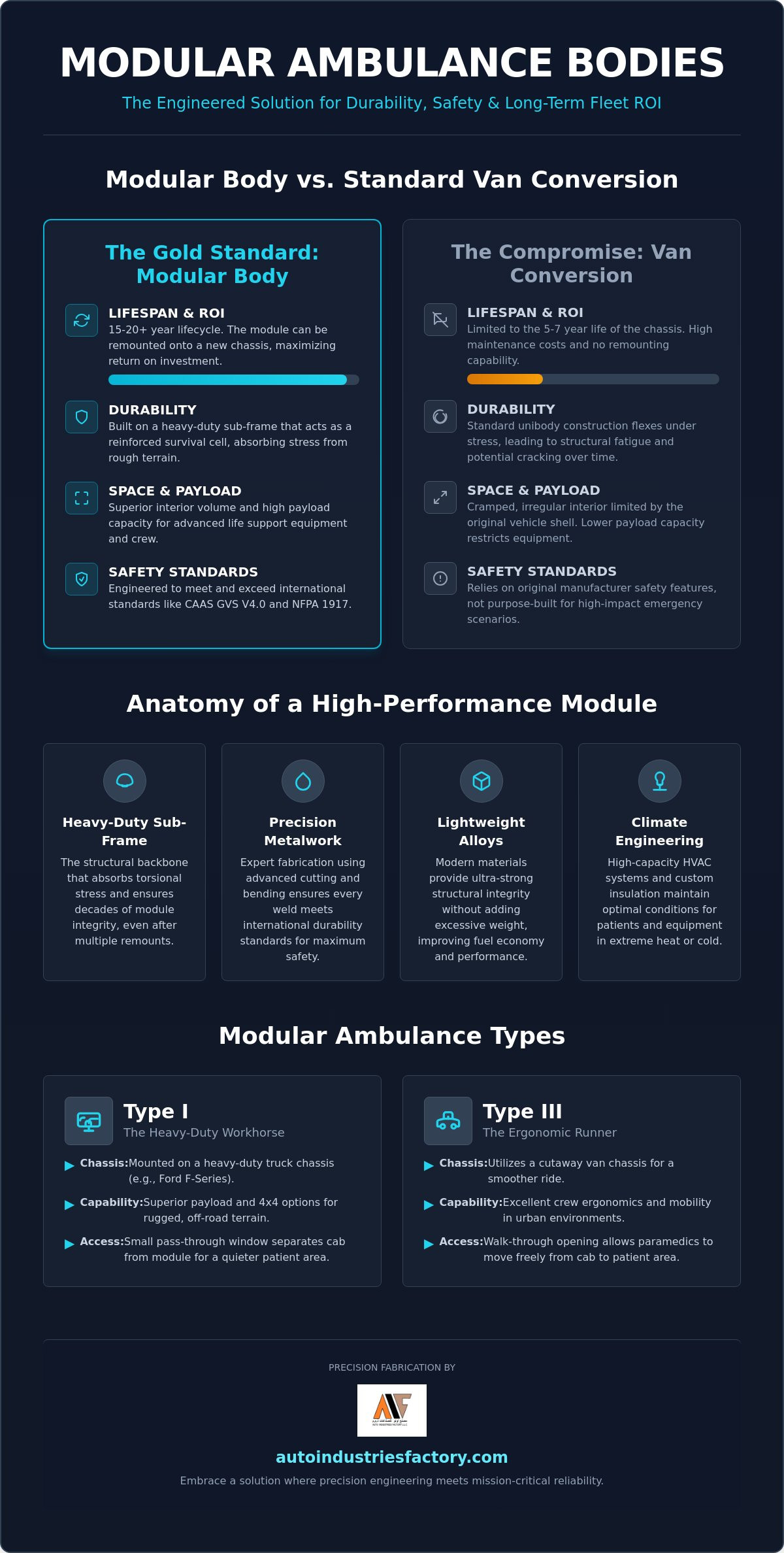
A modular ambulance is a high-performance emergency vehicle where the patient compartment, or "module," is engineered as a separate entity from the vehicle chassis. Unlike standard van conversions where the medical area is integrated into the original vehicle shell, modular ambulance bodies are independent structures designed for maximum durability and interior volume. This design creates a clear distinction between the mechanical platform, usually a heavy-duty truck or cutaway, and the clinical environment where life-saving care happens.
This structural independence is a critical advantage for long-term fleet management. Because the module doesn't flex with the vehicle's frame in the same way a unibody van does, it maintains its integrity during high-speed maneuvers or off-road deployments. High-acuity emergency care providers prefer this setup because it allows for a square, predictable workspace that comfortably accommodates heavy life-support equipment. Most importantly, it enables the "remount" process. When the engine or transmission on the chassis reaches its limit, the high-value medical body can be moved to a brand-new vehicle, significantly extending the return on investment for the fleet.
To see the engineering behind a high-performance conversion in action, watch this helpful video:
Type I vs. Type III Modular Units
Choosing the right platform depends entirely on your specific mission requirements. Type I units are mounted on a truck-style chassis, such as a Ford F-series or GMC platform. These are the heavy hitters of the industry, offering superior payload capacity and often featuring 4x4 capabilities for rugged terrain. Communication between the cab and the module typically happens through a small pass-through window, which helps maintain a quieter environment for the patient.
Type III units utilize a cutaway van chassis. The defining feature here is the "walk-through" opening, which allows paramedics to move freely from the driver’s seat to the patient area without exiting the vehicle. While Type III units offer excellent crew ergonomics and a smoother ride, Type I units remain the preferred choice for heavy-duty applications and maximum towing ability. Our expert team at Auto Industries Factory LLC specializes in both configurations to meet diverse operational needs.
The Evolution of the "Box" Ambulance
The industry has moved far beyond simple transport vehicles. Early modular designs were often heavy and hindered fuel economy, but the shift toward modular ambulance bodies has allowed manufacturers to prioritize both safety and efficiency. Modern engineering has corrected previous weight issues through aerodynamic shaping and the use of lightweight, ultra-strong alloys that maintain structural integrity without taxing the engine.
Reviewing various Ambulance types and designs shows how far specialized fabrication has come. Today’s modules are mobile ICU suites, designed to house advanced telemetry and diagnostic tools while meeting strict international safety standards like CAAS GVS V4.0. This evolution ensures that the "box" isn't just a container; it's a life-saving tool built with master craftsman precision to handle the highest stakes in emergency medicine.
Engineering Durability: The Anatomy of a High-Performance Module
Engineering a modular body isn't just about building a box; it's about creating a reinforced survival cell. In high-stress environments, especially in regional areas with extreme heat or unpaved roads, the sub-frame is the hero. A heavy-duty sub-frame acts as the foundation for modular ambulance bodies, absorbing the torsional stress that would otherwise crack a standard van's unibody. This structural backbone ensures the module remains square and functional for decades, even after multiple chassis remounts. It's the difference between a vehicle that lasts five years and one that serves for twenty.
Precision metalwork is what separates an expert build from a generic conversion. We utilize advanced metal cutting and bending techniques to ensure that the interior surfaces are completely flush. This isn't just for aesthetics; it's a functional requirement for infection control. We integrate medical gas lines and electrical harnesses directly into the wall structures during the fabrication phase. This creates a seamless, sterile interior where no exposed wires or pipes can trap contaminants. It also protects these critical systems from the constant vibration of high-speed response. Every weld and joint is a testament to the master craftsman's approach to mission-critical safety.
Structural Framing and Material Selection
Aluminum alloys are the industry standard for a reason. They provide an elite weight-to-strength ratio that maximizes payload without sacrificing protection. Our process relies on CNC machining and laser cutting to achieve tolerances that manual tools can't match. This precision ensures that doors seal perfectly against dust and moisture, which is vital in desert or tropical climates. We also install heavy-duty reinforcement points specifically for oxygen cylinders and power-load stretchers. If you need a build that handles these technical demands, explore our vehicle modification solutions to see our engineering in action.
Safety Standards and Crashworthiness
Safety isn't a suggestion; it's a requirement. Compliance with international benchmarks like EN 1789 and CAAS GVS V4.0 is non-negotiable for high-performance fleets. These standards ensure the body can withstand rollovers and high-impact collisions while protecting everyone inside. Dynamic crash testing is particularly important for seating and cabinetry. It ensures that life-saving equipment doesn't become a projectile during a sudden stop. Additionally, the modular construction acts as a buffer. It isolates the patient compartment from road noise and engine vibration, allowing paramedics to focus on the patient in a controlled environment.
Modular Bodies vs. Van Conversions: A Comparative Analysis
Choosing between a van conversion and a box-type unit is a decision that defines your fleet's operational capability for the next decade. Standard van conversions are often sufficient for basic patient transport, but they lack the structural volume required for high-intensity medical interventions. Modular ambulance bodies provide a square, wide-body environment that standard van unibodies simply cannot match. While a van’s walls curve inward, a modular unit offers vertical walls that maximize every inch of usable square footage. This extra width allows paramedics to work on both sides of a patient simultaneously, a critical requirement for Advanced Life Support (ALS) calls.
Payload capacity is another area where the modular design dominates. Advanced medical equipment, including power-load stretchers, heavy oxygen cylinders, and multiple cardiac monitors, adds significant weight. Most van platforms operate near their maximum gross vehicle weight rating (GVWR) once fully equipped, which accelerates wear on brakes and suspension. In contrast, modular units are typically mounted on heavy-duty truck chassis with much higher payload ceilings. This extra capacity ensures the vehicle handles predictably even when loaded with specialized gear and a full crew. It also simplifies maintenance access; since the body and chassis are separate components, mechanical repairs to the engine or drivetrain don't require intrusive work on the medical compartment.
Superior Space and Ergonomic Layouts
The 90-degree walls of a modular unit are an engineer’s dream for interior organization. This flat surface allows for the installation of deep, secure cabinetry that stays flush against the wall, preventing wasted "dead space" found in curved van interiors. We focus on optimizing the "Golden Circle," a design philosophy where a medic can reach 90% of critical supplies while remaining safely belted in their seat. Additionally, modular ambulance bodies offer massive exterior storage lockers. These compartments are essential for housing rescue tools, hazardous material kits, and soiled equipment away from the sterile patient environment.
The Remount Advantage: Extending Fleet Life
The most compelling argument for the modular approach is the long-term cost analysis. A standard van conversion is a single-use asset; once the engine or frame wears out, the entire vehicle is retired. However, a high-quality module is built to outlast its chassis by a decade or more. The remounting process involves taking your existing medical body, refurbishing the systems, and mounting it onto a brand-new chassis. This strategy provides significant cost savings of up to 40-50% compared to purchasing a completely new unit. Over a 15-year period, a single modular body can outlast two or three chassis cycles, making it the most fiscally responsible choice for growing fleets. If you're looking to maximize your ROI, our ambulance conversions are designed with this life-cycle longevity in mind.
Customizing Your Modular Ambulance for Mission-Critical Use
Emergency services operate in diverse and often hostile theaters. A generic, "one size fits all" configuration is a liability when seconds matter. Modular ambulance bodies allow for surgical precision in design, ensuring the vehicle is optimized for its specific operational environment. For instance, units deployed in high-heat regions require more than just standard cooling. We integrate high-capacity HVAC systems paired with specialized R-value rated insulation to maintain a stable clinical environment, even when external temperatures exceed 45 degrees Celsius. This level of environmental control is impossible in standard van conversions without significant compromise.
The base vehicle selection is the first strategic decision in the build process. A Toyota Land Cruiser chassis offers unmatched off-road capability for remote extraction and desert deployments. In contrast, GMC and heavy-duty truck platforms provide the higher Gross Vehicle Weight Rating (GVWR) needed for massive Advanced Life Support (ALS) payloads. Modern builds also integrate digital multiplex control systems. These manage emergency lighting, sirens, and real-time oxygen monitoring through a centralized interface. New security protocols, such as those mandated by the February 5, 2026, DEA EMS rule, require advanced storage solutions for controlled substances. Our digital systems include secure, tracked access for narcotics lockers, ensuring your agency stays compliant with the latest security and storage requirements.
Interior Medical Suites and Storage
The interior of the module is a clean-room environment engineered for rapid intervention. We utilize antimicrobial materials for all cabinetry and implement secure latching systems that prevent doors from opening during high-speed transit. Oxygen delivery and suction systems are recessed into the wall structures for immediate access without obstructing the workspace. Seating configurations are designed around medic safety. CPR seats and attendant benches are positioned to keep the paramedic within the "Golden Circle" reach while remaining safely belted during transport.
Specialized Fleet Applications
Versatility is the hallmark of the modular design. These bodies can be adapted into mobile clinics for rural outreach or reinforced for bariatric transport with heavy-duty winches and specialized ramps. For high-risk zones, we offer variants with ballistic protection integrated directly into the modular shell. This multi-role capability is why many agencies combine these builds with police vehicle modifications to create a unified, high-protection fleet. If you are ready to upgrade your response capabilities, view our full range of vehicle modification solutions to find the right fit for your mission.
Precision Fabrication: The Auto Industries Factory LLC Approach
At Auto Industries Factory LLC, we don't just assemble components; we engineer solutions from the ground up. Our commitment to excellence starts with a complete in-house workflow. We control every stage of the build, from the initial CAD blueprints to the final coat of high-durability paint. This vertical integration is the only way to guarantee that modular ambulance bodies meet the extreme standards required for emergency response. By maintaining total oversight, we eliminate the risks associated with outsourcing and ensure that every vehicle reflects our reputation for ruggedness and reliability.
Our "Master Craftsman" philosophy dictates that every weld and joint is a critical safety feature. We understand that in a high-impact collision or a rollover, the integrity of the module's structure is what protects the lives of the paramedics and patients inside. Our master craftsmen utilize high-penetration welding techniques and structural alloys that exceed standard automotive requirements. This focus on engineering precision ensures that our builds aren't just durable; they're dependable fortresses designed for the most high-stakes environments on the planet.
In-House Engineering and Laser Cutting
Precision is the non-negotiable standard in our facility. We utilize advanced CNC technology and high-power laser cutting to fabricate every structural member of the module. This technology allows us to achieve tolerances measured in fractions of a millimeter, ensuring a perfect fit for doors, lockers, and medical equipment mounts. In-house design also facilitates rapid prototyping. When a client needs a custom locker configuration for specialized rescue tools, our engineers can modify the digital model and move to fabrication immediately. For a comprehensive look at our technical capabilities, visit Our Services page.
Quality Assurance and Delivery
A vehicle isn't ready until it has survived our rigorous quality control protocols. Every unit undergoes exhaustive electrical testing to verify the stability of life-support systems and digital controls. We perform high-pressure leak testing to ensure the interior remains sterile and dry in monsoons or desert dust storms. Finally, each ambulance completes a series of road trials to verify handling and braking performance under full load. We deliver "mission-ready" units designed to perform from the very first shift. To learn more about our history of engineering excellence and our regional leadership, explore About Us. We support national fleets by providing a scalable conversion solution that doesn't compromise on the precision of individual craft.
Secure the Future of Your Emergency Fleet
Investing in modular ambulance bodies is a strategic move that prioritizes crew safety and long-term financial stability. These units provide the structural integrity needed for high-acuity care while offering a remountable design that outlasts multiple vehicle chassis cycles. By choosing a box-type conversion, you're ensuring your paramedics have the ergonomic space and payload capacity required to save lives in the most demanding environments. It's a solution built for those who refuse to compromise on mission-critical performance.
At Auto Industries Factory LLC, we leverage advanced in-house CNC and laser cutting technology to deliver medical suites with surgical precision. Our deep expertise in specialized vehicle conversions ensures that every joint and weld meets the highest safety benchmarks. From the initial CAD design to the final road trials, our comprehensive design-to-delivery service guarantees your fleet is mission-ready from the moment it leaves our facility. Don't settle for standard when you can have a master-crafted medical platform.
Request a Quote for Your Custom Modular Ambulance Fleet and discover the difference that precision engineering makes for your daily operations. We're ready to help you build a fleet that stands the test of time and protects those who protect others.
Frequently Asked Questions
What is the main difference between a Type I and Type III modular ambulance?
The primary difference lies in the chassis and cab access. Type I ambulances are mounted on truck-style chassis, such as a Ford or GMC, and feature a small pass-through window between the driver and the patient. Type III units use a cutaway van chassis, which allows for a full walk-through opening. This design difference affects how the crew communicates and moves between compartments during transit.
How long does a modular ambulance body typically last?
A high-performance modular body typically serves a fleet for 15 to 20 years. While the mechanical chassis may wear out after 200,000 miles, the structural integrity of the aluminum box remains intact. This durability allows fleet managers to transfer the module to a new vehicle multiple times. It's a long-term solution that provides far better value than disposable van-based conversions.
Can any truck chassis be used for a modular ambulance conversion?
No, only specific heavy-duty chassis with the correct Gross Vehicle Weight Rating (GVWR) can support a modular conversion. We select platforms like the Toyota Land Cruiser or GMC heavy-duty series because they offer the frame strength required for modular ambulance bodies. Using an undersized chassis would compromise safety, braking performance, and the overall lifespan of the vehicle's suspension system.
What is an ambulance remount and why is it cost-effective?
An ambulance remount is the process of removing a patient module from an old chassis and installing it on a new one. It's highly cost-effective because the medical box represents a significant portion of the vehicle's total value. By refreshing the chassis and refurbishing the interior, agencies can save nearly half the cost of a brand-new unit while maintaining a modern fleet.
Are modular ambulance bodies safer than van conversions in a crash?
Modular bodies are significantly safer due to their independent structural cage. While a van relies on a thin unibody shell, a box-type conversion uses a reinforced sub-frame and heavy-duty aluminum extrusions. This design is engineered to withstand rollovers and side-impact collisions more effectively. It creates a dedicated survival cell that isolates the patient and crew from the primary forces of a crash.
How does the weight of a modular body affect vehicle performance?
The weight of a modular body is higher than a van, but it's managed by a superior chassis and suspension system. This extra weight actually contributes to a more stable ride when the vehicle is properly engineered. It allows for a lower center of gravity and better weight distribution. These factors ensure the ambulance remains planted and predictable during high-speed emergency responses or sharp maneuvers.
Can modular bodies be customized for mobile clinics or other medical uses?
Yes, the square design of these bodies makes them ideal for various medical and tactical applications. We can reconfigure the interior to serve as a mobile immunization clinic, a bariatric transport unit, or even a police command center. The flat walls and high payload capacity allow for the installation of heavy diagnostic equipment that simply wouldn't fit or be supported in a standard van.
What maintenance is required specifically for the modular body?
Maintenance for the body focuses on the structural hardware and environmental seals. You should regularly check the heavy-duty door hinges and latches to ensure they remain secure under high-stress use. It's also vital to inspect the weather stripping and service the high-capacity HVAC system. These steps prevent dust and moisture from entering the sterile clinical environment, ensuring the module remains mission-ready at all times.


