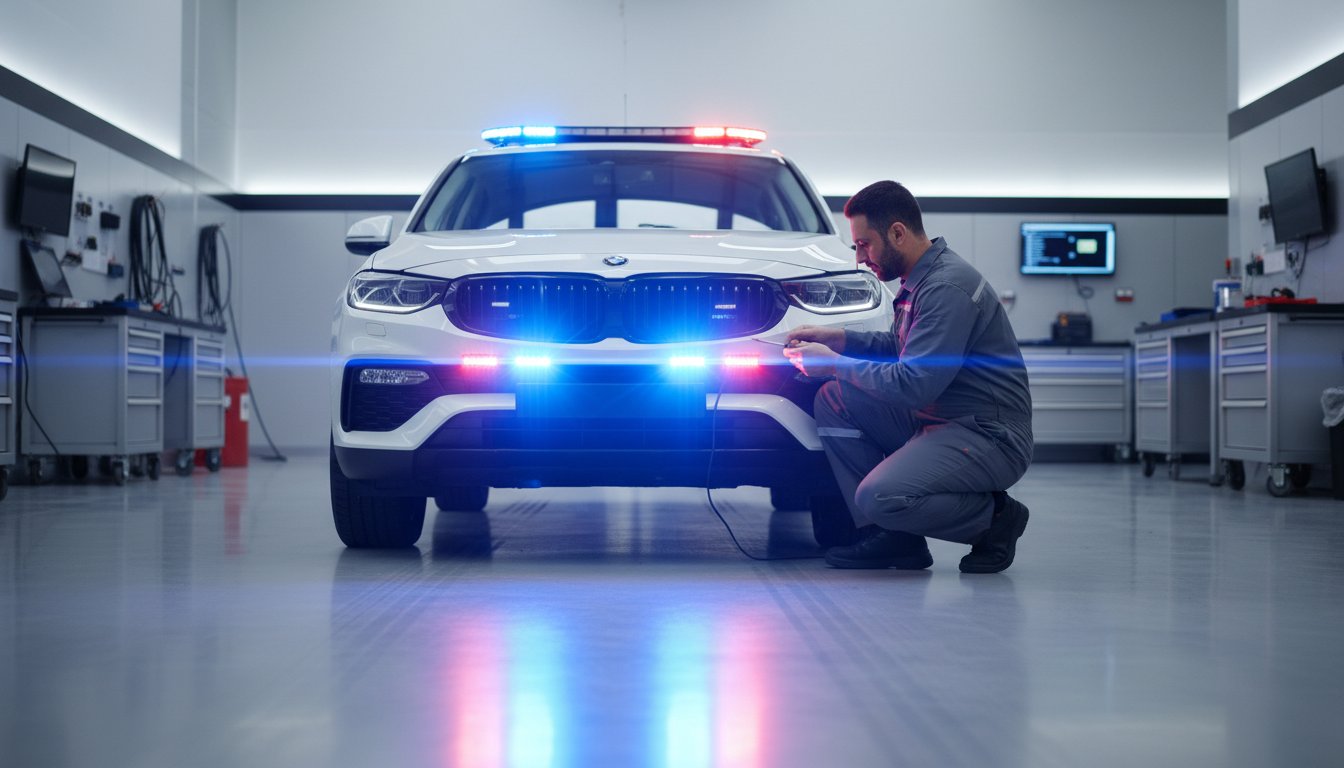
In law enforcement, equipment failure is not an option. A malfunctioning lightbar or a silent siren during a critical response isn't just an inconvenience; it's a direct threat to officer safety and mission success. For law enforcement fleet managers in the UAE, the challenge is immense: navigating strict regulatory standards, choosing between countless technology options, and guarding against the risk of electrical system failure in vehicles pushed to their limits. The pressure to get it right is absolute, as any weakness in the system can lead to vehicle downtime and compromised operational readiness.
This guide, brought to you by Auto Industries Factory LLC, is engineered to provide a definitive solution. We deliver a comprehensive overview of the professional police car lighting and siren fitting process, designed to equip you with the confidence and knowledge needed for a flawless installation. Discover how to select heavy-duty, durable components, understand the critical steps for a secure electrical integration, and ensure your fleet is outfitted with a reliable, highly visible warning system. Prepare to transform your patrol vehicles into mission-ready assets that meet every legal and operational standard, built for long-lasting, dependable service.
Key Takeaways
- Understand the critical difference between buying parts and implementing an engineered system to prevent mission-ending electrical failures and ensure operational reliability.
- Learn to evaluate warning systems beyond the initial price, focusing on durability, performance, and total cost of ownership to maximize your fleet's long-term value.
- Follow our step-by-step guide to the professional police car lighting and siren fitting process, from initial consultation to final system deployment.
- Discover how core components integrate to form a complete warning system, ensuring your vehicles have a superior tactical advantage in the field.
Why Professional Fitting is Non-Negotiable for Emergency Vehicles
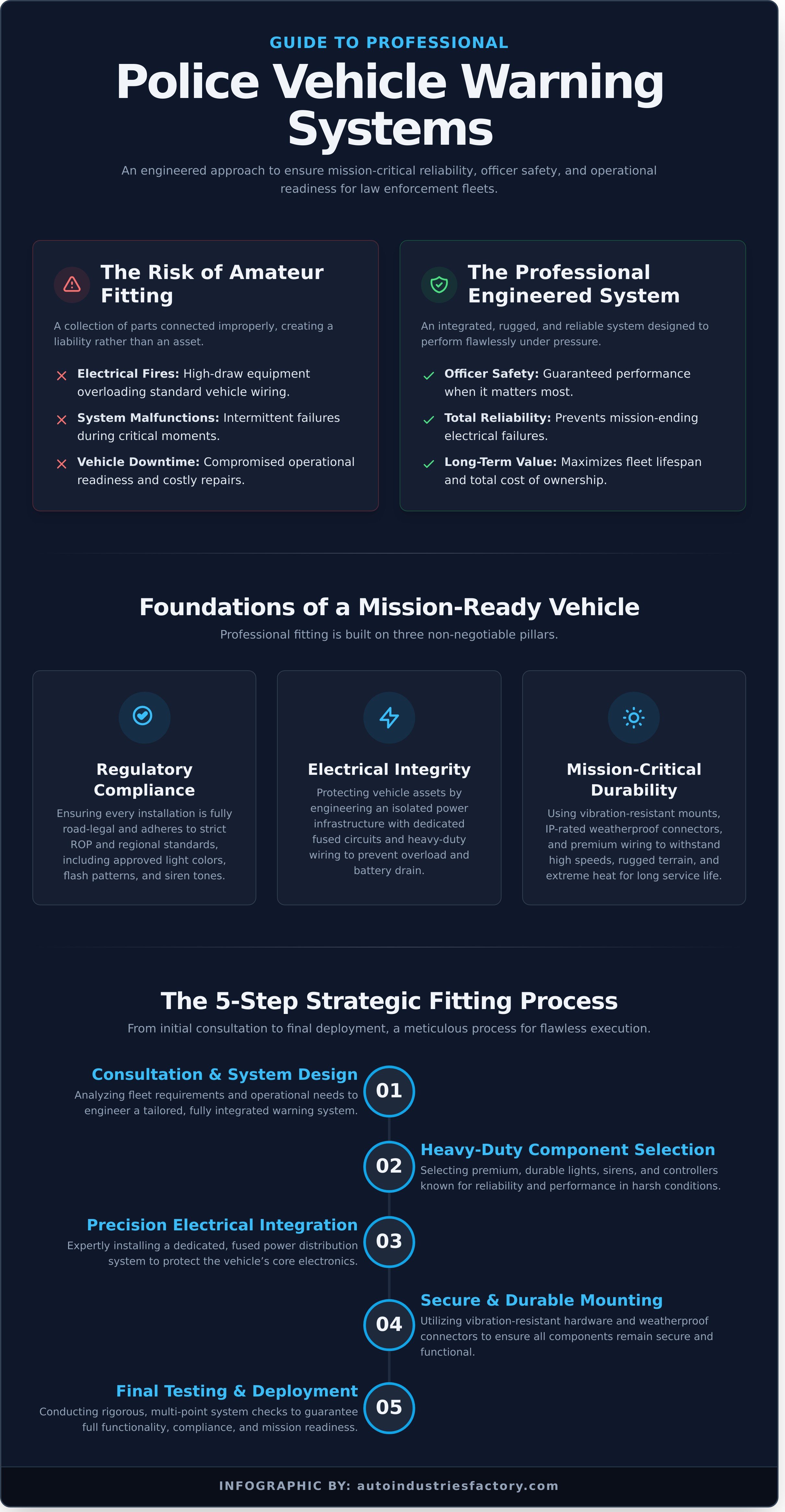
Equipping a police vehicle with lights and sirens goes far beyond simply purchasing high-quality components. The installation process is a critical engineering task where precision and expertise are paramount. An amateur or improper installation can lead to catastrophic failures, including electrical fires, intermittent system malfunctions during an emergency, or complete loss of power. For mission-critical vehicles, professional police car lighting and siren fitting is not a luxury-it is a foundational requirement for officer safety, public trust, and operational readiness.
To appreciate the complexity involved, see how a professional technician organizes and wires an emergency vehicle's control system:
A professional service transforms a collection of individual parts into a rugged, fully integrated, and reliable system designed to perform flawlessly under the most demanding conditions.
Ensuring Compliance and Legality
Operating an emergency vehicle in Oman requires strict adherence to regulations set by the Royal Oman Police (ROP) and other regional authorities. Our technicians are experts in these standards, ensuring every installation is fully compliant. This includes:
- Correct Light Usage: Implementing the approved red and blue color schemes and flash patterns for police designation.
- Siren Tones: Programming sirens with legally mandated tones and ensuring decibel levels are effective without violating noise regulations.
- Full Compliance: Guaranteeing every aspect of the installation meets local laws to ensure the vehicle is road-legal and operationally sound.
Protecting Vehicle Electrical System Integrity
Connecting high-draw emergency equipment directly to a vehicle's standard wiring is a direct path to electrical failure. We safeguard your valuable assets by engineering a separate, isolated power infrastructure. This involves understanding the complex components that make up modern Emergency vehicle lighting systems and integrating them safely. Our approach includes installing dedicated power distribution units, properly rated fused circuits, and heavy-duty wiring to handle the load, preventing battery drain and ensuring the vehicle always starts when needed.
Mission-Critical Reliability and Durability
Emergency vehicles operate in harsh environments, from high-speed pursuits to rugged off-road terrain. Our expert approach to police car lighting and siren fitting focuses on heavy-duty installation techniques. We use vibration-resistant mounting hardware, weatherproof connectors with IP ratings to protect against dust and moisture, and premium automotive-grade wiring that withstands Oman's extreme heat. This meticulous attention to detail ensures your lighting and siren systems remain reliable and durable throughout the vehicle's service life.
Core Components of a Modern Police Vehicle Warning System
A police vehicle's effectiveness in emergency situations hinges on a powerful, integrated warning system. Far more than just flashing lights, this is a suite of advanced visual and audible technologies engineered to command attention and ensure public safety. A professional police car lighting and siren fitting ensures these components work in perfect harmony, creating an unmistakable presence on the road. Understanding each component is key to building a reliable and compliant patrol vehicle.
Primary Lighting Systems: Lightbars and Beacons
The rooftop lightbar is the cornerstone of any police vehicle's visual warning package, designed to provide 360-degree visibility. Modern law enforcement agencies typically choose between full-size lightbars for maximum visual impact and multi-functionality, or low-profile lightbars that offer a sleeker, more aerodynamic design ideal for both marked and unmarked vehicles. Today, advanced LED technology is the undisputed industry standard. Its intense brightness, minimal power consumption, and exceptional durability are critical for operational readiness. Extensive Vehicle Lighting and Reflectivity Studies confirm that the strategic use of high-intensity LED colours and flash patterns significantly enhances vehicle conspicuity and officer safety.
Secondary and Covert Warning Lights
To supplement the main lightbar, secondary lights are installed at critical points on the vehicle to eliminate blind spots. These are essential for safely navigating intersections and alerting distracted drivers. Key secondary systems include:
- Grille and Bumper Lights: Low-mounted and forward-facing for direct, eye-level warnings.
- Dash and Mirror Lights: Provide crucial off-axis visibility to the vehicle's sides.
- Rear Deck and Tail Light Flashers: Critical for protecting officers and managing traffic during roadside stops.
For unmarked or covert operations, stealth lighting is integrated discreetly within headlights, tail lights, and grilles, providing powerful warning capability that remains invisible until activated.
Audible Warning Systems: Sirens and Speakers
The audible warning system is commanded by a siren controller, or amplifier-the brain that powers the speakers and allows officers to switch between tones. Each tone serves a specific purpose: the long, rising Wail is for clearing traffic on open roads, the rapid Yelp demands immediate attention at intersections, and the high-frequency Phaser or Hi-Lo cuts through dense urban noise. The effectiveness of these tones depends entirely on a high-power speaker, which our expert police car lighting and siren fitting process strategically places, often behind the vehicle's grille, for clear, unobstructed forward sound projection.
The Strategic Fitting Process: From Consultation to Deployment
A successful upfit is the result of precision engineering and meticulous planning, not just assembly. Our approach to police car lighting and siren fitting is a collaborative, four-stage process designed to guarantee optimal performance, absolute reliability, and minimal vehicle downtime. We treat every vehicle as a critical asset, ensuring the final integration is flawless, durable, and perfectly aligned with its operational demands on the roads of Oman.
Step 1: Consultation and System Design
Every project begins with a detailed consultation. Our specialists work directly with your fleet manager or agency representatives to define the mission-critical requirements. We assess the specific vehicle model-be it a Nissan Patrol, Toyota Land Cruiser, or any other patrol vehicle-and its intended role. This collaboration informs a custom system design, including a detailed wiring diagram and component layout plan. We design systems that meet or exceed established benchmarks, such as those outlined in the Federal guidelines for emergency vehicle lighting, while ensuring full compliance with all relevant Royal Oman Police (ROP) specifications.
Step 2: Electrical System Preparation
The foundation of a reliable warning system is a robust electrical infrastructure. We install a dedicated, heavy-duty power distribution module or fuse box, completely isolating the emergency equipment from the vehicle's standard OEM wiring. Our technicians run properly gauged, protected wiring directly from the battery, ensuring every new circuit is fused and relayed correctly. This prevents electrical overloads and guarantees that your critical systems have consistent, reliable power when it matters most.
Step 3: Component Installation and Mounting
Physical installation is executed with precision and care. We use specialized techniques to securely mount lightbars, sirens, speakers, and auxiliary lights without compromising the vehicle's structural integrity or finish. All drilling points are professionally treated and sealed with weatherproof grommets to prevent water ingress and long-term corrosion. Wiring is routed neatly and discreetly through the vehicle's interior, secured to prevent chafing or interference with vehicle operation.
Step 4: Final Integration, Testing, and Handover
The final stage brings the entire system to life. All components are connected to the central control unit in the cabin, ensuring an ergonomic and intuitive user interface for the officers. We then conduct a rigorous, multi-point functional test of every light, flash pattern, and siren mode. Upon successful completion, we provide a full handover, including operational training for end-users to ensure they can confidently command every feature. Our expert vehicle conversion services follow this rigorous process to deliver mission-ready results, every time.
Key Considerations When Selecting Lights and Sirens
Equipping a police fleet requires more than just choosing the brightest lights or loudest sirens. For fleet managers in Oman, making an informed technology choice means balancing cutting-edge features with proven reliability to ensure maximum performance, durability, and a low total cost of ownership. The right equipment enhances officer safety and operational effectiveness, making a detailed evaluation essential before any police car lighting and siren fitting project.
Brightness, Optics, and Visibility
Effective visibility is the primary goal of any emergency lighting system. While lumen output is a common metric, it doesn't tell the whole story. The design of the optics is what truly determines how that light is projected. Products with TIR (Total Internal Reflector) optics produce a focused, high-intensity beam for long-distance visibility, while Linear optics provide wider, more uniform light dispersion, crucial for being seen at oblique angles. A successful setup often uses a combination of both to ensure 360-degree, or off-axis, visibility at critical locations like intersections.
Durability and Environmental Ratings
Police vehicles operate in demanding conditions, from high-speed pursuits to exposure to harsh sun and dust. Look for equipment with a high Ingress Protection (IP) rating, such as IP67, which certifies it as completely dust-tight and resistant to water immersion. Material quality is non-negotiable; heavy-duty aluminum housings provide superior heat dissipation and corrosion resistance, while impact-resistant polycarbonate lenses protect the sensitive electronics within from road debris and harsh impacts.
Control Systems and User Interface
The system's usability is paramount for an officer under pressure. Fleets can choose between dedicated switch panels, which offer simple and tactile control, or advanced integrated controllers that can manage lights, sirens, and other vehicle systems from a single interface. Programmable flash patterns allow for customisation based on specific operational needs. As specialists in police and military vehicle modifications, we help you select an ergonomic and intuitive control system that minimises distraction and maximises efficiency. The right choice in your police car lighting and siren fitting directly impacts officer safety and response time.
By carefully considering these technical factors, you ensure your fleet is equipped with a reliable, effective, and durable warning system built for mission-critical performance. For expert consultation on outfitting your fleet, visit us at autoindustriesfactory.com.
Ensuring Operational Readiness with Expert Fitting
Ultimately, the effectiveness of a police vehicle hinges on the reliability of its warning systems. Selecting advanced components is only the first step; the strategic integration and flawless installation are what guarantee performance in high-stakes situations. This commitment to detail is the core of professional police car lighting and siren fitting, and it is what separates an adequate vehicle from a mission-ready asset.
For agencies in Oman demanding this level of excellence, Auto Industries Factory LLC is the definitive partner. As proven specialists in Police & Military Vehicle Modification, our in-house fabrication and precision engineering are trusted by forces across the UAE and GCC. We don't just install equipment; we engineer solutions built for mission success. Equip Your Fleet with Mission-Ready Systems. Contact Auto Industries Factory LLC for a Consultation and take the decisive step toward enhancing your fleet's operational superiority.
Frequently Asked Questions
How long does a full police car lighting and siren fitting take?
The timeline for a full police car lighting and siren fitting depends on the project's complexity. A standard installation on a common patrol vehicle, including a roof-mounted lightbar and siren system, typically takes 1-2 business days. More advanced, custom builds with covert lighting, intricate wiring, and console integration can require 3-5 business days. We provide a precise schedule after a detailed consultation to ensure minimal fleet downtime and meet your operational deadlines with precision.
What are the main regulations for emergency vehicle lights in Oman?
In Oman, all emergency vehicle modifications must strictly adhere to the standards set by the Royal Oman Police (ROP). This includes regulations on approved light colours, which are typically restricted to red and blue for police use. There are also specific requirements for flash patterns, luminosity, and siren tones to ensure public recognition and safety. Our technicians are experts in these regulations, guaranteeing every installation is fully compliant and mission-ready for Omani roads.
Can you integrate new systems with a vehicle's existing CAN bus system?
Yes, our technicians are highly skilled in advanced CAN bus integration. By interfacing our premium lighting and siren controllers with the vehicle's onboard computer network, we enable seamless operation. This allows for features like activating sirens via the vehicle's horn ring or controlling light patterns using factory-installed switches. This advanced integration results in a cleaner installation, enhanced reliability, and a more intuitive user experience for the officers in the field.
What is the difference between covert and overt emergency lighting?
Overt lighting refers to externally mounted, clearly visible emergency systems like roof-mounted lightbars and grille guards. This is standard for marked patrol vehicles to establish a strong, visible presence. Covert lighting is designed to be hidden when not in use. These systems include small, high-intensity LEDs installed within the grille, headlamps, or visors of unmarked vehicles, allowing them to remain inconspicuous until the lights are activated for tactical or surveillance operations.
How do you ensure the high-power systems don't drain the vehicle's battery?
We engineer every installation for maximum electrical efficiency and reliability. This includes using high-efficiency, low-amperage LED technology and installing dedicated power management systems or secondary batteries for high-demand builds. We also implement smart controllers with low-voltage protection, which automatically shut down non-critical equipment if the battery level drops, ensuring the vehicle always has sufficient power to start its engine and remain operational.
What warranty is provided on the installation work and the components?
We stand behind the durability and quality of our work. Every police car lighting and siren fitting service we perform is backed by a comprehensive one-year warranty on all installation workmanship. Furthermore, all components we supply, from lightbars to control units, are covered by their respective manufacturer's warranty. We manage all claims on your behalf, providing a single point of contact and ensuring your fleet's equipment remains in peak operational condition.


