
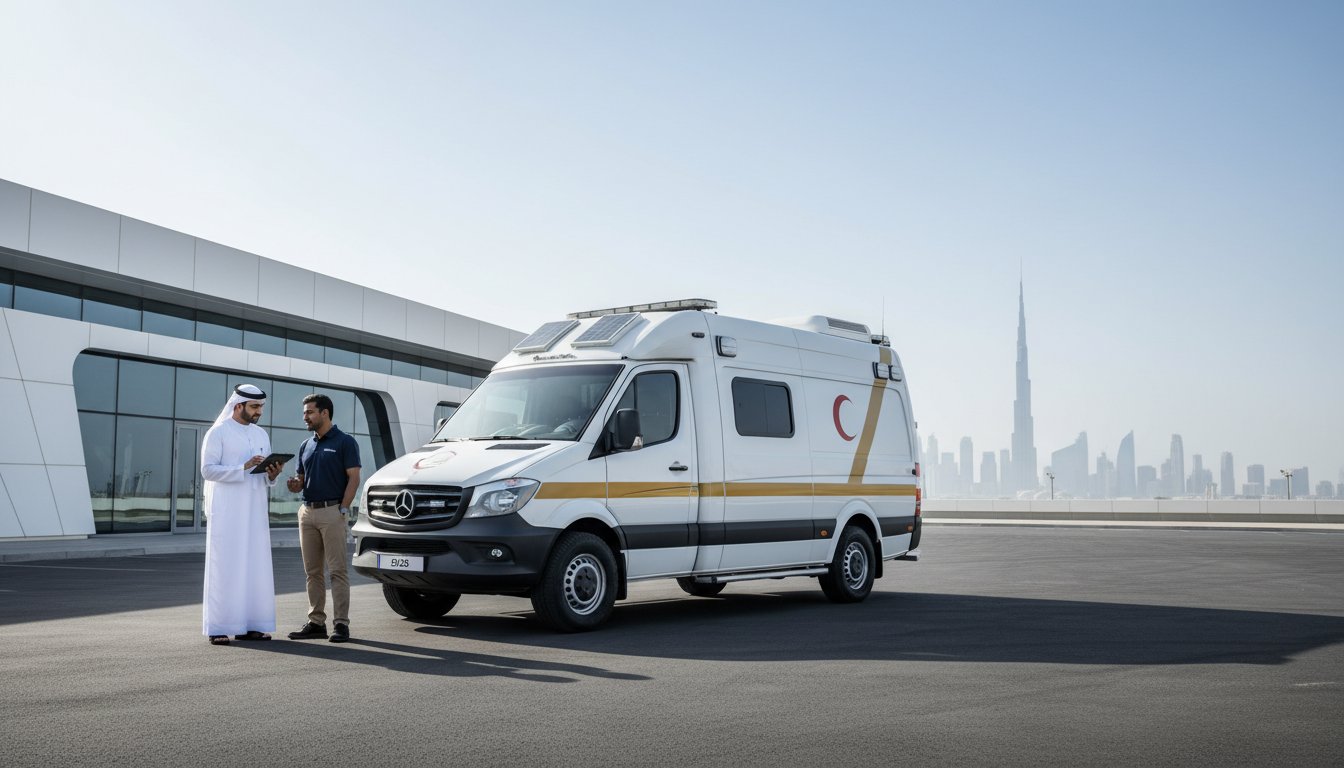
Choosing the wrong vehicle chassis for your fleet isn't just a mistake; it's a multi-million dirham liability that can stall your licensing for months under the 2026 standards. You already know that meeting the rigorous private ambulance service vehicle requirements across the RTA, DCAS, and DOH involves more than just a siren and a paint job. It requires precision engineering that can withstand 50 degree Celsius temperatures and relentless desert terrain while maintaining absolute medical integrity.
Auto Industries Factory (AIF) specializes in solving these complex technical and regulatory challenges to ensure your fleet is road-ready and fully compliant. This expert fabrication guide provides the clarity you need to master private ambulance vehicle requirements in Dubai, Abu Dhabi, and the Northern Emirates without the typical bureaucratic delays. We'll break down the critical differences between Level 4, 5, and 6 ambulance types and explain why specific heavy-duty chassis modifications are essential for operational uptime in the UAE.
Key Takeaways
- Identify the critical differences between DCAS (Dubai) and DOH (Abu Dhabi) licensing to ensure your fleet meets regional compliance standards.
- Learn how to implement EN 1789 and GSO 1794 standards to build rugged, medical-grade vehicles capable of withstanding the extreme GCC climate.
- Gain expert insights into the private ambulance service vehicle requirements for specialized electrical systems and heavy-duty HVAC integration.
- Navigate the complex NOC application process and technical inspection criteria required for successful Dubai Corporation for Ambulance Services registration.
- Streamline your fleet deployment by understanding how professional UAE-based fabrication ensures seamless RTA approvals and technical documentation.
Private Ambulance Service Vehicle Requirements in the UAE: An Overview
Private ambulance services play a vital role in the UAE's healthcare infrastructure, providing specialized support that complements government-run emergency departments. These private entities handle critical care transfers, neonate transport, and medical standby for large-scale events. To operate legally, providers must adhere to strict private ambulance service vehicle requirements set by regional authorities. In Dubai, the Dubai Corporation for Ambulance Services (DCAS) sets the benchmark, while the Department of Health (DOH) governs Abu Dhabi. For the Northern Emirates, the Ministry of Health and Prevention (MOHAP) provides the regulatory framework.
The distinction between emergency transport and non-emergency patient transfer is a key element of UAE compliance. Emergency vehicles require advanced life support (ALS) capabilities, whereas patient transport units focus on stable transfers. Auto Industries Factory (AIF) specializes in engineering these solutions to meet the 2026 standards, which prioritize integrated medical technology. These upcoming regulations focus on 5G-enabled telemetry and enhanced crash-test safety for all interior components. Understanding the global standards for an Ambulance helps operators appreciate why these local regulations are becoming increasingly sophisticated.
To better understand the operational side of these units, watch this helpful video:
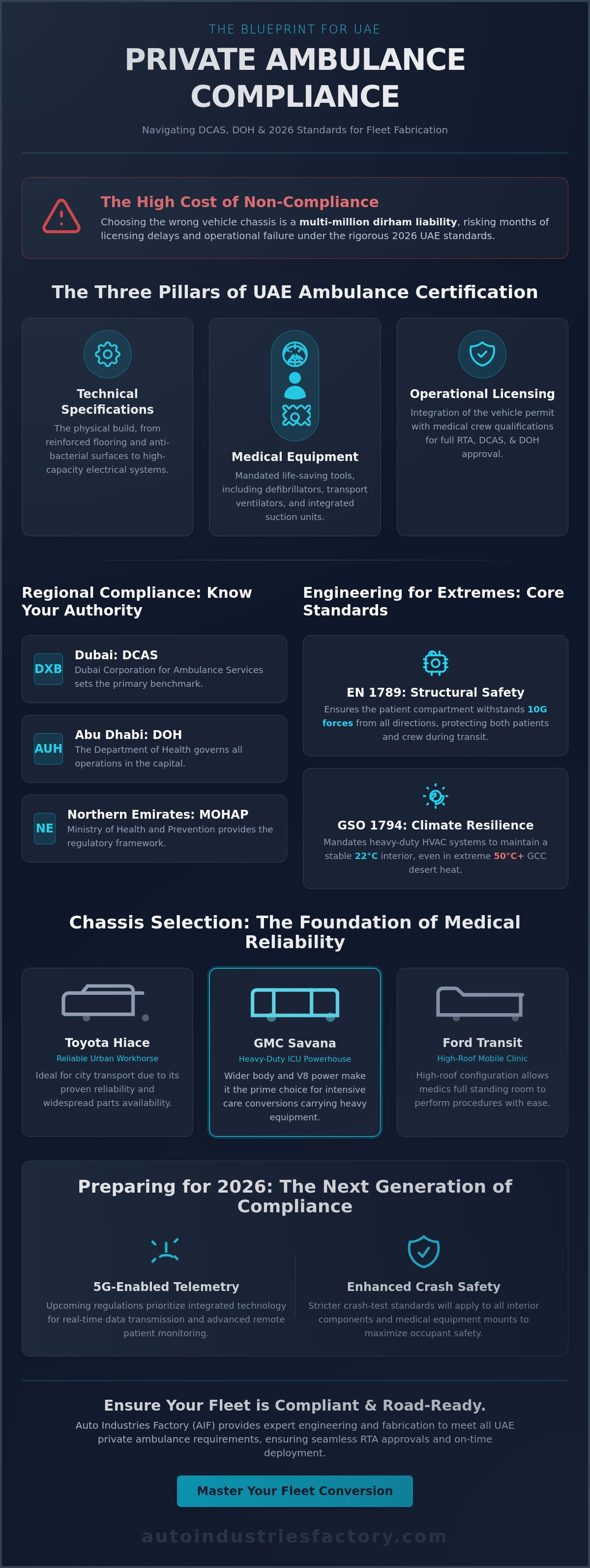
The Three Pillars of UAE Ambulance Compliance
Achieving full certification involves three distinct areas of compliance that operators must address:
- Technical specifications: This covers the physical build, including reinforced flooring, anti-bacterial surfaces, and high-capacity electrical systems.
- Medical equipment: Standards mandate specific life-saving tools like defibrillators, transport ventilators, and suction units must be on board.
- Operational licensing: This integrates the vehicle permit with the qualifications of the medical crew to ensure legal operation.
Each pillar ensures that the private ambulance service vehicle requirements are met with precision, reducing risk during patient transit.
Why Chassis Selection Matters for UAE Terrain
Selecting a vehicle platform requires a deep understanding of local environmental challenges. The Toyota Hiace is a staple for urban transport due to its reliability and parts availability. The GMC Savana offers a wider body and heavy-duty V8 power, making it ideal for intensive care conversions that carry heavy equipment. The Ford Transit is frequently chosen for its high-roof configuration, allowing medics to perform procedures with full standing room. In the UAE, these platforms must withstand 50°C heat and extreme humidity. This requires specialized cooling systems and ruggedized suspension components to ensure durability on both paved roads and desert terrain. The Ambulance Chassis is the structural foundation of medical reliability.
Technical Standards: EN 1789 and GSO 1794 Explained
Adhering to private ambulance service vehicle requirements in the UAE involves more than just installing a siren. The engineering baseline is EN 1789, a European standard that dictates how a medical vehicle is built to protect patients and crew. This standard ensures the patient compartment can withstand 10g acceleration and deceleration forces in all directions. However, because the GCC experiences temperatures exceeding 50°C, the GSO 1794 standard is equally vital. It adapts international rules for the local climate, mandating heavy-duty HVAC systems that maintain an internal temperature of 22°C regardless of external heat.
Structural integrity is a core focus for 2026 compliance. When converting high-roof vans like the Toyota Hiace or Ford Transit, weight distribution becomes a safety priority. Adding medical cabinets, oxygen manifolds, and reinforced roofs shifts the vehicle's center of gravity. Engineers at Auto Industries Factory (AIF) utilize precision fabrication to ensure the load is balanced, preventing rollovers during high-speed emergency responses. Every component, from the stretcher mount to the smallest medical bracket, must pass rigorous pull tests to ensure they don't become projectiles during a collision.
Ambulance Levels: 4, 5, and 6 (DCAS Standards)
The Dubai Corporation for Ambulance Services (DCAS) and other regional authorities categorize vehicles based on clinical capability. Level 4 units are designated for Basic Life Support (BLS), carrying AEDs and essential trauma supplies. Level 5 units serve as Paramedic-led Advanced Life Support (ALS) vehicles, requiring space for advanced cardiac monitors and intensive drug kits. Level 6 units are the most complex, acting as specialized critical care or neonatal units. For a full breakdown of licensing, operators should refer to the DoH Standard for EMS and Ambulance Services, which outlines the specific equipment lists for each tier.
Interior Layout and Ergonomics
Efficiency in the treatment area is a matter of seconds. The 2026 standards emphasize "reach zones," ensuring a paramedic can access 90% of medical consumables while remaining securely buckled. Storage for oxygen cylinders must be crash-tested and typically features external-facing access to prevent gas buildup in the cabin. Lighting is also regulated; the patient area requires flicker-free LED systems providing at least 1,000 lux for medical procedures. Additionally, soundproofing must keep road noise below 70 decibels, allowing for clear communication between the crew and the hospital dispatch. If you're looking to upgrade your fleet to these high standards, you can explore custom conversion solutions tailored for the UAE market.
Navigating UAE Regulatory Licensing: DCAS vs. DOH
Operating a private medical fleet in the UAE requires adherence to two distinct regulatory frameworks. In Dubai, the Dubai Corporation for Ambulance Services (DCAS) governs all medical transport activities. In Abu Dhabi, the Department of Health (DOH) sets the benchmark for clinical and technical standards. You can't legally register a medical vehicle with the Roads and Transport Authority (RTA) until you've secured a No Objection Certificate (NOC) from the relevant health authority. This DCAS ambulance licensing portal serves as the primary gateway for digital applications in Dubai, ensuring every vehicle meets the city's rigorous safety codes.
Dubai (DCAS) Licensing Workflow
The road to a licensed fleet starts with an E-Approval. You must submit technical vehicle specifications and detailed interior floor plans to DCAS for review. Staffing is a critical component of these private ambulance service vehicle requirements. For example, a Type C Intensive Care ambulance requires a licensed Paramedic and an EMT, while Type A transport vehicles may operate with EMTs only. Auto Industries Factory (AIF) specializes in aligning your vehicle's physical layout with these staffing mandates through our services for specialized conversion support. Once the conversion is complete, a physical inspection by DCAS technicians confirms that the oxygen systems, electrical grounding, and medical cabinetry meet the 2026 safety standards.
Abu Dhabi (DOH) and Northern Emirates Compliance
The Department of Health (DOH) in Abu Dhabi maintains its own specific vehicle inspection criteria, focusing heavily on telematics and real-time data sharing with central dispatch. In Sharjah, Ajman, and Ras Al Khaimah, Ministry of Health and Prevention (MOHAP) standards take precedence for inter-emirate medical transport. Maintaining consistent fleet compliance across multiple locations requires a unified engineering approach. Every vehicle must pass a 50-point inspection covering everything from siren decibel levels to the slip-resistance of the flooring before the RTA issues the final commercial registration. These private ambulance service vehicle requirements ensure that patient care remains consistent whether the vehicle is operating in downtown Dubai or the industrial zones of Ajman.
How to Avoid Inspection Delays
The #1 cause of delay in the licensing process is the use of non-certified medical grade materials or missing calibration certificates for onboard equipment. This can push your operational start date back by 30 days or more. To bypass these hurdles, don't wait until the final inspection to check your documentation. Ensure your converter provides a full dossier of Material Safety Data Sheets (MSDS) and ISO certifications during the initial submission phase. AIF conducts pre-inspection audits to guarantee a first-time pass, preventing the costly cycle of re-inspections and modifications. By verifying that every bolt and bracket meets UAE federal law before the vehicle reaches the RTA, you protect your investment and maximize fleet uptime.
Critical Interior Components and Medical Integration
Auto Industries Factory (AIF) specializes in engineering electrical systems that exceed standard private ambulance service vehicle requirements. Every build includes medical-grade pure sine wave inverters and independent backup batteries. These systems ensure that life-saving monitors and ventilators never lose power during engine transitions or idle periods. We install dedicated 220V and 12V outlets at ergonomic intervals to support a full suite of intensive care equipment.
Temperature control is a non-negotiable safety factor in the UAE. Standard vehicle AC units often fail when ambient temperatures reach 50°C in Dubai or Abu Dhabi. Compliance for 2026 mandates secondary, heavy-duty cooling units capable of maintaining a steady 20°C in the patient cabin. Our team integrates high-capacity HVAC systems with independent compressors to ensure patient stability and medication integrity during long-distance transfers.
Oxygen delivery has shifted from loose portable cylinders to centralized piping systems. We install copper-brazed lines with multiple outlets, allowing for seamless connection to built-in flowmeters. This setup reduces the risk of projectile hazards during sudden stops. Modern communication tech is also integrated directly into the cockpit and cabin. This includes GPS telematics for real-time fleet tracking and digital radio systems that maintain constant contact with trauma centers.
Medical Equipment Integration
Securing heavy equipment is a core part of private ambulance service vehicle requirements. We use floor-mounted tracks for stretchers that are rated to withstand 10G impacts. Defibrillators, ventilators, and patient monitors are housed in custom-fabricated, crash-tested mounts. For a deeper look at how we handle these complex installations, read our Ambulance Conversion: The Complete Guide to Professional Medical Vehicles.
Materials and Infection Control
Infection control begins with the choice of materials. AIF uses non-porous, antibacterial ABS or stainless steel for all interior surfaces. We eliminate sharp corners and open seams where pathogens can collect. Our factory uses precision CNC laser cutting to create seamless cabinetry and structural reinforcements. This engineering approach ensures the interior is easy to decontaminate with industrial-grade disinfectants after every mission. Stainless steel fabrication provides the rugged durability needed for the high-frequency use typical of UAE private fleets.
Partnering with Auto Industries Factory (AIF) for Compliant Conversions
Auto Industries Factory (AIF) specializes in engineering high-performance medical vehicles that exceed the private ambulance service vehicle requirements set by UAE authorities. We don't rely on third-party fabricators. Our team manages the entire conversion process within our local facilities. By using in-house CNC laser cutting, press brake folding, and specialized welding, we maintain total control over the structural integrity of every unit. This localized approach ensures that your fleet is built to withstand the unique environmental challenges of the Middle East, such as extreme heat and high humidity.
Navigating the technical documentation for RTA and DCAS inspections can be a bottleneck for many providers. AIF simplifies this by providing comprehensive technical submittals. We prepare all necessary CAD drawings, weight distribution reports, and electrical load calculations required for official approval. Our designs are strictly aligned with the 2026 compliance standards, ensuring your vehicles pass inspections on the first attempt. We offer extensive customization for private fleets, including:
- Custom Medical Layouts: Optimized cabinetry and equipment mounting for Type A, B, or C ambulances.
- Branding and Aesthetics: Full exterior wraps, high-visibility reflective marking, and custom color changes.
- Advanced Medical Integration: Specialized oxygen piping, 220V power systems, and reinforced flooring for heavy equipment.
Our commitment doesn't end when the vehicle leaves the factory. AIF provides dedicated post-conversion support and maintenance programs. This keeps your specialized medical equipment and vehicle modifications in peak condition, maximizing your fleet's uptime and reliability.
Our Fabrication Process in Ajman and Dubai
The AIF fabrication journey begins with a detailed CAD design phase. This ensures every millimeter of space is used efficiently. Following design approval, our technicians in Ajman and Dubai execute the build using heavy-duty, medical-grade materials. In 2024, we successfully delivered high-performance fleets to major private providers across the UAE, proving our capacity for high-volume, high-quality production. You can explore our local manufacturing capabilities and facility details on our About Us page. Every vehicle undergoes a rigorous 50-point quality check before final painting and equipment installation.
Get Started with Your Private Ambulance Fleet
Setting up a new private ambulance service or upgrading an existing fleet requires precision. We offer a professional consultation process to help you understand how current private ambulance service vehicle requirements impact your specific vehicle choices. Whether you're converting a single Toyota Hiace or a fleet of Ford Transits, we provide a clear roadmap for compliance. You can request a free estimate for your project by contacting our technical team directly. We provide transparent lead times and detailed cost breakdowns. Contact AIF today to secure your 2026-compliant conversion and ensure your fleet is built for life-saving reliability.
Secure Your Fleet for 2026 Compliance
Meeting the updated private ambulance service vehicle requirements in the UAE isn't just a regulatory hurdle; it's a commitment to life-saving reliability. By 2026, every vehicle must strictly adhere to EN 1789 and GSO 1794 technical standards to maintain licensing with DCAS in Dubai or DOH in Abu Dhabi. These regulations ensure that medical interiors are crash-tested and integration is flawless.
Auto Industries Factory (AIF) specializes in these high-stakes conversions. We use in-house CNC laser cutting and precision fabrication to build rugged, heavy-duty units that exceed local mandates. We're the trusted partner for operators navigating the complex licensing landscape of the UAE. Whether you're upgrading a Nissan Patrol or a fleet of Toyota Land Cruisers, precision engineering is the only way to guarantee uptime and compliance. Our expert engineers focus on durability to ensure your vehicles are built for the toughest environments.
Don't leave your certification to chance. Request a Free Estimate for Your Ambulance Conversion today. We're ready to help you build a vehicle that protects what matters most.
Frequently Asked Questions
What is the difference between an RTA inspection and a DCAS inspection?
The RTA inspection focuses on the mechanical roadworthiness and safety of the vehicle, while the DCAS inspection evaluates the medical conversion and clinical equipment. You must pass the RTA technical test to ensure the chassis is safe for UAE roads before the Dubai Corporation for Ambulance Services will certify the interior for medical use. DCAS specifically checks for compliance with life-saving standards and patient compartment dimensions.
Can any van be converted into a private ambulance in the UAE?
No, only specific van models that meet the 2026 private ambulance service vehicle requirements for payload and internal height are eligible for conversion. Vehicles must typically have a minimum payload capacity of 1,000kg to support the weight of medical equipment, oxygen systems, and personnel. Additionally, the interior must provide at least 1.6 meters of standing height to allow paramedics to work effectively during transport.
What are the specific oxygen system requirements for a Level 5 ambulance?
Level 5 ambulances require a centralized piped oxygen system featuring at least two 10-liter cylinders with digital pressure monitoring. The 2026 standards mandate that all piping must be medical-grade copper with silver-soldered joints to prevent leaks under high-pressure conditions. These systems must also include an external access port so technicians can swap cylinders without entering the sterile patient area.
How long does the ambulance conversion process take at AIF?
Auto Industries Factory (AIF) typically completes a standard medical conversion within 15 to 25 working days. If you require a highly specialized Level 5 unit with custom fabrication, the timeline can extend to 45 days to ensure all technical systems meet UAE regulations. We provide a clear project roadmap at the start so you can manage your fleet deployment efficiently.
Do I need a special license to drive a private ambulance in Dubai?
Yes, drivers must possess a valid UAE driving license and a mandatory Ambulance Driver Permit issued by DCAS. Obtaining this permit requires completing an Emergency Vehicle Operator Course and passing a specialized medical fitness evaluation. By 2026, all licensed drivers will be required to undergo mandatory skills refresher training every 24 months to maintain their certification.
What are the 2026 requirements for ambulance telematics and GPS?
The 2026 regulations require all private ambulances to be equipped with 5G-enabled telematics that integrate directly with the National Emergency Response System. This hardware must transmit real-time location data and patient vitals to the receiving hospital while the vehicle is in motion. Compliance requires the system to maintain a 99.9 percent uptime to ensure constant connectivity with Dubai's emergency dispatch centers.
Is it possible to convert a used vehicle into a licensed ambulance?
It's possible to convert a used vehicle if it is less than 5 years old and passes a 120-point mechanical inspection. However, meeting the modern private ambulance service vehicle requirements is often more difficult with older models due to electrical load limits and structural wear. Most fleet operators prefer new chassis like the Toyota Hiace or Ford Transit to ensure the vehicle stays in service for the full 7 to 10 year lifecycle.
What kind of warranty does AIF provide on ambulance conversions?
Auto Industries Factory (AIF) provides a comprehensive 24-month warranty on all structural modifications and internal cabinetry. We also include a 12-month warranty on the electrical system and medical gas piping to guarantee reliability in the UAE's extreme heat. All warranty work is performed at our specialized facilities in Ajman or Dubai to ensure your vehicle returns to service as quickly as possible.


