
A single mechanical failure in an emergency response fleet isn't just a technical glitch; it's a direct threat to public safety across the UAE. You likely understand that mission-critical vehicles must perform under extreme desert conditions without the risk of RTA rejection or voided manufacturer warranties. You've probably felt the frustration of trying to navigate complex GSO requirements while worrying about whether your custom fabrication will hold up during a high-stakes task. Achieving true peace of mind with certified vehicle conversions means knowing your investment will pass every inspection without compromising safety.
Auto Industries Factory (AIF) specializes in bridging the gap between heavy-duty engineering and local regulatory compliance. We'll show you how our certified processes ensure your fleet remains road-legal, maintains maximum uptime, and meets the strict requirements of the UAE Ministry of Health and Dubai Police. This article examines the specific engineering benchmarks and certification pathways that turn a standard chassis into a reliable, mission-ready asset for the most demanding environments in Dubai and the Northern Emirates. You'll learn how to protect your fleet from downtime while staying fully compliant with local laws.
Key Takeaways
- Understand the vital difference between basic modifications and professional engineering to achieve total peace of mind with certified vehicle conversions for your specialized fleet.
- Gain insights into GSO 1794 and EN 1789 standards, ensuring your emergency and medical vehicles meet the highest safety benchmarks in the UAE and GCC.
- Discover why in-house fabrication using CNC laser cutting and precision machining is essential for maintaining superior quality control and rugged durability.
- Learn how to navigate the RTA approval process and UAE regulatory landscape to get your converted vehicles road-legal and operational without delays.
- Explore how the "Built to Protect" philosophy at a trusted UAE factory ensures mission-critical reliability for police, military, and ambulance units.
The Critical Role of Certified Vehicle Conversions in the UAE
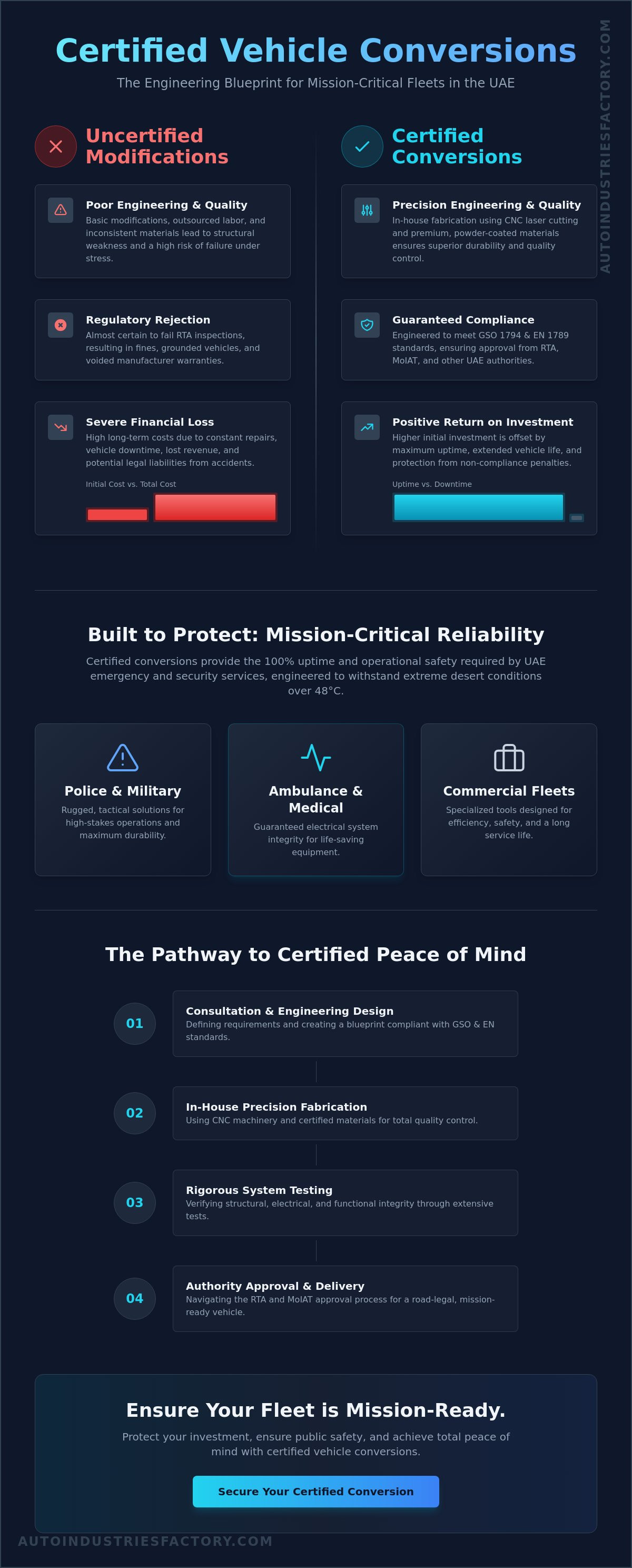
Certified vehicle conversion is a rigorous engineering process, not a simple cosmetic modification. While many enthusiasts explore Car tuning for performance or style, a certified conversion involves structural re-engineering to meet international safety standards. In the United Arab Emirates, where summer temperatures regularly exceed 48°C, the demand for peace of mind with certified vehicle conversions is a necessity for operational safety. This process ensures that every weld, electrical circuit, and structural reinforcement can withstand the heavy-duty cycles required by commercial and emergency fleets.
Choosing an uncertified upfitter carries massive risks. Structural failure during a high-speed maneuver or an electrical fire caused by poor wiring can lead to total vehicle loss and severe legal liabilities. For organizations managing fleets, certification protects the initial vehicle investment. It ensures that the manufacturer warranty remains intact, as the conversion follows approved engineering protocols. This professional approach transforms a standard chassis into a specialized tool without compromising the vehicle's original safety DNA.
To better understand this concept, watch this helpful video:
Mission-Critical Reliability for Emergency Services
Ambulances and police units in Sharjah and Ajman require 100% uptime to serve the public effectively. A single minute of downtime due to a faulty conversion can have life-altering consequences. Certification is the formal verification of engineering integrity through rigorous testing and documentation. When an ambulance's electrical system is certified, it guarantees that life-saving medical equipment, such as defibrillators and ventilators, will perform flawlessly without overloading the vehicle's alternator. This level of precision is why government sectors prioritize peace of mind with certified vehicle conversions when selecting their specialized fabrication partners.
The Economic Impact of Non-Compliant Modifications
The financial consequences of using non-compliant modifications are immediate and severe. Failed RTA inspections in Dubai can result in significant fines and the immediate grounding of a vehicle, leading to thousands of AED in lost revenue per day. Insurance providers often reject claims for modified vehicles if the upfitting lacks proper certification, leaving the owner to cover the full cost of accidents or repairs. While uncertified fabrication might seem cheaper initially, the long-term durability of certified work is significantly higher. Certified conversions use premium, powder-coated materials and CNC-cut components that resist the UAE's corrosive coastal air, ensuring the vehicle stays on the road for its entire intended lifecycle.
Key Standards for Peace of Mind: GSO 1794 and EN 1789
Engineering a vehicle for emergency or high-security use requires more than just mechanical skill; it demands strict adherence to international safety protocols. In the UAE, the Ministry of Industry and Advanced Technology (MoIAT) oversees the UAE standards for vehicle conversions to ensure every modified unit is road-legal and fit for purpose. Achieving peace of mind with certified vehicle conversions starts with understanding the technical benchmarks that separate a basic modification from a life-saving tool.
GSO 1794: The GCC Benchmark for Safety
The GSO 1794 standard is the primary regulation governing ambulance technical requirements across the GCC. It dictates everything from interior dimensions to the specific placement of medical equipment. Because UAE summer temperatures frequently exceed 50°C, GSO 1794 emphasizes high-performance climate control systems that maintain a stable 20°C to 25°C environment for patients. AIF ensures every build meets these rigorous demands, focusing on reinforced insulation and heavy-duty electrical systems. For a deeper look at these technical specifications, you can explore our ambulance conversion guide which details the integration of medical gas systems and crash-tested cabinetry.
Safety features under GSO 1794 also include anti-slip flooring, rounded interior edges to prevent medic injury during transit, and specific lighting intensities for patient care. We don't just follow these rules; we use them as the foundation for our precision fabrication process. This commitment ensures that fleet operators meet all ESMA (Emirates Authority for Standardization and Metrology) requirements for immediate registration.
Ballistic and Armoring Standards
For security and military applications, certification shifts toward ballistic protection levels like VPAM or the BR (Ballistic Rated) scale. Most civilian armored vehicles in the region target BR6 or BR7 levels, which protect against 7.62mm and 5.56mm high-velocity rounds. Achieving peace of mind with certified vehicle conversions in this sector requires a total engineering overhaul. It isn't enough to add steel plates; the vehicle's weight distribution must be recalibrated. Our team ensures that upgraded suspension, heavy-duty braking systems, and reinforced door hinges keep the vehicle agile under the added mass of ballistic glass and armored plating.
Weight management is critical for mission reliability. If a vehicle's center of gravity shifts too far, it becomes a rollover risk. You can learn more about these protection levels in our vehicle armoring guide. By utilizing CNC laser cutting and advanced welding techniques, AIF maintains the structural integrity of the original chassis while providing maximum protection. If you are looking to upgrade your fleet with these high-spec modifications, you can view our full range of certified conversion services to find a solution tailored to your operational needs.
Engineering the Difference: In-House Fabrication vs. Outsourcing
Auto Industries Factory (AIF) specializes in end-to-end manufacturing. Many workshops across Dubai and the Northern Emirates outsource their metalwork to third-party shops, which creates a dangerous gap in quality oversight. We don't do that. By keeping design and fabrication entirely under one roof, we eliminate the risk of "fitment fatigue" where parts don't align correctly during the final assembly. True peace of mind with certified vehicle conversions comes from knowing that the engineer who designed the component is the same expert supervising its installation on the factory floor.
Controlling the entire supply chain allows us to maintain "Mission Reliability." When a vehicle is converted for emergency services or defense, there's no room for component failure. In-house fabrication means we select the specific grade of steel or aluminum, oversee the welding integrity, and perform stress tests before the part ever touches your vehicle. This vertical integration is what separates a professional conversion from a basic modification.
Precision Fabrication with Laser and CNC
Precision is the foundation of high-performance vehicle upfitting. We utilize advanced CNC machining and laser cutting technology to ensure every custom component has a tolerance within 0.1mm. This level of millimetre-perfect fitment is essential for custom canopies and internal equipment racking. If a bracket is off by even a tiny fraction, it creates vibration and noise that eventually leads to structural cracks or hardware failure.
Our engineering team follows strict UAE vehicle modification regulations to ensure every fabricated part meets federal safety standards for road use. For clients requiring heavy-duty front-end protection, our custom bull bars guide explains how we balance weight and impact resistance using precision-folded metalwork. By using high-quality materials and computerized cutting, we significantly reduce the rattling and cabin noise often associated with lower-quality aftermarket additions.
Safari and Off-Road Reinforcement
The UAE desert environment is one of the most demanding on the planet. A standard Toyota Land Cruiser or Nissan Patrol requires significant structural reinforcement to handle the heat and mechanical stress of commercial safari operations. AIF provides comprehensive suspension and chassis upgrades that are specifically engineered for the dunes of Dubai and Abu Dhabi. We don't just add parts; we re-engineer the vehicle's capability.
We focus on reinforcing critical stress points where the chassis meets the body, a process detailed in our safari vehicle conversions resource. Every upgrade is designed to sustain peak performance over thousands of desert kilometres. We conduct rigorous in-house testing, including load-bearing simulations and weld inspections, to verify that every conversion provides peace of mind with certified vehicle conversions. This commitment to engineering excellence ensures your fleet stays operational in the harshest conditions, maximizing your uptime and safety.
Navigating UAE Regulatory Compliance and Authority Approvals
Achieving peace of mind with certified vehicle conversions requires more than just high-quality welding; it demands strict adherence to UAE federal laws. In Dubai and Abu Dhabi, every modification must pass through a rigorous approval chain to ensure public safety. Auto Industries Factory (AIF) specializes in managing this entire regulatory lifecycle, ensuring your fleet meets the 2024 standards set by the Road and Transport Authority (RTA) and other governing bodies. You can't simply modify a chassis and hit the road. The process involves a specific sequence of inspections and permits that vary depending on the vehicle's purpose.
For ambulance fleets, the process extends to the Ministry of Health and Prevention (MOHAP). A medical vehicle won't be licensed without a MOHAP certificate, which verifies that the interior medical equipment and layout meet life-saving protocols. Specialized emergency units or armored vehicles also require Dubai Police or Civil Defence clearance. This is critical if the build includes sirens, specific lighting, or tactical reinforcement. Following these steps ensures your investment is legally protected:
- Initial Engineering: Developing CAD drawings that meet GSO (Gulf Standardization Organization) standards.
- Pre-Approval: Obtaining permits from the RTA or Police before fabrication starts.
- Technical Inspection: Passing a physical check at centers like Tasjeel or Shamil.
- Final Registration: Updating the vehicle's Mulkiya (registration card) to reflect the new configuration.
RTA Inspection and Technical Approval
Registration starts with the technical committee. You'll need to submit detailed engineering drawings, a valid chassis certificate, and the owner's Emirates ID. AIF provides certified technical drawings that satisfy RTA inspectors during structural modification reviews. If you're changing the vehicle's color or adding heavy-duty bull bars, you must obtain a permit before the work begins. Failure to do so can lead to fines starting from AED 500 or the vehicle being impounded during its next annual renewal. Our team ensures every structural change is documented and approved, providing total peace of mind with certified vehicle conversions.
Compliance for Regional Export from the UAE
UAE-built vehicles often serve the wider GCC market. Meeting GSO standards is vital for seamless export to Saudi Arabia, Oman, or Kuwait. A Certificate of Conformity (CoC) acts as the legal passport for your vehicle, proving it meets regional safety and environmental requirements. AIF supports clients by ensuring every build aligns with these regional trade standards. This meticulous attention to detail prevents costly delays at the border and ensures the vehicle is ready for immediate deployment in its destination country.
Ready to ensure your specialized fleet is fully compliant with UAE regulations? Explore our certified conversion services and let our experts handle the paperwork for you.
Why Choose Auto Industries Factory for Your Specialized Fleet
Auto Industries Factory (AIF) specializes in high-specification vehicle modifications from its primary industrial facilities in Ajman and Dubai. Since our inception, we’ve built a legacy as a trusted UAE auto factory by delivering rugged, mission-ready assets that perform in the harshest environments. Our "Built to Protect" philosophy isn't just a marketing slogan; it's a rigorous engineering standard applied to every ambulance, tactical unit, and safari vehicle that leaves our floor. Choosing a partner that understands local regulatory standards ensures you have total peace of mind with certified vehicle conversions.
Our reputation is grounded in transparency and technical excellence. We understand that for fleet managers in the UAE, downtime isn't an option. That’s why we provide comprehensive after-sales support and a standard warranty on all fabrication work. Whether you're operating a single custom vehicle or a massive governmental fleet, our team ensures your assets remain operational and safe. Our commitment to safety and engineering excellence is why clients seek peace of mind with certified vehicle conversions through our specialized factory.
We combine traditional craftsmanship with modern technology. Our facility utilizes CNC laser cutting and high-precision press brakes to ensure every component meets exact specifications. This level of detail is necessary for mission-critical vehicles where failure isn't an option. By maintaining all manufacturing processes in-house, we control quality from the initial design to the final powder-coated finish.
The AIF Signature: Expert Engineering Solutions
We take a master engineer approach to every project. This means we don't just bolt on parts; we integrate complex systems into the vehicle's DNA. Whether you require heavy-duty roof racks for off-road expeditions or reinforced bumpers for security fleets, our team handles the entire lifecycle of the build. You can explore our full range of custom options on Our Services page. Our expertise extends to complex tactical vehicles, where we implement advanced protection and utility features tailored to specific mission requirements.
Get a Free Estimate Today
Ready to upgrade your fleet with reliable engineering? Don't leave your vehicle's performance to chance. Contact our specialists in Dubai or Ajman for a direct engineering consultation. We offer immediate WhatsApp support for quick technical queries and project estimates. Our team is ready to help you design a solution that meets your specific operational needs while adhering to the highest safety standards. Take the first step toward a high-performance fleet and Contact AIF for a Certified Quote today.
Secure Your Fleet with Engineering Excellence
Building a specialized vehicle in the UAE requires more than just mechanical skill; it demands strict adherence to international safety benchmarks. By prioritizing GSO 1794 and EN 1789 standards, fleet managers ensure every unit operates reliably under the most demanding conditions. Auto Industries Factory (AIF) eliminates the risks of third-party errors by handling the entire manufacturing process in-house. Our facility utilizes advanced CNC and laser fabrication to maintain total control over quality and structural durability. This commitment to precision provides peace of mind with certified vehicle conversions that meet all local regulatory approvals and authority requirements. As a leading ambulance manufacturer in the UAE, we've refined our processes to deliver mission-ready solutions that protect lives and assets. Don't settle for shortcuts when your operations depend on rugged, compliant engineering. Our team is ready to transform your technical requirements into a high-performance reality right now.
Upgrade Your Fleet with Certified Conversions - Get a Free Estimate
Frequently Asked Questions
What does "certified vehicle conversion" mean in the UAE?
A certified vehicle conversion in the UAE refers to a modification that complies with the Ministry of Industry and Advanced Technology (MoIAT) standards and possesses a valid Certificate of Conformity. This certification ensures that all structural, electrical, and safety changes meet UAE Cabinet Resolution No. 21 of 2013 regarding vehicle safety. Choosing an approved facility like AIF provides peace of mind with certified vehicle conversions because every weld and component is audited for roadworthiness.
Will a custom conversion void my vehicle manufacturer warranty?
A custom conversion generally voids the manufacturer warranty only on the specific parts or systems altered during the build. Under UAE consumer protection laws, the original warranty remains intact for unaffected components like the engine or transmission unless the modification directly causes a failure. AIF coordinates with major dealerships in Dubai to ensure that conversions for fleet vehicles maintain as much factory coverage as possible through professional engineering standards.
How long does the RTA approval process take for a modified vehicle?
The RTA approval process for a modified vehicle typically takes between 3 to 7 working days after the initial technical inspection at an authorized center. You must submit a technical report from a MoIAT-accredited laboratory to the RTA to update the vehicle’s registration card, known as the Mulkiya. This timeline depends on the complexity of the modification and the accuracy of the engineering drawings provided by the factory during the application.
What are the mandatory standards for an ambulance in Dubai?
Ambulances in Dubai must strictly adhere to the Dubai Corporation for Ambulance Services (DCAS) technical specifications and international EN 1789 or KKK-A-1822 standards. These regulations mandate specific requirements for medical cabinet durability, oxygen system safety, and interior lighting levels measured in lux. AIF builds every unit to exceed these benchmarks, ensuring high performance during critical life-saving missions across the Emirates while meeting all local healthcare authority requirements.
Can AIF modify existing fleet vehicles or only new ones?
Auto Industries Factory (AIF) specializes in converting both brand-new chassis and existing fleet vehicles to meet updated operational requirements. We conduct a 50-point structural assessment on older vehicles to ensure the chassis can handle the additional weight of a conversion safely. This flexibility allows fleet managers to repurpose assets like the Toyota Land Cruiser or Nissan Patrol for specialized roles without the expense of purchasing entirely new units.
Do you provide GSO 1794 compliant ambulances for export?
AIF manufactures ambulances that fully comply with GSO 1794 standards, which are essential for exporting vehicles to Saudi Arabia, Oman, and Kuwait. This standard regulates the safety requirements and testing methods for ambulances across the Gulf Cooperation Council. Our engineering team ensures that every export unit includes the necessary GCC standardization organization labeling for seamless border clearance and registration in the destination country.
What is the difference between BR6 and BR7 armoring levels?
The primary difference lies in the ballistic resistance, where BR6 stops 7.62x51mm soft core rounds and BR7 is designed to defeat 7.62x51mm armor-piercing rounds. BR7 armoring requires thicker 14.5mm ballistic steel and multi-layered glass reaching up to 76mm in thickness to withstand higher velocity impacts. While BR6 provides protection against standard assault rifles, BR7 is the choice for high-threat environments requiring the highest level of civilian armored vehicle security.
How do I get a technical permit for a safari vehicle in Sharjah?
To obtain a technical permit for a safari vehicle in Sharjah, you must first secure a No Objection Certificate from the Sharjah Commerce and Tourism Development Authority (SCTDA). Following this, the vehicle must pass a specialized safety inspection at a Sharjah Asset Management or Tasjeel center to verify roll cage integrity and suspension upgrades. Achieving this certification offers peace of mind with certified vehicle conversions for tour operators who prioritize passenger safety in the desert.


