A single structural failure in the Liwa Desert can turn a premium safari conversion into a life-threatening liability in less than 60 minutes. When you're investing in mission-critical fleet upgrades, you don't have the luxury of guessing about engineering integrity. You already know that the UAE's 50°C summer heat and strict RTA and GSO standards demand more than just aesthetic changes. They require precision fabrication. Identifying the right questions to ask a vehicle converter is the only way to ensure your investment survives the environment and complies with local law.
This article provides a comprehensive checklist designed to help you vet specialists for ambulance, military, and safari projects across Dubai and the Northern Emirates. We'll show you how to verify certifications and assess long-term durability before you sign a contract. You'll gain a clear understanding of the engineering process and learn how to secure a fully certified, heavy-duty vehicle. We will break down 15 essential technical benchmarks that separate professional-grade manufacturing from basic modifications.
Key Takeaways
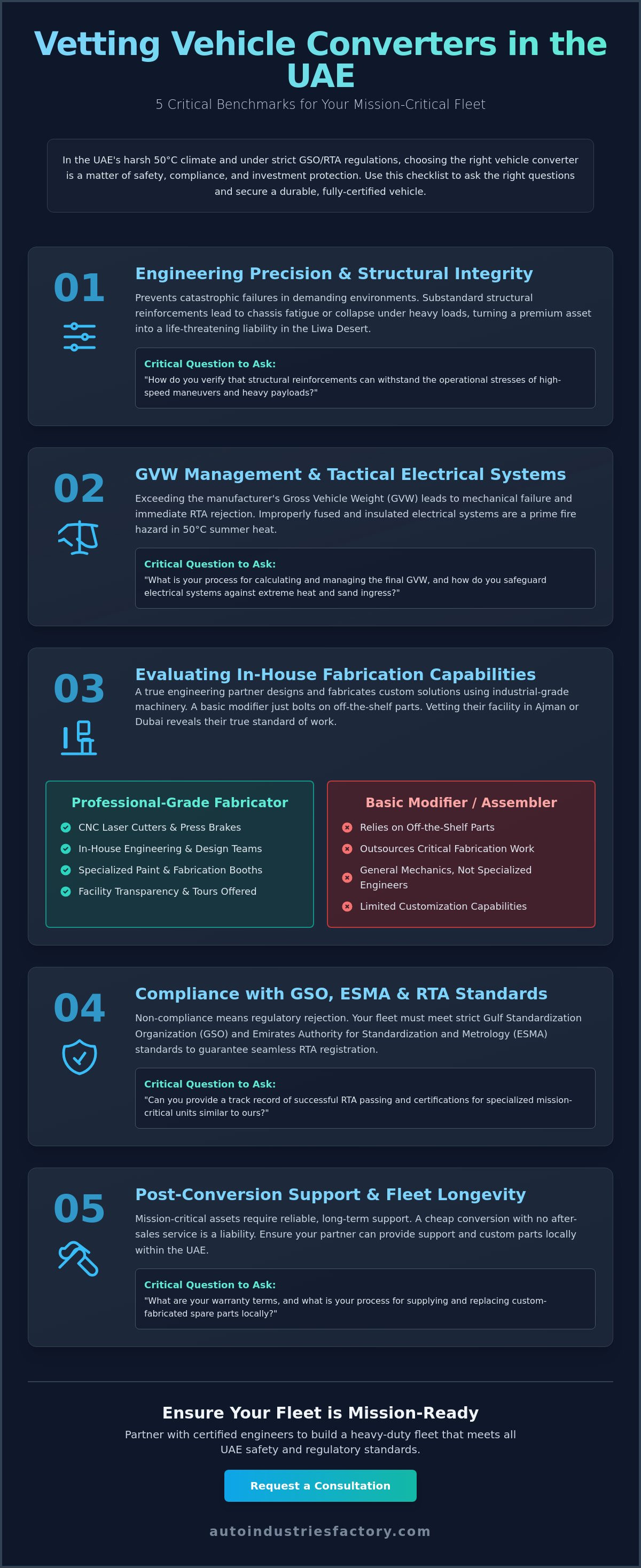
- Understand why engineering precision is vital to prevent structural failures and regulatory rejection in the UAE's demanding environment.
- Identify the technical questions to ask a vehicle converter regarding Gross Vehicle Weight (GVW) management and the integration of advanced tactical electrical systems.
- Discover how to vet a provider's true engineering standards by evaluating their in-house fabrication capabilities and facility transparency in Ajman or Dubai.
- Ensure your fleet meets strict GSO and ESMA standards to guarantee seamless RTA registration and passing for specialized mission-critical units.
- Identify the critical benchmarks for post-conversion support, including warranty terms and the local availability of custom spare parts in the UAE.
Why Choosing the Right Vehicle Converter in the UAE is Mission-Critical
Vehicle conversion is far more than a simple aesthetic upgrade; it's a specialized engineering process that transforms a base chassis into a mission-specific unit. This discipline relies on the deep-rooted history of vehicle modification, where structural integrity meets functional design. In the UAE, where vehicles often serve as mobile clinics, command centers, or tactical assets, the quality of this transformation can be the difference between operational success and catastrophic failure.
The risks associated with poor conversions are severe. Substandard structural reinforcements can lead to chassis fatigue or collapse under heavy loads. Electrical systems that aren't properly fused or insulated are prime candidates for fires, especially during peak summer months. Beyond physical safety, there's the risk of regulatory rejection. UAE authorities, including the RTA and various civil defense bodies, maintain strict standards. A conversion that fails to meet these specifications will be denied registration, turning an expensive asset into a total loss. One of the first questions to ask a vehicle converter should always focus on their track record with local compliance.
To better understand the technical requirements of choosing the right partner, watch this helpful video:
In the context of ambulances and tactical vehicles, a "cheaper" quote is often a red flag. Cutting costs usually means using thinner gauge steel, inferior plywood, or low-grade wiring. For a life-saving unit, these shortcuts aren't just budget adjustments; they're safety hazards. A high-quality build ensures the vehicle remains stable during high-speed maneuvers and that medical equipment stays powered without interruption. When reviewing specialized conversion services, remember that reliability is the most valuable feature you can buy.
The conversion landscape across Dubai, Ajman, and Abu Dhabi is diverse. While many shops claim to offer modifications, only a few possess the industrial-grade machinery required for heavy-duty work. You'll find everything from small workshops to massive factories equipped with CNC laser cutters and specialized paint booths. Understanding this landscape is vital for anyone preparing their list of questions to ask a vehicle converter before committing to a project.
Specialized vs. General Workshops
A general mechanic is not a qualified vehicle converter. Specialized units require dedicated fabrication facilities where engineers use precision tools like press brakes and CNC machinery. A generalist often acts as a parts assembler, bolting on off-the-shelf components that may not be rated for the vehicle's specific mission. A master craftsman, however, designs custom solutions that integrate seamlessly with the vehicle's original engineering, ensuring long-term durability under heavy use.
The Impact of the UAE Climate on Conversions
The UAE climate is one of the harshest on earth. Extreme heat and pervasive sand can destroy electrical components and clog standard cooling systems in weeks. Material choice is critical; while aluminum is lightweight, stainless steel is often preferred for its superior corrosion resistance in coastal areas. Thermal management in UAE vehicle upfitting is the engineering practice of utilizing high-capacity cooling and heat-reflective insulation to protect critical systems from ambient temperatures that frequently surpass 50°C.
Essential Technical Questions for Mission-Critical Conversions
When you're commissioning a specialized build, the most important questions to ask a vehicle converter focus on engineering precision rather than aesthetics. You need to know how the team calculates and manages the final Gross Vehicle Weight (GVW) after the conversion. In the UAE, exceeding the manufacturer's specified GVW leads to mechanical failure and legal registration issues. A professional factory uses advanced 3D modeling to predict weight distribution before a single bolt is turned. This ensures the vehicle remains stable and safe under full load.
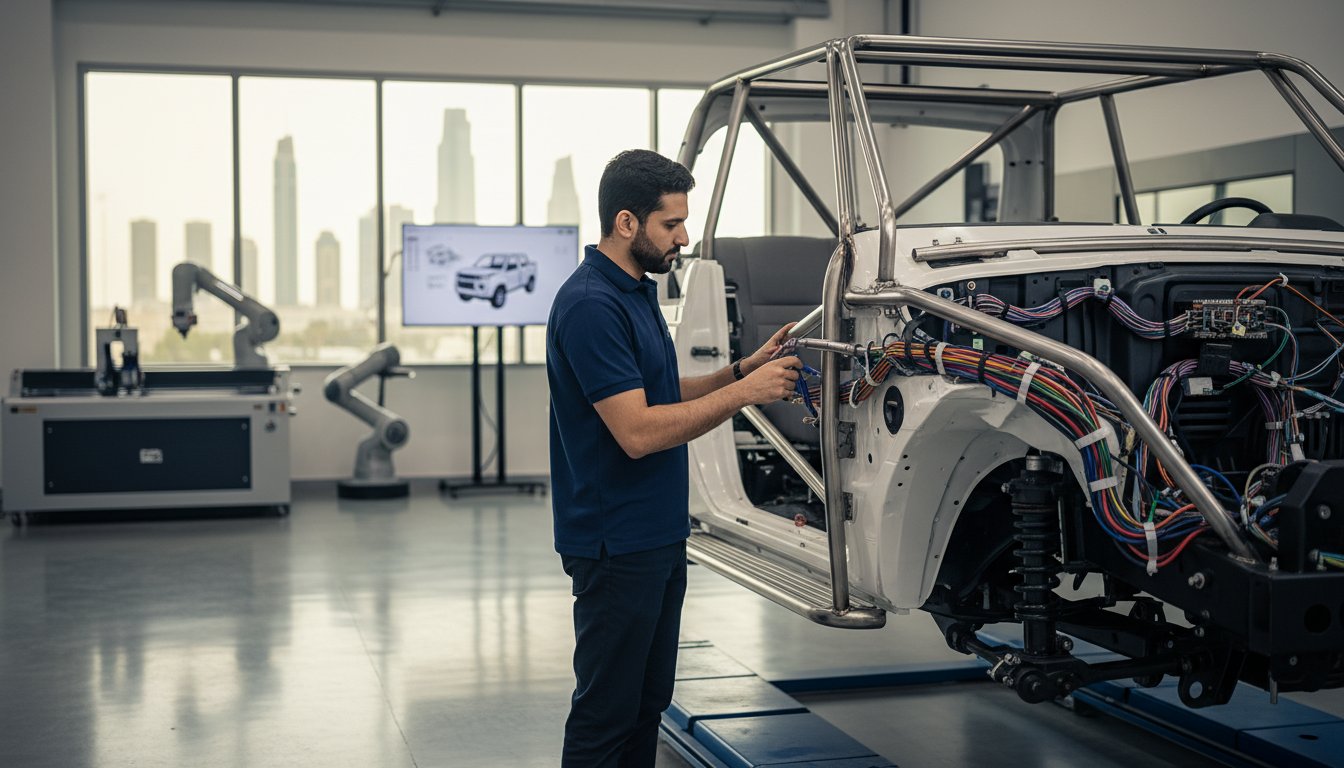
Auto Industries Factory (AIF) specializes in maintaining structural integrity by using laser cutting and CNC machining for all custom parts. Ask your converter if they use these technologies or if they rely on manual fabrication. Precision fitment isn't just about looks; it prevents rattles, leaks, and structural fatigue over time. Whether you're converting a Toyota Land Cruiser for desert patrol or a GMC Savana for medical transport, the reinforcement of the chassis must be handled with surgical accuracy. You should also confirm their experience with specific brands like Nissan and Chevrolet to ensure they understand the unique mounting points and electronic architectures of those platforms.
Weight Distribution and Suspension
Calculating the center of gravity is vital for safari trucks and ambulances that operate in high-stress environments. If the weight is too high or poorly distributed, the vehicle becomes a rollover risk during sharp turns or dune crossings. Ask your converter about their process for heavy-duty suspension upgrades. They shouldn't just add stiffer springs; they must tune the dampers and reinforce the mounting brackets to handle the increased mass. It's also essential to verify that the braking system is upgraded to match the new weight. Stopping distances must comply with AMENA Automotive Association standards to ensure the vehicle is safe for both operators and the public on UAE roads.
Electrical System Integration
Modern mission-critical vehicles are mobile power plants. You must ask about the integration of independent battery systems and high-output alternators. These systems are necessary to run medical monitors or tactical communication gear without draining the starter battery. In the GCC, heat is the primary enemy of electronics. All wiring must be automotive-grade, heat-shielded, and routed away from the exhaust system to withstand 50°C summer days. For detailed insights on how these systems support life-saving tools, refer to this Ambulance Conversion Guide. If you're looking for a partner who prioritizes these engineering details, you can explore our specialized conversion services to see our technical capabilities in action.
Evaluating In-House Capabilities and Engineering Standards
Selecting a partner for a heavy-duty conversion involves more than reviewing a digital portfolio. You need to know how they build. One of the most critical questions to ask a vehicle converter is whether they manage fabrication, painting, and assembly in-house. Outsourcing often leads to communication gaps, project delays, and inconsistent quality across different components. A reputable facility will always welcome a tour of their factory in Ajman or Dubai. Seeing a work-in-progress ambulance or tactical unit provides immediate proof of their engineering standards and quality control (QC) protocols.
A professional converter should demonstrate clear QC checkpoints at every stage. This includes checking the structural integrity of the chassis after modifications and verifying the safety of electrical systems. If a converter cannot explain their inspection process for custom accessory fabrication, like bull bars or roof racks, they might be cutting corners on safety. High-performance units require rigorous testing to ensure they handle the demanding terrain of the UAE without failure.
The Value of In-House Fabrication
Auto Industries Factory (AIF) sets the benchmark for professional standards by housing every stage of production under one roof. When a converter utilizes in-house CNC laser cutting, they achieve a precision fit that manual cutting cannot replicate. This technology ensures a flawless finish on complex metal components. Dedicated welding and painting bays allow for specialized coatings that withstand the 50°C heat of a UAE summer. Having these capabilities on-site means the team has total control over the timeline and the final product's durability. Professional fabrication isn't just about looks; it's about making sure every component survives 100,000 kilometers of hard use.
Prototyping and Design Consultation
Precision begins before the first piece of metal is cut. You should ask if your converter provides detailed 3D designs or technical blueprints during the consultation. For custom safari builds or police units, a collaborative design phase prevents costly errors during the assembly stage. You need to see exactly how a roof rack or interior cabinet fits the vehicle's specific dimensions. This level of detail is vital for specialized armor or heavy-duty protection. For example, expert fabrication of bull bars requires specific engineering to ensure airbag compatibility and optimal approach angles. Without a blueprint, you're essentially guessing.
Look for these specific engineering markers during your factory visit:
- Material certification checks for all steel and aluminum grades.
- Multi-stage inspection during the wiring and electrical integration.
- Load testing for custom roof racks and internal shelving units.
- Final paint thickness verification to ensure long-term corrosion resistance.
Knowing these details helps you identify a converter who prioritizes engineering over aesthetics. It's the difference between a vehicle that looks good and one that performs reliably in mission-critical situations. Always verify that the engineering team is available to discuss your specific requirements directly.
Compliance, Certification, and UAE Regulatory Requirements
In the UAE, a vehicle conversion isn't just about the physical build; it's about legal roadworthiness. One of the critical questions to ask a vehicle converter is whether their work complies with the Gulf Standardization Organization (GSO) and the Emirates Authority for Standardization and Metrology (ESMA). Without these certifications, you'll face immediate rejection at RTA testing centers. Professional converters must provide the necessary documentation to ensure the vehicle passes technical inspections without delays.
Top-tier converters operate as part of the Registered Manufacturer Association (RMA). This status is vital for new vehicles. It allows the converter to manage the registration process while maintaining the original manufacturer warranty. It also ensures that the GSO standards for the Gulf region are strictly followed during the modification process. If a converter cannot explain their RMA status, you risk losing your vehicle's factory support.
Navigating RTA and ESMA Approvals
Every conversion requires a specific certificate to change the vehicle's category from a standard passenger van to an ambulance or mobile workshop. Ask if the converter handles the full RTA technical inspection and "change of vehicle type" certification. High-roof ambulances, for instance, must undergo a specialized tilt test to ensure stability at a 28-degree angle. Requirements often vary between Dubai and Abu Dhabi. Your partner needs deep experience with the specific licensing authority in your chosen Emirate to avoid registration bottlenecks.
International Standards in a Local Context
For medical fleets, compliance with EN 1789 (European) or KKK-A-1822 (US) standards is mandatory for safety and performance. All onboard medical equipment must carry Ministry of Health (MOH) approval to operate legally within the UAE. If you're commissioning an armored vehicle, you must verify ballistic protection levels like VPAM or BR. You should review a detailed Car Armouring Guide to understand how these certifications protect occupants against specific threats. These standards aren't optional; they're the difference between a vehicle that looks the part and one that performs under pressure.
When you're narrowing down your list of questions to ask a vehicle converter, always demand to see physical copies of their previous ESMA approvals. A reputable factory won't hesitate to prove their compliance. They'll show you how they manage the entire workflow from the initial fabrication to the final RTA passing paper. This transparency protects your investment and ensures your fleet hits the road as quickly as possible.
Ensure your fleet meets every local and international safety standard. Explore our certified conversion services at Auto Industries Factory today.
Post-Conversion Support and Fleet Longevity
A vehicle conversion represents a long-term capital investment. It isn't just a one-time purchase. When you finalize your list of questions to ask a vehicle converter, you must focus on the years following the initial delivery. You need a partner who ensures the vehicle stays operational during 50-degree Celsius summers and through heavy-duty off-road use. Auto Industries Factory (AIF) specializes in engineering vehicles that withstand the harshest environments in the Middle East.
Warranty and Maintenance Agreements
Most specialized vehicles operate under a split warranty. The original equipment manufacturer (OEM), such as Toyota or Nissan, covers the base chassis and engine. The converter handles the warranty for the medical equipment, electrical systems, and structural fabrication. You should confirm if the converter offers a standard 12-month warranty on all custom work. Ask about the availability of mobile service teams that can reach your site in Fujairah or Ras Al Khaimah. We define the total cost of ownership as the sum of the initial purchase price plus all maintenance and repair costs over the vehicle’s ten-year service life. High-quality initial fabrication reduces this figure by preventing frequent part failures.
Spare Parts and Repair Turnaround
Downtime is expensive for any fleet. In the UAE, specialized vehicle downtime can cost a business upwards of 1,800 AED per day in lost productivity. You must ask if the converter maintains a local stock of custom spare parts like CNC-cut bull bars, canopies, or medical cabinetry. AIF maintains a robust inventory at our Ajman facility to ensure a 48-hour turnaround for most common repairs. If your operations extend outside the UAE, verify that the factory provides comprehensive technical manuals and export-ready spare parts kits to keep your fleet moving.
Scaling Your Fleet with Auto Industries Factory
Precision and repeatability are essential for growing organizations. As a Trusted UAE auto factory, AIF uses advanced CAD designs and laser-cutting technology to ensure every vehicle is identical to the last. This uniformity is vital for fleet managers who need to maintain standardized training for their drivers and medical staff. When you add five more ambulances or tactical units next year, they will match your current fleet exactly. This level of precision-engineered design simplifies parts management and long-term maintenance schedules. It's the reason why government and private entities choose us for multi-year partnerships. Contact Auto Industries Factory for a free conversion estimate today.
ENGINEER YOUR MISSION SUCCESS WITH PRECISION FABRICATION
Selecting the right partner for your fleet is a mission-critical decision that impacts both safety and operational uptime. By focusing on the essential questions to ask a vehicle converter, you ensure your project meets strict GSO and RTA regulatory requirements within the UAE. Auto Industries Factory (AIF) simplifies this process through our ISO Certified Fabrication Facility, where we eliminate guesswork. We don't rely on external contractors; our in-house CNC laser and engineering team manages every technical detail to deliver a rugged, heavy-duty finish that stands up to the harshest desert environments.
Auto Industries Factory (AIF) specializes in designing and fabricating high-quality conversions that prioritize mission reliability. Reliability isn't a luxury when lives or high-value assets are on the line. It's the result of advanced engineering and a no-nonsense approach to quality control. We provide the durable solutions you need to keep your vehicles moving without compromise. Our team is ready to transform your requirements into a high-performance reality that exceeds local standards. Let's build a fleet that's truly built to protect.
Request a Free Estimate for Your Vehicle Conversion Project
Frequently Asked Questions
Is it legal to modify a vehicle for commercial use in the UAE?
Yes, it's legal to modify vehicles for commercial use in the UAE, provided you obtain the necessary approvals from the Roads and Transport Authority (RTA) or the Ministry of Interior (MOI). Auto Industries Factory (AIF) specializes in ensuring every conversion meets the UAE Federal Law No. 21 of 1995 regarding traffic. We handle the technical documentation required for these regulatory bodies to ensure your fleet remains compliant on Dubai and Ajman roads.
How long does a standard ambulance or safari conversion take?
A standard ambulance or safari conversion typically takes between 4 and 8 weeks to complete. Simple configurations might be ready in 25 days, while complex tactical or advanced life support (ALS) units require the full 60 day window for precision fabrication. We provide a detailed project timeline during the initial consultation so you can plan your fleet deployment accurately without unexpected delays.
Will a professional conversion void my Toyota or GMC manufacturer warranty?
A professional conversion doesn't necessarily void your Toyota or GMC manufacturer warranty if the work follows approved engineering standards. AIF uses non-invasive mounting techniques and OEM-compatible components to protect the vehicle's integrity. One of the critical questions to ask a vehicle converter is how they manage electrical taps and chassis drilling to prevent warranty claims from being rejected by local dealerships like Al-Futtaim or Al Ghandi Auto.
Can I provide my own vehicle for conversion, or do you supply the chassis?
You can provide your own vehicle for modification, or we can supply the base chassis through our network of UAE dealership partners. Many clients deliver their own Toyota Land Cruiser or Nissan Patrol units to our facility in Ajman for custom fabrication. If you prefer a turnkey solution, we source the base vehicle and manage the entire conversion process from procurement to final delivery.
What certifications should I look for in a UAE-based vehicle converter?
Look for ISO 9001:2015 quality management certifications and specific RTA technical approvals when selecting a UAE-based converter. If you're commissioning security or cash-in-transit vehicles, ensure the factory is certified by the Security Industry Regulatory Agency (SIRA). AIF maintains high engineering standards to ensure every vehicle meets the rigorous safety requirements set by the UAE government and international bodies.
Do you provide export services for converted vehicles to other GCC countries?
We provide comprehensive export services for converted vehicles to Saudi Arabia, Oman, Kuwait, and Qatar. Our team manages the cross-border logistics and ensures the vehicle specifications meet the GSO (Gulf Standardization Organization) standards required for registration in other GCC countries. We've successfully exported over 200 units across the region, handling all necessary customs documentation and certificates of origin.
How do you ensure the electrical system can handle medical or tactical equipment?
We ensure electrical reliability by installing dedicated auxiliary battery systems and heavy-duty alternators that operate independently of the vehicle's primary circuit. Our engineers use CNC-cut wiring looms and marine-grade circuit breakers to prevent overloads from medical or tactical equipment. Every unit undergoes a 4-hour load test to simulate extreme desert conditions, ensuring the electronics don't fail when temperatures exceed 45 degrees Celsius.
Can you convert used vehicles or only new ones?
AIF converts both new and used vehicles, though we recommend new chassis for high-stress roles like ambulances or military units. For used vehicles, we perform a 50-point structural inspection to confirm the frame can support the additional weight of the conversion. This is one of the essential questions to ask a vehicle converter because older chassis may require reinforcement to meet current UAE safety standards for commercial operation.


