Selecting a partner to build your life-saving fleet is a mission-critical decision. With complex technical standards, strict compliance requirements, and critical fabrication details to consider, the process can feel overwhelming. How can you be certain you’re choosing a provider that guarantees vehicle reliability and eliminates the risk of costly downtime? This is a common challenge for healthcare providers and fleet managers, and navigating the landscape of ambulance conversion companies in UAE requires a clear, strategic approach.
This comprehensive guide is engineered to provide that clarity. We will break down the essential criteria for evaluating potential partners, from verifying critical certifications like EN 1789 to assessing their in-house fabrication capabilities and commitment to after-sales support. You will gain the expert knowledge needed to confidently select a company that delivers premium, heavy-duty ambulances built for durability and mission-readiness. Prepare to move from uncertainty to confidence and secure a fleet you can depend on when it matters most.
Key Criteria for Evaluating Ambulance Conversion Companies
Selecting a partner to build or modify your emergency vehicle fleet is a mission-critical decision for any healthcare provider or emergency service in the UAE. The quality of the conversion directly impacts patient safety, paramedic efficiency, and vehicle longevity. This guide provides a practical checklist to assess potential ambulance conversion companies in UAE, focusing on the essential pillars of certifications, engineering capabilities, and long-term support to ensure your fleet is reliable, compliant, and ready for any emergency.
To visualize the intricate process of transforming a standard vehicle into a life-saving unit, watch this detailed conversion example:
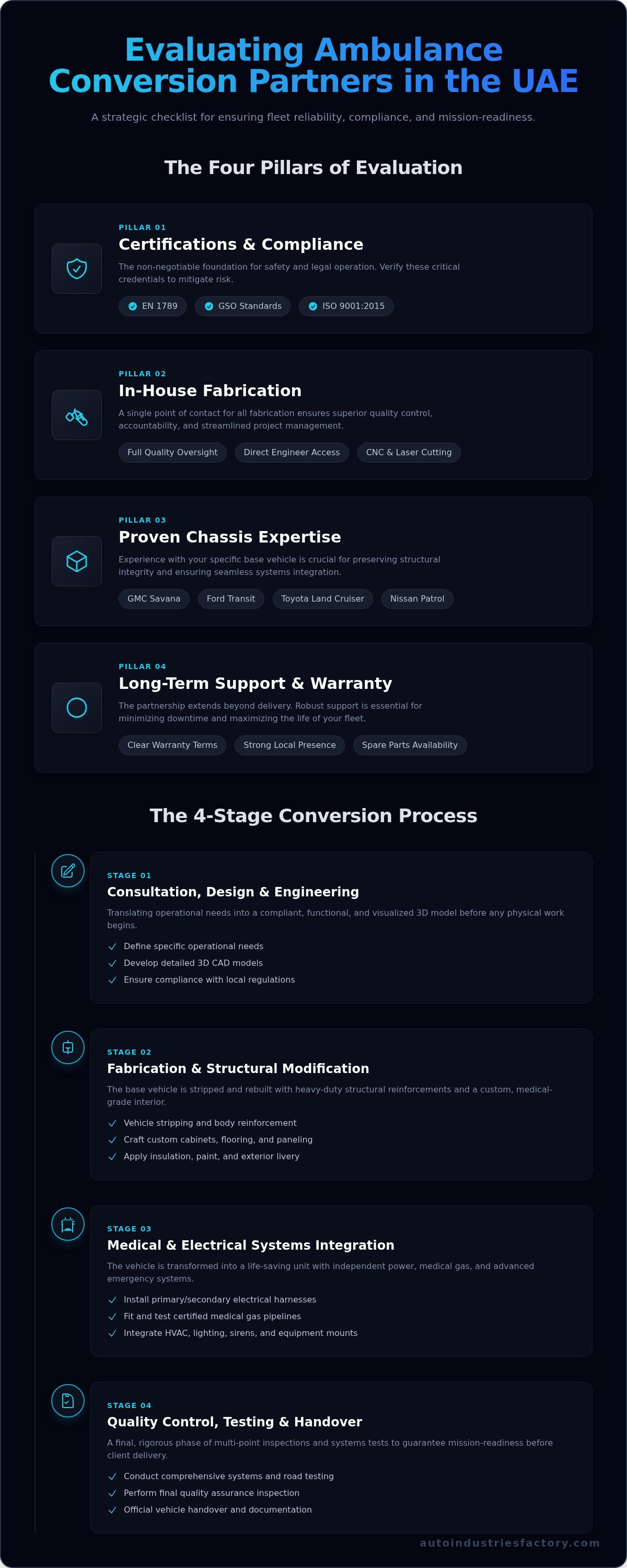
Certifications and Adherence to Standards (EN 1789 & GSO)
Regulatory compliance is the foundation of a safe and legally operable ambulance. Before engaging any company, verify their adherence to critical standards that govern vehicle safety and medical layouts. These certifications align with best practices seen across global emergency medical services and are non-negotiable for approval in the region. Key credentials to demand include:
- EN 1789: The European standard for medical vehicles and their equipment.
- GSO Standards: Compliance with GCC Standardization Organization regulations for vehicle modifications.
- ISO 9001:2015: Proof of a certified quality management system.
In-House Design and Fabrication Capabilities
A company's operational structure reveals much about its quality control. Prioritize specialists with comprehensive in-house facilities, including CNC laser cutting, welding, and fabrication. Performing all work under one roof provides superior quality oversight, ensures accountability, and simplifies project management with a single point of contact. It also grants you direct access to their engineers for precise customization and rapid problem-solving during the build process.
Expertise with Base Vehicle Chassis (GMC, Toyota, etc.)
Proven experience with your specific base vehicle is crucial for structural integrity and seamless systems integration. A premier conversion company will have a deep portfolio of work on popular chassis used in the UAE, such as the GMC Savana, Ford Transit, Toyota Land Cruiser, and Nissan Patrol. This expertise ensures that all modifications, from electrical wiring to cabinetry installation, are executed to preserve the vehicle's core safety and performance characteristics. Always request case studies or examples of similar conversions.
After-Sales Support, Warranty, and Service
The relationship with your conversion partner should not end upon vehicle delivery. Long-term operational readiness depends on robust after-sales support. Clarify the warranty terms for both the conversion work and installed components. A strong local presence in the UAE is vital for ensuring fast response times for service, repairs, and spare parts availability. This commitment to ongoing support is essential for minimizing vehicle downtime and maximizing the life of your critical assets.
Understanding the Ambulance Conversion Process: From Chassis to Clinic
Transforming a standard commercial vehicle into a life-saving mobile clinic is a precision-driven engineering feat. The best ambulance conversion companies in UAE follow a structured, multi-stage process that leaves no detail to chance. This methodical approach ensures every component meets stringent medical, safety, and operational requirements. Understanding these stages allows you to track your project's progress and appreciate the specialized skills required, from initial design to final systems integration.
Stage 1: Consultation, Design, and Engineering
The conversion begins with an in-depth consultation to define your organisation's specific operational needs. This crucial first step determines the layout, required medical equipment, and overall functionality. Our engineers then develop detailed 3D CAD models, allowing you to visualize and approve the interior layout before fabrication begins. All designs are engineered to comply with rigorous local regulations, such as Abu Dhabi's official ambulance standards, ensuring full compliance from the outset. Once the base vehicle is selected, final schematics for electrical and medical gas systems are locked in.
Stage 2: Vehicle Fabrication and Structural Modification
With the design approved, the base vehicle is completely stripped to its core frame. This prepares it for heavy-duty structural modifications, which may include roof extensions for increased headroom or body reinforcement for enhanced durability. Our fabrication specialists then craft the interior using premium, medical-grade materials to build custom cabinets, durable flooring, and seamless wall paneling. The final steps in this stage include applying high-performance insulation, a flawless paint finish, and the official exterior livery and emergency markings.
Stage 3: Medical and Electrical Systems Integration
This stage is where the vehicle becomes a true ambulance. Technicians install complex primary and secondary electrical wiring harnesses to power both the vehicle and the patient cabin's life-support equipment independently. Certified medical gas pipelines for oxygen and air are meticulously fitted and tested. Following this, advanced systems are integrated, including:
- Climate control (HVAC) for the patient compartment
- Interior and exterior emergency LED lighting
- High-output sirens and PA systems
- Communication and radio equipment
- Secure mounting for stretchers, attendant seats, and medical devices
Stage 4: Quality Control, Testing, and Handover
Before any vehicle is delivered, it undergoes a battery of rigorous tests. Every electrical circuit, medical gas outlet, and integrated system is checked for flawless performance. We conduct comprehensive water leak tests to ensure cabin integrity, followed by demanding road tests to identify and eliminate any rattles or operational issues. At Auto Industries Factory LLC (AIF), the entire process is managed in-house for total quality control. The final step involves compiling all documentation, providing your team with thorough training, and conducting the official vehicle handover.
Common Ambulance Types and Customizations in the UAE
Selecting the right ambulance is a mission-critical decision. Not all emergency vehicles are created equal; the optimal design depends entirely on the intended application, patient acuity, and operational environment. The UAE's diverse landscape, from dense urban centers to rugged desert terrain, demands highly specialized vehicles. Understanding the fundamental differences between ambulance types is the first step in defining your fleet's requirements. Every build must adhere to rigorous specifications, such as those outlined in Abu Dhabi's official ambulance standards, ensuring safety and performance are never compromised.
Standard vs. Box Type Ambulances
The two primary configurations offered by ambulance conversion companies in UAE are the standard van type and the larger box type. Standard ambulances, often built on a van chassis like the GMC Savana or Ford Transit, offer excellent maneuverability in congested city streets. Their compact footprint makes them ideal for rapid response in urban settings. In contrast, Box Type ambulances feature a custom-fabricated patient module mounted onto a truck chassis. This design provides significantly more interior space, allowing for a full suite of Advanced Life Support (ALS) equipment and providing medical staff with ample room to work efficiently.
Popular Base Vehicles for the GCC Region
The choice of base chassis is foundational to the ambulance's capability and reliability. In the GCC, certain vehicles have proven their durability and performance in demanding conditions:
- Toyota Land Cruiser & Hilux: World-renowned for their rugged 4x4 capabilities, these are the top choice for off-road and desert rescue operations where reliability is paramount.
- GMC Savana & Chevrolet Express: These full-size vans are a popular and dependable platform for standard Type II ambulances, offering a balance of interior space and drivability.
- Ford Transit & F-Series: Ford's versatile platforms are used for both standard van conversions and as the chassis for larger box type modules, providing robust and flexible solutions.
The final selection is dictated by terrain, required patient capacity, and the level of medical care to be provided onboard.
Specialized Conversions: Mobile Clinics and Neonatal Units
Beyond emergency response, specialized conversions address unique healthcare needs. These advanced projects require a higher level of precision engineering and systems integration. Examples include Neonatal/ICU ambulances equipped with incubators, ventilators, and dedicated life support systems for critical patient transport. Mobile Clinics are custom-built to deliver primary care, health screenings, and vaccination services to remote communities. For extreme environments, 4x4 Desert Ambulances are heavily modified with reinforced suspension, specialized equipment, and robust patient compartments for rescue missions in the most challenging terrains. Executing these complex builds requires a capable conversion partner with proven expertise in custom fabrication and medical integration.
Why In-House Fabrication is a Non-Negotiable Advantage
When selecting a partner for a mission-critical project like an ambulance build, it's crucial to understand their core capabilities. Many companies simply assemble pre-fabricated kits, acting as integrators rather than creators. True industry leaders, however, are genuine fabricators who build components from raw materials. This in-house capability is a powerful indicator of a company's expertise, directly impacting the final product's quality, durability, and timeline. It is perhaps the most critical question to ask any of the top ambulance conversion companies in UAE.
Unmatched Quality Control
Complete control over the manufacturing process is the foundation of a superior vehicle. When a company fabricates its own components, every stage is managed internally, from raw material selection to the final weld. This eliminates the risks associated with third-party supplier errors and ensures every element meets exacting standards.
- Material Integrity: Full control over the grade of steel, the quality of aluminum, and the durability of all fittings.
- Direct Oversight: Engineers and technicians can directly supervise the build on the factory floor, ensuring precision and adherence to design specifications.
- End-to-End Accountability: Every component is guaranteed to meet both internal quality benchmarks and external regulatory requirements without compromise.
Superior Customization and Flexibility
In-house fabrication unlocks a level of customization that kit-based assembly can never match. Instead of being constrained by standard layouts, a fabricator can design and build truly bespoke solutions for unique operational needs. Modifications and adjustments can be made swiftly during the build process, ensuring the final vehicle is perfectly tailored to its purpose. This agility means our team of experts can engineer custom medical cabinets, equipment mounts, and structural reinforcements on demand.
Efficiency and Accountability
Relying on external suppliers creates dependencies that can lead to significant project delays and communication breakdowns. A company with in-house fabrication capabilities provides a single, streamlined point of contact for the entire project. This integrated approach fosters a more efficient workflow, from initial design and engineering to production and final assembly. Problems are solved faster, communication is clearer, and you have one accountable partner dedicated to delivering your project on time and to the highest standard, setting apart the best ambulance conversion companies in UAE.
Partner with the UAE's Leading Ambulance Conversion Experts
Selecting the right partner for your ambulance fleet is a mission-critical decision. The key to success lies in verifying technical compliance, understanding the conversion process, and prioritizing partners with complete in-house fabrication capabilities. Among the top ambulance conversion companies in UAE, those who control the entire manufacturing process from chassis to clinic deliver unparalleled quality, durability, and reliability when it matters most.
Auto Industries Factory (AIF) exemplifies this standard of excellence. From our advanced fabrication facility in Ajman, we engineer premium, heavy-duty ambulances built on proven GMC and Toyota chassis. Every conversion is meticulously crafted to be fully EN 1789 and GSO compliant, ensuring your fleet is equipped for maximum safety and operational uptime.
Ready to upgrade your emergency response capabilities? Request a Free Consultation for Your Ambulance Fleet and let our specialists design a custom solution that meets your precise operational needs.
Frequently Asked Questions
What is the typical timeline for an ambulance conversion project in the UAE?
A standard ambulance conversion on a common base vehicle like a Toyota HiAce typically requires 4 to 6 weeks from vehicle intake to final handover. This timeline can vary based on the complexity of the project. Highly customized conversions, such as those with advanced life support (ALS) systems or specialized off-road modifications, may require additional time for engineering, fabrication, and equipment integration. We provide a precise schedule after finalizing the project specifications.
Can you convert a vehicle that our organization already owns?
Yes, we specialize in converting client-owned vehicles. Our technical team will conduct a thorough assessment of your existing vehicle to confirm its suitability and structural integrity for conversion. We frequently work with client-provided vans, SUVs like the Toyota Land Cruiser, and truck chassis. This allows you to leverage your existing assets while upgrading them into fully-equipped, mission-ready emergency medical vehicles, a core service offered by top ambulance conversion companies in UAE.
What kind of warranty and after-sales service do you provide for your conversions?
We stand behind the quality and durability of our work with a comprehensive warranty that covers all fabrication, electrical systems, and installed components against defects in materials and workmanship. Following delivery, our after-sales support includes technical assistance, maintenance guidance, and a reliable supply of spare parts. Our goal is to ensure your fleet remains operational and dependable for its critical life-saving duties, maximizing uptime and vehicle longevity.
Do you handle the necessary regulatory approvals and vehicle registration post-conversion?
For vehicles operating within the UAE, we manage the entire regulatory process, securing approvals from authorities like the RTA and Ministry of Health. For clients in Oman, we engineer the conversion to meet all Royal Oman Police (ROP) and Omani Ministry of Health standards. We provide a complete documentation package to ensure a smooth import, inspection, and registration process once the vehicle arrives in Oman, working closely with your local team.
How much does a typical ambulance conversion cost?
The cost is determined by the vehicle type, medical equipment level, and customization. A basic patient transport conversion on a standard van can range from 15,000 to 25,000 USD, excluding the vehicle. An advanced life support (ALS) unit or a rugged 4x4 off-road ambulance with specialized gear will typically cost between 30,000 and 60,000 USD. We provide a detailed, itemized quote based on your specific operational requirements.
Can you export converted ambulances to other countries in the GCC or Africa?
Absolutely. We have extensive experience exporting our robustly built ambulances across the GCC to countries like Oman, Saudi Arabia, and Bahrain, as well as to various nations in Africa. Our dedicated logistics department manages the entire export process, from secure vehicle transport to preparing all necessary customs and shipping documentation. We ensure every unit is built to meet the specific environmental and regulatory conditions of the destination country, guaranteeing a seamless delivery.
What information do I need to provide to get an accurate quote?
To receive a precise and comprehensive quote, please provide our team with the following details: the make and model of the base vehicle, its intended use (e.g., patient transport, mobile clinic, ALS rescue), a list of essential medical equipment, and any requirements for custom fabrication or branding. Specifying the final destination country is also crucial for factoring in shipping and any region-specific modifications needed for your ambulance conversion.


