
Choosing the heaviest bull bar isn't always the safest move for your vehicle's long-term performance. While it's tempting to equate mass with security, the reality is that front-end protection is a precise engineering trade-off. You likely already recognize that a high-quality bar is essential for surviving animal strikes or harsh off-road impacts, yet you're rightly concerned about how excessive weight might compromise your suspension and payload capacity. The aluminum vs steel bull bars debate isn't just about price; it's about matching your equipment to your vehicle's specific mission profile.
In this ultimate comparison for 2026, you'll discover the critical differences in impact energy absorption and corrosion resistance that define these two materials. We've analyzed the latest manufacturing trends and safety standards to provide a clear roadmap for your decision. We will break down how modern alloy designs are challenging traditional steel dominance, the impact of ADR compliance on your choice, and which material provides the best protection without exceeding your GVM limits. By the end of this guide, you'll have the technical insight needed to select a solution that ensures both vehicle safety and operational efficiency.
Key Takeaways
- Identify the strategic role of bull bars as mission-critical structural protection for specialized units like ambulances and safari vehicles.
- Evaluate the high tensile strength of steel for maximum protection during animal strikes and its reliability for heavy-duty recovery operations.
- Compare the 30-50% weight savings of aluminum vs steel bull bars to maintain vehicle payload and prevent front-axle suspension fatigue.
- Analyze how material choice impacts long-term maintenance, especially the superior corrosion resistance of aluminum in humid or coastal environments.
- Discover the advantage of precision in-house fabrication and CNC laser cutting for seamless integration with modern vehicle safety systems.
The Strategic Role of Bull Bars in Vehicle Protection
Bull bars represent the first line of defense for specialized vehicle fleets. They aren't cosmetic additions; they are mission-critical structural shields. In high-risk environments like emergency response or remote safari tours, a bull bar provides the necessary armor to protect the chassis and front-end components from catastrophic failure. Whether it's an animal strike on a rural highway or a low-speed collision in a congested urban zone, these components absorb and redistribute impact energy to keep the vehicle in motion.
Beyond structural integrity, these bars safeguard the vehicle's vital systems. A minor impact can easily puncture a radiator or crush a cooling assembly. In remote locations, such a failure doesn't just end the mission; it leaves the crew stranded. By shielding these sensitive engine parts, a well-engineered bar ensures the vehicle remains operational after a strike. This reliability is why the choice between aluminum vs steel bull bars is a fundamental engineering decision for any fleet manager or off-road specialist.
Protection for Specialized Vehicle Conversions
Specialized units like ambulances and police vehicles operate under extreme conditions where front-end durability is non-negotiable. For emergency services, a reinforced front end allows for safer navigation through debris or congested areas during high-priority calls. Similarly, in safari vehicle conversions, the bull bar must withstand the relentless vibrations and unpredictable obstacles of rugged off-road terrains. These modifications transform a standard truck into a robust tool capable of sustained performance in the world's harshest environments. Every custom fabrication must account for the specific threats encountered in the field.
Critical Factors: Weight, Safety, and Airbag Compatibility
Engineering a protective bar requires more than just welding metal together. Modern bull bar designs must be fully compatible with vehicle safety systems, particularly airbag deployment sensors. If a bar is too rigid, it might delay the airbag trigger. If it's too soft, it won't protect the vehicle. Precision is required to ensure that crush rates match the manufacturer's original safety specifications.
Weight management is the other side of the safety coin. Adding mass to the front axle changes the vehicle's center of gravity. This affects braking distances, steering response, and accelerates suspension wear. Professional fabrication ensures that the mounting systems are custom-welded to handle these stresses while maintaining safety standards. Choosing between aluminum vs steel bull bars requires a calculated look at how much weight your specific vehicle platform can carry without compromising its handling or the safety of its occupants.
Steel Bull Bars: Maximum Strength for High-Impact Missions
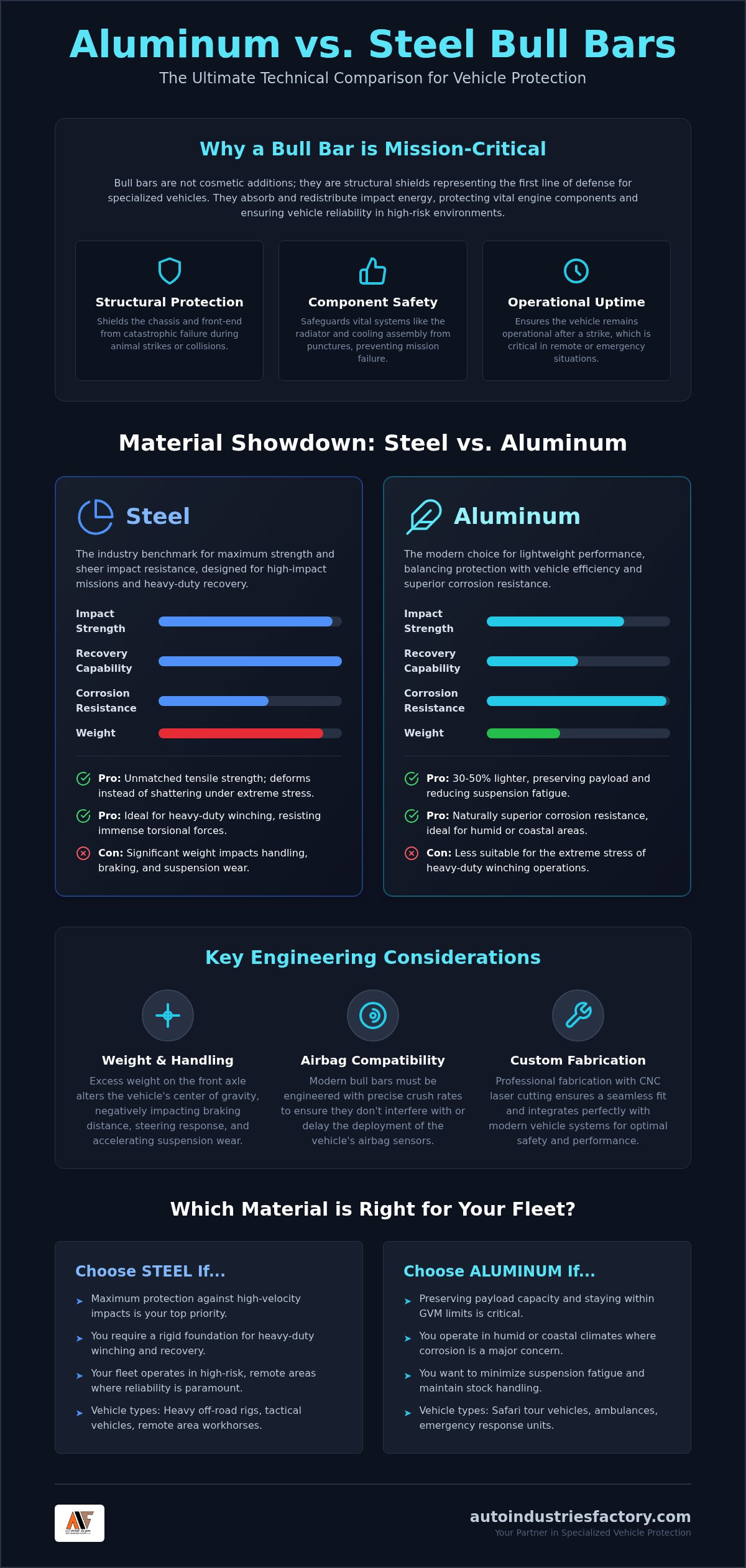
Steel remains the industry benchmark for sheer impact resistance. When analyzing aluminum vs steel bull bars, the primary advantage of steel lies in its high tensile strength. Unlike other materials that may crack or shatter under extreme stress, steel is designed to deform slightly while maintaining structural integrity. This characteristic is vital during high-velocity animal strikes or tactical maneuvers where the primary objective is to protect the radiator and engine bay at all costs.
While steel is undeniably heavier, the trade-off is superior protection in isolated areas. A steel bar provides the rigid foundation required for heavy-duty winching and recovery operations. In situations where a vehicle is bogged in deep sand or mud, the structural rigidity of a steel mounting system ensures that the chassis can handle the immense pressure of a recovery without warping or failing. For those operating in high-risk zones, this reliability is worth the additional mass.
Engineering for Durability and Recovery
The structural properties of steel make it the only logical choice for high-capacity winches. A winch exerts localized stress on the bull bar that can exceed several tons. Professional fabricators prioritize steel for these applications because it resists the torsional forces that would compromise an alloy bar. To combat oxidation, modern steel components receive a multi-stage powder coating. This ensures the bar remains rust-free even after years of exposure to harsh environments. Our team's expertise in custom bull bars and bumpers ensures that every weld and bend meets these rigorous performance standards.
Ideal Applications for Steel Protection
Tactical durability is the reason military and police units consistently specify steel. In these high-stakes roles, the ability to perform a push maneuver or survive multiple small impacts is more important than weight savings. For fleet operators managing heavy-duty off-road expeditions, steel offers a unique advantage: repairability. If a steel bar is bent in a remote location, it can often be straightened or welded back together by a technician. This is a critical factor when compared to aluminum, which usually requires a full replacement after a significant strike.
Safety is another core consideration for any professional fleet. While bull bars are built for strength, they must also align with modern standards. Research into pedestrian safety tests highlights how material choice and design influence impact outcomes. If your mission profile involves high-risk zones where structural failure isn't an option, you should explore our specialized fabrication services to see how we engineer these robust solutions.
Aluminum Bull Bars: Lightweight Performance and Corrosion Resistance
Aluminum isn't just a light-duty alternative to steel; it's a high-performance material that provides specific tactical advantages for modern fleets. When evaluating aluminum vs steel bull bars, the most immediate benefit is the massive reduction in front-end mass. Typically, an aluminum bar is 30% to 50% lighter than its steel equivalent. This weight reduction isn't merely about making the vehicle easier to drive. It's about preserving the structural life of the front suspension, reducing the frequency of brake pad replacements, and improving overall fuel efficiency across a high-mileage fleet.
Modern aerospace-grade alloys have significantly narrowed the gap in impact resistance. While steel remains the primary choice for heavy recovery, high-tensile aluminum alloys offer exceptional rigidity for standard off-road use and animal strikes. These materials are engineered to meet strict vehicle safety regulations, ensuring they absorb energy in a controlled manner to protect occupants while shielding critical engine components from damage. This balance of strength and weight makes aluminum a sophisticated choice for operators who prioritize vehicle dynamics.
Optimizing Vehicle Payload and Suspension
Managing Gross Vehicle Mass (GVM) is a constant challenge for fleet managers. For specialized units like ambulance conversions, every kilogram matters. These vehicles already carry heavy medical equipment, oxygen tanks, and reinforced interiors. Adding a heavy steel bar can push the front axle over its legal limit, leading to poor handling and increased maintenance costs. An aluminum solution provides the necessary front-end protection without compromising the payload capacity. A lighter front end also results in more responsive steering and a more stable ride on corrugated safari tracks, where heavy front-end weight often leads to premature shock absorber failure.
Longevity in Harsh Environments
In humid or coastal regions, oxidation is a persistent threat to steel equipment. Aluminum is naturally corrosion-resistant because it forms a protective oxide layer when exposed to the atmosphere. This makes it the superior choice for vehicles operating near the ocean or in tropical climates where salt air quickly degrades powder-coated steel. If a steel bar is chipped by a rock, it will rust if not repaired immediately. Aluminum is much more forgiving in these environments.
Beyond durability, aluminum offers aesthetic flexibility. It can be polished to a high-shine finish or powder-coated to match any fleet color profile. Maintenance is straightforward and less frequent than with steel counterparts. This long-term resilience ensures that the vehicle maintains a professional appearance throughout its service life without the need for frequent sandblasting or repainting to hide rust spots. For fleets operating in high-moisture zones, the lower total cost of ownership makes aluminum an economically sound investment.
Head-to-Head: Choosing the Right Material for Your Fleet
Selecting the correct material requires a precise evaluation of your mission's operational risks. The aluminum vs steel bull bars decision shouldn't be based on aesthetics or initial purchase price alone. It's a technical choice between impact energy management and vehicle payload preservation. To make an informed decision, fleet managers must weigh these five key metrics:
- Weight: Aluminum is 30% to 50% lighter, preserving front-axle capacity.
- Strength: Steel offers superior tensile durability for high-velocity strikes.
- Cost: Steel is typically more affordable upfront, while aluminum saves on long-term fuel.
- Corrosion: Aluminum is naturally rust-resistant; steel requires maintained coatings.
- Repairability: Steel can often be straightened and welded; aluminum usually requires full replacement after a major strike.
The "Winch Factor" also plays a decisive role. If your fleet performs frequent heavy-duty recoveries, steel's rigidity is essential to prevent mounting point deformation. While aluminum bars can support winches with synthetic ropes for lighter tasks, steel remains the tactical standard for high-capacity recovery missions. You must match the bar's structural limits to the recovery requirements of your environment.
Total Cost of Ownership Analysis
A comprehensive TCO analysis reveals that the cheaper upfront cost of steel can be deceptive. Over 100,000 km of fleet operation, the added weight of steel increases tire wear and accelerates suspension fatigue. This leads to more frequent servicing intervals for shock absorbers and bushings. Fuel consumption also rises with every extra kilogram on the front end. However, steel's repairability offers a safety net. If a vehicle suffers a mid-level impact, a technician can often restore a steel bar to service. Aluminum's "single-use" nature after significant deformation means a higher replacement frequency in high-impact zones.
Matching Material to Vehicle Platform
Vehicle platforms like the Toyota Land Cruiser LC70 and Hilux have different tolerances for front-end weight. Tactical and military units utilizing the LC70 platform often prioritize steel to ensure the vehicle can perform push maneuvers or survive multiple small impacts without structural failure. Conversely, safari tour trucks benefit significantly from the weight savings of aluminum. These vehicles must stay under their Gross Vehicle Mass (GVM) while carrying passengers and heavy gear, making aluminum the smarter choice for maintaining handling and comfort. For a solution tailored to your specific fleet requirements, you can explore our services for custom fabrication and engineering.
Custom Fabrication: The Auto Industries Factory Advantage
While the choice of aluminum vs steel bull bars is a foundational decision, the engineering of the mounting system determines survival in a high-impact collision. Mass-produced retail bars often utilize universal brackets that compromise structural integrity to fit multiple vehicle types. We specialize in custom-welded mounting systems designed for maximum energy absorption. This ensures that impact forces are directed away from the chassis, protecting both the vehicle and its occupants. By focusing on mission-critical applications, we position our fabrication as a structural solution rather than a cosmetic accessory.
Precision Engineering and Quality Control
Our fabrication process begins with precision CAD design to ensure perfect alignment with the vehicle's original chassis points. Using in-house CNC laser cutting and CNC machining, we achieve tolerances that mass-produced retail products cannot match. This level of precision is vital for high-performance platforms like the Toyota Land Cruiser and Hilux, where safety system calibration is sensitive to metal placement. Every weld and bend is inspected to meet our rigorous standards for ruggedness and reliability. By keeping the entire process in-house, we maintain absolute control over material quality and structural finish, ensuring every build is ready for the harshest environments.
Next Steps for Fleet Managers and Operators
Professional fleet management requires solutions that minimize downtime and maximize protection. We provide a direct consultation process to assess your specific operational risks, payload requirements, and vehicle platforms. Whether you are managing a fleet of ambulances or specialized safari trucks, our team offers the technical expertise to guide your material selection and design specs. You can learn more about our fabrication capabilities or request an expert assessment for your upcoming project. To begin your conversion or request a bulk quantity quote, contact the Auto Industries Factory team today for a comprehensive fabrication solution.
Securing Your Fleet with Precision Engineering
Choosing between aluminum vs steel bull bars is a strategic decision that impacts your vehicle's safety and operational lifespan. Steel remains the tactical standard for high-impact protection and heavy recovery; however, aluminum provides the essential weight savings required to maintain GVM in specialized ambulance and safari conversions. Your choice must align with your mission's unique environmental and structural demands to ensure long-term performance and vehicle reliability.
At Auto Industries Factory LLC, we don't believe in universal solutions. Our engineering experts provide direct access to custom designs tailored for high-performance platforms. We utilize expert in-house fabrication with CNC machining and laser cutting to ensure every component meets rigorous quality standards. Whether you're managing a military unit or an emergency response fleet, our team delivers the ruggedness your operations require. Take the next step in optimizing your vehicle's front-end protection and Request a Quote for Custom Bull Bars and Fleet Solutions today. We look forward to engineering a solution that keeps your team moving safely through any terrain.
Frequently Asked Questions
Which is better for off-roading, aluminum or steel bull bars?
Modern high-tensile aluminum alloys provide sufficient protection for most standard animal strikes. While steel is more rigid and better at absorbing high-velocity kinetic energy, an engineered aluminum bar successfully shields your radiator and engine components from catastrophic damage. For fleets operating in high-risk zones with frequent large animal encounters, steel remains the tactical benchmark for total structural security and continued vehicle mobility after an impact.
Will a steel bull bar affect my vehicle’s fuel consumption?
Yes, the additional weight of a steel bull bar typically leads to a measurable increase in fuel consumption. Because steel is significantly heavier than aluminum, it places a constant load on the engine and suspension systems. Over long distances, such as 100,000 km of fleet operation, this weight also accelerates tire wear and suspension fatigue. Choosing aluminum helps mitigate these ongoing operational costs by preserving the vehicle's original power-to-weight ratio. Additionally, professional tuning from Dynogen Remapping Solutions can help recover lost efficiency and torque for vehicles carrying heavy equipment.
Many aluminum bull bars are winch-compatible, but they require specialized internal reinforcement to handle the stress. While they can support synthetic rope winches for moderate recovery tasks, they don't possess the same torsional rigidity as steel. For heavy-duty recovery missions involving high-capacity winches and steel cables, a steel bar is the safer and more reliable choice. Expert fabrication ensures that whichever material you choose, the mounting system handles the specific recovery stresses required.
Can a steel bull bar be repaired after an accident?
Steel is highly repairable due to its material properties and the ease of professional welding. If a steel bar is bent or dented during an impact, a skilled fabricator can often straighten or reinforce it to restore its function. Aluminum, conversely, tends to crack or fatigue upon significant impact, making repairs difficult and often unsafe. In most high-impact scenarios, an aluminum bar requires a complete replacement to maintain your vehicle's safety standards.
How does adding a bull bar affect my vehicle’s warranty and airbag safety?
Adding a bull bar won't void your vehicle warranty if it's professionally engineered and correctly installed. Airbag safety is preserved by ensuring the bar's mounting system is compatible with the vehicle's original crush rate sensors. We utilize precision CAD design and CNC machining to ensure our custom builds trigger safety systems exactly as the manufacturer intended. Always verify that your fabrication partner follows strict safety standards to prevent interference with modern sensors and adaptive cruise control.
Is an aluminum bull bar more expensive than a steel one?
Aluminum bull bars usually have a higher upfront purchase price because the raw material and specialized welding processes are more costly. However, the total cost of ownership is often lower over the vehicle's lifespan. By reducing the weight on the front axle, you'll save on fuel, tires, and suspension maintenance. When comparing aluminum vs steel bull bars, you must decide if you prefer lower initial capital expenditure or improved long-term operational efficiency.
Which material is better for coastal environments with high salt air?
Aluminum is the superior choice for coastal operations because it's naturally resistant to corrosion. It forms a protective oxide layer that prevents deep rust, even when the surface is chipped by road debris. Steel is prone to oxidation and requires a high-quality powder coating to stay protected. If the coating on a steel bar is compromised in a high-salt environment, rust will spread rapidly, eventually compromising the bar's structural integrity and professional appearance.


