

The most expensive ambulance conversion isn't the one with the highest initial invoice. It's the one that fails a mandatory inspection or suffers a cooling failure in 50°C heat. For fleet managers and healthcare providers, calculating the ambulance conversion cost uae requires looking beyond the sticker price to account for engineering precision and strict regulatory compliance. You likely feel the pressure of meeting the latest standards from the Federal Authority for Ambulance and Civil Defence while trying to avoid the pitfalls of opaque industry pricing.
This 2026 procurement guide provides the transparency you need to budget effectively. We'll explore the primary cost drivers, from the structural integrity required for the EN 1789 "Sledge Test" to the specialized HVAC systems essential for the Arabian Peninsula. You'll gain a clear framework for evaluating fabrication partners and understanding how technical choices, such as selecting a box-type unit versus an extended roof modification, impact your long-term ROI. We'll break down the functional differences between Type A, B, and C units to ensure your investment delivers life-saving performance without compromising your capital budget.
Key Takeaways
- Identify how the classification of Type A, B, or C units and specific medical equipment packages directly impact your total procurement investment.
- Compare the functional advantages and budget implications of popular UAE platforms, including the Toyota Land Cruiser and GMC Savana.
- Navigate the 2026 regulatory landscape to ensure your ambulance conversion cost uae covers mandatory EN 1789 safety and crash-test standards.
- Understand the long-term ROI of in-house laser cutting and specialized metal fabrication for vehicle durability in extreme desert temperatures.
- Establish a clear framework for vetting fabrication partners based on their technical engineering capabilities and local after-sales support.
Primary Cost Drivers for Ambulance Conversions in the UAE
Ambulance Classification and Budget Tiers
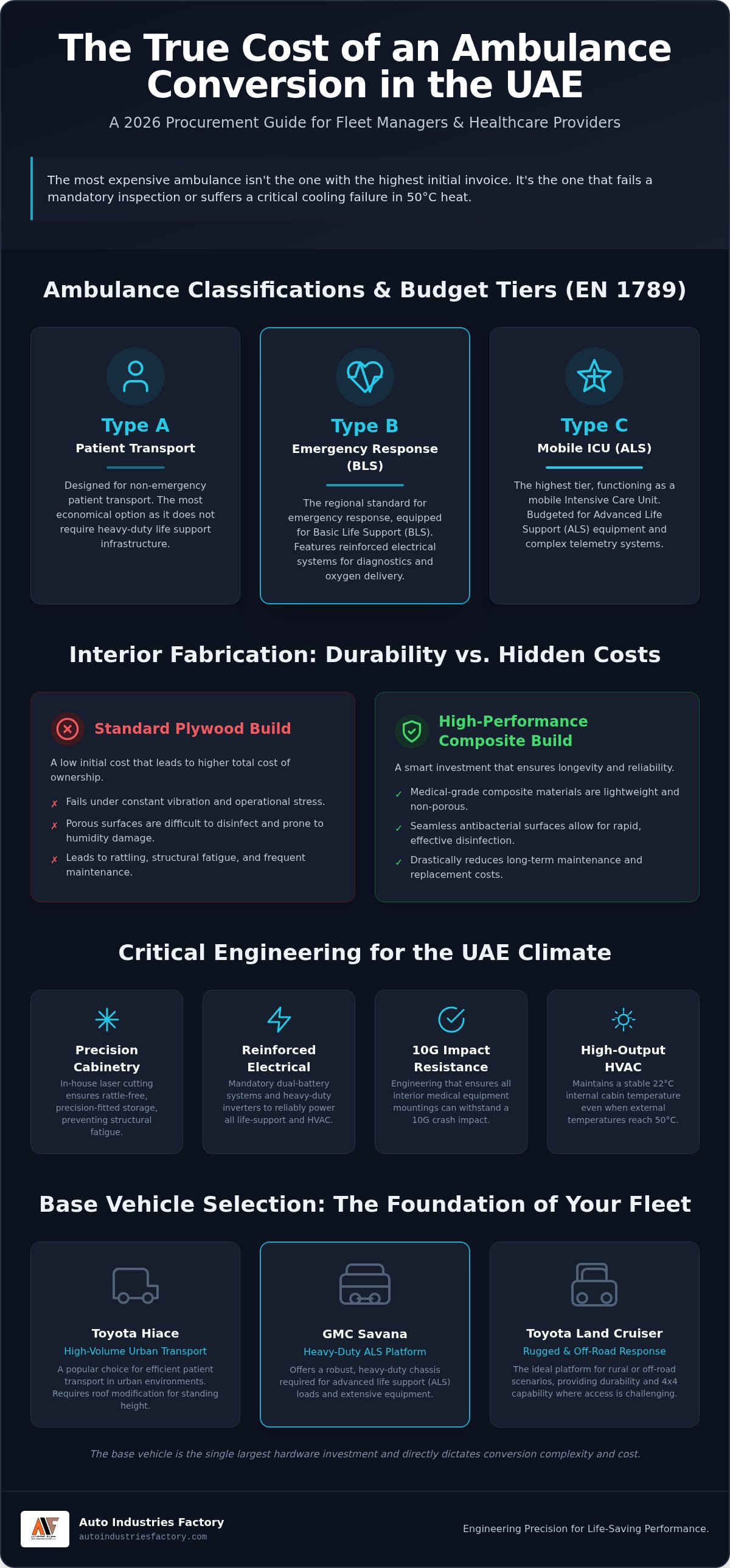
Investment levels vary based on the intended clinical application. The industry generally follows the EN 1789 standard, which categorizes ambulance types into three distinct tiers. Type A units are designed for simple patient transport. They are the most economical option because they don't require heavy-duty life support infrastructure. Type B units serve as the regional standard for emergency response. These include basic life support (BLS) setups with reinforced electrical systems to power diagnostic tools and stable oxygen delivery. Type C units are the highest tier. These function as mobile intensive care units. The budget for Type C accounts for advanced life support (ALS) equipment integration and complex telemetry systems. Each step up in classification adds technical complexity and cost.
The Impact of Internal Fabrication Materials
Internal cabin construction defines the vehicle's lifespan. Standard plywood interiors often fail under the vibration and humidity of local operations. High-performance builds utilize medical-grade composite materials. These are lightweight and entirely non-porous. Choosing superior materials impacts the overall ambulance conversion cost uae; however, it drastically lowers the total cost of ownership through reduced maintenance. Our custom fabrication processes focus on several key areas:
- Seamless Surfaces: We prioritize antibacterial wall panels that allow for rapid disinfection. This reduces turnaround time between emergency calls.
- Precision Cabinetry: Utilizing in-house laser cutting ensures that every cabinet is precision-fitted. This eliminates the rattling that leads to structural fatigue.
- Electrical Reliability: UAE climate demands a reinforced electrical backbone. Dual-battery systems and heavy-duty inverters are mandatory to support high-output HVAC units. These systems must maintain 22°C even when external temperatures hit 50°C.
Precision engineering in the fabrication stage ensures that all interior medical equipment can withstand a 10G crash impact. This level of safety is a non-negotiable part of the procurement process in the UAE market.
Base Vehicle Selection vs. Conversion Expenses
The base vehicle represents the single largest hardware investment in any fleet expansion. Choosing between a Toyota Hiace, GMC Savana, or a Toyota Land Cruiser sets the foundation for both maneuverability and medical capability. In the UAE market, the Toyota Hiace remains a high-volume favorite for urban transport, while the GMC Savana offers the heavy-duty chassis required for advanced life support (ALS) loads. Your choice here directly dictates the ambulance conversion cost uae, as each platform requires unique structural modifications to accommodate medical racks and heavy oxygen cylinders.
Van-Based Conversions on Toyota and GMC Platforms
Standard roof vans are rarely sufficient for emergency response because they don't provide enough vertical space for paramedics to perform life-saving procedures. Most 2026 standards require a minimum internal height to allow medical staff to stand upright. Upgrading to a high-roof model or performing an extended roof modification on a GMC or Toyota platform involves significant engineering labor. We utilize in-house laser cutting and CNC machining to create structural reinforcements that don't compromise the vehicle's center of gravity. You can explore Our specialized vehicle conversion services to see how we handle these complex structural upgrades on various chassis platforms.
Box-Type Ambulance Fabrication Costs
Box-type ambulances offer the maximum possible volume but involve higher upfront fabrication expenses. These units require engineering a precision interface between the cab and a separate, custom-built medical box. We fabricate these boxes using insulated sandwich panels designed specifically to withstand the UAE's 50°C summer peaks. Every joint is precision-welded to prevent the vibration-related failures common in cheaper, imported units. Adhering to Regulatory Compliance and Technical Standards ensures these custom builds meet the strict safety criteria required for national registration. While the box-type configuration is more complex, it often allows for a more efficient medical layout than a standard van body.
Payload capacity is a critical factor in long-term durability. Overloading a standard van chassis leads to premature suspension failure and increased fuel consumption. A box-type conversion on a heavy-duty chassis might have a higher initial ambulance conversion cost uae, but its ruggedness often results in a lower total cost of ownership over a five-year service life. Evaluating these technical trade-offs with a specialized fabrication partner ensures your fleet remains compliant and cost-effective through every mission.
Regulatory Compliance and Technical Standards
Compliance in the UAE market isn't a mere administrative hurdle. It's a rigorous engineering mandate. Every vehicle must meet the strict safety and technical guidelines set by the Federal Authority for Ambulance and Civil Defence, which became effective on January 1, 2026. These regulations ensure that ambulances function as safe, mobile clinical environments under extreme conditions. Navigating these requirements is a significant factor in the ambulance conversion cost uae, as it demands specialized certification and high-precision fabrication that standard workshops can't provide.
EN 1789 Standards and Fabrication Precision
The European standard EN 1789 governs the structural integrity of the medical cabin. Its most demanding requirement is the "Sledge Test," which mandates that all interior fittings, medical equipment mounts, and cabinetry must withstand a 10G crash impact. We utilize in-house CNC machining to fabricate heavy-duty brackets that secure vital equipment like oxygen cylinders and cardiac monitors. Standard mounting solutions often fail these dynamic tests, potentially turning life-saving tools into dangerous projectiles. Precision engineering also includes a detailed weight distribution analysis. Maintaining a balanced center of gravity is essential for vehicle stability during high-speed emergency maneuvers and ensures optimal braking safety under full load.
Adhering to these safety benchmarks requires a deep understanding of vehicle dynamics. The GCC Standardization Organization provides the technical framework for vehicle modifications across the region, ensuring that every converted unit maintains its structural integrity. Documentation and certification fees for specialized vehicle registration are also part of the procurement budget. These fees cover the official inspections required by the Ministry of Health and local health authorities to verify that the vehicle meets all clinical and safety standards before it enters service.
Electrical and Climate Control Requirements
The UAE climate presents unique challenges for medical electronics and patient comfort. To remain compliant, an ambulance must maintain an internal temperature of 22-24°C even when external temperatures exceed 50°C. This level of climate control necessitates heavy-duty HVAC systems, reinforced cooling loops, and specialized insulation. Standard vehicle alternators aren't enough; we install high-output alternators and auxiliary battery systems to support the constant electrical draw. Redundant wiring harnesses, protected by heat-resistant conduits, ensure that life-critical systems never lose power. Digital control panels allow paramedics to monitor medical gas levels and battery status in real-time, providing the data needed for mission-critical decisions. These robust electrical upgrades are essential for the reliability and safety of any professional ambulance fleet.
Total Cost of Ownership: Durability and Maintenance
High-stakes environments demand more than a low entry price. The true ambulance conversion cost uae reveals itself over a full operational cycle. A unit that sits in the workshop for vibration-related repairs is a liability, not an asset. Professional fleet managers prioritize builds that utilize in-house laser cutting and CNC machining because these technologies ensure every bracket and mount fits with precision. This level of craftsmanship eliminates the mechanical stress that leads to structural failure in harsh desert conditions. By focusing on ruggedness during the fabrication stage, you minimize the long-term expenses associated with component fatigue and electrical shorts.
The Value of Precision Fabrication
Precision isn't a luxury; it's a maintenance strategy. Standardized parts allow for rapid replacement, significantly reducing vehicle downtime. Unlike manual welding, which can vary in quality, laser-cut components offer consistent strength across the entire fleet. Brackets fabricated through CNC processes withstand the constant 10G forces mentioned in previous sections far longer than traditional alternatives. This engineering approach ensures that medical racks don't rattle loose over thousands of kilometers. You can learn more about our quality fabrication process and how it extends the service life of every mission-critical vehicle.
Protection and Exterior Modifications
Fleet protection requires more than internal medical infrastructure. Exterior modifications like custom bull bars and heavy-duty rear bumpers act as the first line of defense against operational damage. In rural or off-road response scenarios, a front-mounted brush guard prevents costly radiator or engine damage from minor impacts. These components are fabricated from high-grade steel and treated for maximum corrosion resistance to withstand the UAE's high-salinity coastal air. Similarly, custom-fabricated rear steps and bumper guards protect the vehicle's bodywork during heavy stretcher use and frequent loading cycles. This proactive protection reduces the frequency of body shop visits and keeps your units in the field. For a deeper dive into these protective components, see our Custom Bull Bars and Bumpers Guide.
Resale value remains a powerful indicator of initial build quality. A well-maintained ambulance with corrosion-resistant metal fabrication and seamless interior panels retains its market value far better than units with deteriorating plywood or poorly integrated electrical systems. When you calculate the ambulance conversion cost uae, consider the residual value at the end of a seven-year lifecycle. Units built with precision engineering don't just perform better; they're more attractive to secondary buyers in the regional market. Investing in superior materials upfront secures a higher return when it's time for fleet renewal. If you're ready to build a fleet that lasts, request a technical consultation for your next conversion project.
Selecting a Conversion Partner in the UAE
Direct control over the manufacturing floor is the only way to guarantee the structural integrity required for emergency vehicles. When a factory manages laser cutting, CNC machining, and specialized welding under one roof, they eliminate the markups associated with outsourced components. This setup also significantly improves delivery speed. If a custom bracket needs adjustment to fit a specific GMC or Toyota chassis, an in-house team handles it in hours, not weeks. This level of vertical integration is what allows for the specialized durability needed in our harsh climate. For a deeper look at the technical standards involved, read The Complete Guide to Ambulance Conversion.
Local UAE-based manufacturing provides a critical advantage for after-sales support. Emergency fleets can't afford long periods of downtime while waiting for international parts or remote technical advice. Auto Industries Factory LLC understands regional road conditions and the specific wear patterns caused by extreme heat. This proximity ensures that if your fleet requires a rapid modification or a structural repair, the original engineers are available to perform the work. Whether you're commissioning a specialized safari ambulance for remote desert response or a high-volume mobile clinic, local expertise ensures the build remains compliant with national standards throughout its lifecycle.
Requesting a Comprehensive Conversion Quote
Transparency in quoting is the hallmark of a professional fabricator. An accurate estimate for the ambulance conversion cost uae should be based on a detailed technical brief rather than a generic price list. When requesting a quote for your 2026 procurement cycle, ensure you provide the following data points:
- Base Vehicle Chassis: Specify the exact model and roof height (e.g., Toyota Hiace High Roof).
- Clinical Classification: Define if the unit is Type A, B, or C.
- Climate Control Needs: Detail the required HVAC output for patient compartment stability.
- Custom Accessories: Include requirements for bull bars, rear bumpers, or specialized roof racks.
Professional builds in 2026 follow a structured timeline involving design approval, structural fabrication, and final equipment integration. Most custom medical vehicle projects require a lead time that accounts for rigorous safety testing and documentation. To secure a build that meets your specific mission requirements and budget, Contact Auto Industries Factory LLC for a specialized quote. Our team of expert engineers is ready to transform your chassis into a high-performance, life-saving asset.
Secure Your Fleet's Operational Future
Procurement for emergency services in 2026 demands a shift from looking at upfront expenses to evaluating total lifecycle performance. You've seen how structural integrity and compliance with the Federal Authority for Ambulance and Civil Defence are the true drivers of ambulance conversion cost uae. Choosing a partner with complete in-house fabrication capabilities ensures that every laser-cut bracket and CNC-machined mount meets the 10G force safety standards required for national registration. We specialize in GMC and Toyota platforms, providing custom engineering solutions that withstand the UAE's extreme thermal and operational rigors.
By eliminating middle-man markups and focusing on rugged, corrosion-resistant metalwork, you protect both your patients and your capital investment. It's time to transition from standard modifications to precision-engineered medical vehicles that deliver reliability on every mission. Our factory is ready to support your expansion with direct manufacturing and specialized welding expertise. We look forward to engineering your next high-performance fleet solution.
Request an Ambulance Conversion Quote
Frequently Asked Questions
What is the average cost range for an ambulance conversion in the UAE?
Industry benchmarks for Basic Life Support (BLS) ambulances typically range from AED 300,000 to AED 500,000, while Advanced Life Support (ALS) units can reach up to AED 1,000,000. These figures reflect the market for new, fully equipped vehicles in 2026. The specific ambulance conversion cost uae depends on the chosen chassis and the level of medical technology integrated into the cabin. Professional fabrication using CNC machining ensures these investments meet all regional safety standards.
Does the conversion cost include the base vehicle?
Conversion quotes usually cover the interior modification and medical fit-out only, unless the client requests a turnkey procurement package. Most healthcare providers supply their own Toyota Hiace or GMC Savana chassis for our engineering team to modify. If a full solution is required, the total investment must combine the base vehicle purchase price with the specialized fabrication labor. This separation of costs allows for greater transparency when evaluating the quality of the structural engineering.
How long does a professional ambulance conversion take to complete?
A high-quality ambulance conversion typically requires several weeks to move from design approval to final certification. Type A transport units generally have shorter lead times than Type C mobile intensive care units due to their lower technical complexity. In 2026, timelines also account for mandatory inspections by the Federal Authority for Ambulance and Civil Defence. Managing all fabrication in-house allows for better control over these schedules by eliminating the delays associated with outsourced components.
Are there different costs for Type A, B, and C ambulance builds?
Investment levels scale significantly according to the clinical classification of the unit. Type A ambulances for simple transport require basic interior finishes and oxygen mounts. Type B emergency units demand more robust electrical systems and basic life support infrastructure. Type C units represent the highest tier, requiring advanced telemetry systems and reinforced mounts for intensive care equipment. Each step up in classification introduces new engineering requirements that directly influence the total procurement budget.
Can I convert a used van into an ambulance in the UAE?
Converting a used van is possible but often difficult due to strict 2026 regulatory standards. Most UAE health authorities require the chassis to meet specific safety benchmarks that older vehicles may no longer satisfy. Structural reinforcements for EN 1789 compliance are most effective when integrated into newer frames that are free from metal fatigue. You should verify that any pre-owned vehicle can pass the mandatory 10G crash-test certifications before committing to a conversion project.
What medical equipment is typically included in a standard conversion quote?
How do UAE climate conditions affect the cost of ambulance fabrication?
Extreme regional heat is a major cost driver, necessitating heavy-duty HVAC systems and reinforced cooling loops. To remain compliant, an ambulance must maintain an internal temperature of 22-24°C even when external temperatures exceed 50°C. This requires high-output alternators, auxiliary batteries, and specialized insulation panels. While these upgrades increase the initial investment, they prevent the cooling failures and equipment malfunctions that are common in vehicles not engineered for the harsh Arabian Peninsula climate.
Is it cheaper to buy a pre-built ambulance or a custom conversion?
Custom conversions often provide superior long-term ROI because they are engineered for specific UAE operational requirements. While pre-built units might appear cheaper initially, they frequently lack the specialized metal fabrication and electrical redundancy needed for local durability. A custom build allows you to select rugged platforms like the GMC Savana or Toyota Land Cruiser. This ensures the vehicle's payload and structural integrity are perfectly matched to your clinical mission, reducing long-term maintenance expenses.


