

A single loose bolt or a porous surface that traps pathogens can turn a life-saving vehicle into a liability during a high-speed emergency response. You understand that in the patient compartment, every millimetre of space and every kilogram of weight directly impacts vehicle performance and patient care. Achieving excellence in ambulance interior design and fabrication requires more than standard modification; it demands precision engineering and a no-nonsense approach to international safety protocols. Poorly mounted equipment and non-compliant materials aren't just technical flaws, they're risks that compromise mission readiness.
This article provides the technical roadmap to mastering the engineering standards needed to build durable, high-performance units. We'll examine the transition to the NFPA 1900 (2024 edition) standards, the critical role of SAE J3027 for patient restraint, and how advanced metal fabrication techniques eliminate hygiene risks and mounting failures. From weight distribution to EN 1789 compliance, you'll learn how to transform a standard chassis into a rugged medical environment. We'll explore the integration of modular designs and advanced materials that ensure your fleet remains compliant and operational in the most demanding climates.
Key Takeaways
- Learn how international safety standards like EN 1789 and NFPA 1900 dictate the structural integrity and layout requirements for mission-ready medical units.
- Discover how precision ambulance interior design and fabrication utilises CNC machining and high-grade materials to eliminate hygiene risks and prevent equipment mounting failure.
- Master ergonomic layout strategies, such as the "Reach Zone," to ensure paramedics can access life-saving equipment while remaining safely seated and restrained.
- Understand the engineering requirements for heavy-duty electrical looms and high-output HVAC systems designed to sustain performance in extreme operational climates.
- Identify critical criteria for selecting a fabrication partner, focusing on the technical advantages of in-house manufacturing over simple outsourced assembly.
The Fundamentals of Ambulance Interior Design and Fabrication
Professional ambulance fabrication is a complex structural engineering process. It's far removed from basic vehicle customisation. Every cabinet, bracket, and floor panel must function as a cohesive system under extreme stress. High-stakes emergency response demands Ambulance Design Fundamentals that prioritise durability over aesthetics. While "off-the-shelf" interior kits might look sufficient in a showroom, they frequently fail in the field. These pre-fabricated units often lack the reinforced mounting points required to survive years of high-speed manoeuvres and constant vibration.
True ambulance interior design and fabrication focuses on the synergy between the vehicle chassis and the medical compartment. This ensures that the added weight of medical equipment doesn't compromise the vehicle's centre of gravity or braking performance. A well-engineered layout allows paramedics to perform life-saving interventions without unbuckling their restraints; this directly impacts both provider safety and patient outcomes.
Core Objectives of Medical Space Engineering
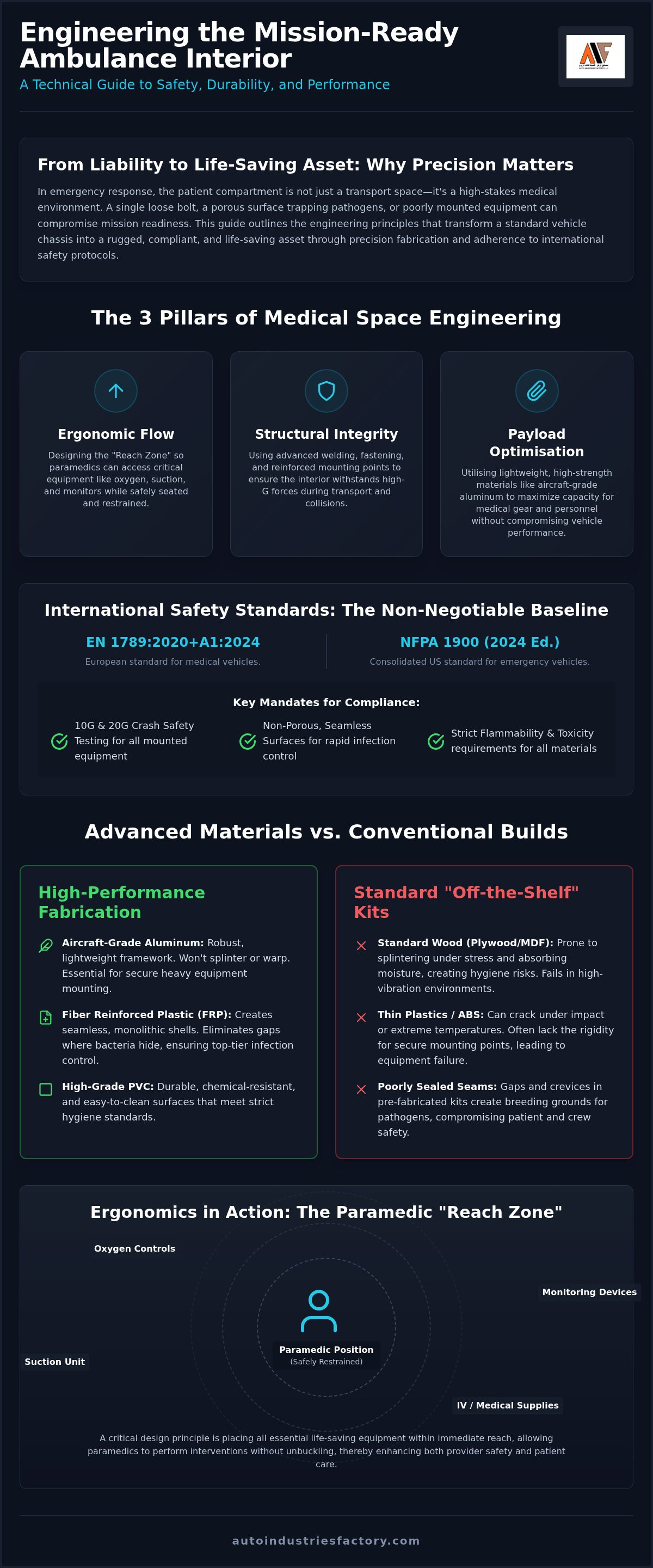
The primary goal of medical space engineering is to create a seamless workflow. We focus on three critical pillars:
- Ergonomic Flow: Designing the "Reach Zone" so that oxygen, suction, and monitoring equipment are accessible from a seated position.
- Structural Integrity: Using advanced welding and fastening techniques to ensure the interior remains intact during high-speed transport.
- Payload Optimisation: Utilising lightweight, high-strength materials like aluminium to maximise the available weight for medical devices and personnel.
Safety Standards and Regulatory Compliance
Compliance isn't optional. It's the baseline for mission-readiness. Modern fabrication must adhere to rigorous international standards, including the latest EN 1789:2020+A1:2024 specifications and the consolidated NFPA 1900 (2024 edition). These standards mandate strict 10G and 20G crash safety testing to ensure that every piece of mounted equipment stays secured during a collision. Beyond structural strength, materials must meet specific flammability and toxicity requirements. Surfaces must be non-porous and seamless to facilitate rapid infection control. Professional ambulance conversions integrate these safety requirements into the initial CAD phase, ensuring that the final build is both compliant and durable.
Advanced Materials and Fabrication Technologies
The choice of materials in ambulance interior design and fabrication determines the vehicle's long-term operational viability. While basic converters might rely on standard wood or thin plastics, high-performance units utilise a strategic blend of aircraft-grade aluminium, Fiber Reinforced Plastic (FRP), and high-grade PVC. Aluminium provides a robust, lightweight framework that doesn't splinter or warp under constant stress. It's the industrial standard for heavy-duty mounting points where medical equipment must remain secure during high-G manoeuvres. In contrast, FRP is used to create seamless, monolithic shells that eliminate gaps where bacteria can hide, ensuring the highest levels of infection control.
Metalwork vs. Composite Materials
Integrating a metal internal frame is essential for securing heavy medical devices like monitors and oxygen systems. While composite materials provide excellent hygiene and thermal insulation, they often lack the shear strength required for crash-safety compliance. A hybrid approach uses aluminium extrusions for the structural "skeleton" and composite panels for the interior "skin." This combination ensures the unit remains lightweight enough to preserve the vehicle's braking and acceleration performance on platforms like the Toyota Hiace or GMC Savana. Adhering to Ambulance Safety and Design Standards requires this level of material sophistication to protect both crew and patients.
Precision Engineering Tools
Precision is not negotiable in a mission-critical environment. In-house CNC machining allows for the creation of cabinets and storage units that fit the vehicle's contours with millimetre accuracy. This eliminates the gaps and misalignments that lead to persistent rattles and structural weaknesses over time. When every component is designed using CAD/CAM software, the transition from digital model to physical part is flawless. In-house laser cutting technology minimises material waste while significantly increasing the structural precision of every reinforcement bracket and mounting plate. Advanced welding and bonding techniques then fuse these components into a single, rattle-free assembly that can withstand the rigours of continuous emergency service.
Building a fleet with repeatable quality requires a partner who controls the entire manufacturing process from the first cut. If you need a solution that balances durability with precision engineering, explore our specialised vehicle conversion services to see how we apply these technologies.
Ergonomics and Layout Optimization for Medical Missions
Efficient ambulance interior design and fabrication is measured by the seconds saved during a medical crisis. The layout must be engineered around the 'Reach Zone,' a technical specification that ensures paramedics can access life-saving equipment without unbuckling their safety restraints. In a high-speed transit environment, maintaining a seated and restrained position is critical for crew survival. We strategically position oxygen ports, suction units, and cardiac monitors within a 180-degree arc of the primary attendant seat. This patient-centric philosophy also integrates advanced acoustic insulation and vibration dampening to reduce noise levels, which lowers patient anxiety and improves provider communication.
The Paramedic Workspace
The 'Action Area' is the focal point of the medical compartment, specifically the space surrounding the patient's head and upper torso. This zone requires precision engineering to house mobile ventilators and monitoring arrays. Our fabrication process focuses on several key ergonomic features:
- Integrated Countertops: Fabricated with marine-grade edges to contain spills and prevent equipment from sliding during transit.
- Dynamic Seating: Ergonomic attendant seats with multi-point harnesses that offer mobility without sacrificing impact protection, reflecting the high ergonomic standards also seen in specialized medical furniture from Selim Aksesuar.
- Shadowless Lighting: High-intensity LED arrays positioned to eliminate shadows during delicate procedures like intubation or IV placement.
Every surface is designed for rapid disinfection. We use seamless transitions between the walls and the floor to prevent the accumulation of bio-hazardous material, ensuring the unit remains hygienic after every mission.
Storage and Equipment Integration
Mission-readiness depends on the ability to locate and deploy trauma kits instantly. We engineer custom storage solutions that go beyond basic shelving. This includes lockable, tamper-evident cabinets for narcotics and sensitive pharmaceuticals, as well as reinforced compartments for heavy oxygen cylinders. Modular shelving systems allow for fleet-wide flexibility, enabling operators to reconfigure the interior as medical technology or mission requirements change. By using CNC-machined components, we ensure that every cabinet fits perfectly within the vehicle's structural frame. For agencies needing bespoke configurations, our services provide the technical expertise to turn complex layout requirements into a rugged, operational reality.
Electrical Systems and Climate Control Integration
The electrical infrastructure is the nervous system of any high-performance medical unit. It's not enough to simply pull wires; professional ambulance interior design and fabrication requires a power architecture that supports cardiac monitors, ventilators, and telemetry systems simultaneously without voltage drops. We integrate these systems during the early shell assembly to ensure every loom is protected and every circuit is redundant. Reliability in the field depends on an electrical layout that is as rugged as the vehicle's chassis. If the power fails, the mission fails, which is why we prioritise industrial-grade components and interference-free routing.
Mission-Critical Electrical Infrastructure
Modern ambulances are mobile data hubs. We fabricate dedicated conduits that separate high-voltage lines from sensitive data cables to prevent electromagnetic interference. This ensures that communication remains crystal clear when it matters most. Our builds feature several key electrical advancements:
- Heavy-Duty Looms: We use colour-coded, marine-grade wiring looms engineered to withstand constant vibration and high-current demands.
- Smart Control Panels: Centralised interfaces allow the crew to manage interior lighting, sirens, and oxygen flow with a single touch.
- Telemetry Integration: Built-in systems facilitate the real-time transmission of patient vitals to receiving hospitals, improving the continuity of care.
By using ventilated housings for inverters and power modules, we prevent thermal shutdown during prolonged operations in high-ambient temperatures.
Advanced Climate Control Fabrication
Maintaining a stable cabin temperature is a strict medical requirement for pharmaceutical storage and patient stability. We utilise high-density thermal insulation within the wall cavities to create a definitive thermal break between the exterior metal skin and the interior compartment. Our team uses CAD software to design custom ductwork that ensures even airflow distribution, eliminating "hot spots" that can compromise medical electronics. High-capacity cooling is an absolute necessity for national fleet operations where ambient temperatures consistently challenge the operational limits of standard automotive systems.
Redundancy is built into every layer, from deep-cycle battery banks to high-efficiency inverters that provide clean AC power when the engine is off. Shore-power connections allow the unit to remain mission-ready while at the base, keeping equipment charged and the cabin pre-cooled. If your fleet requires a robust electrical infrastructure that won't fail under pressure, contact us for a technical consultation on your next custom build.
Selecting a Specialist for Ambulance Interior Fabrication
A proven portfolio isn't just a gallery of photos; it's evidence of engineering precision across diverse vehicle platforms. Look for a partner with a track record of successful conversions on high-performance platforms like the Toyota Hiace and GMC Savana. This experience ensures they understand the specific structural and electrical nuances of each vehicle, preventing common issues like weight distribution imbalances or electrical system overloads.
Centrally managed design and manufacturing significantly reduce lead times by eliminating third-party delays. When the engineering team works in the same facility as the laser cutters and CNC machines, technical challenges are solved in real-time. This level of integration ensures consistency across large fleets, where every unit must be identical for paramedic familiarity and maintenance efficiency. To understand more about our technical approach and the machinery we use to achieve this precision, you can learn more about us and our fabrication expertise.
Final Conversion and Quality Assurance
The final conversion stage involves a multi-stage inspection process that goes far beyond a visual check. Every medical unit undergoes rigorous testing to ensure mission-readiness. This includes:
- Electrical Load Testing: Running all medical and vehicle systems simultaneously to verify power stability.
- Structural Validation: Inspecting all laser-cut brackets and mounting points for torque and alignment.
- Climate Control Verification: Stress-testing HVAC systems in high-ambient temperatures to ensure pharmaceutical-grade stability.
Post-delivery support is equally critical. A specialist should provide comprehensive fleet maintenance considerations to keep your units operational for years. For a broader look at fleet management and technical specifications, see our sibling article on Ambulance Conversion. Choosing a partner who prioritises industrial-grade quality control over rapid assembly ensures your fleet remains a rugged, dependable asset in the field.
Engineering Your Mission-Ready Medical Fleet
Precision in ambulance interior design and fabrication isn't a luxury; it's the foundation of every successful emergency response. You've seen how integrating advanced materials with in-house CNC and laser cutting technology creates a compartment that is both hygienic and structurally resilient. By prioritising EN 1789 compliant engineering, you ensure that your fleet meets the highest international safety standards, protecting your crew and patients during high-G impacts. From ergonomic "Reach Zone" layouts to heavy-duty electrical systems designed for extreme climates, every detail contributes to a vehicle that performs under pressure.
Building a high-performance medical unit requires a partner who understands the high stakes of your industry. Our status as specialists in high-performance vehicle conversions on platforms like GMC and Toyota means your fleet is engineered for maximum operational longevity. Don't settle for basic conversions when you can have a purpose-built solution that is mission-ready from day one. Request a technical consultation for your custom ambulance fleet today and let's discuss your next build. Your team deserves the reliability that only precision engineering can provide.
Frequently Asked Questions
What is the best material for ambulance interior fabrication?
Aircraft-grade aluminium and Fiber Reinforced Plastic (FRP) are the industry standards for ambulance interior design and fabrication. Aluminium provides the necessary structural strength for mounting heavy medical equipment, while FRP offers a seamless, non-porous surface for superior infection control. We also utilise high-grade PVC for cabinetry to ensure long-term durability and hygiene. These materials are chosen specifically to balance vehicle weight management with the ruggedness required for high-stakes emergency response.
How long does the ambulance interior design and fabrication process take?
The timeline for professional ambulance interior design and fabrication typically depends on the specific complexity of your custom requirements and fleet size. While basic conversions might move faster, a bespoke build involving in-house laser cutting and CNC machining ensures engineering precision. Most technical builds require several weeks to move from the initial CAD design phase through to final quality assurance and rigorous medical system testing.
Are custom ambulance interiors compliant with EN 1789 standards?
Yes, professional custom interiors are engineered to meet or exceed EN 1789:2020+A1:2024 standards for medical vehicles. Compliance involves rigorous testing of the patient compartment, including 10G and 20G crash safety verification for all mounted equipment and seating. Our fabrication process integrates these safety protocols from the design phase, ensuring that every bracket and storage unit remains secure during high-speed manoeuvres or a potential impact.
Can existing vans be retrofitted with new medical interiors?
Existing high-performance platforms like the Toyota Hiace or GMC can be retrofitted if the vehicle's chassis remains structurally sound. The process involves stripping the original interior and installing reinforced mounting points for new medical cabinetry and heavy-duty electrical looms. It's a practical solution for fleet managers who want to upgrade their medical technology and interior ergonomics without the capital expense of purchasing a completely new vehicle chassis.
What are the weight considerations for ambulance interior design?
Weight management is a critical engineering constraint that directly affects vehicle braking, acceleration, and overall fuel efficiency. We utilise lightweight aluminium fabrication to minimise the interior's mass, leaving more payload capacity for essential life-saving equipment and personnel. Every component is calculated to ensure the vehicle's centre of gravity remains stable. This prevents dangerous handling characteristics and ensures the vehicle remains responsive during high-speed emergency driving conditions.
How do you ensure medical equipment remains secure during transport?
Security is achieved through precision-engineered mounting systems and reinforced internal framing. We use in-house laser cutting to fabricate custom brackets that lock monitors, ventilators, and oxygen cylinders directly into the vehicle's structural skeleton. These mounts are tested to survive extreme G-forces, ensuring that life-saving devices don't become dangerous projectiles during a collision or a rapid evasive manoeuvre. This approach maintains a safe environment for both patients and paramedics.
What climate control features are essential for ambulances in hot climates?
High-ambient temperatures require high-output HVAC systems and superior thermal insulation. Essential features include custom-fabricated ductwork for even airflow and a definitive thermal break in the wall cavities to block exterior heat. We also integrate redundant cooling systems and high-efficiency inverters to maintain pharmaceutical-grade temperatures. This ensures that sensitive medical electronics and medications remain stable even when the vehicle is stationary or operating under a heavy electrical load.
Why is in-house fabrication better than using pre-made kits?
In-house fabrication offers superior structural integrity and bespoke layout flexibility that pre-made kits simply cannot match. By using CNC machining and laser cutting on-site, we create components that fit the specific contours of the vehicle perfectly. This eliminates the gaps and loose fittings common with generic kits. The result is a rattle-free environment that is significantly more durable and easier to maintain over years of continuous emergency service.


