

Selecting an emergency vehicle based on price alone is a high-stakes gamble with your crew's operational safety. In the world of specialized conversions, the structural integrity of your fleet is the foundation of every life-saving intervention. You likely understand the frustration of trying to fit advanced medical gear into a chassis that lacks the necessary payload capacity or struggling with a vehicle that is too bulky for tight urban environments. Matching the right platform, whether it's a box-type ambulance or a van-based unit, is a critical engineering requirement. Technical knowledge of ambulance types 1, 2, and 3 ensures that your equipment fits perfectly and your vehicle remains stable under extreme conditions.
This guide clarifies the technical distinctions between ambulance types 1, 2, and 3 to help you build a high-performance fleet. You'll gain a clear decision-making framework for procurement and a deep understanding of how chassis-to-module integration impacts long-term durability. We'll analyze everything from the heavy-duty truck platforms of Type 1 units to the streamlined efficiency of Type 2 vans and the versatile cutaway designs of Type 3 models. This analysis provides the technical insight needed to select a conversion partner capable of delivering a rugged, mission-ready solution that performs under pressure.
Key Takeaways
- Learn to distinguish between the vehicle chassis and the patient module to understand the fundamental architecture of modern emergency response units.
- Master the technical specifications of ambulance types 1, 2, and 3 to ensure your fleet is optimized for payload capacity and medical efficiency.
- Compare the maneuverability of Type 2 van-based conversions with the heavy-duty structural reinforcement of Type 1 box-type ambulances.
- Understand how advanced fabrication techniques like CNC machining and laser cutting provide the precision required for complex medical and electrical system integration.
- Evaluate the operational benefits of walk-through access in Type 3 hybrids for improved crew communication and patient care during transit.
Decoding Ambulance Classifications: Why Type Matters
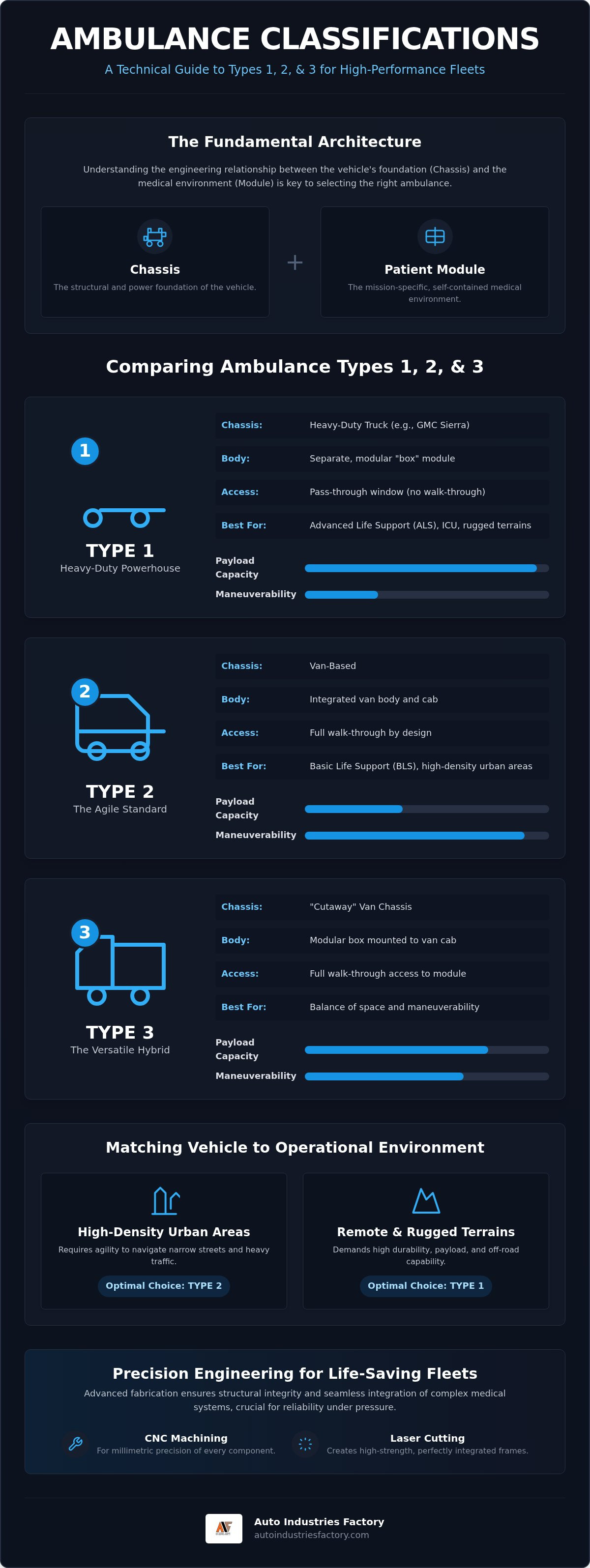
The three-type system provides a standardized framework for emergency vehicle architecture. It isn't just about size; it's about the fundamental engineering relationship between the chassis and the patient module. In professional conversions, the chassis acts as the power and structural foundation, while the module serves as the mission-specific medical environment. This distinction is vital because it directly impacts payload capacity, equipment storage, and the ergonomics of patient care. Understanding ambulance types 1, 2, and 3 allows procurement officers to match vehicle capabilities with specific medical demands.
Using standardized Ambulance Classifications allows fleet managers to select the precise tool for their specific operational needs. International standards like EN 1789 define the crash-test requirements and equipment mounting protocols that keep crews safe. Without these classifications, the industry would lack the consistency needed for high-stakes medical transport and structural reliability.
Operational Criteria for Selecting an Ambulance Type
Operational environments dictate the ideal vehicle configuration. High-density urban areas require the agility of Type 2 van-based units to navigate narrow streets and heavy traffic. Conversely, remote or rugged terrains demand the off-road capability of Type 1 truck-based platforms. The medical mission profile also plays a role. A Basic Life Support (BLS) unit may prioritize maneuverability, while an Advanced Life Support (ALS) or mobile ICU requires the expanded interior volume of a box-type ambulance to accommodate complex monitoring and life-support systems.
The Engineering Perspective: Chassis-to-Body Integration
Structural reinforcement is non-negotiable in specialized vehicle conversions. When a modular box is mounted to a chassis, the center of gravity shifts. Engineers must account for weight distribution to maintain vehicle stability during high-speed maneuvers. At Auto Industries Factory, our conversion services utilize in-house fabrication, including CNC machining and laser cutting, to ensure millimetric precision. This seamless integration allows for the installation of heavy medical gear without compromising the vehicle's structural integrity. Every weld and bracket is engineered to survive the rigors of emergency response across all ambulance types 1, 2, and 3, ensuring the finished unit is both a reliable transport and a high-performance medical facility.
Type 1 Ambulances: Heavy-Duty Modular Powerhouses
Type 1 units represent the peak of structural durability in emergency fleets. These vehicles utilize a heavy-duty truck chassis, such as a GMC Sierra or specialized Toyota platform, paired with a separate modular "box" body. This architecture provides the highest payload capacity of all ambulance types 1, 2, and 3, making it the primary choice for Advanced Life Support (ALS) and intensive care missions. Unlike integrated van designs, the separate module allows for independent structural reinforcement and easier remounting on new chassis in the future. This modularity ensures that the high-value medical compartment can outlast the mechanical lifespan of the underlying truck.
A defining feature of this classification is the pass-through window. This small portal facilitates essential communication between the driver and the medical crew without requiring a full walk-through cabin. This design choice prioritizes the structural integrity of the truck cab while maintaining a vital link for mission coordination. Organizations like the Ambulance Manufacturers Division emphasize that these configurations must meet rigorous safety standards to protect both patients and personnel during high-speed response. The isolation of the cab also helps in reducing noise and vibration within the patient area, creating a more stable environment for critical procedures.
Design and Fabrication of Type 1 Box Modules
Engineering a Type 1 box-type ambulance requires millimetric precision and a deep understanding of industrial metalwork. We utilize advanced in-house fabrication, including laser cutting and CNC machining, to create high-strength aluminum or steel frames. These frames are then structurally reinforced to provide superior impact protection during a collision. This level of customization allows for complex internal layouts tailored to specific medical gear, oxygen delivery systems, and communication arrays. Our process covers the complete solution, moving from initial 3D design to precision assembly and final specialized painting to ensure long-lasting performance in the field.
Typical Use Cases for Type 1 Units
Type 1 units excel in environments where durability is non-negotiable. They are frequently deployed for long-distance patient transfers that require heavy life-support equipment and multiple medical attendants. Their truck-based frames provide the necessary torque and suspension for rugged terrain or off-road response where standard vans might fail. Fire-rescue departments often favor these units for their ability to carry both medical supplies and heavy rescue tools simultaneously. If you are managing a fleet that operates in demanding conditions, exploring our specialized conversion solutions can help you build a more resilient response team.
Type 2 Ambulances: The Agile Van-Based Standard
Type 2 units utilize a standard van chassis with an integrated medical interior, representing the most streamlined configuration in the industry. Unlike the modular designs discussed previously, these vehicles maintain the original van’s factory body, which is then converted into a functional clinical environment. This integrated approach offers superior aerodynamics and fuel efficiency compared to other ambulance types 1, 2, and 3. These characteristics make Type 2 units the preferred choice for rapid response in high-density urban traffic where agility and speed are paramount. At Auto Industries Factory, we specialize in the extended roof ambulance conversion, often using the Toyota Hiace platform to provide the necessary vertical clearance for medical personnel.
The primary engineering challenge of a Type 2 conversion is balancing the compact exterior with a high-functioning interior. Because the medical crew works within the existing van shell, every modification must be precise. We use advanced fabrication techniques to ensure that the interior remains sterile, durable, and lightweight. This keeps the vehicle’s center of gravity low and maintains factory-standard handling, which is a critical safety factor during high-speed emergency maneuvers.
Maximizing Space in Van-Based Conversions
Optimizing the interior of a van requires a master craftsman’s eye for detail. We utilize in-house CNC machining and laser cutting to create custom medical cabinetry and oxygen delivery systems that follow the vehicle’s specific contours. Strategic placement of these systems ensures that paramedics can access life-saving gear without obstructing the patient area. We also incorporate ergonomic seating that allows for continuous patient monitoring while maintaining crew safety during transit. By using weight-saving fabrication materials, we protect the vehicle’s acceleration and braking performance, ensuring the unit remains responsive under pressure.
When to Choose a Type 2 Configuration
Type 2 units are ideal for Basic Life Support (BLS) and non-emergency transport missions. Their smaller footprint is a major advantage for urban fleets that need to navigate narrow streets or park in restricted hospital bays. While they lack the massive payload of Type 1 modular units, their lower operating costs and mechanical simplicity make them a cost-effective solution for high-volume metropolitan response. Choosing a Type 2 configuration is a strategic decision for agencies that prioritize rapid intervention and maneuverability within the broader framework of ambulance types 1, 2, and 3. These units provide a reliable, efficient platform for missions where the sheer size of a box-type ambulance would be a hindrance rather than a benefit.
Type 3 Ambulances: The Versatile Chassis-Cab Hybrid
Type 3 units represent a sophisticated hybrid in the emergency vehicle market. These vehicles utilize a van-style chassis-cab, typically a cutaway platform, integrated with a modular box body. This configuration offers a strategic middle ground between the heavy-duty Type 1 truck and the integrated Type 2 van. Within the technical hierarchy of ambulance types 1, 2, and 3, the Type 3 is distinguished by its walk-through design. This allows the crew to move freely between the driver’s seat and the patient compartment without exiting the vehicle, a feature that enhances both safety and operational coordination during transit.
Engineering these units requires high-level precision. At Auto Industries Factory, we utilize advanced fabrication like laser cutting and CNC machining to ensure the modular box aligns perfectly with the cutaway chassis. This level of integration across ambulance types 1, 2, and 3 requires a master craftsman’s approach to fabrication. It involves complex electrical and HVAC systems to maintain a climate-controlled environment across both cabins. Because the cabins are connected, the insulation and sealing must be robust to prevent noise, vibration, and environmental contamination from affecting the patient area.
Engineering the Walk-Through Connection
Maintaining structural integrity is the primary concern during a cutaway conversion. We implement mission-specific structural reinforcement to ensure the vehicle remains stable and safe under the stress of emergency response. Our in-house design team creates custom transition seals that provide a weather-tight and sound-dampened connection between the cab and the module. We also integrate advanced communication and control systems that bridge both areas, allowing the driver and medical team to operate as a single, synchronized unit.
Operational Benefits of Type 3 Units
Type 3 ambulances are the ideal choice for Advanced Life Support (ALS) missions in suburban and mixed-use environments. They provide a larger medical workspace and more storage for rescue tools compared to Type 2 vans, yet they remain more maneuverable than the larger Type 1 truck-based units. The internal cabin access significantly improves crew safety, as personnel don't have to step out into traffic or harsh weather to reach the patient. This configuration is a versatile solution for fleets that require a high-capacity medical environment without sacrificing the driving dynamics of a van-based platform. If you need a high-performance box-type ambulance built for complex ALS missions, contact us for a custom conversion estimate today.
The Conversion Process: Precision Engineering for Life-Saving Fleets
The transition from classifying ambulance types 1, 2, and 3 to deploying a mission-ready unit depends entirely on the precision of the conversion process. At Auto Industries Factory, we don't just assemble components; we engineer complete solutions. Every project begins with detailed in-house design and 3D modeling to map out complex medical configurations before a single piece of metal is cut. This phase is critical for ensuring that high-value equipment like ventilators and monitors fits securely within the specialized cabin. By visualizing the layout in a digital environment, we eliminate spatial conflicts that often plague standard conversions.
Our fabrication facility utilizes advanced CNC machining and laser cutting to achieve millimetric precision in every component. This level of accuracy is essential when integrating medical, electrical, and oxygen systems that must function flawlessly under pressure. We provide structural armoring and mission-specific reinforcement for vehicles operating in high-risk zones, ensuring the patient module remains a secure sanctuary. Rigorous quality control protocols then test every system for absolute reliability, from the integrity of the oxygen lines to the stability of the electrical grid. This engineering-first approach is what separates a standard vehicle from a rugged, life-saving platform.
Customizing for Mission-Specific Needs
Customization goes beyond the clinical interior. We integrate specialized medical gear tailored to the specific mission profile of the fleet, ensuring every monitor and pump has a dedicated, reinforced mounting point. Our team also handles visual branding through custom paint and high-visibility livery that meets national safety standards. To enhance the vehicle's ruggedness, we fabricate custom accessories in-house, including heavy-duty bull bars, front brush guards, and specialized roof racks. These additions provide essential protection for the vehicle’s front-end and expand storage capacity for critical rescue tools.
Why Fabrication Expertise Matters for Longevity
The durability of an ambulance is tested by both the clock and the environment. We prioritize corrosion resistance and specialized painting techniques to protect the chassis and module from extreme temperature fluctuations and harsh climates. Because modular boxes add significant weight, we implement heavy-duty suspension upgrades to maintain handling and safety across all ambulance types 1, 2, and 3. This ensures the vehicle remains responsive even when fully loaded with crew and equipment. Learn more about our specialized vehicle conversion services to see how our fabrication expertise can optimize your fleet's long-term performance and reliability.
Optimizing Your Fleet for Mission-Critical Performance
Mastering the technical differences between ambulance types 1, 2, and 3 is the first step toward building a fleet that actually performs under pressure. Whether you require the heavy-duty modular power of a Type 1 unit or the urban agility of a Type 2 van, the underlying engineering determines the vehicle’s operational lifespan. Selecting the right platform is about more than matching a medical mission. It's about ensuring your crew has a stable, reinforced environment for life-saving interventions. When lives are on the line, you don't want to compromise on structural integrity.
Auto Industries Factory provides the precision required for these complex conversions. We specialize in GMC and Toyota platforms. By utilizing expert in-house fabrication and laser cutting, we deliver mission-ready solutions for the medical, military, and police sectors. Our master craftsmen ensure every structural reinforcement and electrical system integration meets the highest standards of reliability. Request a technical consultation for your ambulance fleet conversion today to start building a more robust response capability. Your team deserves a vehicle that is as dependable as they are.
Frequently Asked Questions
What is the main difference between Type 1 and Type 3 ambulances?
The primary difference lies in the chassis architecture and cabin access. A Type 1 ambulance utilizes a heavy-duty truck chassis with a separate modular box, while a Type 3 uses a van-style cutaway chassis. Type 3 units feature a walk-through connection between the cab and patient area. In contrast, Type 1 models typically use a pass-through window, prioritizing the structural isolation of the truck cab for heavy-duty missions.
Which ambulance type is best for urban environments?
The Type 2 ambulance is the preferred choice for urban environments due to its integrated van chassis and streamlined aerodynamic profile. These units offer superior maneuverability in high-density traffic and narrow city streets where larger vehicles struggle. Their smaller footprint allows for easier parking in restricted hospital bays and faster navigation through metropolitan bottlenecks compared to the larger modular units found in other ambulance types 1, 2, and 3.
Can a Type 2 ambulance be used for Advanced Life Support (ALS)?
While Type 2 units are frequently used for Basic Life Support (BLS), they can be configured for ALS if the interior space is professionally optimized. This requires strategic placement of medical cabinetry and oxygen systems using advanced fabrication to accommodate monitoring gear. However, many agencies prefer Type 1 or Type 3 for ALS due to the increased interior volume and payload capacity required for complex life-support procedures and multiple medical attendants.
What chassis are commonly used for Type 1 ambulance conversions?
Type 1 conversions typically rely on heavy-duty truck platforms like the GMC Sierra or rugged Toyota truck frames. These chassis provide the structural integrity and torque needed to carry a separate modular patient compartment. Using these platforms allows for mission-specific structural reinforcement, ensuring the vehicle can handle the added weight of specialized medical systems or structural armoring if the unit is deployed in high-risk national zones.
Is a 'box-type' ambulance safer than a 'van-type'?
Safety depends on the engineering and fabrication quality rather than just the vehicle shape. A box-type ambulance offers a larger patient area and the ability to remount the module on a new chassis, which provides long-term structural reliability. Van-type units offer integrated factory-tested bodies but have less interior space for paramedics to maneuver. Both must meet rigorous crash-test standards to ensure the protection of the crew and the patient during transit.
How long does a professional ambulance conversion take?
Conversion timelines vary based on the complexity of the medical, electrical, and communication systems required for the mission. A complete solution involving in-house 3D design, laser cutting, and custom painting takes several weeks to ensure all quality control standards are met. Factors like chassis availability and the extent of structural reinforcement also impact the final delivery schedule for specialized response units designed for the medical and military sectors.
Are custom bull bars necessary for emergency vehicles?
Custom bull bars and front brush guards are essential for protecting the vehicle's cooling system and engine during high-speed responses or off-road missions. In rugged environments, these metal accessories prevent minor impacts from disabling the vehicle. We fabricate these components in-house using precision metal cutting to ensure they provide maximum protection without compromising the vehicle's safety sensors or aerodynamics, making them a vital addition for any emergency response fleet.
What standards govern ambulance conversions in the UAE?
Ambulance conversions across the country must adhere to national health and safety regulations, often aligning with international standards like the CAAS Ground Vehicle Standard or KKK-A-1822F. These guidelines ensure that ambulance types 1, 2, and 3 maintain specific crash-test ratings and medical equipment mounting protocols. Our fabrication process utilizes CNC machining to meet these precision requirements, ensuring mission-critical reliability for all police, military, and medical vehicle modifications.


