

A standard van conversion is often a temporary fix for a permanent emergency response challenge. While traditional vans struggle with cramped quarters and poor insulation, a custom-engineered ambulance+module is designed to outlast its chassis by decades. You've likely felt the frustration of trying to fit Advanced Life Support (ALS) equipment into a narrow interior or watching a vehicle reach its end-of-life far too soon. It's a common pain point for fleet managers across the UAE who need equipment that stands up to rigorous demands and extreme heat.
We understand that your fleet represents a massive investment that must deliver total reliability every time the siren sounds. This guide dives into the technical superiority of "Box Type" ambulances, showing you how advanced fabrication provides more workspace and better climate control. You'll discover how a well-built module can be remounted onto a new chassis to slash long-term costs while maintaining strict compliance with international safety standards. We're breaking down the engineering behind structural reinforcement and custom interiors to help you build a more resilient emergency response network.
Key Takeaways
- Understand why the increased interior width and height of a modular unit are essential for paramedic movement and Advanced Life Support (ALS) efficiency.
- Learn how a custom-fabricated ambulance+module provides superior structural integrity and impact protection compared to standard van-based conversions.
- Discover the engineering advantages of in-house laser cutting and CNC machining for creating durable, mission-ready vehicles that withstand extreme environments.
- Identify the key payload and terrain factors that determine whether a 4x4 or 4x2 chassis is the optimal choice for your fleet requirements.
- Explore how modular designs allow for strategic remounting, significantly extending the service life of your emergency response investment.
What is an Ambulance Module? Defining the Modular Unit
An ambulance+module is a self-contained, precision-engineered medical compartment designed to function as a mobile emergency room. Unlike standard van conversions where the medical space is restricted by the vehicle's original steel body, a modular unit is a separate "box" fabricated from high-strength aluminum or composite materials. This independent construction allows for a wider, taller, and more ergonomic workspace that remains consistent regardless of the underlying chassis. Understanding the various Ambulance Types and Designs is essential for fleet managers evaluating modular solutions for high-stakes environments.
In the industry, these units are typically categorized into Type I and Type III configurations. A Type I module is mounted on a truck-style chassis, such as a heavy-duty pickup, while a Type III module is attached to a cutaway van chassis. Both versions prioritize structural integrity and medical payload capacity. Because the module is a separate entity, it can be detached and remounted onto a new chassis once the original engine or drivetrain reaches its limit. This "remounting" capability is a core financial advantage, often extending the service life of the medical environment to 20 years or more.
The Anatomy of a Box Type Ambulance
The strength of a modular unit lies in its skeleton. At Auto Industries Factory LLC, we utilize in-house laser cutting and CNC machining to create a reinforced structural frame. This framing supports the external shell and provides secure mounting points for life-saving equipment. The anatomy of a high-performance module includes several critical components:
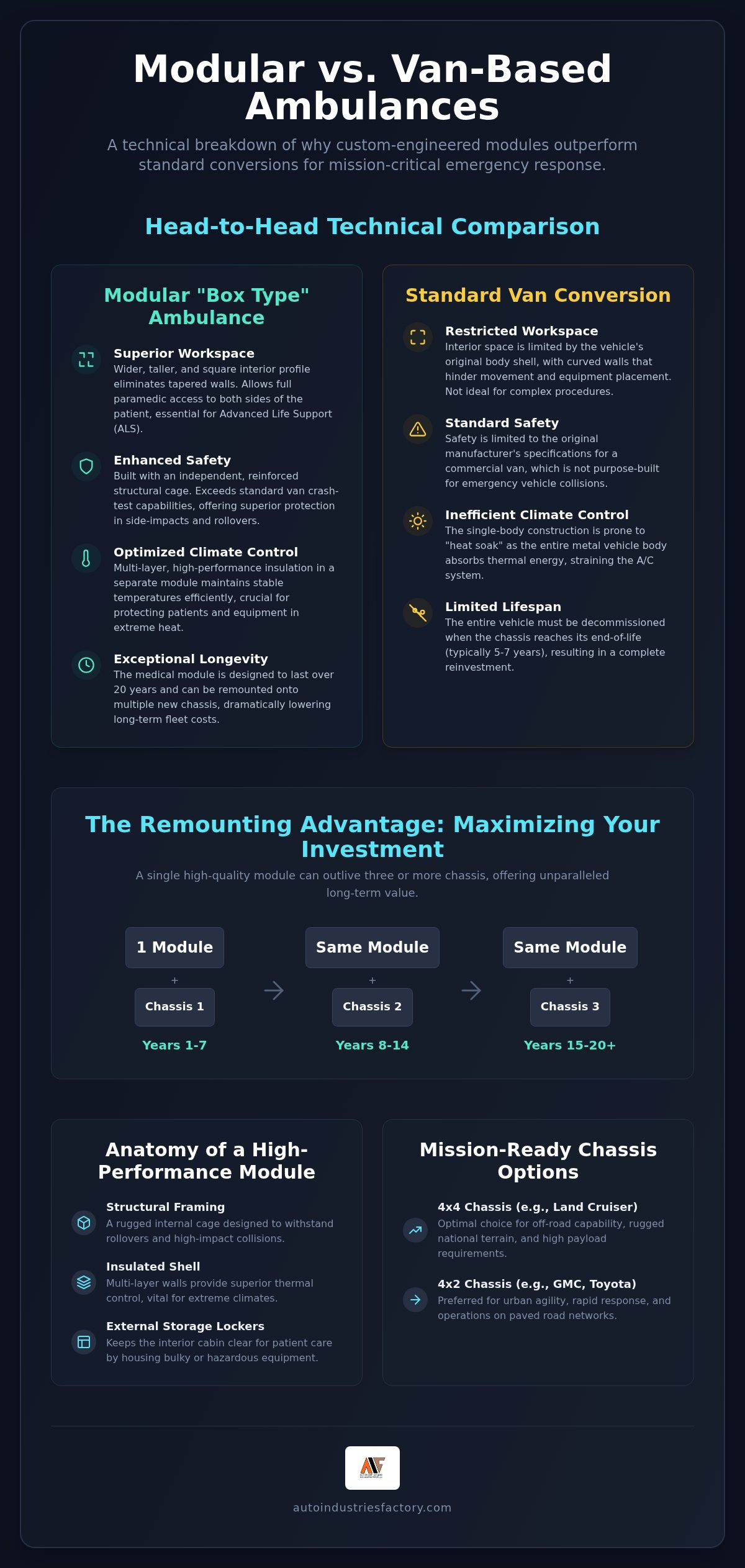
- Structural Framing: A rugged internal cage designed to withstand rollover forces and side-impact collisions.
- External Storage Lockers: Dedicated compartments for oxygen cylinders, rescue tools, and hazardous materials, keeping the interior cabin clear for patient care.
- Insulated Shell: Multi-layer walls that provide superior thermal control, which is vital for maintaining a stable environment in the extreme heat of the UAE.
Extended Roof vs. Modular Box Units
Choosing between an extended roof conversion and a full box module depends on your mission profile. Extended roof ambulances on GMC or Toyota platforms are often preferred for urban agility and rapid response. They offer more vertical room than a standard van but are still limited by the vehicle's original width.
In contrast, the square profile of an ambulance+module eliminates the curved walls found in vans. This "box" design provides significantly more cubic volume, allowing paramedics to move freely around the patient. For Advanced Life Support (ALS) missions, this extra space is non-negotiable. It provides the necessary room for complex monitoring equipment, ventilators, and multiple crew members to work simultaneously without obstruction. For rugged national terrain, mounting these modules on a 4x4 Toyota Land Cruiser chassis creates a mission-specific solution that combines off-road capability with a full-scale medical suite.
Modular vs. Van-Based Conversions: A Technical Comparison
The decision between a standard van conversion and a dedicated ambulance+module often determines the operational effectiveness of a fleet for decades. While van-based units offer lower initial costs, they provide significantly less interior volume. A modular unit features a square interior profile, eliminating the tapered walls found in standard automotive bodies. This extra width allows paramedics to work on both sides of the patient, which is a critical requirement for complex medical interventions and Advanced Life Support (ALS) procedures.
Safety is another engineering priority that favors the modular design. These units are built with an independent structural cage that exceeds the crash-test capabilities of standard van bodies. By adhering to Ambulance Manufacturers Division standards, these modules provide superior protection during side-impact collisions. The separate construction also allows for high-performance insulation. In the extreme temperatures of the UAE, a separate module maintains climate control far more efficiently than a converted van body, protecting both patients and sensitive medical equipment from heat soak.
The Remounting Advantage
One of the strongest arguments for the ambulance+module is its incredible longevity. While a vehicle chassis typically reaches its operational limit in 5 to 7 years due to high mileage and engine wear, a high-quality medical module is engineered to last 15 to 20 years. This creates a unique opportunity for "remounting." When the base vehicle wears out, the module is refurbished and transferred to a brand-new chassis.
This process offers a massive cost-benefit advantage. Reusing the medical compartment saves significantly compared to purchasing a completely new vehicle. It's also a more sustainable choice, reducing waste by keeping the most expensive part of the ambulance in active service. If you're planning a long-term fleet strategy, understanding these differences is vital. You can find more details in our Ambulance Conversion Guide.
Chassis Compatibility: GMC and Toyota Platforms
The versatility of modular units allows them to be paired with various high-performance platforms. For national fleet requirements across the UAE, the Toyota Land Cruiser is a preferred choice. Its rugged 4x4 capabilities, combined with a custom-fabricated module, create a vehicle that can reach remote desert locations while providing a full medical suite.
For larger Type I units, the GMC heavy-duty chassis provides the necessary payload capacity for massive medical suites. These platforms offer the power and stability required to carry heavy equipment without compromising speed or safety. Whether you need an agile off-road responder or a high-capacity urban unit, we provide custom vehicle solutions engineered for mission success.
Engineering and Fabrication: The Manufacturing Process
Precision engineering transforms raw materials into a life-saving environment. At Auto Industries Factory LLC, the fabrication of an ambulance+module begins with sophisticated 3D modeling. This digital phase allows our engineers to simulate equipment placement and structural stress before a single piece of metal is cut. By visualizing the medical workflow in a virtual space, we ensure that every square centimeter of the module is optimized for paramedic efficiency. It's a process that prioritizes mission readiness from the first blueprint.
Once the design is finalized, our in-house laser cutting technology takes over. This process ensures a perfect fitment of all structural components, eliminating the gaps and misalignments common in manual fabrication. We use CNC machining to produce custom interior cabinetry and specialized medical mounts. This level of precision is vital for securing heavy cardiac monitors and ventilators during high-speed transport. The final assembly involves expert welding and high-grade painting to produce a rugged, corrosion-resistant finish that survives the harsh coastal and desert climates of the UAE.
Material Selection for Mission-Critical Use
Durability starts with the right substrate. We utilize high-strength aluminum alloys for the main shell to achieve significant weight reduction without sacrificing structural integrity. This lower weight improves vehicle handling and reduces wear on the chassis for national fleets. Inside, the ambulance+module features internal ABS liners. These non-porous surfaces allow for rapid sanitation and superior infection control between calls. To support the weight of heavy stretchers and bariatric equipment, we integrate reinforced flooring systems that distribute stress evenly across the chassis mounts.
Electrical and Communication System Integration
A modern emergency vehicle is a mobile data center. Our technicians handle all electrical integration in-house, ensuring that sirens, emergency lighting, and telemetry systems function flawlessly. We install dual battery systems and high-capacity power inverters to provide consistent energy for sensitive medical devices. Every wire is color-coded and protected by heat-resistant conduits to prevent failure in extreme conditions. For a deeper look at our technical capabilities, you can explore Our Specialized Services. This comprehensive approach ensures that the vehicle's electrical backbone is as rugged as its physical frame.
Key Features and Equipment for Modern Modules
Beyond the structural frame, the utility of an ambulance+module is defined by its internal layout and integrated systems. A mission-ready unit must house complex Advanced Life Support (ALS) equipment while maintaining a streamlined workflow for the crew. We engineer every module to accommodate cardiac monitors, ventilators, and infusion pumps with secure, shock-resistant mounts. This ensures that sensitive electronics remain operational even during high-speed response or off-road maneuvers on rugged terrain. It's about providing a stable environment where precision medical work can happen anywhere.
Oxygen delivery is another critical engineering focus. We utilize internal medical-grade piping systems with multiple outlets strategically placed near the patient's head and the squad bench. For safety, oxygen cylinders are housed in external storage lockers. This design isolates high-pressure tanks from the patient compartment, reducing risk during a collision. Our seating configurations, including ergonomically designed attendant seats and multi-functional squad benches, are built to provide comfort while ensuring paramedics stay safely buckled while performing life-saving tasks.
Optimizing the Medical Workspace
Efficiency in the field depends on ergonomics. We place monitors and suction units within the paramedic's primary reach zone to minimize movement during critical interventions. Secure, lockable storage for narcotics and specialized trauma kits is integrated into the cabinetry, utilizing CNC-machined components for a perfect fit that won't rattle or fail. Lighting is equally vital; we install high-intensity internal LED systems that provide surgical-grade visibility without creating glare on the driver’s rearview mirror. This level of detail is also present in our work with Police Vehicle Modifications, where layout precision is essential for tactical success.
Safety and Compliance Standards
Protecting the lives of the crew and the patient is our absolute priority. Our modular builds are designed to meet rigorous safety benchmarks, including EN 1789 compliance for medical vehicle standards. This involves extensive testing of seat strength, cabinet retention, and overall structural integrity. Every ambulance+module we produce features integrated Roll-Over Protection Systems (ROPS). These reinforced pillars and headers ensure the survival space remains intact in the event of a rollover. High-visibility emergency lighting and siren packages are also standard, ensuring national visibility and safe passage through traffic. If you're ready to upgrade your fleet with these advanced features, contact us today for a custom fabrication quote.
Selecting the Right Module for National Fleet Requirements
Choosing the correct ambulance+module requires a deep analysis of your mission profile and geographic area of operations. In the UAE, national fleets often face a dual challenge: navigating dense urban traffic and responding to emergencies in remote desert terrain. Selecting between a 4x2 and 4x4 chassis is the first critical decision. For urban centers, a 4x2 GMC platform provides excellent stability and smooth transport. However, for rural or desert response, a 4x4 Toyota Land Cruiser platform equipped with a rugged modular unit is essential for reaching patients where standard vehicles cannot venture.
Payload capacity is equally vital. Fleet managers must calculate the total weight of the crew, full medical equipment, and the patient to ensure the vehicle remains within its Gross Vehicle Weight Rating (GVWR). Overloading a chassis leads to premature mechanical failure and compromised safety. Beyond standard emergency response, we offer customization for specialized units, such as neonatal transport equipped with dedicated incubator mounts or heavy-duty rescue modules designed for technical extrication. Partnering with a specialist who understands these technical nuances is the only way to ensure your fleet meets national safety and performance benchmarks.
The Auto Industries Factory Advantage
We provide a comprehensive, solution-oriented approach to vehicle modification. Our facility maintains complete in-house control over every stage of the process, from the initial 3D design to the final painting and electrical testing. This vertical integration eliminates the quality gaps often found when outsourcing fabrication steps. With extensive experience on high-performance platforms like Toyota and GMC, we build vehicles that are as durable as they are precise. You can learn more about our commitment to engineering excellence on our About Us page, where we detail our role as a regional leader in specialized vehicle conversions.
Getting Started with Your Custom Build
The journey to a mission-ready fleet begins with a detailed consultation and design phase. During this stage, our engineers work closely with your medical directors to map out the ideal interior layout for your specific needs. We provide realistic timeline expectations for fabrication and delivery, ensuring your fleet remains operational during the transition. For organizations managing national-scale requirements, we offer technical estimates that reflect the complexities of bulk fleet orders. Contacting a master craftsman for your ambulance+module ensures that every weld and wire is optimized for the high stakes of emergency medicine. Reach out to our team to request a technical estimate and begin the design of your custom emergency response solution.
Engineering the Future of National Emergency Fleets
Investing in a modular fleet is a strategic decision for long-term operational excellence. A custom-fabricated ambulance+module provides the structural integrity and medical workspace required for Advanced Life Support while offering a service life that far exceeds standard van conversions. You gain the technical ability to remount these high-performance medical compartments onto new chassis, effectively maximizing your capital investment over twenty years.
Our specialized in-house CNC and laser cutting ensure every structural component meets the highest standards of precision and fitment. As a provider trusted by national emergency response agencies throughout the UAE, we utilize ISO-certified fabrication processes to deliver rugged, mission-critical solutions on GMC and Toyota Land Cruiser platforms. We don't just build vehicles; we engineer mobile life-saving environments that stand up to the most demanding desert and urban conditions.
If you're ready to enhance your fleet's capability and ensure maximum protection for your crew, Request a Technical Consultation for Your Ambulance Fleet. We look forward to engineering your next mission-specific solution.
Frequently Asked Questions
What is the main difference between a modular ambulance and a van conversion?
A modular unit is a separate, custom-fabricated compartment mounted onto a chassis, whereas a van conversion modifies the vehicle's existing steel shell. The ambulance+module offers a square interior profile that eliminates the tapered walls of a van. This design provides significantly more cubic volume for paramedics to perform Advanced Life Support (ALS) procedures. While van conversions are agile for urban use, modular units offer superior workspace and equipment storage.
Can an ambulance module be remounted on a new chassis?
Yes, remounting a module onto a brand-new chassis is a standard industry practice and a major financial advantage. While a vehicle's engine and drivetrain typically reach their limit within 5 to 7 years of emergency service, a high-quality box module is engineered to last up to 20 years. This allows fleet managers to refurbish the medical compartment and transfer it to a new platform, significantly reducing the cost of fleet replacement.
What chassis are best suited for an ambulance module?
The best chassis depends on your specific mission requirements and terrain. For national fleet operations in the UAE, the Toyota Land Cruiser is a preferred platform for 4x4 response in rugged desert areas. For larger, high-capacity Type I units, heavy-duty GMC chassis provide the necessary payload for extensive medical equipment. Both platforms offer the durability and power required to support the weight of a fully equipped medical module.
How long does it take to fabricate a custom ambulance module?
Fabrication timelines for a custom ambulance+module vary based on the level of technical customization and the total size of the fleet order. The process involves a detailed design phase, 3D modeling, and precision laser cutting before final assembly and electrical integration. For an accurate timeline that reflects your specific equipment needs and chassis choice, it's best to consult with our engineering team for a detailed project schedule.
What safety standards do modular ambulances typically meet?
Modular ambulances are engineered to meet rigorous international safety benchmarks, including EN 1789 standards for medical vehicles. These units feature integrated Roll-Over Protection Systems (ROPS) and reinforced structural framing to ensure the survival space remains intact during a collision. All internal cabinetry and medical mounts are precision-machined to ensure equipment stays secured even during high-impact events or extreme off-road maneuvers.
Are ambulance modules more expensive than standard van ambulances?
Modular units generally require a higher initial investment than standard van conversions due to the complex engineering and materials involved. However, they are often more cost-effective over a 20-year period. Because the module can be remounted on multiple chassis throughout its life, the long-term cost per vehicle is significantly lower. This makes the modular approach a superior choice for agencies focused on long-term fleet sustainability and durability.
How is climate control handled in a modular ambulance unit?
Climate control in a modular unit is handled through a high-performance, independent HVAC system. Unlike van conversions that often rely on the vehicle's original cooling, a module features thick, insulated walls that provide a superior thermal barrier. This is critical for maintaining stable temperatures for patients and sensitive medications in extreme heat. The system ensures consistent airflow and temperature regulation regardless of the external environmental conditions.
What materials are used in the construction of the box module?
We utilize high-strength aluminum alloys for the external shell and structural framing to ensure maximum durability with minimum weight. This material choice prevents corrosion and handles the stress of heavy payloads efficiently. Inside, the module is fitted with non-porous ABS liners for easy sanitation and infection control. The flooring is reinforced with heavy-duty substrates designed to support the weight of advanced stretchers and specialized medical equipment.


