Selecting the right armored vehicle is a critical decision that balances threat assessment, operational requirements, and engineering integrity. For organizations and individuals seeking enhanced security, understanding the nuances of ballistic protection, vehicle types, and essential modifications is paramount. This guide will help you learn how to select the right armored vehicle by understanding protection levels, key engineering features, and the procurement process, ensuring your investment delivers uncompromising safety and reliability.
Understanding Ballistic Protection Levels: What Do the Ratings Mean?
The foundation of any armored vehicle is its ability to withstand ballistic threats. To ensure quality and reliability, this capability is measured against internationally recognized standards. These protection standards are critical because they provide a clear, objective measure of a vehicle's defensive capabilities, allowing buyers to match the vehicle to their specific threat environment.
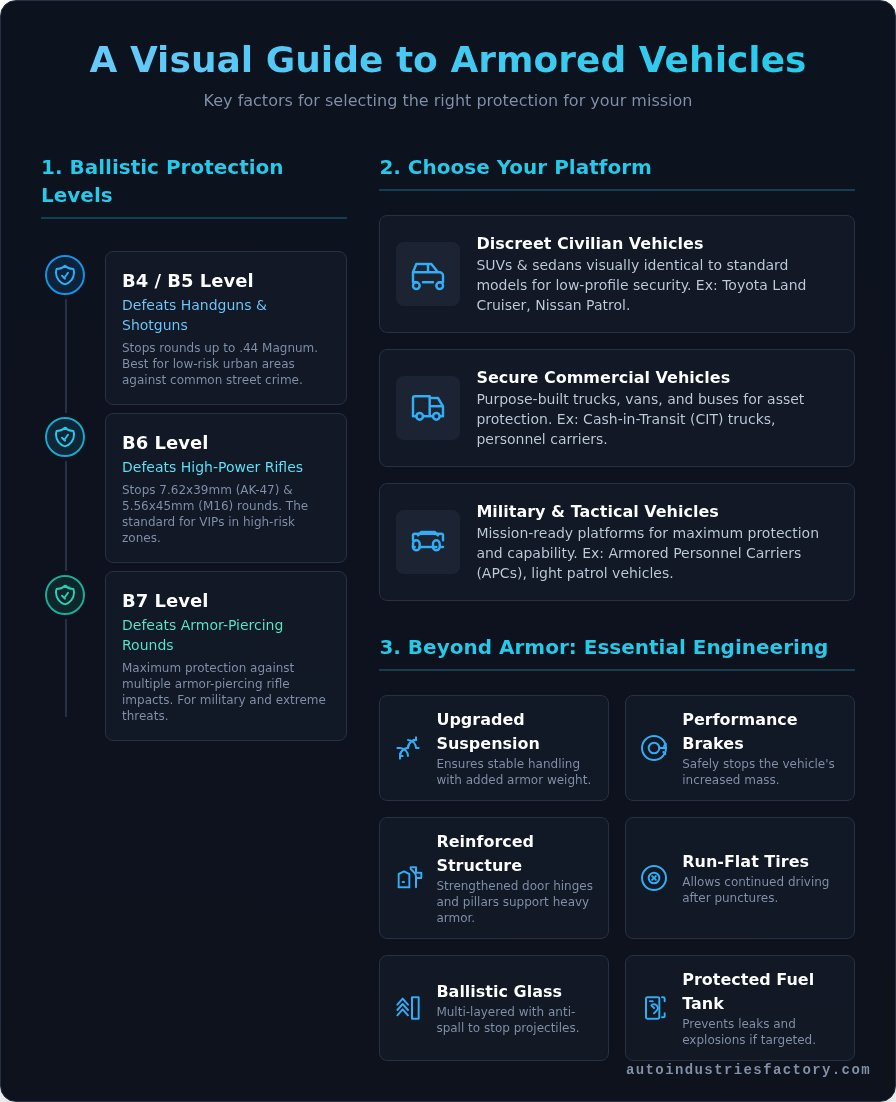
The most common standard used globally, particularly in Europe and the Middle East, is the CEN 1063 Ballistic Resistance Standard. This system classifies armor levels from B4 to B7, each corresponding to a different level of protection.
- B4/B5 Level: This level offers effective protection against handguns and shotguns, including rounds up to a .44 Magnum. It is a common choice for civilian vehicles in low-to-medium risk urban environments where the primary threats are from street crime.
- B6 Level: Representing a significant increase in protection, the B6 level is engineered to defeat high-power rifle rounds, including ammunition from common assault rifles like the AK-47 (7.62x39mm) and M16 (5.56x45mm). This is the standard for many VIPs, NGOs, and corporations operating in higher-risk regions.
- B7 Level: This is the highest level of protection under the CEN standard, designed to stop multiple impacts from armor-piercing rifle rounds. B7-rated vehicles offer maximum security and are typically used by government agencies, military personnel, and individuals facing extreme threats.
While CEN is a primary benchmark, other standards like the National Institute of Justice (NIJ) standard in the United States exist and offer comparable classifications. Understanding these ratings is the first step in making an informed choice.
How to Choose the Right Protection Level for Your Mission
Selecting the appropriate ballistic level is not about choosing the highest rating, but the most suitable one. You must first assess your specific threat level by identifying the most likely risks you will face. An executive operating in a major city may only require B4 protection, while a security team in a conflict zone would need a minimum of B6. Next, consider the operational environment. A discreet armored sedan for urban use has different requirements than a rugged SUV designed for rural or hostile territories. The goal is to balance the necessary protection with vehicle performance and discretion, ensuring the vehicle is a capable and effective tool for your mission.
Types of Armored Vehicles Available for Sale
Not all armored vehicles are created equal. The effectiveness of an armored solution depends heavily on the base vehicle platform, as its chassis, engine, and drivetrain must be able to support the significant weight of the armor without compromising performance or reliability. The choice of vehicle type should align directly with its intended purpose.
Armored Civilian Vehicles: Discreet Protection
For many clients, maintaining a low profile is as important as the protection itself. Armored civilian vehicles are designed to be visually indistinguishable from their standard counterparts. Popular platforms include robust SUVs like the Toyota Land Cruiser and Nissan Patrol, which offer excellent durability and off-road capability. Armored sedans and luxury cars are also common choices for executive transport, providing a secure environment without attracting unwanted attention.
Armored Commercial Vehicles: Securing Assets
When the mission involves protecting valuable assets, specialized commercial vehicles are required. Cash-in-Transit (CIT) trucks are purpose-built with reinforced cargo areas and advanced security features for financial institutions. For transporting valuable goods across challenging terrain, armored pickup trucks offer a combination of ruggedness and security. Additionally, armored buses and vans can be configured for the secure transportation of personnel or sensitive materials.
Military & Tactical Vehicles: Mission-Ready Solutions
For defense, law enforcement, and security operations, military-grade vehicles provide the highest levels of protection and tactical capability. Armored Personnel Carriers (APCs) are designed for safely moving troops through hostile environments. Light patrol vehicles offer a blend of mobility and protection for reconnaissance and security missions. These platforms are often built from the ground up or heavily modified to meet specific defense needs, incorporating features not found in civilian conversions.
Beyond the Armor: Critical Engineering You Can’t Overlook
True security is not just about adding steel plates. A properly engineered armored vehicle is a holistic system where every component is upgraded to handle the significant stress of the added weight. The additional mass from armor impacts the vehicle's suspension, brakes, and structural integrity, and failing to address these areas can lead to catastrophic failure.
Upgraded Suspension and Braking Systems
A heavy-duty suspension is non-negotiable for safety and performance. Upgraded components ensure that the vehicle's handling remains stable and predictable, especially during evasive maneuvers. Equally important are high-performance brakes, which must be powerful enough to safely stop the vehicle's increased mass. Without these upgrades, the vehicle becomes unsafe to operate at speed or in emergencies.
Reinforced Structural Components
The vehicle's original structure is not designed to support hundreds or thousands of kilograms of armor. Key structural components must be reinforced. This includes strengthening door hinges and pillars to prevent sagging and ensure proper closure of the heavy armored doors. It is also essential to protect critical components like the engine bay, battery, and Electronic Control Unit (ECU) to keep the vehicle mobile under attack.
Essential Safety and Performance Features
Several key features complete a comprehensive armoring package. Run-flat tire systems are essential, allowing the vehicle to continue driving for a significant distance even after the tires have been punctured. Multi-layered ballistic glass with an anti-spall layer prevents projectiles and glass fragments from entering the cabin. Finally, a protected fuel tank prevents leaks and explosions if targeted. These integrated systems ensure survivability. Learn about our advanced engineering process.
Procurement Options: Custom Conversion vs. Off-the-Shelf
When looking for armored vehicles for sale, buyers face a key choice: commissioning a custom conversion or purchasing a pre-built or used vehicle. Understanding the advantages and disadvantages of each approach is crucial to finding the right solution for your needs and budget.
The Custom Conversion Advantage
A custom conversion allows you to tailor the vehicle and its protection package to your exact specifications. You can select a base vehicle you trust-such as a Toyota, Ford, or GMC-and have it armored to the precise ballistic level your mission requires. This process also allows for the seamless integration of specialized equipment, such as communications systems, tactical gear, or custom interior layouts. This bespoke approach is the core expertise of Auto Industries Factory, ensuring the final product is perfectly aligned with your operational needs.
Considerations for Used Armored Vehicles
While the lower initial cost of a used armored vehicle can be attractive, it comes with inherent risks. The vehicle's history may be unknown, and crucial components like the ballistic steel and glass can degrade over time, potentially compromising their protective capabilities. If considering a used vehicle, it is imperative to have it subjected to a thorough inspection by an armoring specialist to verify its condition and integrity.
Why Choose Auto Industries Factory for Armored Vehicles?
Your mission's success and your personnel's safety depend on a vehicle engineered with proven expertise and uncompromising quality. At Auto Industries Factory, we provide complete, in-house fabrication and conversion services at our state-of-the-art facility in the UAE. Our vehicles are meticulously built for durability, reliability, and peak performance under the most demanding conditions.
We are specialists in engineering and delivering solutions for military, police, and commercial clients who require absolute dependability. From the initial design and engineering phase to final fabrication and delivery, we control every aspect of the process to ensure the highest international standards are met and exceeded. Request a consultation for your custom armored vehicle.
Frequently Asked Questions
What is the difference between a B6 and B7 armored vehicle?
A B6-rated vehicle is designed to stop high-power rifle rounds, such as those from an AK-47. A B7-rated vehicle provides a higher level of protection, capable of defeating armor-piercing rifle rounds, offering maximum defense against military-grade threats.
How much weight does armoring add to a standard SUV?
The added weight depends on the vehicle size and the level of protection. A B6 armoring package for a large SUV like a Toyota Land Cruiser can add between 500 to 1,200 kg or more.
Can any car be armored?
While many vehicles can be armored, not all are suitable platforms. The ideal base vehicle has a robust ladder-frame chassis, a powerful engine, and a durable drivetrain to handle the significant added weight effectively. Unibody vehicles are generally less suitable for high-level armoring.
What is the typical lead time for a custom armored vehicle conversion?
The lead time can vary depending on the complexity of the project, the protection level, and the availability of the base vehicle. A standard conversion typically takes between 30 to 90 days from start to finish.
Do you offer after-sales service and maintenance?
Yes, reputable armoring companies provide comprehensive after-sales support, including maintenance services for the specialized components like suspension, brakes, and ballistic glass to ensure the vehicle remains in optimal condition.
Are your vehicles certified by an independent authority?
Materials such as ballistic steel and glass are typically certified by independent laboratories. While entire vehicles can be certified, it is a costly process. A manufacturer's reputation and adherence to strict engineering standards are key indicators of quality.
Protecting what matters most requires a solution built with precision, expertise, and an unwavering commitment to quality. At Auto Industries Factory, we translate complex security needs into robust, reliable, and mission-ready armored vehicles. Our team of engineers and fabricators is ready to design a solution tailored to your specific operational requirements. Discuss Your Armored Vehicle Needs with Our Experts today to learn how we can enhance your security and ensure mission success.