

The term "green ambulance" has emerged with two distinct meanings in the world of emergency medical services (EMS). Understanding the difference-from eco-friendly vehicle technology to critical patient triage systems-is essential for modern fleet managers and healthcare administrators. This guide will help you understand both key meanings and what they signify for the future of EMS fleets.
Defining 'Green Ambulance': Triage Code vs. Sustainable Vehicle
To make informed procurement and operational decisions, it is crucial to first address the two different applications of the term "green ambulance." One refers to a patient's condition within a triage system, while the other describes the vehicle's environmental impact. This guide covers both concepts, with a primary focus on the advanced engineering and technology behind sustainable EMS fleets.
The Green Ambulance in Patient Triage Systems
In certain regions, such as the UAE, emergency services like the Dubai Corporation for Ambulance Services utilize a color-coded system to classify patient severity. In this context, a green ambulance is a vehicle transporting a non-urgent or non-critical patient. The purpose of this system is to immediately inform other road users, traffic authorities, and receiving hospitals of the case's severity, allowing for better resource management and more appropriate on-road response from the public.
The Green Ambulance as a Sustainable Emergency Vehicle
Globally, the more common definition of a green ambulance refers to a vehicle designed and manufactured to have a minimal environmental impact. This is part of a worldwide shift in healthcare and government sectors to reduce the carbon footprint of their operations. These vehicles focus on utilizing electric (EV), hybrid, or other low-emission technologies to reduce both operational costs and pollution without compromising mission-critical performance and reliability.
Key Technologies in Sustainable Ambulance Manufacturing
Creating a truly sustainable ambulance involves more than simply replacing a diesel engine with an electric motor. It requires a holistic engineering approach that considers the entire vehicle system, from the chassis and body fabrication to the power requirements of onboard medical equipment. At Auto Industries Factory, we specialize in the custom integration of these advanced systems to deliver robust and reliable emergency vehicles.
All-Electric (EV) and Hybrid Drivetrains
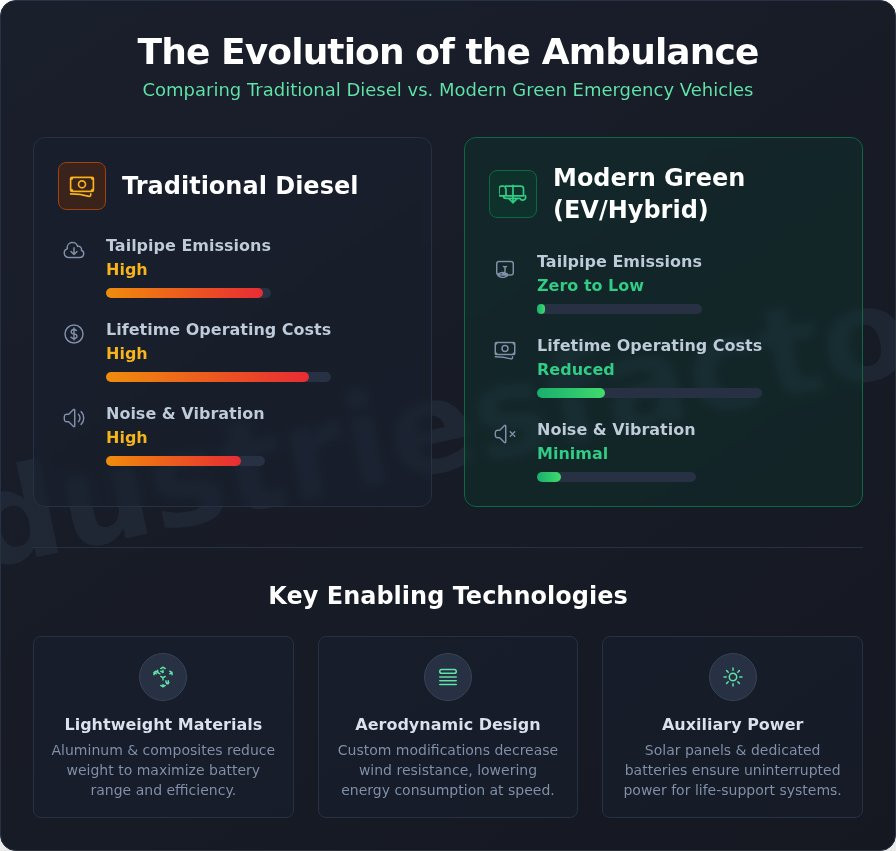
The core of a green ambulance is its powertrain. All-electric (EV) models offer significant benefits, including zero tailpipe emissions, much quieter operation for patient comfort, and lower long-term fuel costs. However, fleet managers must consider key challenges such as battery range under full load, payload capacity, and the need for robust charging infrastructure. As a bridge technology, hybrid systems combine an internal combustion engine with an electric motor, offering extended range while still reducing emissions compared to traditional diesel vehicles.
Lightweight Materials and Aerodynamic Design
Efficiency in a green ambulance is directly linked to its weight and shape. The use of advanced materials like high-strength aluminum and specialized composites in the vehicle conversion process significantly reduces overall weight. This weight reduction is critical for maximizing battery range and operational efficiency. Furthermore, custom aerodynamic modifications to the vehicle body can decrease wind resistance, further lowering energy consumption, especially at higher speeds.
Auxiliary Power Solutions for Medical Equipment
An ambulance's life-support systems demand a constant, reliable power source. Sustainable solutions address this by integrating high-efficiency solar panels on the roof to supplement the power for onboard systems like communication devices, lighting, and climate control. This reduces the need for engine idling, saving fuel and cutting emissions at the scene. Additionally, dedicated, independent battery packs for critical medical equipment ensure uninterrupted operation and patient safety.
Operational Benefits for Modern EMS and Healthcare Fleets
Adopting green ambulances into an emergency fleet provides significant and measurable long-term advantages. These benefits go beyond environmental responsibility, impacting everything from the financial bottom line to the well-being of patients and crew.
Reduced Lifetime Operating Costs
One of the most compelling arguments for sustainable ambulances is financial. Electric drivetrains result in dramatic savings on diesel fuel, a major expense for any EMS fleet. Furthermore, with far fewer moving parts than a traditional combustion engine, electric vehicles require less routine maintenance, leading to lower service costs and increased vehicle uptime. Over the life of the vehicle, these savings can represent a substantial return on the initial investment.
Meeting Environmental, Social, and Governance (ESG) Goals
For public and private healthcare organizations, a green ambulance fleet is a powerful statement of commitment to sustainability and corporate responsibility. It actively improves air quality in the urban communities where these vehicles operate most frequently. This operational shift aligns with government green initiatives and increasingly stringent environmental regulations, positioning the organization as a forward-thinking leader in the healthcare sector.
Enhanced Patient and Crew Experience
The performance of a green ambulance directly benefits those inside it. The near-silent operation of an electric motor drastically reduces noise and vibration, creating a calmer and more comfortable environment for patients during transport. For EMS crews, the elimination of diesel fumes around an idling vehicle creates a cleaner, healthier work environment. Engineer a superior fleet with Auto Industries Factory.
Auto Industries Factory: Engineering the Future of EMS Vehicles
Successfully converting a standard vehicle platform into a reliable, mission-ready green ambulance demands a high level of specialized engineering expertise. Our process is built on a foundation of durability, performance, and uncompromising safety, ensuring every vehicle we deliver is prepared for the rigors of emergency service.
Custom Conversion for Sustainable Platforms
Our team possesses deep expertise in modifying a wide range of vehicle chassis for electric or hybrid ambulance applications. We perform critical structural reinforcements to manage the additional weight and distribution of battery systems, ensuring the vehicle's integrity and handling characteristics are optimized. Our custom fabrication capabilities allow for the seamless integration of charging systems, advanced power management controls, and all necessary medical infrastructure.
Powering Critical Onboard Medical Systems
The reliability of an ambulance is measured by its ability to power life-support equipment without failure. We design and install robust, isolated electrical systems engineered to provide stable, uninterrupted power to ventilators, monitors, and other critical devices. Our solutions are built for complete reliability when it matters most, giving EMS professionals the confidence they need to perform their duties. Request a consultation for your specialized vehicle needs.
Frequently Asked Questions
What is the primary role of a green ambulance?
A green ambulance has two roles depending on the context. As a triage code (e.g., in the UAE), it signifies a non-critical patient transport. As a vehicle type, its role is to perform all the functions of a standard ambulance while minimizing environmental impact and reducing long-term operating costs through sustainable technology.
Are electric ambulances powerful and reliable enough for emergency response?
Yes. Modern electric vehicle platforms provide instant torque for rapid acceleration, and their designs are becoming increasingly robust. When engineered by a specialist conversion company, the electrical systems, battery management, and structural integrity are built to meet the stringent demands of emergency services, ensuring high reliability.
What is the typical range of an all-electric ambulance?
The range of an all-electric ambulance varies based on the base vehicle, battery size, payload, and operational conditions. Many current models offer a range of 100 to over 150 miles (160-240 km) on a single charge, which is typically sufficient for urban and suburban operational cycles. The key is to match the vehicle's range to the specific needs of the service area.
How does the cost of a green ambulance compare to a traditional diesel one?
The initial purchase price of a green ambulance, particularly an all-electric model, can be higher than its diesel counterpart. However, this is offset by a significantly lower total cost of ownership due to massive savings on fuel and reduced maintenance requirements over the vehicle's lifespan.
Can a standard van be converted into a green ambulance?
Yes, many of the most effective green ambulances are based on commercially available electric van platforms. A specialized vehicle converter like Auto Industries Factory then performs the necessary structural modifications, interior fabrication, and installation of medical and electrical systems to transform it into a compliant and fully equipped ambulance.
What infrastructure is needed to support an electric ambulance fleet?
Supporting an electric ambulance fleet requires a planned charging infrastructure. This typically involves installing Level 2 or DC fast chargers at the ambulance station or deployment points. A thorough assessment of the existing electrical supply and operational patterns is necessary to ensure vehicles are always charged and ready for deployment.
Whether you are navigating local triage protocols or planning the next generation of your emergency fleet, understanding the role of the green ambulance is vital. By embracing sustainable technology, EMS providers can enhance operational efficiency, reduce costs, and contribute to a healthier environment without sacrificing performance or safety. Discuss your custom ambulance conversion project with our experts.


