

A 4×4 is the starting point for desert travel, not the whole solution. Effective desert safari vehicle modifications should support traction, ground clearance and suspension on sandy, uneven terrain. A suitable SUV should also allow tire-pressure adjustment, while reinforced tires, skid plates and recovery gear can add practical support.
It’s easy to focus on engine power or appearance, but how a vehicle handles sand matters just as much. Ground clearance affects the space beneath it, suspension influences how it responds to uneven terrain, and traction depends on the drivetrain, tires and driving conditions working together.
This guide explains how these factors affect a vehicle’s suitability for UAE dune driving. Compare common modification priorities, understand what safety equipment can contribute, and assess whether a setup suits the terrain and intended use. The goal is to clarify the trade-offs before choosing a safari vehicle conversion.
Key Takeaways
- Assess ground clearance, suspension and four-wheel-drive traction together; one upgrade alone won’t determine how a vehicle handles sand.
- Consider tire-pressure adjustment, reinforced tires, skid plates and recovery gear as part of a complete desert-readiness plan.
- Compare modified and stock 4x4s against the terrain, intended use and trade-offs, rather than assuming more modifications always mean safer travel.
- Separate off-road capability from UAE road-approval requirements, which may depend on the type of vehicle change.
- Understand how modifications can introduce new safety risks, including changes to vehicle handling and component loads.
Ground clearance, suspension and traction
A 4×4 is the recommended starting point for desert safaris in the UAE. Four-wheel drive can help maintain traction, while suitable ground clearance and suspension matter on sandy, uneven terrain. These features work as a system: clearance creates space beneath the vehicle, suspension helps the wheels follow changing ground, and traction helps deliver drive through the tires.
Ground clearance is the distance between a vehicle’s underside and the terrain. On a dune, sand can rise beneath the chassis as the vehicle crests or crosses a depression. Adequate clearance reduces the chance of underbody contact, but a high stance alone doesn’t make a vehicle suitable. Tires, suspension and the overall setup also affect how it moves across uneven ground.
Suspension connects the wheels to the vehicle and manages their movement over changing surfaces. On soft sand, the wheels need to stay in contact with the ground to transmit drive. A setup suited to uneven terrain can help control wheel movement, but modifications should match the vehicle and its intended use. Changes to ride height can also affect how the vehicle behaves through turns and over bumps.
Traction depends on more than the four-wheel-drive badge. The drivetrain, tires, surface and tire pressure all play a part. A suitable desert-driving SUV should have four-wheel drive, adequate ground clearance and the ability to adjust tire pressure. Pressure adjustment matters because sand calls for different considerations than firm roads. Follow a deliberate process before leaving paved surfaces:
- Identify the vehicle’s drivetrain and confirm it is four-wheel drive.
- Assess clearance against the vehicle’s lowest exposed components.
- Review how suspension changes affect wheel travel and vehicle height.
- Plan tire-pressure adjustment for the terrain, then restore road pressure before returning to paved driving.
Compare common setups by their intended use, not by appearance alone. A stock 4×4 may suit lighter use, while a purpose-modified 4×4 may address specific clearance or suspension needs. A two-wheel-drive vehicle lacks the four-wheel-drive feature recommended for UAE desert safaris.
| Vehicle option | Clearance | Suspension | Traction considerations |
|---|---|---|---|
| Stock 4×4 SUV | Assess as supplied | Standard configuration | Four-wheel drive; assess tire-pressure adjustment |
| Modified 4×4 SUV | Changes may provide more space underneath | Set up for intended terrain | Four-wheel drive; tires and pressure remain relevant |
| Two-wheel-drive vehicle | Vehicle-dependent | Vehicle-dependent | Doesn’t meet the 4×4 recommendation |
Choose the 4×4 setup whose clearance and suspension suit the terrain, while keeping tire-pressure adjustment and the vehicle’s intended use in view. A disciplined setup matters more than adding height without considering how the whole vehicle responds.
Safety equipment, including reinforced tires, skid plates and recovery gear
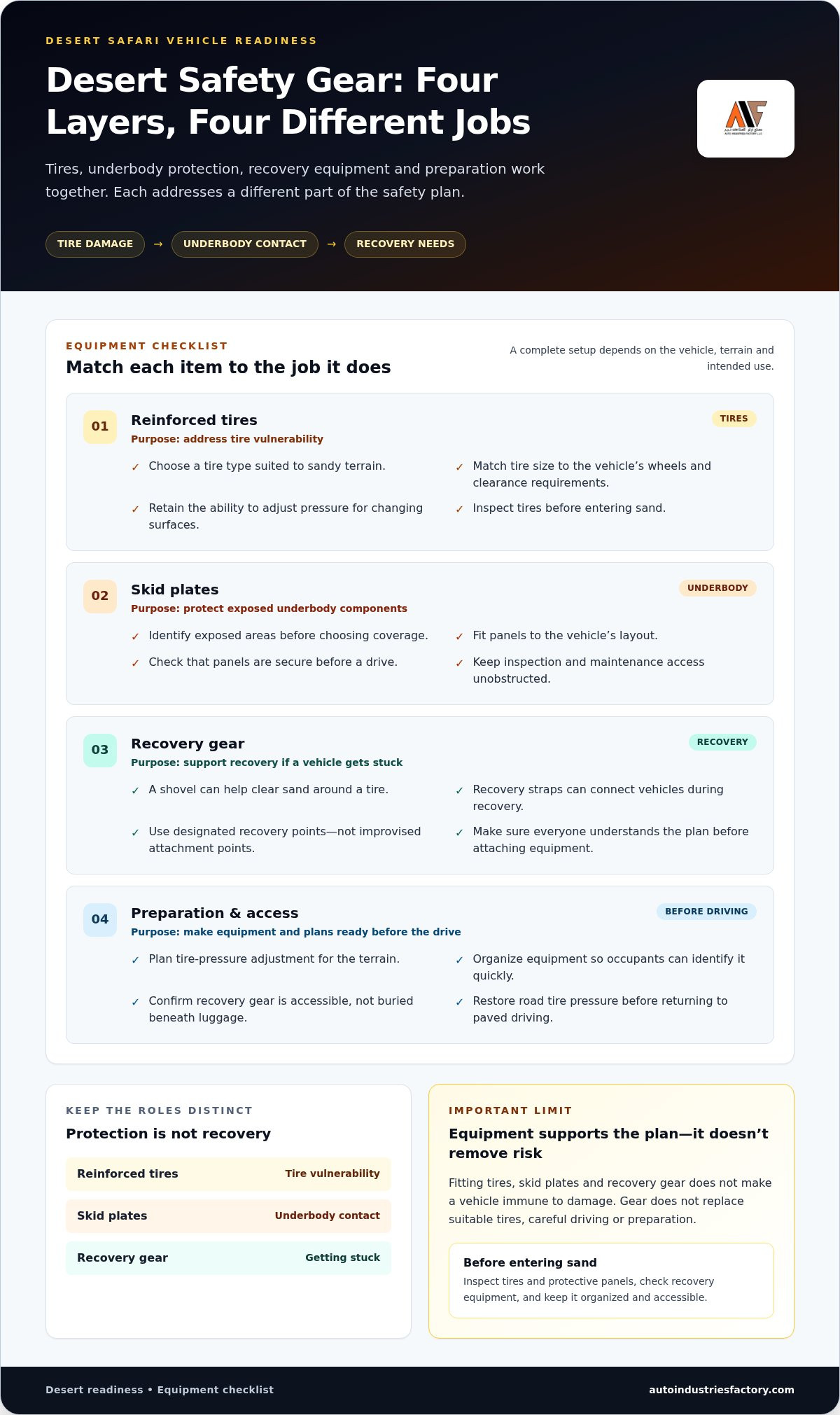
For UAE dune travel, equipment should address tire damage, underbody contact and recovery needs. Vehicle conversion specialists can help plan desert vehicle modifications and installation across the UAE.
Reinforced Tires
Reinforced tires are recommended equipment for 4×4 vehicles used on desert safaris in the UAE. Unlike skid plates, they help address tire vulnerability rather than protecting the vehicle’s underside. There isn’t one tire size that suits every SUV: match the size to the vehicle’s wheel and clearance requirements. Choose a tire type suited to sandy terrain, and retain the ability to adjust pressure for changing surfaces.
Skid Plates
Skid plates are protective panels fitted beneath exposed components, where contact with sand or uneven ground can cause damage. Unlike reinforced tires, they protect the underbody rather than the tire casing. Placement matters: identify exposed areas first, then choose coverage suited to the vehicle’s layout without obstructing inspection or maintenance.
Recovery gear supports a different part of the safety plan. It can help when a vehicle loses momentum or gets stuck, but it doesn’t replace suitable tires, careful driving or preparation. A shovel can help clear sand around a tire, while recovery straps can connect vehicles during recovery. Use designated recovery points, and make sure everyone understands the plan before attaching equipment.
Think of equipment as a set of complementary functions:
- Tires: reinforced construction and a size suited to the vehicle.
- Underbody protection: skid plates covering exposed components.
- Recovery: suitable gear, accessible recovery points and a shared plan.
- Preparation: a pressure-adjustment plan and equipment inspection before entering sand.
Before a drive, inspect the tires, check that protective panels are secure, and confirm recovery equipment is accessible. Gear packed beneath luggage, for example, may be difficult to reach when a vehicle is stuck. Keep equipment organized so occupants can identify it quickly, and avoid improvised attachment points during recovery.
Reinforced tires, skid plates and recovery gear each address a different risk; fitting all three doesn’t make a vehicle immune to damage. The right combination depends on the vehicle, terrain and intended use. When assessing conversion options, consider how each modification works as part of the complete vehicle.
Rental choice can also shape equipment decisions. Before choosing a vehicle, consider whether its tires, underbody protection and recovery setup suit the planned outing. Confirm what equipment is already fitted or supplied, and identify any gaps before setting off.
Whether you’re using a rental or a personal vehicle, keep preparation practical: check that essential gear is present, secure and easy to reach, and make sure occupants know how to use it. If the vehicle’s equipment or recovery points are unclear, resolve that before entering sand rather than relying on assumptions. This keeps the vehicle’s capabilities, route and recovery plan aligned, while recognizing that equipment reduces specific risks but cannot eliminate them.
These equipment standards are just as critical for self-drive expeditions abroad; for travelers embarking on remote desert journeys such as wyprawy 4x4 namibia, verifying proper recovery gear, ground clearance, and tire durability is essential before heading into isolated dunes.
Are vehicle modifications for desert driving legal in the UAE, and what approvals are required?
Desert capability and public-road approval are separate considerations in the UAE. A vehicle that performs well on sand isn’t automatically approved for every road-use configuration. Before changing tires, ride height, bumpers or lighting, identify the intended use and seek guidance on the approval route for that specific work.
Start with a written description of every proposed change. For example, list a suspension lift, larger tires and a front bumper separately rather than describing the project simply as an off-road upgrade. Include how each change affects vehicle dimensions, visibility, external fittings and surrounding components. This gives the relevant emirate vehicle-licensing authority a clear scope to assess.
Approval considerations can differ for a removable item and a change to the vehicle’s structure or operating equipment. A recovery tool carried inside the vehicle is not the same modification as a permanently mounted external bar. Changing tire size can affect clearance and handling, while changing lighting can affect visibility for other road users. Describe the installation, not just the part.
Use this sequence before work begins:
- Write down each modification, including its location and purpose.
- Separate removable equipment from permanent changes to the vehicle.
- Ask the relevant emirate vehicle-licensing authority which inspection or approval applies.
- Keep the authority’s response and modification records with the vehicle documents.
- Complete any required inspection or registration update before public-road use.
For a vehicle used only in a controlled off-road setting, clarify site access rules separately from public-road requirements. A private desert venue may set its own entry conditions, while access roads can still involve public-road use. For example, a lifted SUV driven to a dune site has a different use pattern from a vehicle transported directly to a closed course.
Keep records of the original configuration and completed work. Useful documents include the vehicle identification details, a list of installed components, invoices and any inspection paperwork. If a later change alters the setup, such as replacing the tires or adding a fixed bumper, update the modification record and seek guidance on that change.
The practical approach is to make approval part of the modification plan, not an afterthought. Specify the vehicle, intended use and exact changes, then follow the relevant UAE authority’s direction before relying on the modified configuration on public roads. This helps distinguish an off-road equipment choice from a change that affects the vehicle’s road-use status.
How do modified 4x4s compare with stock vehicles on desert safaris?
A stock 4×4 and a modified 4×4 can both suit desert travel, but they serve different needs. Compare their equipment, condition and intended terrain rather than assuming every added part improves performance.
A stock SUV retains its factory configuration. Its behavior may be more familiar on paved roads, and it avoids changes that affect ride height or vehicle weight. For example, a stock four-wheel-drive SUV with suitable clearance may meet the needs of occasional trips on easier desert routes. Its limits depend on the vehicle and terrain.
A modified 4×4 can address identified needs through additions such as reinforced tires, underbody protection or recovery equipment. Each change has a distinct job. A skid plate protects exposed components; recovery gear supports a recovery plan. Neither replaces appropriate driving or makes a vehicle suitable for every dune route. A plan for desert safari vehicle modifications should begin with a clear operational need.
| Criteria | Stock 4×4 | Modified 4×4 |
|---|---|---|
| Configuration | Factory setup | Changed to suit selected needs |
| Underbody protection | As supplied | Can include skid plates |
| Tire setup | Factory-fitted tires | May use reinforced tires suited to the vehicle |
| Recovery preparation | Equipment carried separately | Can include dedicated recovery gear |
| Road behavior | Factory handling characteristics | Changes can affect handling and vehicle weight |
The table shows why “modified” isn’t a single performance category. A vehicle with added recovery equipment differs from one with altered suspension, even if both are called modified. Added components also require careful fitment and mounting. A poorly matched change can create handling or clearance concerns rather than solve the original problem.
Use the intended route to guide the comparison. For occasional trips on easier terrain, a well-maintained stock 4×4 may be practical. For repeated use or more demanding conditions, identify the specific limitation first. If underbody contact is the concern, consider protection; if recovery readiness is the gap, plan suitable equipment.
Before deciding, compare these factors:
- Terrain: Consider whether the route includes soft sand, uneven ground or frequent dune crossings.
- Use pattern: Distinguish occasional recreational trips from regular fleet operation.
- Vehicle changes: Assess how added weight, altered height and installed equipment interact.
- Readiness: Include tire condition, recovery preparation and driver familiarity in the decision.
Choose a stock vehicle when its existing setup matches the route and intended use. Choose desert safari vehicle modifications to address clear operational needs, not appearance alone. Meanwhile, travelers visiting the UAE who prefer to experience dune excursions without preparing an off-road vehicle can arrange guided safari packages through local tour specialists like cityrisetours.com. A deliberate comparison helps align the vehicle, equipment and driving plan.
What are the safety risks of modifying a vehicle for desert driving?
A desert-ready modification can solve one problem while creating another. On a UAE dune route, added height may improve underbody clearance but also change how an SUV responds in turns. Assess every modification as part of the complete vehicle, not as a standalone upgrade.
Suspension changes can alter ride height, wheel movement and handling. A lift that is poorly matched to the vehicle can affect how the tires meet the ground over uneven sand. Larger tires may also change clearance and steering response. A modification plan should account for vehicle weight, intended load and how components interact.
Added equipment creates another risk to manage. A heavy bumper, roof rack or recovery item increases vehicle mass, and equipment mounted high can affect how the vehicle feels during cornering. Loose cargo can shift on uneven ground. Secure heavy items and consider where each addition sits relative to the vehicle’s center of gravity and load capacity.
Tire changes need equal care. A tire that doesn’t suit the wheel or vehicle can cause fitment problems, while pressure changes affect tire behavior on sand and firmer surfaces. Before driving, inspect tires for damage and confirm the selected size clears surrounding components throughout steering movement. Restore the appropriate road pressure before returning to paved roads.
Inspect installed equipment with a focused sequence:
- Mounting: Check that bumpers, racks, skid plates and recovery points are firmly attached.
- Clearance: Turn the wheels and look for tire contact with bodywork or suspension parts.
- Visibility: Confirm added bars or accessories don’t obstruct lights or the driver’s view.
- Load: Secure recovery gear and luggage so they can’t move during a dune crossing.
- Operation: Test steering, braking and equipment access in a controlled setting before entering sand.
Recovery gear can also create hazards if used incorrectly. A strap attached to an unsuitable point can damage the vehicle, and people standing close to a loaded recovery line face avoidable danger. Identify purpose-built recovery points and establish a clear plan before attempting to move a stuck SUV. Keep bystanders away from the recovery path.
Use a written modification list to connect every change with its purpose and inspection. For example, record why a skid plate was added, how a tire size was selected and where recovery equipment is secured. A systematic vehicle modification plan keeps fitment, load, visibility and operation in view. Reassess the setup whenever equipment or intended use changes.
Auto Industries Factory: Ambulance Conversions
Auto Industries Factory offers Ambulance Conversions and Safari Vehicle Conversions for different vehicle requirements. If your priority is a purpose-built desert vehicle, its Safari Vehicle Conversions are the relevant next step after assessing clearance, traction, equipment and intended use. Organizations planning specialized fleet vehicles can also consider Police & Military Vehicle Modifications and Metal Canopies and Roof Racks.
Bring a clear scope to the project discussion: identify the vehicle, its operating environment and the modifications you’re considering. This connects the conversion to practical needs instead of adding equipment without a defined purpose. Safari conversions suit readers seeking a specialized vehicle configuration; Ambulance Conversions address a separate fleet requirement.
Contact Auto Industries Factory to discuss your vehicle conversion requirements.
Turn your fleet requirements into a clear build plan
The next step is to turn your operating needs into a defined vehicle brief. Identify the terrain, duty cycle, passenger or equipment requirements, and how the vehicle will be used on public roads. Then prioritize changes that serve those needs. A focused brief makes desert safari vehicle modifications easier to assess as a complete vehicle conversion, rather than a collection of unrelated upgrades.
Auto Industries Factory offers Safari Vehicle Conversions for desert-use requirements, alongside Ambulance Conversions and Police & Military Vehicle Modifications for other specialized fleet needs. Choose the direction that matches your vehicle’s role, then bring its intended use and required configuration into the discussion.
Contact Auto Industries Factory about your fleet to discuss the right conversion path. A well-defined brief is a strong place to begin.
Frequently Asked Questions
What vehicle modifications are recommended for desert safaris in the UAE?
For a UAE desert safari, prioritize a four-wheel-drive vehicle, suitable ground clearance and equipment matched to the route. A vehicle used for occasional guided trips may need a different setup from one operating regularly across varied terrain. Assess the complete configuration, including tire condition, protective equipment, recovery preparation, and passenger or cargo load. Choose upgrades to address a specific operating need rather than adding parts simply because they’re common off-road accessories.
Which suspension upgrades improve off-road performance in desert vehicles?
Suspension changes should suit the vehicle’s weight, tire setup and intended terrain; no single upgrade fits every desert vehicle. For example, assess a fleet vehicle carrying equipment with that load in mind, not just through an unloaded test drive. Consider how a proposed change affects wheel movement, ride height, steering response and component clearance as a connected system. A lift alone doesn’t establish that the suspension is suitable for sand.
Do desert safari vehicles need skid plates, recovery points, or a roll cage?
Skid plates and suitable recovery points serve specific off-road purposes, while a roll cage isn’t a universal fit for every safari vehicle. Underbody protection shields exposed components; recovery points provide designated attachment locations for recovery equipment. A roll cage changes the vehicle’s interior structure and occupant space, so its suitability depends on the vehicle and intended use. Consider each item separately, including fitment, access and compatibility with the vehicle’s existing configuration.


