

Type II van-based conversions are one ambulance conversion type. Configurations also vary by chassis, body style and the care capabilities they support. The right setup depends on the vehicle platform and the unit’s intended role.
A van-based design can be a practical starting point, but the conversion must balance usable space, patient-care requirements and daily operating demands. Look beyond the vehicle itself: the interior needs to support the crew’s workflow.
This guide compares van-based conversions with other chassis and vehicle formats, then explains how medical capability shapes an ambulance’s layout and equipment. You’ll see what distinguishes each option and how vehicle conversion expertise brings the requirements together in a functional configuration for use in the UAE.
Key Takeaways
- Compare van-based and box-type layouts by considering crew workflow, available space and the vehicle’s intended role.
- Assess chassis and body style together: each affects how the ambulance can be configured for its operating needs.
- Define the required level of care before planning the interior, equipment placement and medical supply storage.
- Look at fabrication and conversion expertise as part of the configuration decision, especially when vehicle structure and interior requirements must work together.
- Use the main conversion categories to narrow down which ambulance setup best fits the mission.
1. Type II van-based ambulance conversions
A Type II ambulance conversion starts with a van, retaining its familiar body while adapting the interior for emergency transport. This format can suit services that need a maneuverable unit with a purpose-built patient-care area. The final layout depends on the van platform, crew workflow, patient access and mission-specific equipment.
Start by matching the base vehicle to its working conditions. The conversion plan should account for interior volume, door access, payload capacity and space for crew movement. For example, the side-door opening affects access to stored supplies, while the rear entry shapes patient loading. These details influence cabinet placement, seating and clear pathways.
For UAE use, the applicable vehicle approval and certification requirements depend on the intended configuration and operation. A 2023 Mercedes-Benz Sprinter ambulance is described as complying with TS EN 1789+A2, a technical standard cited for that vehicle.
The unit’s intended care role determines its equipment and interior features. A conversion can be arranged around patient and crew seating, secured storage, work surfaces, lighting and accessible equipment locations. Keep essential supplies within reach and limit loose items that could obstruct movement. Frequently used items, for instance, can sit near the working area, with less frequently used supplies stored separately.
Safety planning includes secure mounting, safe movement through the cabin and maintenance access. The occupational fatality figure cited for EMS workers is about 12.7 deaths per 100,000 EMS workers. This figure describes occupational risk, not a Type II vehicle’s performance. During maintenance, inspect conversion components such as cabinet fastenings, door operation, electrical connections and interior surfaces. A fault in any of these areas can disrupt access, storage or equipment operation.
Before choosing among ambulance conversion types, define the service’s practical requirements. Consider the care role, crew numbers, essential equipment, loading method and operating environment. Then compare those needs with the van’s usable interior and proposed layout. A clear requirements list helps prevent unnecessary equipment from crowding the workspace and shows where secure storage matters most.
Type II van-based conversions do not follow one fixed interior package. Their value lies in matching the van platform to the required workflow and equipment arrangement. A well-planned layout brings access, storage and safe movement together, while the vehicle’s approval pathway depends on its intended use in the UAE.
2. Ambulance classifications by chassis and vehicle type
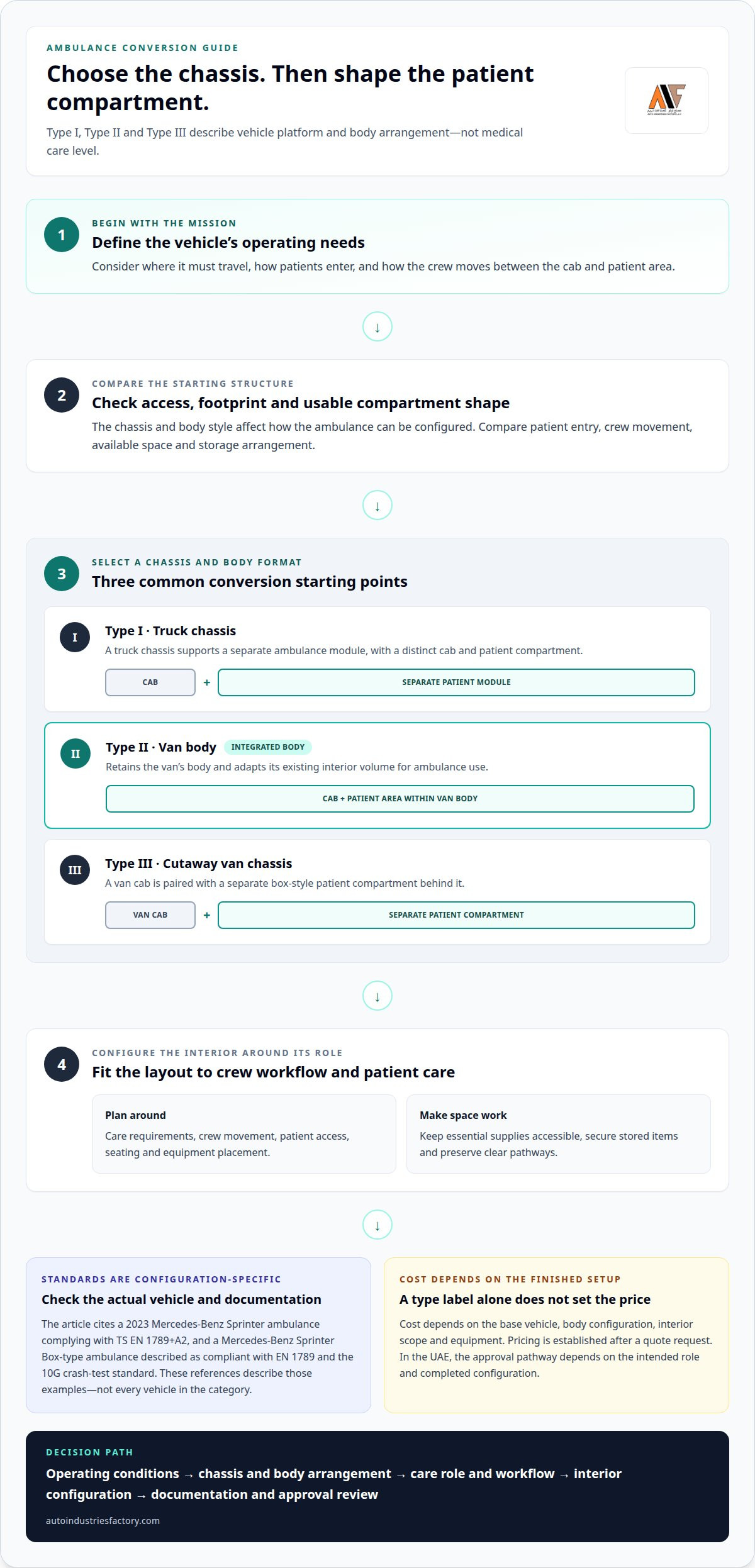
Chassis classification describes the vehicle platform and body arrangement, not the medical care level. Type I typically uses a truck chassis with a cab and separate patient module. Type II retains a van body. Type III uses a cutaway van chassis with a separate patient compartment. Each format provides a different starting point for conversion planning.
A Type I layout separates the cab from the ambulance module, allowing for a dedicated patient compartment. The chosen chassis affects access and the vehicle’s overall footprint. A Type II retains the van’s integrated body and uses its existing interior volume. A Type III combines a van cab with a separate box-style patient area behind it.
Vehicle examples show how the body format can vary. The Mercedes-Benz Sprinter Box-type ambulance is described as compliant with EN 1789 and the 10G crash-test standard. Its box body differs from a van-based conversion, which works within the van’s existing body. Those labels identify configuration features, not a guarantee that every vehicle in that category has identical equipment.
Type I, Type II and Type III differ in chassis, body layout and available conversion space. Their cost depends on the base vehicle, body configuration, interior scope and equipment, with pricing established after a quote request. A type label alone cannot determine the final cost.
- Type I: A truck chassis supports a separate ambulance module, giving the conversion a distinct cab and patient compartment.
- Type II: A van body provides the starting structure, and the conversion adapts its interior for ambulance use.
- Type III: A cutaway van chassis supports a separate patient compartment behind the cab.
To compare configurations, start with the service’s operating conditions. Consider where the vehicle must travel, how patients enter and how the crew moves between the cab and patient area. Then compare the chassis footprint, usable compartment shape and storage arrangement. For example, a box body offers a different basis for interior planning than an integrated van body.
In the UAE, the intended vehicle role and completed configuration matter when assessing the relevant approval pathway. Keep the chassis identity, conversion details and vehicle documentation aligned throughout planning. The Mercedes-Benz Sprinter example shows why standards references should relate to a specific configuration, rather than be assumed to apply to every ambulance conversion.
For a project comparing a van platform with a box-style patient compartment, review ambulance conversion services as a practical next step. A defined chassis and body preference helps focus the configuration discussion on the vehicle’s intended use.
3. Ambulance classifications by medical capability
Medical capability describes the care a unit is configured to support. It is separate from chassis classification: a van or box body can be planned around different care requirements. In the UAE, define the intended service role before settling the interior layout. That decision shapes equipment selection, storage capacity and crew access.
A transport-focused configuration may prioritize patient transfer and organized access to essential supplies. A higher-capability setup can be customized to include advanced life support systems. Plan where each item will be stored, how staff will reach it and how it will be secured during vehicle movement. The care role determines the arrangement, not just the vehicle body.
Pediatric care brings distinct storage and access considerations. A conversion can include pediatric equipment, with dedicated space planned to keep it identifiable and reachable. Separate storage, for example, helps distinguish pediatric supplies from other onboard items. The layout should also preserve clear working space around the patient area instead of filling every surface with equipment.
Additional medical supply storage is another customization option. Its usefulness depends on the service’s supply list and how crews replenish and use items. A practical planning sequence is to identify required equipment, group items by use, assign storage locations, then review access and securement. This turns a general equipment list into a workable interior plan.
- Define the care role: Set the expected patient-care scope before specifying interior features.
- Map equipment access: Place frequently used items where the crew can reach them within the planned workflow.
- Plan specialized storage: Allocate dedicated space for pediatric equipment or additional medical supplies where needed.
- Review the completed layout: Check that stored items remain secured and that crew movement stays clear.
These steps help avoid a common planning error: specifying equipment without considering how it fits into the working compartment. Advanced life support systems, for example, need planned positions and access, while pediatric supplies need recognizable, practical storage. Each choice affects the next, so develop the layout and equipment plan together.
Medical capability also shapes how a conversion is evaluated. Compare the proposed equipment list with the intended care role, then assess whether the interior supports access, storage and movement. Do not treat a capability label as a complete specification. Two units described in similar terms can have different equipment arrangements to meet their service requirements.
In short, classify a unit by the care it is equipped to support, then translate that role into a coordinated interior plan. Advanced life support systems, pediatric equipment and additional supply storage are customization options, not a universal package. Clear requirements help align the vehicle’s working space with the crew’s intended tasks.
4. Ambulance conversion expertise
Ambulance conversion expertise connects the vehicle platform, fabrication work and operational requirements. A conversion is more than an interior fit-out: every decision affects how components are shaped, joined and arranged around the chosen vehicle. An extended-roof ambulance on a GMC or Toyota platform, for example, needs a plan based on that vehicle’s structure and intended use.
Begin with a written requirements brief. Record the chosen platform, intended care role, crew workflow, storage needs and preferred body configuration. Mark which features are essential and which are optional. This gives the fabrication team a clear basis for planning and helps prevent late changes from conflicting with earlier layout decisions.
Next, translate the brief into fabrication requirements. Metal cutting and bending shape components for the planned configuration. Laser cutting produces accurately shaped parts, while CNC machining supports controlled component fabrication. Welding joins fabricated elements, and painting completes the finish. These capabilities matter because each part’s fit affects how the assembled conversion works.
Vehicle-specific planning matters. A GMC and a Toyota may need different component shapes, mounting locations and interior arrangements. Do not treat a layout developed for one platform as a direct template for another. Assess the selected vehicle, map each planned component, and resolve fit and access before fabrication begins.
A disciplined workflow includes review points throughout the project. Compare the requirements brief with the proposed layout, then check fabricated components against that plan. Before handover, inspect the finished work for fit, finish, secure installation and access to intended storage. A cabinet that matches the drawing, for example, still needs a practical opening path in the completed vehicle.
- Scope: Document the platform, body format, care role and required interior functions.
- Plan: Match component dimensions and locations to the selected vehicle.
- Fabricate: Use appropriate cutting, bending, machining, welding and painting processes.
- Review: Compare completed work with the agreed configuration and examine fit and access.
For UAE projects, include the operating environment in the initial brief. Consider expected routes, parking conditions and day-to-day use, then translate those needs into practical layout and material decisions. Keep vehicle documentation and conversion records organized alongside the finished configuration. This makes it easier to identify what was installed and how the completed unit was planned.
Strong conversion expertise shows in the connection between planning and finished fabrication. A clear brief guides vehicle-specific decisions, and precise metalwork brings those decisions into physical form. Reviewing each stage helps keep the completed ambulance aligned with its intended role, from the base platform through final fit and finish.
5. What are the main types of ambulance conversions?
Ambulance conversions are commonly grouped by chassis, body style and medical capability. These categories describe separate decisions, not competing labels for the same feature. Type II identifies a van-based format, while a box body describes the patient compartment’s shape. A medical capability plan determines the equipment and storage the interior must support.
The familiar chassis classifications are Type I, Type II and Type III. Type I uses a truck chassis with a separate patient module. Type II adapts a van body. Type III uses a cutaway van chassis with a separate patient compartment. Each starts with a different vehicle structure, shaping the available space and conversion approach.
Body configuration adds another distinction. A box-type ambulance has a dedicated box-style patient compartment, while an extended-roof conversion changes the vehicle’s roof arrangement. Extended-roof ambulances are available on GMC and Toyota platforms. Consider the platform and body style together: the configuration must fit the selected vehicle rather than rely on a generic layout.
Care capability forms a separate category. A conversion can be arranged for its intended patient-care role, with equipment and storage planned around that work. Customized configurations can include advanced life support systems, pediatric equipment and additional medical supply storage. These features affect interior planning, so identify equipment requirements before finalizing the layout.
- Chassis type: Compare Type I, Type II and Type III based on the vehicle structure and compartment arrangement.
- Body style: Consider a van-based layout, box-type compartment or extended-roof format.
- Care capability: Define the required equipment, pediatric provisions and supply storage.
Use these categories as a planning sequence. First, select the platform and body arrangement. Then define the care role and translate it into equipment locations, storage and crew access. A box-type patient compartment and an extended-roof van, for example, represent different body approaches, but either still needs a care plan suited to its intended use.
In the UAE, the completed configuration and intended role are important considerations when planning vehicle approval. Keep documentation aligned with the chosen chassis and conversion details. A standards reference applies to the configuration it describes, so do not assume that one vehicle’s specifications automatically define every ambulance in the same category.
Ambulance conversion types therefore combine three decisions: chassis, body configuration and care capability. Separating these decisions makes comparisons clearer and helps turn a broad requirement into a practical brief, such as a van-based unit with a specified roof format and a defined equipment-storage plan.
Auto Industries Factory LLC: Ambulance Conversions
Auto Industries Factory LLC provides ambulance conversions planned around a specific vehicle platform and operating role. Its offerings include box-type ambulances and extended-roof ambulance conversions on GMC and Toyota vehicles. These options give fleet planners a practical starting point for matching body configuration with space and workflow requirements.
Bring together the preferred vehicle, body format and intended use before defining the conversion. A clear brief helps focus the discussion on the configuration that fits the project. For ambulance conversion requirements, explore ambulance conversion services.
Contact Auto Industries Factory LLC to discuss your ambulance conversion, or visit its website.
Set the direction for your next vehicle project
Turn your operational priorities into a clear project brief before selecting a vehicle configuration. Identify the units your fleet needs, how they will be used and which requirements matter most. This direction helps keep procurement and conversion decisions aligned as plans develop.
Choosing among ambulance conversion types is one part of a broader specialized-vehicle strategy. Auto Industries Factory LLC offers Ambulance Conversions, Police & Military Vehicle Modifications, and Safari Vehicle Conversions. If your plans include one of these vehicles, connect your intended use with the conversion requirements you have identified.
Contact Auto Industries Factory LLC to discuss your vehicle conversion requirements and take the next step with a defined project direction.
Frequently Asked Questions
What is a Type II ambulance conversion?
A Type II conversion is an ambulance built by adapting a van body for patient transport and onboard care. The designation describes the vehicle format, not its medical capability or exact equipment package. Two Type II units, for instance, can have different interior layouts because their intended roles differ. When comparing them, examine how each setup supports crew movement, patient access and the unit’s planned work.
What is a van-based ambulance conversion?
A van-based ambulance conversion starts with a van platform, but the term can describe more than one configuration. Type II ambulances use a van body, while Type III designs use a cutaway van chassis with a separate patient compartment. “Van-based” is therefore broader than “Type II.” Identify the body and chassis arrangement to understand what a particular conversion term means.
What vehicles are best for ambulance conversion?
No single vehicle suits every ambulance project. Match the platform to the intended operating role, required body layout, access needs and available interior space. GMC and Toyota are examples of platforms used for extended-roof ambulance conversions. For a fleet decision, compare each proposed vehicle against the same requirements, such as patient entry, crew workflow and planned equipment storage, before selecting a configuration.
What regulations and certification apply to ambulance conversions in the UAE?
In the UAE, applicable vehicle approval and certification requirements depend on the ambulance’s intended configuration and operation. The 2023 Mercedes-Benz Sprinter ambulance is described as complying with TS EN 1789+A2; the Sprinter Box-type ambulance is described as compliant with EN 1789 and the 10G crash-test standard.


