
Procuring a fleet of ambulances for operations across the Middle East is more than a major capital investment; it's a critical decision that directly impacts patient outcomes and crew safety. How do you cut through marketing claims to verify a supplier's true engineering capabilities? The challenge lies in finding a vehicle robust enough for extreme desert heat and rugged terrain while navigating complex regional standards like GSO and EN 1789. A poor choice can lead to costly downtime, compromised safety, and a fleet that fails when it's needed most. The search for the best ambulance manufacturers Middle East is a high-stakes process demanding precision and expert insight.
This definitive 2026 guide is engineered to eliminate that risk. We provide a complete, actionable framework for evaluating potential suppliers, giving you a clear set of objective criteria to compare manufacturers effectively. By the end of this article, you will have a short-list of credible partners and the confidence to make a large capital investment that guarantees patient safety, crew security, and long-term operational reliability. We empower you to choose a manufacturer whose vehicles are built for mission-critical performance.
Key Takeaways
- Learn why standard ambulances often fail in the region's climate and which specific heat-resistant features are critical for operational reliability in Oman.
- Utilize our 5-point evaluation framework to objectively compare suppliers, starting with the crucial difference between in-house fabrication and basic assembly.
- Discover what truly separates the best ambulance manufacturers Middle East has to offer by looking beyond the spec sheet at factors like structural integrity.
- Gain a clear understanding of the supplier market, from global brands to regional specialists, to identify the right partner for your fleet's unique requirements.
The Unique Demands for Ambulances in the Middle East
Selecting an ambulance for service in Oman and the wider GCC region is a high-stakes decision that goes far beyond standard vehicle procurement. A generic ambulance, designed for temperate climates, will quickly fail under the immense operational stress of the Middle East. While the fundamental purpose of an ambulance remains the same-providing mobile pre-hospital care, as detailed in this Ambulance overview-the vehicle itself must be radically different to succeed here. The combination of extreme ambient heat, punishing terrain from modern cityscapes to rugged wadis, and a strict regulatory framework demands a specialized approach that only the best ambulance manufacturers Middle East can provide.
To better understand the level of specialization required, watch this video on modern ambulance manufacturing:
Extreme Heat and Its Impact on Vehicle & Medical Systems
Ambient temperatures in Oman can soar above 50°C, placing extraordinary strain on every component. This intense heat can lead to engine overheating, premature failure of sensitive electronics, and degradation of medical supplies. A mission-critical ambulance must be engineered with heavy-duty engine cooling systems, advanced insulation for the patient cabin, and a superior, high-output HVAC system to maintain a safe temperature for both patients and life-saving equipment like defibrillators and monitors.
Compliance: Understanding GSO vs. EN 1789 Standards
Navigating the regulatory landscape is non-negotiable. While the European EN 1789 standard is a common global benchmark, all ambulances operating in the GCC must comply with GSO (GCC Standardization Organization) standards. These regulations include specific requirements tailored to the region's unique conditions. Working with the best ambulance manufacturers in the Middle East means partnering with a team that has deep, proven experience in navigating these complex requirements and can provide all necessary documentation.
When vetting a supplier, always request proof of compliance, including:
- GSO Certificate of Conformity for the specific ambulance model.
- Documentation for EN 1789 compliance, if applicable.
- Material test reports for heat and fire resistance.
- Certificates for individual components, such as seating and patient restraints.
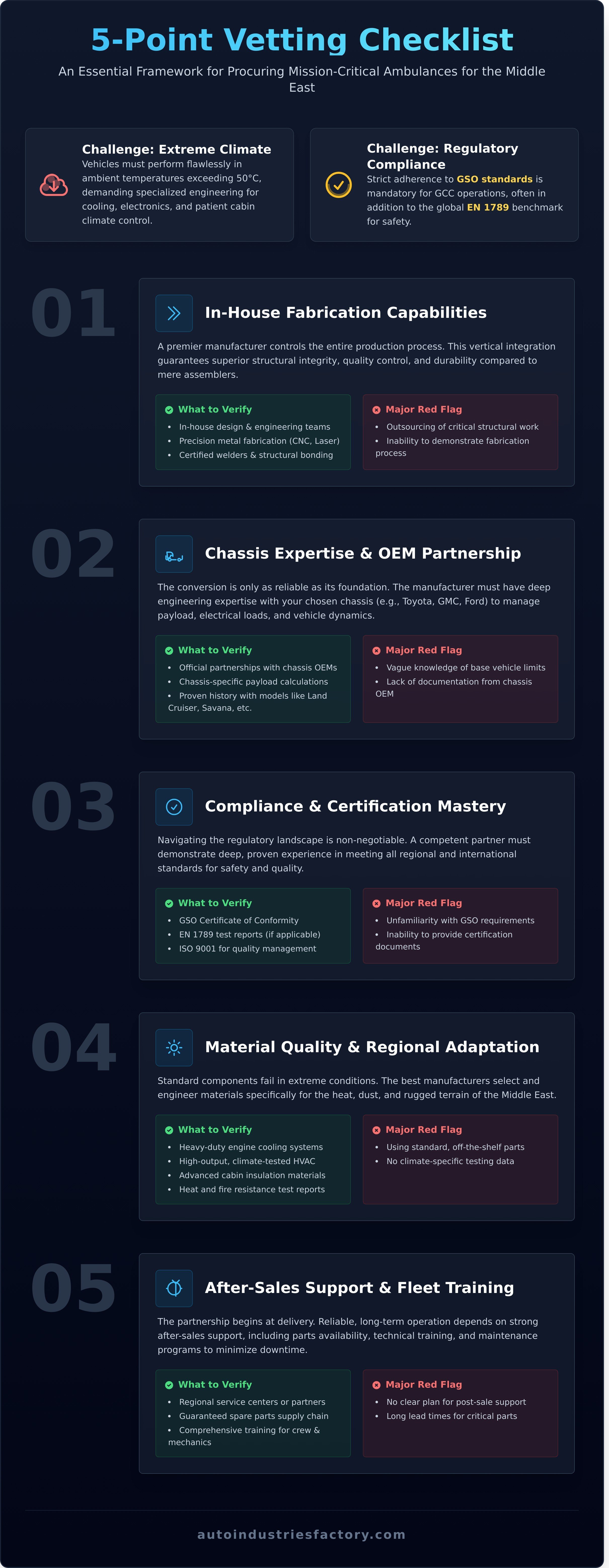
The 5-Point Checklist for Vetting Ambulance Manufacturers
Selecting a partner for your emergency vehicle fleet is a mission-critical decision that extends far beyond the initial price. To identify the best ambulance manufacturers Middle East has to offer, you need an objective framework. This 5-point checklist provides a systematic approach to evaluate a supplier’s true capability, ensuring you invest in ambulances that are durable, compliant, and built for life-saving reliability in demanding environments like those found across Oman.
Criterion 1: In-House Fabrication Capabilities
A premier manufacturer controls the entire production process. Companies with in-house design, precision metal fabrication (CNC, laser cutting), and certified welding deliver a structurally superior and more durable vehicle. They are not mere assemblers. This vertical integration guarantees quality control at every stage, from the sub-frame to the cabinetry. A major red flag is any supplier that outsources critical structural work, as this introduces variables in quality and accountability.
Criterion 2: Chassis Expertise and Partnerships
The ambulance conversion is only as reliable as the base vehicle it’s built upon. A manufacturer must possess deep, proven expertise with your chosen chassis, whether it’s a rugged Toyota Land Cruiser for off-road access or a high-capacity GMC Savana for urban response. This knowledge is crucial for properly managing payload distribution, integrating complex electrical systems without overloading the vehicle, and ensuring the final product maintains its durability and performance characteristics.
Beyond engineering, comprehensive compliance is non-negotiable. Your chosen partner must hold key international certifications like ISO 9001 and demonstrate a thorough understanding of regional requirements, including GSO standards. A manufacturer's familiarity with detailed regulations, such as the Abu Dhabi EMS standards, demonstrates a deep commitment to meeting the highest levels of safety and operational excellence required in the GCC.
Criterion 3: Customization and After-Sales Support
An ambulance is a specialized tool, not a standard product. The best ambulance manufacturers in the Middle East act as true partners, offering extensive customization to tailor layouts, medical equipment integration, and communication systems to your specific operational needs. This flexibility must be backed by a robust after-sales support network, including clear warranty terms, readily available spare parts in the region, and responsive technical assistance to maximize your fleet’s uptime.
An Overview of Ambulance Manufacturers Serving the Middle East
When procuring life-saving vehicles in Oman, you will encounter three distinct categories of suppliers. Each offers a different level of quality, customization, and long-term value. The market includes large international brands, dedicated regional specialists, and smaller local converters. Applying the 5-point evaluation checklist from the previous section is essential to critically assess any potential partner, regardless of their size or origin.
Global Players vs. Regional Specialists
Large international manufacturers offer the benefit of globally recognized vehicle platforms and extensive production histories. However, their solutions are often standardized for a global market, potentially lacking the specific modifications needed for Oman's demanding climate and operational protocols. Furthermore, the final conversion and outfitting work may be subcontracted to a local partner, leading to potential inconsistencies in quality and accountability.
In contrast, a regional specialist is purpose-built for the GCC market. These companies possess an intrinsic understanding of local supply chains, maintenance challenges, and the nuances of navigating regional regulations. Because their engineering, fabrication, and assembly processes are consolidated in-house and within the region, they offer superior quality control and a more direct line of communication, making them strong contenders for the best ambulance manufacturers Middle East clients can partner with.
How to Identify a True Specialist
Distinguishing a genuine specialist from a simple importer requires due diligence. A true manufacturing partner provides more than just a vehicle; they deliver an engineered solution built for mission reliability. Look for these key indicators of expertise:
- Proven Regional Performance: Request a portfolio of completed projects and testimonials from clients in Oman or neighbouring GCC countries, such as government health authorities or major private hospitals.
- Factory Transparency: A confident manufacturer will welcome a factory tour, either in-person or virtually. This allows you to witness their engineering capabilities, from metal fabrication and assembly to electrical systems and quality assurance, firsthand.
- Regulatory Command: An expert will not hesitate to discuss technical standards. They should fluently explain how their vehicles comply with GSO requirements and can detail their adherence to critical benchmarks like the Abu Dhabi Department of Health ambulance standards, which often inform best practices across the region.
Finally, smaller local converters may offer basic vehicle modifications at a lower cost, but they typically lack the deep engineering, certification, and robust testing required for advanced life support (ALS) or critical care ambulances. For mission-critical fleets, a proven specialist is the most reliable investment.
Beyond the Box: Key Differentiators in Ambulance Construction
A detailed specification sheet can list every piece of equipment, but it rarely reveals the true quality of an ambulance. The most crucial differentiators lie not in the features list, but in the engineering philosophy and manufacturing process behind the vehicle. The best ambulance manufacturers Middle East distinguish themselves by focusing on the core systems that ensure safety, reliability, and long-term operational performance, especially in demanding environments like those found across Oman.
At the heart of a superior ambulance is its structural integrity. This goes far beyond the base vehicle's chassis. A premium conversion includes a reinforced sub-frame to handle the added weight of medical equipment and the stress of emergency driving. Integrated rollover protection cages and reinforced body panels are not optional extras; they are fundamental safety features that protect both crew and patient in the event of an accident. This foundational strength is what separates a durable, long-lasting emergency vehicle from a simple van conversion.
The Critical Role of the Electrical System
A mission-critical ambulance relies on an isolated, heavy-duty electrical system to power life-support equipment without fail. Advanced multiplex systems reduce complexity and potential failure points, while intelligent battery management and shoreline connections ensure constant readiness. A top-tier manufacturer proves their engineering integrity by providing detailed electrical schematics, which are vital for efficient diagnostics and future upgrades, ensuring your fleet's uptime is maximized.
Interior Design for Efficiency and Safety
The patient compartment must be a model of efficiency and safety. This is achieved through meticulous ergonomic design, placing critical equipment within easy reach to reduce paramedic response times. Patient safety is paramount, with certified cot mounting systems and robust restraints for all equipment to prevent movement during transit. The use of durable, non-porous, and easily sanitized interior materials is non-negotiable for infection control. See examples of expert vehicle conversion solutions to understand this philosophy in action.
Ultimately, when evaluating a provider, look beyond the surface-level features and inquire about their process. A deep focus on structural reinforcement, systems engineering, and ergonomic design is the true hallmark of the best ambulance manufacturers, ensuring your vehicles are built for life-saving reliability and maximum durability.
Partnering with Auto Industries Factory for Your Fleet
When your evaluation framework demands proven quality, full compliance, deep customization, and robust after-sales support, Auto Industries Factory LLC (AIF) stands out as a premier partner. Based in our state-of-the-art facility in Ajman, UAE, we are strategically positioned to serve clients across the region, including Oman. We are recognized among the best ambulance manufacturers Middle East has to offer because we deliver on our promises, with a proven track record of equipping government agencies and private healthcare providers with mission-critical fleets.
Our core expertise lies in the conversion of rugged and reliable chassis from world-class brands like GMC and Toyota. We specifically engineer these vehicles to master the demanding regional terrain, ensuring they perform flawlessly whether navigating city streets or remote landscapes. More than just a supplier, AIF acts as your long-term fleet partner, providing comprehensive support to ensure your vehicles remain dependable and ready for any emergency.
Our In-House Fabrication Advantage
At AIF, we control every critical step of the manufacturing process under one roof. From precision CNC laser cutting and metal fabrication to final assembly, advanced electrical wiring, and flawless painting, our in-house capabilities ensure total quality control. This vertical integration not only guarantees superior structural integrity and durability but also allows for an unmatched level of customization. We encourage prospective clients to visit our facility to see our commitment to engineering excellence firsthand.
Ready to Build Your Next Ambulance?
Your operational requirements are unique, and your emergency vehicles should be built to match. The expert team at Auto Industries Factory LLC is prepared to consult with you to understand your specific challenges and objectives. We provide detailed engineering consultations to design and fabricate the perfect ambulance solution for your mission. Let Auto Industries Factory LLC help you build a fleet you can depend on when lives are on the line. Request a free estimate for your custom ambulance conversion today.
Partner with the Experts for Your Lifesaving Fleet
Choosing an ambulance manufacturer for operations in the Middle East is a decision that directly impacts patient outcomes. As this guide has shown, success depends on a rigorous vetting process and a deep understanding of how advanced fabrication can meet the region's unique environmental and operational demands. By focusing on compliance, durability, and custom capabilities, you can confidently identify the best ambulance manufacturers Middle East has to offer.
The right partnership extends beyond a simple vehicle purchase; it's about securing a fleet engineered for reliability. At Auto Industries Factory, our in-house engineering and fabrication in Ajman, UAE, provides complete quality control. Our deep expertise in GSO and EN 1789 standards has made us the trusted choice for government and private sector clients who require heavy-duty, mission-ready solutions.
Ready to build a fleet that protects what matters most? Contact our experts to design your specialized ambulance fleet. Let us put our proven capability to work for you.
Frequently Asked Questions
What is the typical lead time for a custom ambulance conversion in the Middle East?
A typical custom ambulance conversion requires approximately 8 to 12 weeks from chassis arrival to final delivery. This timeline can vary based on the complexity of the medical equipment integration and the level of custom fabrication required. Factors such as the availability of the base vehicle and specific client-requested modifications can also influence the final production schedule. We provide a detailed project timeline upon confirmation of the final design and specifications for maximum transparency and planning.
What certifications should I demand from an ambulance manufacturer?
You should always demand proof of ISO 9001:2015 certification for quality management systems. Furthermore, ensure the conversion work complies with regional standards, such as those set by Oman's Ministry of Health, and international benchmarks like the European EN 1789 standard. The best ambulance manufacturers Middle East will readily provide documentation for their quality control, materials, and adherence to these critical safety and operational standards, demonstrating their commitment to engineering excellence and crew safety.
Can you build ambulances on a chassis that I provide?
Yes, absolutely. Auto Industries Factory (AIF) specializes in converting client-provided chassis into mission-ready ambulances. We have extensive experience working with a wide range of base vehicles popular in Oman and the GCC, including the Toyota Land Cruiser, Nissan Patrol, Ford Transit, and Mercedes-Benz Sprinter. Our engineering team will assess your chassis to ensure it meets the structural and payload requirements for the intended ambulance type and medical equipment, guaranteeing a safe and durable final product.
Do you handle the shipping and logistics for exporting ambulances to other GCC countries?
Yes, we provide a complete, end-to-end logistics solution. Our dedicated team manages all aspects of exporting ambulances from our UAE facility to Oman and other GCC countries. This includes preparing all necessary export documentation, coordinating with trusted shipping partners, and managing customs clearance procedures to ensure a seamless and timely delivery to your specified location. We handle the complexities of cross-border transport so you can focus on your operations.
What kind of warranty is offered on the conversion work and installed equipment?
We stand behind our engineering with a comprehensive warranty package that ensures reliability and protects your investment. All of our ambulance conversion work, including fabrication, electrical systems, and cabinetry, is covered by a robust 3-year warranty. The premium medical equipment installed is covered by the original manufacturer's warranty, which is typically a minimum of one year. We provide full support to facilitate any claims, ensuring your fleet remains operational and mission-ready.
How do you ensure the ambulance's air conditioning can handle 50°C+ temperatures?
Our ambulances are engineered specifically for the extreme climate of Oman and the wider region. We install heavy-duty, high-output air conditioning systems with separate powerful evaporator units for the patient and driver cabins. The patient compartment features advanced thermal insulation to maintain a stable, cool environment. Every system undergoes rigorous load testing to ensure it delivers exceptional cooling performance and reliability, even when operating in ambient temperatures exceeding 50°C (122°F).
What is the difference between a Type I, Type II, and Type III ambulance?
The ambulance types are defined by their chassis and cabin structure. A Type I ambulance uses a heavy-duty truck chassis with a separate, custom-fabricated patient module. A Type II is a van-based conversion, where the original van body is outfitted as the patient compartment. A Type III ambulance uses a cutaway van chassis with a custom-built patient module that has a pass-through connection to the driver's cab. Each type offers different advantages in terms of space, payload, and maneuverability.


