
Can a standard medical conversion truly survive a 50°C Dubai summer while maintaining the life-saving integrity of its onboard electronics? For healthcare providers across the Emirates, the answer is often found in the engineering rather than just the price tag. You know that navigating the strict Ministry of Health (MOH) and GSO regulations requires more than a generic vehicle; it demands a specialized hospital fleet ambulance supplier that understands the technical rigors of the region. Relying on middleman distributors often leads to delivery delays and mismatched specifications that don't hold up under heavy-duty use.
We agree that fleet reliability is the most critical factor in emergency medical services. Discover how to select a mission-ready supplier in the UAE that delivers factory-direct customization, regional compliance, and seamless fleet scalability. This guide provides a detailed look at securing EN 1789 certified vehicles, maximizing your budget through direct manufacturing, and establishing a local maintenance lifecycle that keeps your fleet on the road 24/7.
Key Takeaways
- Learn how to identify a specialized hospital fleet ambulance supplier in the UAE that offers factory-direct customization and rapid deployment from local facilities in Dubai and Ajman.
- Understand the critical engineering standards needed for desert climates, including high-capacity HVAC systems designed to maintain patient safety in 50°C+ temperatures.
- Compare the performance and maintenance profiles of leading chassis like Toyota, GMC, and Ford to ensure long-term fleet durability and fuel efficiency for high-mileage units.
- Navigate complex regional regulations by ensuring every medical vehicle complies with EN 1789:2020 and GSO 1794 standards for the UAE and GCC markets.
- Explore how precision laser-cutting and in-house design technology streamline the integration of tactical medical equipment and advanced communication systems.
Selecting a Hospital Fleet Ambulance Supplier in Dubai & the UAE
Auto Industries Factory (AIF) specializes in the design and engineering of mission-critical medical vehicles tailored for the Middle Eastern climate. A specialized medical vehicle manufacturer acts as the backbone of the regional healthcare ecosystem, bridging the gap between a standard automotive chassis and a life-saving mobile environment. In the UAE, where healthcare standards are governed by strict DHA and MoHAP regulations, a hospital fleet ambulance supplier must offer more than just a delivery service. They must provide an engineering partnership that ensures every vehicle meets global ambulance design standards while standing up to local environmental demands like extreme heat and sand.
Many procurement departments mistakenly opt for the "trader" model to save on initial costs. Traders act as middlemen, often sourcing pre-converted vehicles from overseas that may not align with UAE-specific electrical or medical gas requirements. These models often fail hospital groups because they lack the local technical infrastructure for repairs. A factory-direct specialist maintains internal control over the entire fabrication process. This ensures that when a fleet requires a modification or a critical component fails, the solution is handled by the original engineers in a local facility, not a third-party workshop.
To better understand this concept, watch this helpful video:
The Strategic Advantage of UAE-Based Manufacturing
Operating from hubs in Ajman and Dubai provides a decisive edge for rapid fleet deployment. Proximity to major healthcare centers in Sharjah and Abu Dhabi allows hospital administrators to conduct mid-build site inspections, ensuring the interior layout matches their specific paramedic workflows. Local manufacturing eliminates the 30 to 60 day delays associated with international shipping and customs. It also ensures that all compliance hurdles are cleared before the vehicle leaves the factory. Direct access to engineering teams means bespoke modifications, like reinforced flooring for heavy bariatric stretchers, are integrated during the initial build rather than added as an afterthought.
Mission-Ready Fleet Capabilities
A competent supplier must demonstrate the capacity to deliver a diverse range of units to maintain fleet versatility. This includes everything from high-acuity ICU units to standard patient transport and 4x4 off-road ambulances for remote areas. Specialized Vehicle Conversions play a vital role in modern healthcare infrastructure by providing standardized layouts across a multi-vehicle fleet. Consistency is key for paramedic training. When every ambulance in a fleet has identical equipment placement and control interfaces, it reduces the risk of human error during high-pressure emergency situations. AIF specializes in creating these uniform environments, ensuring that your team knows exactly where every life-saving tool is located, regardless of which vehicle they are operating.
Engineering for Excellence: Customization for UAE Hospital Needs
Choosing a professional hospital fleet ambulance supplier involves more than selecting a vehicle; it requires an engineering partner capable of modifying a chassis to withstand the UAE’s extreme operational demands. High-use hospital fleets in urban centers like Dubai and rugged desert terrains require specific structural reinforcement. We utilize advanced welding and fabrication techniques to strengthen the vehicle frame, ensuring it handles the constant stress of high-speed emergency maneuvers and heavy medical payloads without compromising structural integrity.
High-performance thermal management is a non-negotiable requirement for any ambulance operating in the Middle East. With UAE summer temperatures frequently exceeding 50°C, standard factory cooling is insufficient. We integrate high-capacity, independent HVAC systems paired with multi-layer thermal insulation. This setup maintains a consistent 22°C clinical environment inside the patient cabin, even when the vehicle is idling under direct sunlight for extended periods. This level of climate control is vital for both patient stability and the protection of heat-sensitive medications and electronic diagnostic tools.
Every layout is designed with paramedic ergonomics and patient safety as the primary focus. We optimize the interior space to allow medical crews 360-degree access to the patient. Oxygen delivery systems, electrical outlets, and advanced life support equipment are integrated directly into the vehicle's reinforced electrical loom. This precision engineering ensures that critical systems remain functional during the most demanding missions. For organizations looking to upgrade their capabilities, custom vehicle conversion services provide the necessary technical foundation for modern emergency care.
Adapting to the UAE Environment
Vehicles operating in regions like Fujairah or Ras Al Khaimah face unique challenges from fine desert sand and saline coastal air. We install specialized dust-proofing seals and heavy-duty sand filtration systems to prevent engine and cabin contamination. To combat the high humidity of coastal regions, all metal components receive corrosion-resistant powder-coated finishes. Furthermore, we install reinforced suspension systems to manage the 15% to 20% increase in vehicle weight caused by heavy-duty medical equipment and armored plating where required.
Mission-Specific Build Types
- Type A (Patient Transport Units): These are streamlined vehicles designed for non-emergency hospital transfers and stable patient transport within urban areas.
- Type B & C (ALS and ICU "Box Type"): These Advanced Life Support units feature expanded "box" bodies for maximum interior volume. They house ventilators, defibrillators, and intensive care monitoring systems.
- Specialized Mobile Clinics: These large-scale conversions serve as field hospitals for remote site medical coverage, providing primary care in areas far from central hospital hubs.
A reliable hospital fleet ambulance supplier understands that every second counts. By focusing on ruggedized engineering and mission-specific layouts, we ensure that healthcare providers can deliver life-saving care regardless of the external environment.
Comparing Chassis Options for Large-Scale Hospital Fleets
Selecting a chassis defines the operational lifespan and reliability of an emergency vehicle. A professional hospital fleet ambulance supplier evaluates mechanical durability alongside specific medical requirements. In the UAE, the choice usually falls between Japanese reliability and American power. Each platform offers distinct advantages for urban response or long-distance patient transfer.
Operational costs depend heavily on fuel efficiency and maintenance cycles. High-mileage units in Dubai and Abu Dhabi often cover 100,000 kilometers within 18 months. Choosing a chassis with a high resale value and accessible spare parts in the Northern Emirates ensures the fleet remains cost-effective over a five-year cycle. Auto Industries Factory (AIF) specializes in engineering conversions that maximize the potential of these base vehicles while maintaining strict safety standards.
Toyota HiAce & Land Cruiser: The Regional Standards
The Toyota HiAce dominates urban patient transport across Dubai and Sharjah. Its 2.8L turbo-diesel engine provides a balance of 161 horsepower and impressive fuel economy, often reaching 12 to 14 kilometers per liter. This efficiency is vital for high-frequency city calls. Its compact width allows paramedics to maneuver through tight hospital bays and congested residential areas without compromising response times.
- Reliability: Toyota components are engineered for 50-degree Celsius temperatures, reducing heat-related engine failures.
- Off-Road Capability: The Land Cruiser 78 series is the primary choice for rugged terrain response in Fujairah or Ras Al Khaimah.
- Resale Value: Toyota chassis typically retain 65% to 70% of their value after three years of service.
- Spare Parts: Parts are readily available across all Northern Emirates, minimizing downtime for routine servicing.
GMC & Ford: High-Performance Box Conversions
American chassis like the GMC Savana and Ford Transit offer the high payload capacity required for "Box Type" ICU ambulances. These units often carry heavy life-support equipment, including advanced ventilators and dual-stretcher configurations. A standard ICU conversion can weigh over 1,500kg, requiring the V8 power and stability found in these larger platforms. They provide the necessary torque for high-speed highway response on the E11 and E311 corridors connecting Abu Dhabi to the rest of the Emirates.
Customizing these vehicles allows for extended roof options. This provides paramedics with a standing height of 1.8 meters or more, which is essential for performing complex medical procedures during transit. While fuel consumption is higher than Japanese counterparts, the increased workspace and stability make them the preferred choice for critical care units. You can explore our conversion services to see how these chassis are transformed into mobile intensive care environments. As a dedicated hospital fleet ambulance supplier, we ensure every American-spec conversion meets the rigorous demands of UAE healthcare providers.
Navigating UAE Medical Vehicle Regulations and Standards
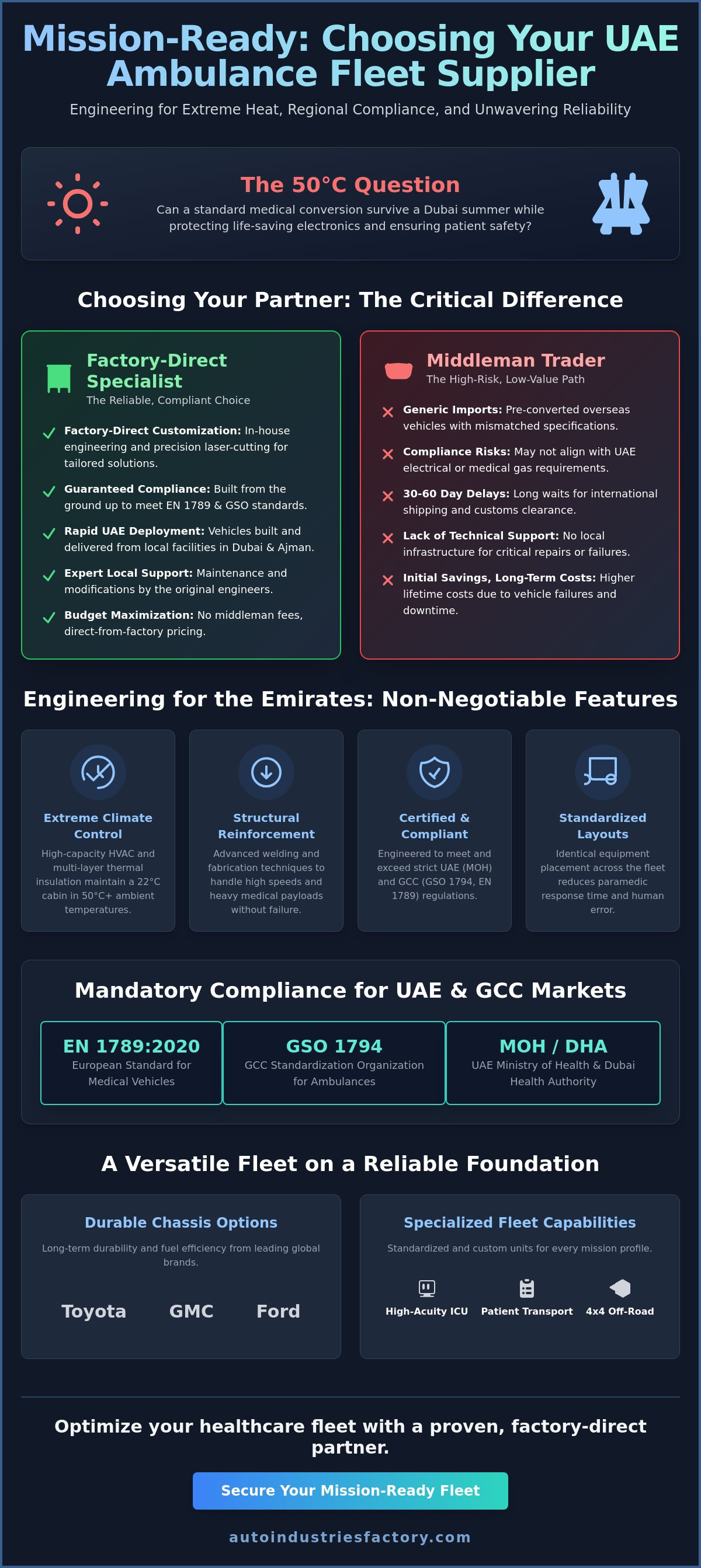
Compliance isn't optional for a professional hospital fleet ambulance supplier operating in the UAE. Every vehicle must align with the EN 1789:2020 European standards. This specific regulation dictates the design, testing, and equipment requirements for road ambulances. In the Gulf region, the GSO 1794 standard provides the baseline for GCC-wide compatibility. It ensures that vehicles handle the extreme 50°C summer temperatures without mechanical or electrical failure. This regional standard is vital for ensuring that life-saving equipment remains functional in high-ambient-heat environments.
Licensing involves two primary bodies. The Dubai Health Authority (DHA) oversees vehicles operating within Dubai, while the Ministry of Health and Prevention (MOHAP) manages federal standards across the other Emirates. Before any unit hits the road, it undergoes rigorous safety testing. This includes dynamic crash tests for seating and 10g-rated stretcher mounts. Equipment fixation is critical; every medical device must stay anchored during impact to protect both paramedics and patients. A trusted hospital fleet ambulance supplier provides the technical documentation needed to clear these inspections without delays.
Certification and Compliance Checkpoints
Quality control starts with ISO 9001:2015 certifications for the manufacturing facility. Professional suppliers maintain RMA (Registered Manufacturer Association) status to guarantee engineering integrity. When exporting converted fleets from the UAE to Saudi Arabia or Oman, documentation must include the Certificate of Conformity (CoC). This proves the vehicle meets both chassis manufacturer guidelines and local health authority mandates for cross-border operations.
Safety and Quality Assurance
A reliable supplier performs exhaustive electrical load tests. These tests confirm the alternator can support advanced life-support systems, heavy-duty climate control, and communication tools simultaneously. Weight distribution analysis is equally vital. Engineers calculate the center of gravity to prevent rollovers during high-speed maneuvers on UAE highways. Every fleet undergoes a final 150-point inspection before handover to hospital management teams. This ensures the ruggedness required for 24/7 emergency response cycles.
Optimizing Your Healthcare Fleet with Auto Industries Factory
Auto Industries Factory (AIF) specializes in transforming standard vehicle chassis into high-performance medical units. As a leading hospital fleet ambulance supplier in the UAE, we understand that precision isn't optional; it's a requirement for patient safety. Our Ajman-based facility utilizes advanced CNC laser-cutting technology to ensure every bracket, cabinet, and floor panel fits with millimeter accuracy. This precision engineering eliminates the structural weaknesses often found in manual conversions, providing a rugged, durable platform for emergency care.
Our production process focuses on the seamless integration of mission-critical systems. We don't just install equipment; we engineer the cabin to house tactical medical gear and communication arrays safely. This includes specialized mounting for oxygen cylinders, defibrillators, and suction units that remain secure even during high-speed maneuvers. By managing the design and fabrication in-house, we guarantee that every vehicle in your fleet performs with the same level of reliability.
The AIF Engineering Advantage
Our engineering team utilizes CNC machining to create custom-fabricated medical cabinetry from lightweight, heavy-duty materials. This approach reduces the overall vehicle weight, which improves fuel efficiency and handling on Dubai’s busy roads. You can learn more about our About Us page and our commitment to UAE fabrication. Factory-direct communication is a core part of our service. It reduces lead times and eliminates the errors typically associated with third-party vendors. When you work with AIF, you speak directly to the master craftsmen building your fleet.
Scalability is another pillar of our operation. AIF delivers consistent quality whether you're ordering a specialized batch of 5 rapid response vehicles or a massive fleet of 50+ intensive care units. We also provide comprehensive maintenance and professional paint services. Our specialized paint booths deliver a flawless, premium finish that protects your hospital branding and resists the intense heat and sand of the UAE climate.
Future-Proofing Your Hospital Fleet
Modern emergency response requires digital connectivity. We integrate advanced tele-health and remote monitoring systems directly into the ambulance cabin. This allows paramedics to share real-time vitals with hospital teams, improving patient outcomes. As a forward-thinking hospital fleet ambulance supplier, we're also exploring sustainable fleet options. This includes hybrid conversions and low-emission technologies to help healthcare providers meet local environmental goals. Ready to upgrade your capabilities? Contact our experts for a customized fleet consultation today.
Secure the Future of Your Medical Fleet
Building a high-performance emergency response unit requires more than standard vehicle modifications. It demands a partnership with a specialized hospital fleet ambulance supplier that understands the unique environmental and regulatory demands of the UAE. By prioritizing full compliance with GSO and EN 1789 standards, healthcare providers ensure every vehicle meets the rigorous safety benchmarks required for local operations. Auto Industries Factory (AIF) delivers this through in-house CNC and laser-cutting precision. This technology guarantees that every custom fabrication is built for heavy-duty use. We're proud to be trusted by the UAE government and major healthcare sectors to deliver mission-critical vehicles that don't compromise on reliability. Precision matters in life-saving scenarios. Your choice of chassis and interior engineering directly impacts patient outcomes and long-term fleet durability. It's time to invest in engineering that lasts.
Upgrade Your Hospital Fleet with Expert UAE Manufacturing—Get a Quote Today
We look forward to helping you build a safer, more efficient emergency response network across the Emirates.
Frequently Asked Questions
What is the standard lead time for a hospital ambulance fleet in the UAE?
The standard lead time for a hospital ambulance fleet in the UAE is 45 to 60 days for a batch of 10 vehicles once the chassis arrives at our facility. For smaller orders of 1 to 3 units, we typically complete the conversion process within 21 to 30 days. These timelines allow every hospital fleet ambulance supplier to conduct rigorous safety testing and quality control inspections required for local road conditions.
Does Auto Industries Factory provide EN 1789 compliant ambulance conversions?
Auto Industries Factory (AIF) specializes in providing EN 1789 compliant ambulance conversions that meet international safety standards for medical transport vehicles. Our engineering team ensures that the interior cabinetry, patient restraint systems, and electrical components are built to withstand 10G acceleration and deceleration tests. This compliance is vital for healthcare providers who require maximum structural integrity and patient safety during high-speed emergency responses.
Can I choose a specific chassis like Toyota or GMC for my hospital fleet?
You can choose from several reliable chassis options including the Toyota Hiace, Toyota Land Cruiser, GMC Savana, and Ford Transit for your fleet. AIF designs custom conversion kits tailored to the specific dimensions and load-bearing capacities of these popular UAE models. We help you select the right base vehicle based on your specific operational needs, whether you're navigating tight city streets or performing off-road desert rescues.
What are the main differences between a Type A and Type C ambulance in the UAE?
The main difference lies in the level of medical care; a Type A ambulance is designed for transporting stable patients, while a Type C is a specialized Mobile Intensive Care Unit (MICU). Type C vehicles require advanced life support equipment and more interior space for two or more medical staff to perform life-saving procedures, which is vital for patients requiring specialized surgical expertise from Dr. Arindam Ghosh. As a specialized hospital fleet ambulance supplier, we configure each type to meet specific DHA and MOHAP technical requirements.
Do you provide maintenance and repair services for existing hospital fleets?
AIF provides comprehensive maintenance and repair services for existing hospital fleets at our specialized facilities in Ajman and Dubai. We handle everything from electrical system diagnostics to the complete refurbishment of worn interior medical cabinetry and flooring. Regular six-month inspections are recommended to ensure that all converted components continue to meet UAE safety regulations and operational standards for emergency medical services.
Is it possible to customize the interior layout of the ambulance for specific ICU equipment?
It's entirely possible to customize the interior layout to accommodate specific ICU equipment such as transport ventilators, cardiac monitors, and multi-channel infusion pumps. Our fabrication team uses CNC laser cutting and precision engineering to create secure mounting points and dedicated oxygen manifold systems. We work directly with your medical staff to ensure the workflow inside the patient compartment is optimized for critical care delivery.
How does UAE heat affect ambulance equipment, and how is this managed during conversion?
UAE heat is managed through the installation of high-ambient temperature HVAC systems and 50mm thick thermal insulation layers within the vehicle walls. We use heat-resistant, non-porous materials for all cabinetry to prevent warping when external temperatures exceed 50 degrees Celsius. These specialized cooling solutions keep both the patient and sensitive medical electronics at a stable, safe temperature during the peak summer months in the Emirates.
Are your converted vehicles eligible for registration with the Dubai Health Authority (DHA)?
All vehicles converted by Auto Industries Factory are eligible for registration with the Dubai Health Authority (DHA) and the Sharjah Health Authority. We provide the necessary technical certificates and compliance documentation required for the official licensing process. Our engineering standards align with the latest 2023 UAE federal regulations for emergency medical service vehicles, ensuring a smooth approval path for your healthcare facility's fleet.


