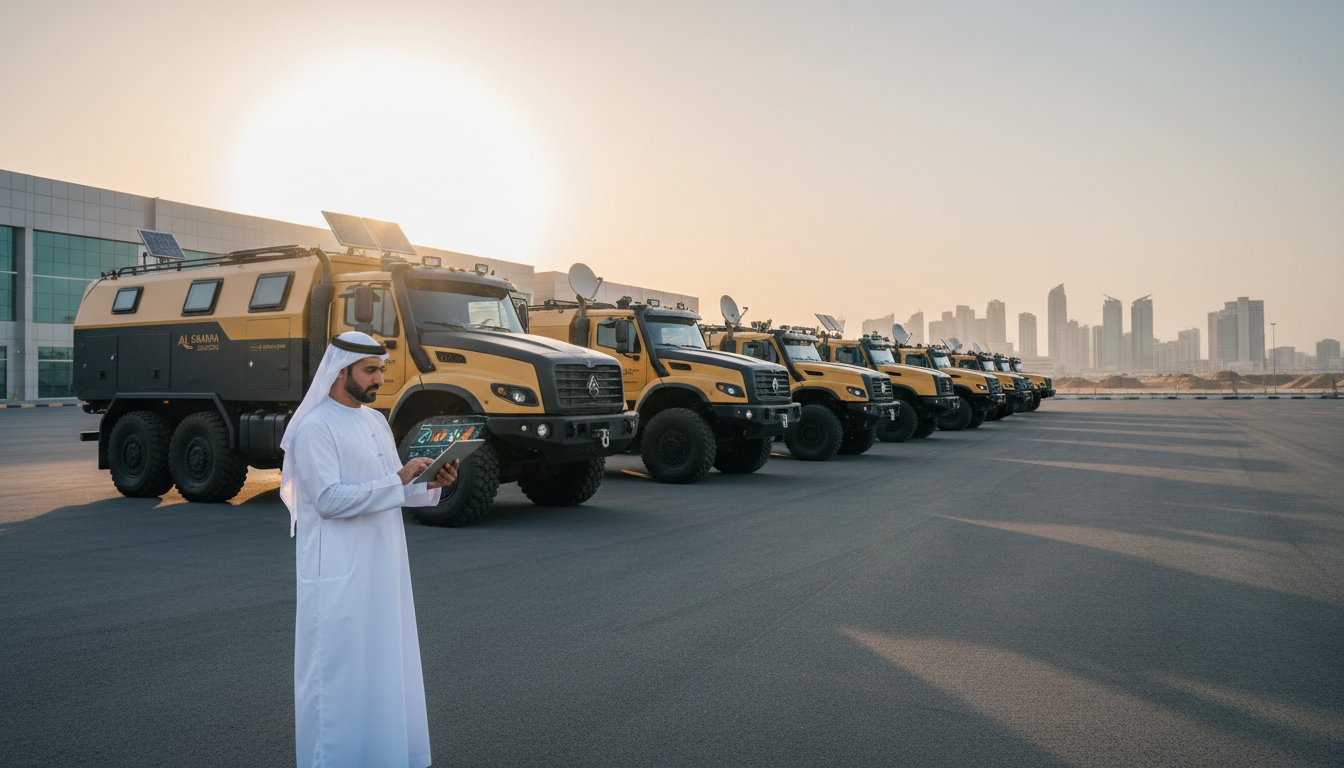
The directive from the finance department is often uncompromising: reduce upfront procurement costs. But when a low-bid vehicle conversion fails under the demanding regional climate, the real expenses in operational downtime and emergency repairs quickly dismantle any initial savings. This cycle of equipment failure doesn't just strain your budget; it directly compromises mission readiness when it matters most. For fleet managers, the challenge is clear.
This is your definitive 2026 guide to justifying custom vehicle fleet costs not as an expense, but as a strategic investment in capability and long-term value. Auto Industries Factory LLC understands this challenge deeply. We provide a powerful, data-backed framework to build a bulletproof business case for your CFO, proving how premium, heavy-duty conversions deliver a superior Return on Investment (ROI). You will learn to shift the focus from acquisition price to Total Cost of Ownership (TCO), ensuring your specialized fleet is engineered for maximum lifespan and flawless performance in challenging conditions across the GCC.
Key Takeaways
- Learn to shift your focus from initial acquisition price to a comprehensive Total Cost of Ownership (TCO) model that accounts for operational reliability and future resale value.
- Discover a strategic framework for justifying custom vehicle fleet costs by aligning the investment directly to your organization's core mission and operational goals.
- Understand the critical difference between low-cost bolt-on parts and structurally integrated conversions to evaluate true long-term durability and safety.
- Explore how leveraging local UAE-based engineering provides a strategic advantage for Omani fleets, ensuring faster turnaround on maintenance and mission-critical parts.
Beyond the Sticker Price: Redefining Custom Fleet Costs in 2026
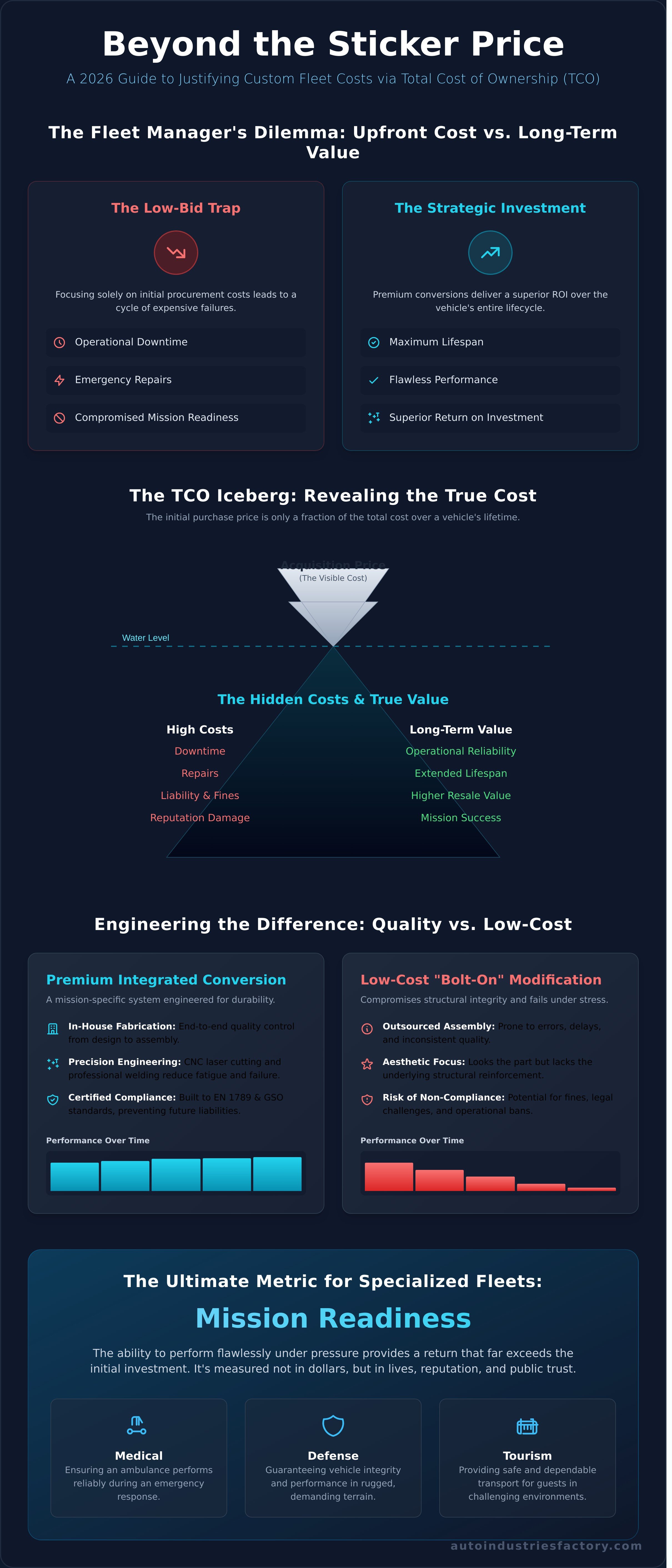
In 2026, fleet management in Oman and across the GCC has evolved far beyond a simple price comparison. The true cost of a specialized vehicle is not found on the initial invoice; it's a complex calculation of acquisition, operational integration, and long-term reliability. This modern approach requires a strategic shift from a "lowest bid" mentality to a "highest utility" model. Evaluating the complete Total Cost of Ownership reveals that a higher upfront investment in precision engineering often yields substantial savings and superior performance over the vehicle's lifecycle. This is the cornerstone of justifying custom vehicle fleet costs for mission-critical operations.
To better understand this crucial concept, the following video provides a clear breakdown of calculating total cost of ownership for your fleet:
For critical infrastructure in sectors like Medical, Defense, and Tourism, a standard vehicle is often a liability. There is a fundamental difference between an aesthetic modification-like a custom paint job-and a mission-critical engineering conversion, such as reinforcing a chassis or installing certified medical-grade equipment. As the demand for specialized vehicles grows, the UAE has become a central hub for advanced fabrication, providing robust, purpose-built solutions designed to excel in the demanding conditions of the region.
The Economic Impact of Mission Failure
What is the cost of an ambulance's engine overheating during an emergency response in the desert? It's measured not just in repair bills, but in lives, reputation, and public trust. Custom engineering-including upgraded cooling systems, heavy-duty suspension, and ingress protection-prevents these catastrophic failures. Ultimately, Mission Readiness is the ultimate ROI metric for fleets, where the ability to perform flawlessly under pressure provides a return that far exceeds the initial investment.
Compliance as a Cost-Saving Measure
Adhering to rigorous international standards like EN 1789 for ambulances or regional GSO regulations is not an expense; it's a strategic investment. Compliant conversions prevent costly future liabilities from fines, insurance claim denials, and legal challenges. For businesses in Oman, sourcing from a certified fabricator like Auto Industries Factory (AIF) ensures that each unit is built to the highest safety and performance specifications, securing long-term operational value and simplifying international export.
The Engineering Behind the Investment: Why Quality Conversions Command a Premium
A custom fleet vehicle is more than just a base model with added accessories; it is an integrated, mission-specific system. The difference between a low-cost modification and a premium-grade conversion lies in the engineering that occurs beneath the surface. While "bolt-on" parts may look the part, they often compromise the vehicle's structural integrity and fail under operational stress. At Auto Industries Factory (AIF), we focus on high-precision fabrication and integrated reinforcements, providing a robust platform that ensures long-term reliability and performance.
In-House Fabrication vs. Outsourced Assembly
Managing the entire conversion process in-house, from design to final assembly, is fundamental to quality control. This end-to-end manufacturing approach eliminates the errors and delays common with outsourced components. Our investment in advanced CNC laser cutting and professional welding ensures that every cut is precise and every joint is strong, drastically reducing the vibration-related fatigue that plagues 4x4 vehicles in rugged terrain. This precision guarantees that every unit in a fleet is identical and performs to the same high standard. Investing in this design integrity upfront prevents expensive mid-cycle repairs, a critical factor in any Total Cost of Ownership analysis for government fleets, and is essential for justifying custom vehicle fleet costs over the vehicle's entire service life.
Durability in Extreme GCC Climates
Operating a specialized fleet in Oman demands engineering that accounts for extreme environmental challenges. Standard components are simply not built to withstand the intense summer heat, coastal humidity, and fine desert sand. This is why we integrate:
- Advanced Cooling Systems: Upgraded radiators and auxiliary coolers to protect engines and critical equipment under heavy load.
- Specialized Coatings: Heat-reflective finishes that reduce cabin temperatures and protect sensitive electronics.
- Robust Electrical Systems: A standard passenger car's electrical system will fail when tasked with powering medical, communication, or tactical equipment. We engineer heavy-duty systems with higher-capacity alternators and wiring to handle the load reliably.
System Integration and Weight Distribution
Adding significant weight through armoring or heavy equipment fundamentally alters a vehicle's dynamics. The science of maintaining a low and stable Center of Gravity (COG) is critical for operator safety and vehicle longevity. Our engineers meticulously calculate and manage weight distribution to preserve handling characteristics and prevent rollovers. Proper load balancing directly extends the life of core components like suspension and braking systems, reducing long-term maintenance costs. Furthermore, effective payload management is directly linked to improved fuel efficiency, as a balanced and optimized vehicle requires less energy to operate.
Total Cost of Ownership (TCO) vs. Initial Price: The Hidden Risks of Under-Specifying
A low initial price is often a mask for exorbitant long-term expenses. Fleet managers in Oman focused solely on the upfront invoice fall into the "Cheap Trap," where budget conversions lead to spiraling costs from excessive downtime, frequent repairs, and higher insurance premiums. The true measure of value is not the purchase price, but the Total Cost of Ownership (TCO) over the vehicle's entire operational lifecycle. A professionally engineered unit from Auto Industries Factory (AIF) is a strategic asset designed to minimize these hidden costs.
Calculating the 5-Year Lifecycle Cost
When analyzing a 5-year operational window, the financial advantages of a premium conversion become undeniable. A budget build may save $5,000 upfront but can easily incur over $15,000 in extra maintenance, parts, and lost revenue from downtime. AIF's precision-engineered conversions, built with heavy-duty materials and certified techniques, reduce unscheduled maintenance by up to 30%. This TCO-focused approach is critical when building the business case for fleet technology and advanced custom vehicles. Furthermore, our focus on durability significantly flattens the depreciation curve, ensuring a higher resale value in the secondary market. This value is protected by transferable warranties and accessible, local support right here in the region.
The "Safety Premium": Justifying Costs through Risk Mitigation
Beyond operational expenses, under-specifying a vehicle introduces significant safety and financial risks. Inadequately fabricated components can fail under stress, leading to accidents, costly workplace injuries, and potential legal liabilities. This is a core component of justifying custom vehicle fleet costs: investing in safety is not an expense, but a critical form of risk mitigation. Our custom-fabricated bull bars and reinforced chassis are not cosmetic additions; they are engineered safety systems designed to protect your most valuable asset-your crew. A clear example is the ROI of armoring military troop carriers: the upfront investment is minimal compared to the immense cost of compromising personnel safety and mission success.
Strategic Framework: How to Present the Business Case for Specialized Conversions
Securing the budget for purpose-built vehicles requires shifting the conversation from initial price to long-term operational value. For fleet managers in Oman, successfully justifying custom vehicle fleet costs involves a strategic presentation grounded in data, mission alignment, and forward-thinking engineering. It’s about demonstrating that a specialized conversion is not an expense, but a critical investment in efficiency, safety, and mission success.
The first step is to align the fleet upgrade directly with your organization’s core objectives. Whether for emergency medical services where response times save lives, or for oil and gas exploration in rugged terrain where vehicle failure means costly downtime, the vehicle's role is mission-critical. Next, meticulously document the "pain points" of your current standard fleet. Calculate the real costs of frequent repairs, operational limitations, and safety incidents-all quantified in USD. This data transforms the argument from a request for a new vehicle into a solution for existing, expensive problems.
Building the ROI Presentation
A compelling return on investment (ROI) case is built on hard evidence. Use maintenance logs and failure reports to show how standard vehicles underperform in specialized roles, leading to higher lifetime costs. Emphasize the value of modular designs that allow for future technology upgrades rather than complete vehicle replacement. To add tangible proof of quality, encourage stakeholders to conduct a physical quality audit by arranging a visit to the AIF facility in Ajman, where they can witness the engineering and fabrication standards firsthand.
Navigating Procurement and Tenders
In the procurement phase, the technical specifications are your most powerful tool. Write tenders that prioritize performance, durability, and safety standards over the lowest price. Specify key processes like "Factory Acceptance Testing" (FAT) as a mandatory contract clause. This ensures each vehicle is rigorously tested and approved at the factory before shipment, eliminating costly on-site issues. For government and semi-government tenders in Oman, highlighting the value of UAE-based manufacturing can be a significant advantage, citing benefits like regional expertise, faster support, and simplified logistics.
Maximizing Fleet Longevity with Auto Industries Factory (AIF) Engineering
A vehicle is more than an asset; it is a critical operational tool engineered for a specific mission. At Auto Industries Factory (AIF), we specialize in transforming robust standard chassis from GMC and Toyota into elite, specialized units built for maximum durability and performance. For fleet operators in Oman, our strategic location in the UAE provides a vital logistical advantage, ensuring rapid turnaround for custom parts and expert repairs to minimize downtime and protect your investment.
True fleet optimization means moving beyond generic, one-size-fits-all accessories that often compromise on fit and resilience. AIF’s in-house, precision fabrication delivers superior, purpose-built components that integrate flawlessly with your vehicles.
- Custom Bull Bars: Engineered to match your vehicle's specific chassis for maximum frontal protection in demanding conditions.
- Heavy-Duty Roof Racks: Designed to handle specific load requirements safely, without compromising vehicle stability or dynamics.
- Integrated Storage Solutions: Tailored to secure valuable equipment efficiently, improving workflow and operator safety.
This meticulous approach is the AIF Signature-a powerful combination of rugged, field-tested capability and professional aesthetics that enhances your brand image and operational readiness.
Ambulance Solutions: Built for Life-Saving
AIF engineers premium ALS and BLS ambulances, featuring extended roof conversions on GMC and Toyota platforms for an optimal mobile medical workspace. We seamlessly integrate certified medical oxygen, advanced electrical, and powerful suction systems. Our medical interiors set the gold standard for hygiene and durability, using non-porous, easy-to-sterilize materials essential for demanding healthcare environments.
Tactical and Defense Conversions
For police and defense units operating across Oman, structural integrity is non-negotiable. We expertly reinforce vehicle chassis and cabins for troop carriers and tactical units, integrating advanced communications and surveillance equipment without sacrificing cabin space. Custom painting and specialized protective coatings ensure long-term durability in diverse operational environments, from arid deserts to coastal regions.
Safari and Off-Road Excellence
In Oman’s world-class tourism sector, justifying custom vehicle fleet costs is directly tied to delivering an unforgettable guest experience. We engineer custom suspension systems for a smoother, safer ride over rugged terrain and design guest-focused seating that maximizes both comfort and viewing angles. This focus on quality helps safari operators protect their most important asset: their reputation.
Investing in expert conversion from a specialist like Auto Industries Factory is the most effective strategy for ensuring fleet sustainability and long-term ROI. It is the definitive method for justifying custom vehicle fleet costs by building vehicles that simply last longer and perform better. Contact AIF today for a free estimate on your custom fleet conversion.
From Cost to Capability: The Final Word on Fleet Investment
As we've explored, the process of justifying custom vehicle fleet costs within Oman’s demanding operational landscape requires a strategic shift in perspective. The true measure of value is not the initial purchase price, but the long-term Total Cost of Ownership (TCO). Investing in premium, purpose-built conversions means prioritizing mission reliability, maximizing vehicle longevity, and reducing costly downtime. This approach transforms your fleet from a significant expense into a powerful, performance-driven asset.
Auto Industries Factory (AIF) delivers this strategic advantage. Trusted by the UAE Police and Military, our in-house CNC and laser fabrication capabilities ensure every specialized GMC and Toyota conversion meets the highest standards of durability. We provide the robust, heavy-duty engineering that underpins a compelling business case for your investment and guarantees performance in the toughest conditions.
Ready to build a fleet that delivers a measurable return? Upgrade Your Fleet with AIF Precision Engineering and equip your operations for the challenges of 2026 and beyond.
Frequently Asked Questions
Why is the initial cost of a custom vehicle conversion so much higher than a standard model?
The higher initial cost reflects the precision engineering, specialized labor, and premium, heavy-duty materials required for a custom build. Unlike mass-produced vehicles, each conversion involves bespoke design and fabrication tailored to your operational needs. This level of quality and purpose-built functionality is a key factor in justifying custom vehicle fleet costs, as it ensures mission-critical reliability and compliance with standards like those from Oman’s Ministry of Health for ambulances.
How does a custom-built fleet improve my company’s bottom line over three years?
A custom-built fleet boosts your bottom line through enhanced operational efficiency and durability. Purpose-built vehicles reduce task time, lower fuel consumption from optimized layouts, and minimize costly downtime with heavy-duty components designed for Oman's demanding climate. These long-term gains in productivity and reduced maintenance are key factors in justifying custom vehicle fleet costs. Over three years, the total cost of ownership is often significantly lower than that of a standard fleet requiring constant modification and repair.
What are the most critical factors to consider when choosing a conversion partner in the UAE?
When selecting a partner in the UAE for your Omani fleet, prioritize their in-house engineering and fabrication capabilities. A partner with advanced CNC machinery and a dedicated design team ensures precision and quality control. Verify their experience with Omani regulations, such as Royal Oman Police (ROP) specifications for security vehicles. Finally, assess their after-sales support structure, including warranty and parts availability in the region, to guarantee long-term fleet reliability and seamless cross-border service.
Can I justify the cost of armoring a vehicle if it isn’t used in a high-risk zone?
Absolutely. Armoring provides critical risk mitigation beyond designated high-risk zones. It is a vital investment for protecting high-value assets, such as cash-in-transit, or ensuring the safety of executives and VIPs traveling across Oman. The presence of a discreetly armored vehicle acts as a powerful deterrent against opportunistic threats. This proactive security measure protects your most valuable assets-your people and your cargo-providing peace of mind and demonstrating a commitment to safety.
How does local UAE manufacturing at AIF reduce my long-term maintenance costs?
Sourcing from AIF in the UAE significantly cuts long-term maintenance costs for your Omani fleet. Our components are engineered specifically for the Gulf's harsh climate, using materials that resist heat and corrosion better than standard imports. Furthermore, our regional proximity means faster access to spare parts and expert technical support, drastically reducing vehicle downtime. This eliminates long international shipping delays and ensures your fleet remains operational and cost-effective throughout its service life.
What is the expected lifespan of a professionally converted ambulance vs. a basic modification?
A professionally converted ambulance from a specialist like AIF is engineered for a lifespan of 8-10 years or more, even under rigorous daily use. This is because every system-from the electrical wiring to the cabinetry and medical mounts-is integrated into the vehicle's structure using durable, medical-grade materials. In contrast, a basic modification often uses non-specialized parts and may fail within 2-3 years, leading to critical service disruptions and higher replacement costs.
How do custom accessories like bull bars and roof racks impact vehicle fuel efficiency?
Custom accessories add weight and alter a vehicle's aerodynamics, which can lead to a minor increase in fuel consumption, typically between 2-5%. However, professional-grade accessories are engineered to be as lightweight and aerodynamic as possible to mitigate this effect. The immense value they add in vehicle protection, cargo capacity, and operational capability far outweighs the modest fuel cost increase, making them a justifiable investment for any serious off-road or commercial fleet in Oman.


