
For a specialized fleet in the UAE, the environment isn't just a backdrop; it's a constant mechanical assault that can strip the value and structural integrity from a vehicle in a single season. You've likely seen how quickly relentless UV rays and abrasive desert sand turn standard automotive paint into a costly liability. High-performance protective vehicle coatings UAE are no longer an optional luxury for industrial fleets; they're a critical engineering requirement. Whether you're managing rugged safari vehicles or high-stakes ambulance conversions, the goal is clear: total protection that withstands the world's harshest operating conditions.
This article explores how industrial-grade coatings provide the long-term structural protection your specialized units need to stay operational. We'll examine why integrating these solutions during the fabrication of custom bull bars and canopies is the only way to ensure a lasting professional aesthetic. You'll discover the technical shift toward advanced formulations and how these systems slash maintenance costs while defending against coastal corrosion. From precision metal prep to the final finish, it's time to learn how to harden your fleet against the elements.
Key Takeaways
- Understand how the sandblasting effect and extreme UV levels compromise standard paint, making specialized coatings a necessity for fleet longevity.
- Learn why polyurethane and epoxy primers are the industrial standard for protective vehicle coatings UAE, offering superior chemical and corrosion resistance over standard detailing products.
- Identify the critical differences between surface-level aesthetic detailing and fabrication-grade coatings that protect the structural integrity of custom metalwork.
- Discover a two-step framework for selecting the right coating based on your vehicle's specific duty cycle and regional environmental exposure.
- Gain insight into how in-house laser cutting and CNC machining ensure that protective finishes are integrated perfectly into the manufacturing of specialized units.
The UAE Climate: Why Standard Vehicle Paint Isn’t Enough
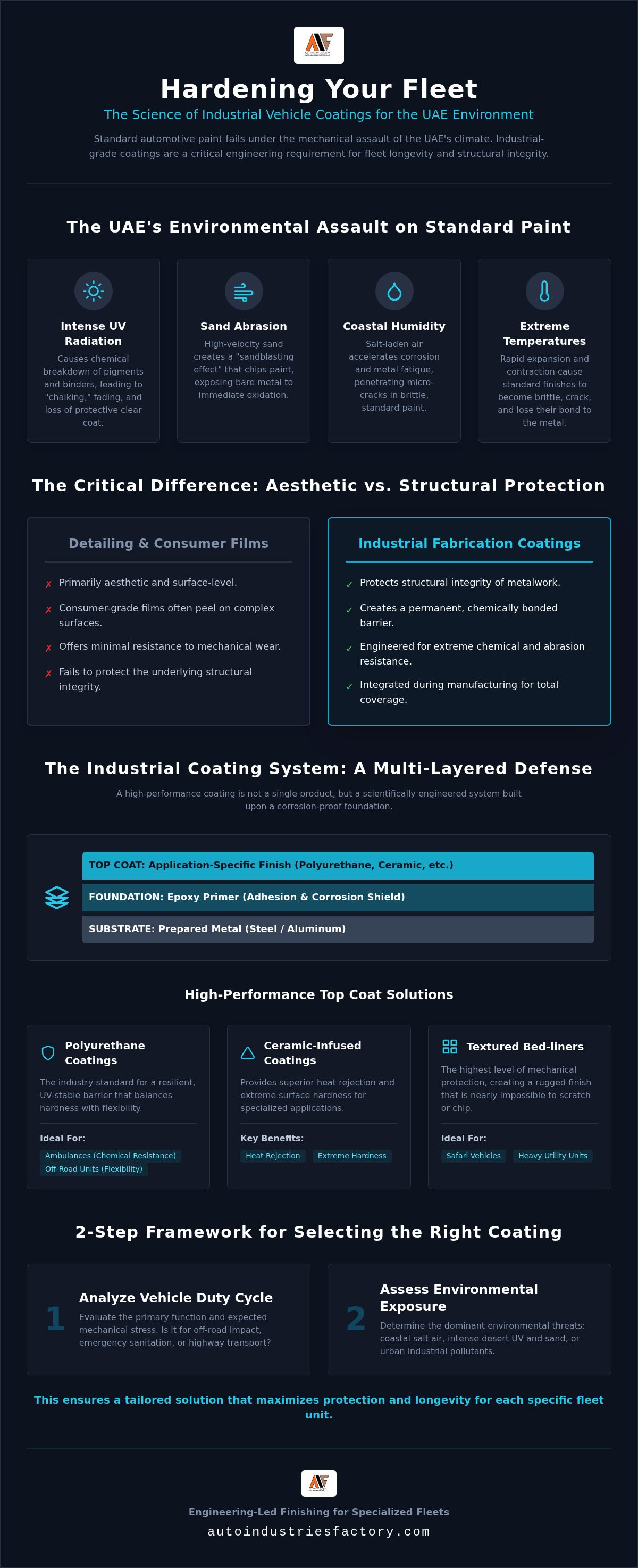
The UAE environment is a rigorous testing ground for engineering resilience. Operating a specialized fleet here means confronting intense UV exposure, high-velocity sand abrasion, and coastal humidity that accelerates metal fatigue. Standard Automotive paint systems designed for temperate climates fail quickly under these conditions. They lack the chemical density required to resist the region's thermal stress and mechanical wear. For mission-critical units like ambulances or military vehicles, a failed coating isn't just an aesthetic issue; it's the start of structural degradation.
Industrial-grade protective vehicle coatings UAE must address four environmental pillars: UV stability, abrasion resistance, moisture barriers, and thermal flexibility. When temperatures fluctuate between cool nights and scorching midday peaks, coatings expand and contract. Standard finishes often become brittle. This leads to micro-cracks that allow humidity to reach the substrate, especially in coastal regions where salt air accelerates oxidation. A robust coating acts as a non-permeable shield, maintaining its bond even under extreme thermal shifts.
The Impact of UV Radiation on Fleet Longevity
Intense solar radiation acts as a catalyst for the chemical breakdown of pigments and binders in standard clear coats. Over time, this leads to "chalking," where the protective layer disintegrates into a powdery residue. For emergency and police fleets, this degradation compromises visibility and professional branding. Specialized vehicles require high-solid UV inhibitors that maintain color depth and gloss even after years of exposure. We prioritize these industrial formulations to ensure that specialized conversions, such as police units and mobile clinics, remain recognizable and structurally sound.
Sand Abrasion and Mechanical Wear
Driving on national highways during a sandstorm creates a literal sandblasting effect. This mechanical wear is most aggressive on forward-facing components like custom bull bars, front bumpers, and wheel arches. Standard paint chips easily under this impact, exposing raw metal to immediate oxidation. Industrial protective vehicle coatings UAE incorporate impact-resistant additives that absorb kinetic energy rather than cracking. This is particularly vital for safari vehicle conversions and off-road units that face constant gravel and sand impact. By applying these rugged solutions to custom-fabricated metal canopies and accessories, we ensure the underlying metalwork remains shielded from premature wear.
Types of Industrial Protective Vehicle Coatings
Industrial fleet protection requires a shift from consumer-grade films to high-performance chemical bonding. While basic films often peel or fail on complex geometries, professional protective vehicle coatings UAE utilize advanced material science to create a permanent barrier against the elements. This process begins with epoxy primers, which serve as the essential foundation for any corrosion-resistant system. These primers provide the necessary adhesion and chemical resistance to prevent oxidation from taking hold beneath the surface. Using high-quality Protective coatings for corrosion control is the only way to ensure that the underlying steel or aluminum remains structurally sound over a multi-year duty cycle.
Polyurethane coatings are high-performance, polymer-based finishes engineered to provide a resilient, UV-stable barrier that balances extreme surface hardness with the flexibility needed for industrial vehicle applications. Beyond polyurethane, specialized fleets often utilize ceramic-infused coatings for superior heat rejection and surface hardness. For utility and safari units, textured bed-liners offer the highest level of mechanical protection, creating a rugged finish that is nearly impossible to scratch or chip during heavy field use.
High-Performance Polyurethane Solutions
The choice between coating elasticity and hardness is critical for specialized vehicles. Off-road units, such as safari conversions, require a degree of flexibility in their coating to handle chassis flex without cracking. Conversely, ambulance and medical units demand high chemical resistance. These vehicles undergo frequent sanitization with harsh medical-grade cleaners; a standard paint job would degrade under such a rigorous cleaning schedule. Our industrial polyurethane systems are designed to withstand these chemicals while maintaining a non-porous, professional finish that meets strict hygiene standards.
Specialized Coatings for Custom Metalwork
Custom-fabricated accessories like bull bars and roof racks present unique coating challenges. While powder coating is a common choice, industrial wet paint systems often provide better field repairability and a more uniform finish on complex, CNC-machined parts. Precision is mandatory here. If a coating doesn't reach every recessed edge of a laser-cut bracket, corrosion will inevitably start at that weak point. We ensure complete coverage by integrating our painting process directly with our fabrication workflow. If you're looking for a durable finish for your specialized equipment, you can explore our professional painting services to see how we handle these technical requirements. This integrated approach ensures that every custom bumper and brush guard leaves the factory with a finish that matches the ruggedness of the build itself.
Detailing vs. Fabrication Coatings: Making the Right Choice
For national fleet operators, the cost-benefit analysis favors industrial solutions. While detailing has lower upfront costs, the frequency of reapplication in the UAE’s harsh climate leads to higher cumulative expenses. Fabrication coatings are a one-time investment during the vehicle’s modification phase. They protect the substrate from the moment the unit enters service, preventing the deep-seated corrosion that leads to expensive structural repairs or premature decommissioning.
Executive transport and standard passenger cars are the primary candidates for professional detailing. These vehicles operate mostly on paved roads and are often stored in climate-controlled environments. If you are looking to hire a well-maintained vehicle for your stay or business needs, you can learn more about AL MADINA CAR RENTAL. A maintenance schedule involving periodic polishing and light ceramic top-coats keeps these units looking pristine. However, detailing has clear limitations in high-wear industrial environments. A thin layer of wax or a consumer-grade sealant will vanish within days when exposed to the sandblasting effect of desert highway travel or the heavy-duty cleaning cycles required for medical units.
Ambulances, police units, and military vehicles require a different level of finishing. These specialized units undergo significant structural modifications, including welding and the addition of custom bull bars or roof racks. Industrial coatings are integrated into the modification process. This ensures that every weld point and laser-cut edge is sealed before assembly. This integration is vital for mission-critical units where downtime isn't just an expense; it's a risk to public safety. By providing a rugged, non-permeable barrier, industrial coatings deliver a long-term ROI through reduced maintenance and extended vehicle lifespans. You can view our full range of specialized modification services to see how we prioritize these industrial finishes in every build.
Selecting Protective Coatings for Specialized Fleets
Selecting the right protective vehicle coatings UAE requires a rigorous evaluation of the vehicle’s operational environment. Standard factory paint is often insufficient for the high-stress duty cycles of modified fleets. You must first define whether the vehicle serves an off-road, emergency, or utility purpose. Each mission profile dictates a different chemical composition for the coating. For instance, coastal operations demand advanced moisture barriers to fight salt-induced oxidation, while desert interior units require maximum resistance to high-velocity sand abrasion.
Once the environment is assessed, evaluate chemical and biological exposure requirements. We recommend an in-house fabrication application over third-party detailing for industrial units. Applying coatings during the metal fabrication stage allows us to protect laser-cut edges and CNC-machined components before final assembly. This integrated approach eliminates the hidden gaps where corrosion typically begins in complex conversions. Finally, establish a maintenance protocol. Routine inspections of high-impact areas like bull bars and wheel arches ensure the coating's integrity remains intact. This is especially important for vehicles operating near the coast, where salt air can find even the smallest breach in a finish. By identifying and touching up minor chips early, you prevent the need for full-scale metal restoration later.
Requirements for Emergency and Medical Vehicles
Ambulances require sanitization-friendly surfaces that resist harsh medical decontaminants. We prioritize non-porous coatings that won't harbor bacteria, ensuring the interior of a box type ambulance remains a sterile environment. These units also need high-visibility finishes that don't fade under the intense UAE sun. We ensure the coating is perfectly integrated with emergency lighting and siren mounting points. This precision prevents moisture ingress at the drill sites, which is a common failure point for third-party modifications that lack integrated fabrication and finishing.
Off-Road and Safari Vehicle Specifics
Land Cruiser and Hilux modifications face constant impact from rock chips and gravel during desert expeditions. We apply ruggedized coatings to custom bumpers and brush guards to maintain their structural strength and prevent surface pitting. Beyond abrasion, our coatings for custom canopies serve a dual purpose by providing thermal insulation. This reduces the heat load on the vehicle's cooling system and keeps the interior temperature manageable during midday desert travel. Learn about our safari vehicle conversions to see how we apply these protective standards to professional off-road builds. If you're ready to specify a finish for your next fleet project, request a technical consultation for our coating solutions.
Engineering-Led Finishing at Auto Industries Factory
Auto Industries Factory LLC bridges the gap between heavy metal fabrication and high-performance finishing. Most providers outsource their painting services. This creates a technical disconnect that often leads to surface vulnerabilities during final assembly. We solve this by handling the entire process in-house. From the initial metal cutting to the final bake in our spray booths, every step is synchronized. This integrated workflow ensures that the protective vehicle coatings UAE we apply bond perfectly with the precision-engineered substrate.
Our facility utilizes in-house laser cutting and CNC machining to prepare every part. This precision preparation is the secret to a perfect fit. When parts fit together with engineering-grade accuracy, there are no forced joints or stressed points where paint might crack or flake. This is vital for specialized vehicle conversions where structural integrity is a non-negotiable requirement. We don't just build vehicles; we engineer them to survive the harshest environments. Our technicians ensure that every weld and joint is properly treated before any finish is applied.
Our Professional Painting and Finishing Process
A professional finish starts with a controlled environment. Our state-of-the-art spray booths are designed to meet national standards for industrial finishing. This allows us to handle complex requirements, such as custom color matching for police and military fleet units. We maintain a strict quality control protocol for every mission-critical unit that leaves our floor. Our technicians monitor temperature, humidity, and curing times to ensure the coating reaches its maximum chemical resistance. This level of oversight is why our industrial finishes outlast standard commercial applications.
Complete Conversion Solutions
We provide a comprehensive path from structural reinforcement to the final protective coating. This is the only way to guarantee that custom accessories like bull bars, roof racks, and bumpers are truly built to last. When we fabricate a front metal bull bar or a brush guard, the coating isn't an afterthought. It's a fundamental part of the component's design. This ensures that even the most complex geometries receive a uniform, impact-resistant shield. Explore our full range of vehicle conversion services to see how our engineering-led approach delivers ruggedness you can trust. Our commitment to quality ensures that every specialized conversion we deliver is ready for immediate deployment in the field.
Hardening Your Fleet for the Future of UAE Operations
Securing the longevity of a specialized fleet requires more than just reactive maintenance. It demands a proactive engineering strategy where protective vehicle coatings UAE are integrated directly into the fabrication process. You've seen how standard finishes fail under extreme thermal stress and abrasive sand. By choosing industrial-grade polyurethane and epoxy systems, you ensure that your mission-critical units remain operational and professional for years to come. These solutions aren't just about aesthetics; they're about preserving the structural integrity of your investment.
As a specialist in high-stakes conversions for ambulances, police, and military vehicles, we offer complete in-house design, fabrication, and painting. This integrated approach makes us a trusted partner for national fleet solutions, as we eliminate the vulnerabilities often found in outsourced finishing. Don't leave your mission-critical units exposed to the region's harsh climate. Request a Quote for Specialized Vehicle Coating and Conversion to secure the structural integrity of your fleet. We're ready to help you engineer a more resilient future.
Frequently Asked Questions
What is the best protective vehicle coating for the UAE climate?
Industrial-grade polyurethane and epoxy systems are the gold standard for the region's harsh climate. They provide the necessary UV stability and chemical resistance to withstand extreme heat and constant sand abrasion. Unlike standard automotive paint, these coatings create a dense, non-permeable barrier. This protection is critical for specialized fleets like ambulances and police units that operate in high-stakes desert environments where standard finishes fail quickly.
How long do industrial vehicle coatings last in desert conditions?
A high-performance industrial coating can last for several years, often matching the vehicle's entire operational lifespan if maintained correctly. In desert conditions, the longevity depends on the coating's thickness and its ability to resist UV degradation. Regular inspections of high-impact areas like custom bull bars help identify minor chips early. This proactive maintenance prevents sand abrasion from reaching the metal substrate and causing structural damage.
Can custom-fabricated accessories like bull bars be color-matched to the vehicle?
Yes, we provide precise color matching for all custom-fabricated accessories, including bull bars, roof racks, and bumpers. Our in-house painting facility allows us to synchronize the finish of the accessory with the vehicle's primary body color. This is particularly important for police and military fleets that require a uniform, professional appearance. We use durable, industrial-grade pigments that maintain their color depth even under intense solar radiation.
Is a professional color change legal for fleet vehicles in the UAE?
Professional color changes are legal provided you follow the national regulations set by the transport authorities. Any modification to a vehicle's primary color must be reported and updated on the registration documents. This ensures the vehicle remains roadworthy and compliant with national laws. We handle the technical side of the vehicle color change process, ensuring the finish meets industrial standards for specialized units like mobile clinics or troop carriers.
What is the difference between car detailing and industrial vehicle painting?
Car detailing focuses on aesthetic restoration using thin layers of wax or ceramic sealants applied manually. Industrial vehicle painting involves a high-stakes chemical bonding process performed in controlled spray booths. Protective vehicle coatings UAE for industrial fleets are designed for structural survival and chemical resistance rather than just surface-level shine. These systems are integrated into the fabrication of specialized units to provide long-term defense against mechanical wear.
Do specialized vehicles like ambulances require specific types of paint?
Ambulances require specialized coatings that are non-porous and resistant to harsh medical-grade disinfectants. These finishes must withstand frequent chemical sanitization without degrading or losing their protective properties. Additionally, high-visibility white or custom fleet colors must be UV-stable to prevent yellowing or chalking. Our in-house process ensures that box type ambulances and extended roof units receive a finish that meets these rigorous hygiene and durability requirements.
How do protective coatings help reduce fleet maintenance costs?
Protective coatings reduce costs by preventing the structural corrosion and paint degradation that lead to expensive repairs. By shielding the metal substrate from sandblasting and humidity, these coatings extend the time between major refurbishments. Protective vehicle coatings UAE also simplify cleaning, as dirt and contaminants don't bond as easily to the industrial surface. This leads to less downtime and a higher resale value for the fleet vehicles.
Can existing fleet vehicles be retrofitted with protective coatings?
Existing fleet vehicles can be retrofitted with industrial protective coatings after a thorough surface preparation process. This typically involves precision cleaning and mechanical abrasion to ensure proper adhesion of the new epoxy primers and polyurethane topcoats. Retrofitting is an excellent way to extend the service life of safari vehicles or utility units that have begun to show signs of environmental wear. It effectively restores the structural defense of the vehicle body.


