When personal security is non-negotiable, choosing the right armored vehicle is a decision with zero margin for error. The industry can be incredibly difficult to navigate, filled with confusing certifications and complex logistical hurdles that leave you questioning who to trust. For high-value individuals and organizations in Oman and beyond, this uncertainty is a significant risk. The challenge is clear: how do you confidently select from the world's top armored car companies without the expert knowledge to verify their claims and engineering prowess?
This definitive buyer's guide is engineered to provide that clarity. We cut through the noise, breaking down exactly how to evaluate a manufacturer's capabilities, from understanding crucial ballistic standards to verifying production quality and international delivery protocols. You will gain the confidence to compare global and regional providers based on objective, mission-critical criteria, ensuring a smooth acquisition process from initial consultation to final delivery of a heavy-duty vehicle built to protect what matters most.
What Do Armored Car Companies Actually Do? (An Inside Look)
The work of premium armored car companies goes far beyond the common myth of simply welding steel plates to a vehicle. These are highly specialized engineering firms dedicated to the complete, discreet re-manufacturing of a vehicle for survivability. Their core mission is to transform a standard production vehicle, such as the popular Toyota Land Cruiser or Nissan Patrol seen across Oman, into a protected asset that can withstand ballistic and explosive threats while retaining the original factory appearance and performance characteristics. It is a meticulous process rooted in advanced engineering and precision fabrication.
The Armoring Process: From OEM Vehicle to Protected Asset
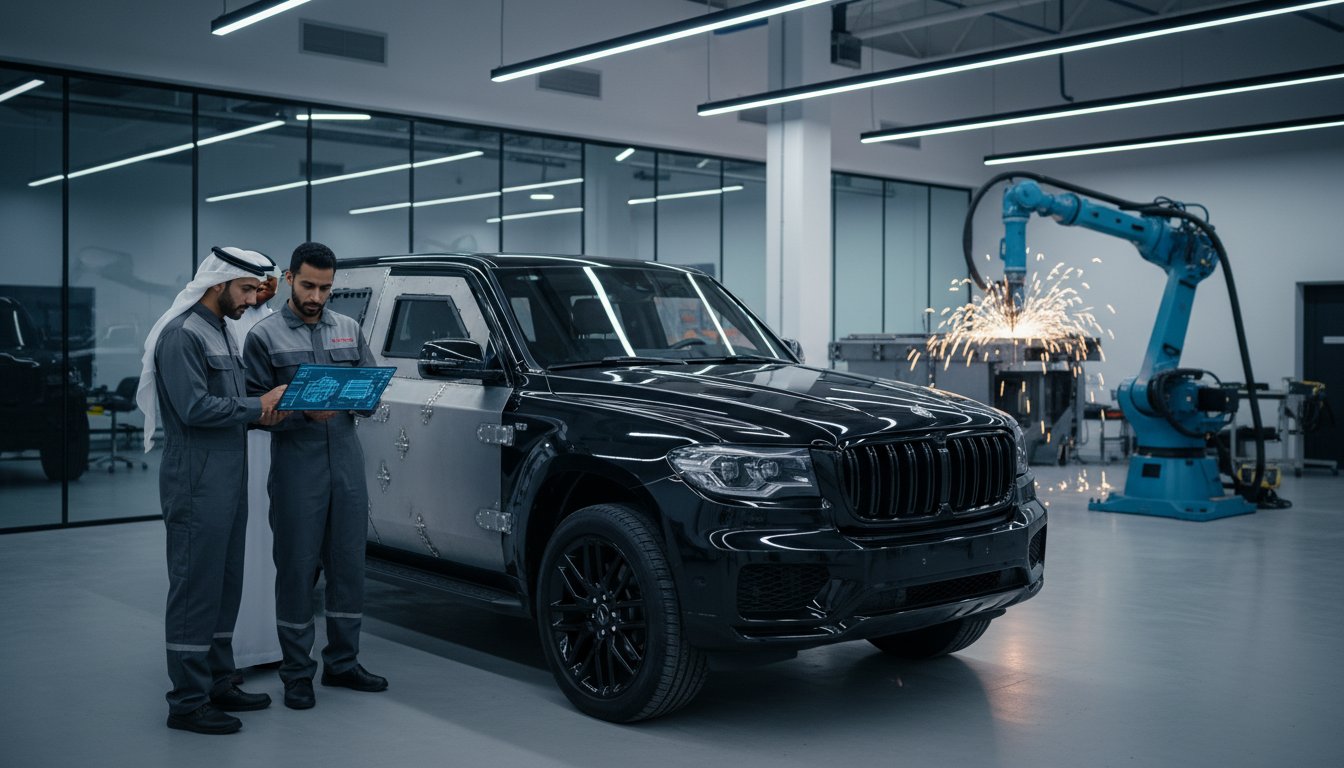
Every project begins with a detailed consultation to assess threat levels and select an appropriate base vehicle. The vehicle is then completely stripped down to its bare chassis and frame. Expert fabricators construct a self-contained armored "capsule" from laser-cut, high-hardness ballistic steel, which is then painstakingly welded into the vehicle's body. After integration, the original interior is carefully re-fitted, and numerous system upgrades are installed. The process concludes with rigorous quality control, including road tests to ensure flawless performance and handling.
Core Materials: The Science of Ballistic Protection
The effectiveness of an armored vehicle depends entirely on the quality of its materials. The construction of a modern civilian armored vehicle involves a multi-layered defense strategy using advanced materials:
- Ballistic Steel: This high-hardness, heat-treated steel forms the primary structure of the passenger cabin's protective shell.
- Ballistic Glass: Replacing all original glass, this multi-layered composite of polycarbonate and glass can stop high-velocity rounds while preventing spalling (shattering) on the interior side.
- Composite Materials: Lightweight aramids like Kevlar® and Dyneema® are used in the roof, floor, and other areas to provide robust protection against fragmentation and specific ballistic threats without adding excessive weight.
- Overlap Systems: All potential ballistic gaps, such as door seams and window frames, are reinforced with overlapping steel plates to ensure complete, 360-degree protection.
Beyond Armor: Critical Performance and Safety Upgrades
Adding up to 1,000 kg or more of armor places immense stress on a vehicle's original components. Reputable armored vehicle manufacturers address this by overhauling critical systems to ensure safety and escape capability. Key upgrades include heavy-duty suspension systems with custom-rated springs and shocks, high-performance brake systems with larger calipers and pads, and certified run-flat tire systems that allow for continued mobility after punctures. Furthermore, the battery, ECU, and fuel tank are shielded, and bumpers are often reinforced for enhanced durability.
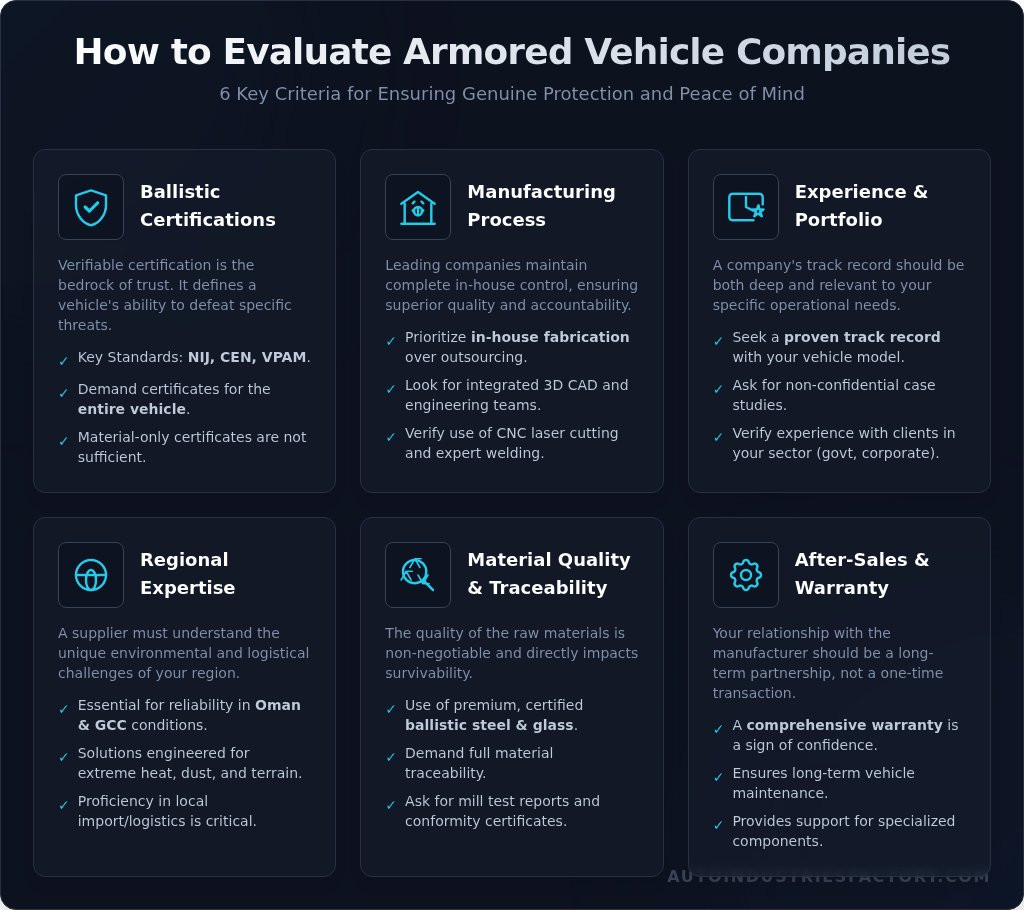
How to Evaluate Armored Vehicle Companies: 6 Key Criteria
Selecting a partner for vehicle armoring is a critical security decision that extends far beyond a company's marketing claims. A truly professional armoring solution is a product of precision engineering, certified materials, and proven experience. To ensure you are investing in genuine protection, use these six objective criteria to vet potential suppliers and ask the right questions during consultations.
1. International Ballistic Certifications (NIJ, CEN, VPAM)
Verifiable certification is the bedrock of trust in the armoring industry. These standards define a vehicle's ability to defeat specific threats. For example, CEN BR6 is a common standard for protection against assault rifles. When evaluating providers, it's crucial to understand the official NIJ ballistic protection levels and their European (CEN) or German (VPAM) equivalents. Insist on seeing official certificates for the entire vehicle or a prototype, not just for the raw materials. A certificate for a steel plate is not the same as a certificate for a fully assembled, road-tested armored vehicle.
2. Manufacturing Process: In-House vs. Outsourced Fabrication
Leading armored car companies maintain complete in-house control over the entire conversion process. This ensures superior quality, consistency, and accountability. Look for facilities with integrated capabilities, including:
- 3D CAD design and engineering teams
- CNC laser cutting for ballistic steel
- Expert welding and fabrication workshops
- Integrated assembly and finishing
Companies that outsource critical armoring work introduce risks of inconsistent quality and a fragmented supply chain, potentially compromising the vehicle's structural integrity.
3. Experience and Client Portfolio
A company's experience should be both deep and relevant to your needs. Do they have a proven track record armoring the specific vehicle model you require, such as the Toyota Land Cruiser or Nissan Patrol commonly used in Oman? Ask for non-confidential case studies or references from clients in your sector, whether it's government, corporate security, or a non-governmental organization.
4. Regional Expertise and Logistical Support
An armored vehicle must perform reliably in its intended environment. A supplier with experience in Oman and the wider GCC region will understand the unique challenges posed by extreme heat and dusty conditions, engineering solutions for engine cooling, HVAC systems, and suspension durability. They will also be proficient in navigating local import regulations and providing essential after-sales support within the region.
5. Material Quality and Traceability
The quality of the raw materials is non-negotiable. Reputable manufacturers use premium, certified ballistic steel and multi-layered glass from internationally recognized suppliers. Demand transparency. Ask for mill test reports for the steel and certificates of conformity for the armored glass to ensure full material traceability and confirm you are receiving the protection you paid for.
6. After-Sales Support and Warranty
Your relationship with the manufacturer should not end upon delivery. A comprehensive warranty is a sign of confidence in the product. Scrutinize the terms, paying close attention to coverage for high-stress components like suspension upgrades and potential issues like glass delamination. Ensure the company has a clear process for providing spare parts, especially custom-fitted armored glass, to keep your vehicle operational.
The Global Leaders: A Look at Major Armored Car Companies
The global market for armored vehicles is dominated by a select group of manufacturers known for their engineering prowess, extensive production capabilities, and robust global supply chains. While numerous regional specialists offer custom solutions, these industry titans set the benchmark for quality, certification, and innovation. Understanding their core strengths is essential for any serious buyer, whether a government agency in Oman or a multinational corporation operating in high-risk zones. These leading armored car companies are often categorized by their scale and regional specialization.
Large-Scale International Manufacturers
These companies operate with immense production capacity and a vast global footprint, offering a diverse range of pre-engineered and custom-built armored vehicles. Their scale allows them to serve large fleet orders for military, law enforcement, and commercial clients worldwide.
- INKAS® (Canada): Renowned for one of the most diverse vehicle inventories in the industry. INKAS excels in armoring everything from premium luxury sedans and SUVs to special-purpose vehicles like cash-in-transit (CIT) trucks and tactical armored personnel carriers (APCs).
- The Armored Group (USA): With a strong focus on high-level certifications (VPAM, STANAG), The Armored Group is a trusted supplier for government agencies, military forces, and law enforcement. They are known for their rigorous testing and mission-specific vehicle designs.
- Streit Group (UAE): Strategically based in the United Arab Emirates, Streit Group is a dominant force in the Middle East, African, and Asian markets. Their portfolio is massive, featuring over 120 vehicle models designed for extreme durability and performance.
Established North American Specialists
North America is home to some of the industry's most long-standing and respected armored car companies. These firms combine decades of engineering experience with advanced manufacturing techniques to produce highly reliable protective vehicles. Many of these specialists, often aligned with standards promoted by organizations like the National Armored Car Association (NACA), are primary contractors for government and corporate clients across the globe.
- Alpine Armoring (USA): With a long and distinguished history, Alpine Armoring emphasizes its commitment to US-based engineering and manufacturing. They are known for their meticulous craftsmanship and discreet armoring solutions for VIPs and corporate executives.
- International Armored Group (USA): True to its name, IAG maintains a significant global presence with production facilities in the U.S., UAE, and Turkey. This distributed network allows them to efficiently serve a worldwide clientele with tailored logistical and support solutions.
Why a Regional Vehicle Conversion Specialist Can Be Your Best Choice
While global conglomerates dominate the landscape of armored car companies, clients in Oman and across the GCC often find superior value and precision by partnering with a regional vehicle conversion specialist. These expert fabricators offer a level of customization, regional understanding, and direct support that larger, mass-production-focused firms cannot match. When your mission requires more than an off-the-shelf solution, a specialist provides the tailored engineering needed to meet unique operational threats and environmental challenges.
The Advantage of Multi-Purpose Conversion Expertise
A key indicator of a fabricator's deep engineering capability is a diverse portfolio. Companies that also design and build other mission-critical vehicles-such as heavy-duty ambulances, police patrol units, and tactical vehicles-possess a comprehensive understanding of systems integration, chassis dynamics, and long-term reliability. This cross-disciplinary experience translates directly into more robust and dependable armored vehicles, as they are engineered from a holistic perspective, not just as an added layer of steel.
Auto Industries Factory: UAE-Based Fabrication and Armoring
A prime example of this specialized expertise in the region is Auto Industries Factory (AIF). Based in the UAE and serving clients throughout Oman and the Middle East, AIF is a trusted partner for defense, security, and private organizations. With comprehensive in-house capabilities-from initial CAD design and precision CNC laser cutting to expert welding and flawless paint application-AIF maintains complete control over quality at every stage. Their extensive experience modifying rugged platforms like the Toyota Land Cruiser and Nissan Patrol for military and police forces ensures every vehicle is built to protect what matters. Explore our custom vehicle modification capabilities.
Choosing a regional expert like AIF offers distinct advantages for buyers in Oman:
- Local Insight: A deep understanding of the region's extreme climate, challenging terrain, and specific operational requirements.
- Logistical Simplicity: Easier and faster logistics for vehicle delivery, maintenance, and access to support compared to international armored car companies.
- Direct Collaboration: The ability to work directly with the engineers and technicians building your vehicle, ensuring your exact specifications are met.
- Custom Solutions: Unmatched flexibility to create truly bespoke armoring and modification packages tailored to your mission profile.
The Acquisition Process: From Threat Assessment to Delivery
Purchasing a custom-armored vehicle is a mission-critical investment in safety. The process is not a simple transaction but a collaborative partnership built on precision engineering and trust. For first-time buyers in Oman, understanding this structured journey is the first step toward acquiring a robust, reliable security asset. This guide demystifies the process, from initial consultation to final delivery.
Step 1: Define Your Threat Level and Requirements
The foundation of any armored vehicle solution is a professional threat assessment. Work with security advisors to define the realistic risks you or your principals face. This analysis directly dictates the required ballistic protection level, such as the widely recognized B6 (EN1063 BR6) standard for defense against high-powered rifle rounds. Beyond ballistics, outline your operational needs: passenger capacity, required payload for equipment, and the primary terrain-whether navigating Muscat's urban centers or covering long distances across rugged desert landscapes.
Step 2: Requesting Quotes and Vetting Proposals
With a clear brief, you can approach a shortlist of qualified armored car companies for proposals. A quote is more than a final price; it is a statement of engineering integrity. Scrutinize the details beyond the cost:
- Materials: Are they using certified, high-hardness ballistic steel and multi-layered aramid fibers?
- Components: Does the quote include essential heavy-duty upgrades to suspension, brakes, and hinges to manage the added weight?
- Certifications: Does the company adhere to internationally recognized standards like VPAM or STANAG?
- Support: Evaluate the warranty terms, after-sales service network in the region, and availability of specialized driver training.
Step 3: Production Oversight and Final Delivery
Transparency during manufacturing is a hallmark of a premier armoring partner. Reputable firms provide regular progress reports, including photos of the vehicle during the conversion process. If feasible, arrange a pre-shipment inspection to verify the build quality firsthand. For delivery to Oman, ensure the company has experience navigating the logistics, including secure shipping to Sohar or Salalah, comprehensive insurance, and managing import documentation required by the Royal Oman Police (ROP).
Choosing the right manufacturing partner transforms this complex acquisition into a seamless security solution. Companies specializing in custom vehicle conversions are equipped to guide you through every technical and logistical challenge.
Your Partner in Advanced Vehicle Protection
Choosing the right protection is a critical decision. This guide has shown that navigating the world of armored car companies requires more than just comparing specifications; it demands a thorough evaluation of engineering capabilities, material quality, and the provider's understanding of your specific operational environment. While global giants have their place, a regional specialist often delivers a more tailored and robust solution, especially for the unique challenges faced in Oman and the wider region.
At Auto Industries Factory, we are specialists in military and police vehicle conversions. Our complete in-house design, fabrication, and manufacturing process in Ajman, UAE, ensures total quality control from start to finish. With deep expertise in engineering vehicles for the demanding GCC climate, we build solutions that are both durable and mission-ready. Discuss your vehicle protection requirements with our UAE-based engineering team to discover how our advanced capabilities can serve your needs.
Take the decisive step towards securing what matters most.
Frequently Asked Questions About Armored Vehicles
How much does an armored car cost?
The cost to armor a vehicle depends heavily on the base model and the required level of ballistic protection. In Oman, armoring a standard SUV like a Toyota Land Cruiser to a B6 protection level can range from $50,000 to over $150,000, in addition to the vehicle's purchase price. Higher protection levels or specialized features such as run-flat tires, reinforced suspension, and fire suppression systems will increase the final investment. A detailed quote is essential for accurate pricing based on specific security needs.
What is the difference between factory-armored and aftermarket-armored vehicles?
Factory-armored vehicles are built by the Original Equipment Manufacturer (OEM), integrating protection during the initial assembly. This often ensures a seamless finish and a comprehensive factory warranty. In contrast, aftermarket armoring is performed by a specialized company that disassembles a standard vehicle to retrofit it with ballistic materials. This process offers greater flexibility in vehicle choice and customization, but the final quality is entirely dependent on the engineering expertise of the aftermarket provider.
Can any make or model of car be armored?
While many vehicles can be armored, not all are suitable candidates. The ideal base vehicle must have a robust body-on-frame chassis and a powerful engine to handle the significant added weight of ballistic steel and glass. For this reason, heavy-duty SUVs like the Toyota Land Cruiser, Nissan Patrol, and Lexus LX are premium choices in Oman. Smaller passenger cars or those with unibody construction often lack the structural integrity or payload capacity required for effective and reliable armoring solutions.
How long does the armoring process typically take?
The timeline for a vehicle armoring conversion is a meticulous engineering process. A standard B6-level protection package for an SUV typically requires between 45 and 90 days to complete. This comprehensive process includes vehicle disassembly, custom fabrication and installation of ballistic panels, fitting of armored glass, and crucial upgrades to the suspension and braking systems. Leading armored car companies prioritize precision engineering over speed to ensure flawless integration and uncompromising occupant safety.
Does armoring a vehicle affect its performance and handling?
Yes, adding hundreds of kilograms of armor significantly impacts a vehicle's dynamics, affecting acceleration, increasing braking distances, and altering cornering stability. To mitigate these effects, reputable armoring specialists perform mandatory upgrades to the suspension, brakes, and tires. These heavy-duty modifications are precisely engineered to manage the added mass, restoring the vehicle's handling characteristics as closely as possible to the original specifications and ensuring it remains safe and reliable to operate under all conditions.
Is it legal for a private citizen to own an armored vehicle?
In the Sultanate of Oman, it is legal for a private citizen or corporation to own an armored vehicle, but the process is regulated. Any prospective owner must first apply for and obtain a permit from the Royal Oman Police (ROP) before purchasing or importing the vehicle. Professional armored car companies with experience in the region are typically well-versed in these requirements and can provide valuable assistance to clients in navigating the necessary regulatory approvals to ensure full compliance with Omani law.


