

A Toyota Hiace ambulance is only as reliable as the industrial-grade engineering behind its conversion. You already know that in emergency medical services, a vehicle's failure isn't just a mechanical issue; it's a direct threat to patient outcomes and staff safety. You need a platform that doesn't just drive, but performs under the extreme stress of high-volume, 24/7 fleet operations without compromising on structural integrity. We'll show you how a professional Toyota Hiace ambulance conversion by Auto Industries Factory LLC bridges the gap between a standard van and a life-saving medical unit through precision fabrication and compliant engineering.
This guide breaks down the essential 2026 specifications, from heavy-duty structural reinforcements to interior layouts designed for maximum medical efficiency. You'll discover the technical advantages of in-house laser cutting and CNC machining that define a truly robust medical vehicle. We'll also preview the critical compliance standards, such as EN 1789, that ensure your fleet is ready for the most demanding environments. By the end of this article, you'll understand why the Hiace remains the global benchmark for medical transport when it's backed by expert craftsmanship and no-nonsense engineering solutions.
Key Takeaways
- Identify why the Toyota Hiace is the preferred platform for urban fleets, balancing compact exterior dimensions with global parts availability.
- Compare the functional differences between standard, high roof, and box-type configurations to determine which model best suits your specific mission profile.
- Discover how precision engineering, such as CNC machining and structural reinforcement, creates a superior Toyota Hiace ambulance conversion built for long-term durability.
- Evaluate the critical interior layout requirements for 2026, including integrated oxygen systems and ergonomic stretcher placement for enhanced patient safety.
- Learn how bespoke fabrication transforms a standard chassis into a mission-critical medical environment tailored to specific operational requirements.
Why the Toyota Hiace is the Premier Platform for Urban Ambulance Conversions
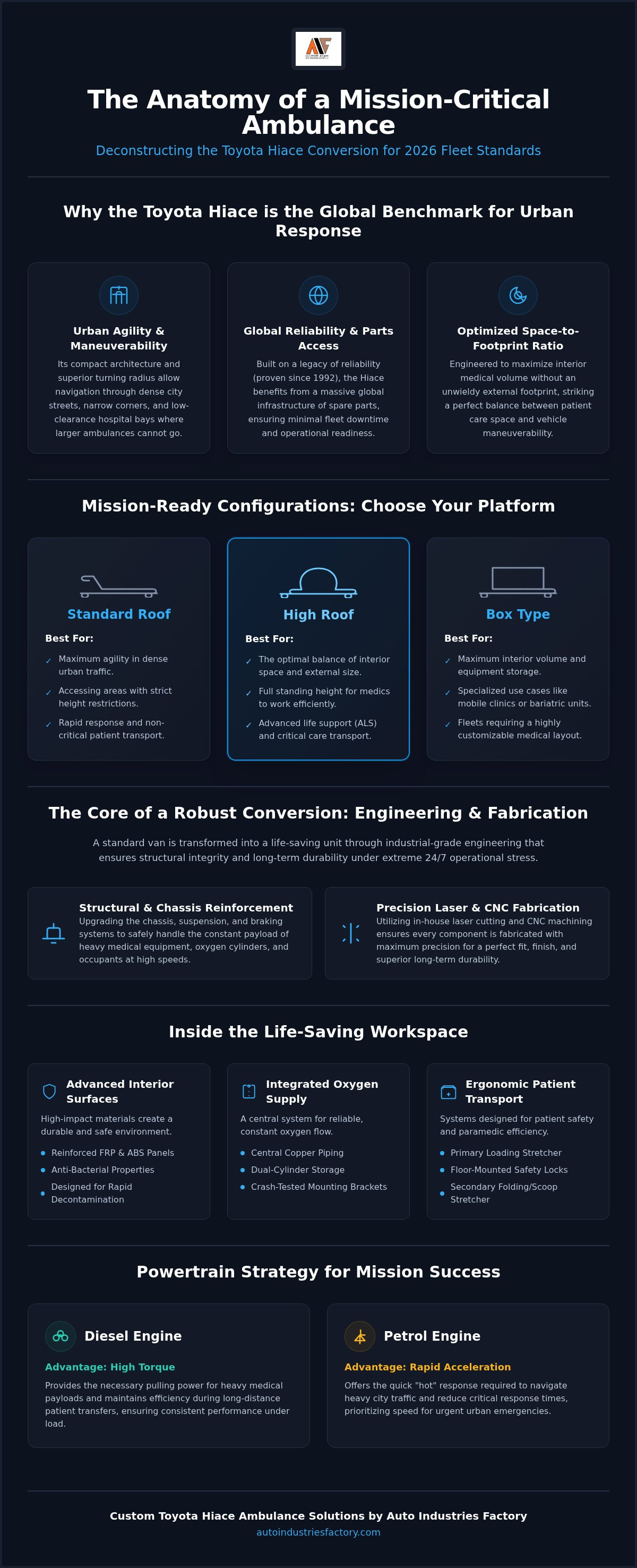
The Toyota Hiace stands as the global gold standard for urban emergency response. Its success isn't accidental. It's the result of a platform engineered to maximize interior volume without the unwieldy footprint of American-style truck ambulances. For a Toyota Hiace ambulance conversion, this compact architecture allows paramedics to reach patients in dense urban environments where larger vehicles simply cannot pass. It offers a surgical balance between external maneuverability and internal utility.
The platform’s legacy is well-documented. Toyota has refined this specific utility since the launch of the Toyota HiMedic in 1992, proving that a van-based chassis can support high-intensity medical operations. In the UAE, this reliability is backed by a massive infrastructure of spare parts and technical expertise. This ensures that fleet downtime remains minimal even for high-mileage units. When a vehicle is out of service, lives are at risk. The Hiace minimizes that danger through sheer mechanical persistence.
Mechanical Reliability and Fleet Longevity
Emergency duty cycles are brutal on vehicles. A standard van isn't naturally built to carry a full medical suite, heavy oxygen cylinders, and multiple occupants at high speeds. This is where professional engineering from Auto Industries Factory LLC becomes critical. We reinforce the chassis to handle the constant payload of a Toyota Hiace ambulance conversion, ensuring the suspension and braking systems don't fail under pressure. Our master craftsmen utilize precision fabrication to integrate these upgrades seamlessly.
Engine choice is another strategic factor for fleet managers. Diesel variants provide the high torque necessary for heavy medical payloads and long-distance patient transfers. Petrol engines, conversely, offer the rapid acceleration required for "hot" responses in heavy city traffic. Both options benefit from Toyota’s legendary transmission reliability. You can explore our specialized conversion services to see how we optimize these mechanical foundations for 2026 fleet requirements.
Urban Navigation and Response Times
Dense city centers present unique obstacles. Narrow streets, tight residential corners, and low-clearance hospital parking bays can stop a truck-based ambulance in its tracks. The Hiace features a superior turning radius that allows drivers to navigate congested areas with precision. This maneuverability directly correlates to faster response times and safer patient transport. It's about getting the medic to the patient without delay.
Height clearance is equally vital. Many emergency entrances and underground bays are height-restricted. The Hiace profile, even in high-roof configurations, is designed to clear these standard architectural barriers. By choosing a platform that fits the existing urban infrastructure, fleet managers eliminate the risk of route delays or vehicle damage during critical missions. It's a pragmatic, no-nonsense solution for a high-stakes industry.
Essential Medical Equipment and Interior Layout for Hiace Ambulances
A professional Toyota Hiace ambulance conversion turns a standard van into a mobile life-support environment. This transformation requires more than just placing equipment inside; it demands the seamless integration of life-saving technology into a reinforced structural frame. At Auto Industries Factory LLC, we focus on high-impact interior materials like reinforced FRP and ABS panels. These surfaces aren't just durable; they're anti-bacterial and designed for rapid decontamination between missions.
The heart of the patient compartment is the stretcher system. We install primary loading stretchers with dedicated floor-mounted safety locks and secondary folding units to maximize transport capacity. For 2026 fleets, we prioritize integrated oxygen supply systems over portable kits. These systems feature central copper piping, dual-cylinder storage with secure crash-tested brackets, and wall-mounted flowmeters. This setup ensures a constant, reliable oxygen flow during critical transport phases. You can explore our tailored conversion solutions to see these systems in detail.
- Advanced Cabinetry: Secure storage for medications and consumables using lightweight, high-strength materials.
- Climate Control: High-capacity independent AC units and ventilation systems designed for extreme UAE temperatures.
- Medical Mounting: Dedicated, vibration-resistant points for defibrillators, suction units, and patient monitors.
Patient Compartment Ergonomics
Seconds save lives. The interior layout of a Toyota Hiace ambulance conversion is engineered around the "Golden Hour" principle. Every piece of equipment must be within the paramedic’s reach while they're securely belted. We utilize ceiling-mounted IV tracks and adjustable LED lighting to provide a flexible workspace. These designs adhere to international ambulance safety standards, ensuring that the crew can move efficiently without compromising their own protection during high-speed maneuvers.
Electrical and Communication Systems
Modern medical devices demand stable, high-quality power. Our conversions feature dual-battery architectures that isolate the vehicle’s starting power from the medical equipment load. We install pure sine wave inverters to prevent electrical surges from damaging sensitive monitors or ventilators. An external shore power inlet allows the fleet to maintain charged equipment while stationary at the station. In the cockpit, a centralized control panel gives the driver total management over sirens, lighting, and rear-cabin climate without distraction. This technical precision is what defines a mission-critical vehicle.
Comparing Hiace Configurations: Standard Roof vs. High Roof vs. Box Type
Selecting the right configuration is a strategic decision that defines your fleet's operational limits. A Toyota Hiace ambulance conversion isn't a one-size-fits-all product. The choice between standard roof, high roof, or a custom box-type body depends entirely on the level of care required during transit. While the mechanical base remains the same, the vertical and lateral space determines which medical procedures are physically possible for the crew.
Standard roof models are the workhorses of non-emergency patient transport. With an interior height of approximately 1,350 mm, they're ideal for stable patients who don't require standing interventions or complex monitoring. Their lower profile makes them the most efficient option for navigating multi-story hospital parking structures with strict height limits. It's a pragmatic choice for clinics and private transport services focused on rapid, low-clearance urban mobility.
High Roof Advantages for Emergency Care
Emergency response demands a high-roof configuration. An interior standing height of 1,700 mm to 1,900 mm allows paramedics to perform CPR and other life-saving maneuvers with full mobility. This vertical space also enables the installation of overhead storage lockers for specialized trauma kits and heavy-duty oxygen piping. In high-temperature climates, the increased volume facilitates better airflow, which keeps the patient compartment cooler during peak summer months. This added space is essential for maintaining a professional medical environment during high-stress missions.
Box-Type Ambulances: The Heavy-Duty Choice
When a mission requires Advanced Life Support (ALS) or Intensive Care (ICU) capabilities, a box type Toyota Hiace ambulance conversion is the superior engineering solution. Unlike van-based bodies, the box-type module is a custom-fabricated unit that offers a wider, square interior. This allows for dual-stretcher configurations or the inclusion of bulky diagnostic equipment like portable ventilators and advanced monitors. It provides the maximum possible volume for medical staff to operate without restriction.
At Auto Industries Factory LLC, we use in-house laser cutting and CNC machining to build these modules with structural reinforcements. This ensures the vehicle maintains structural integrity despite the increased width. We focus on precise weight distribution to prevent body roll, making these units suitable for long-distance rural transfers where road conditions vary. Engineering these configurations requires a deep understanding of center-of-gravity dynamics. A high-roof or box-type unit carries more weight higher up; we mitigate this through specialized chassis reinforcement and suspension tuning. This no-nonsense approach to safety ensures that even a fully loaded ALS unit remains stable during high-speed emergency cornering. You can learn more about our precision engineering on our about us page.
The Engineering and Fabrication Standards of a Mission-Critical Conversion
A mission-critical vehicle is defined by the precision of its fabrication. At Auto Industries Factory LLC, we treat every Toyota Hiace ambulance conversion as an engineering challenge that requires industrial-grade solutions. We don't rely on generic kits. Instead, our process begins with in-house design and structural analysis to ensure the vehicle can withstand the rigors of emergency service. This master craftsman approach ensures that every modification strengthens the platform rather than compromising it.
Material selection is a science in itself. We utilize high-impact ABS and reinforced FRP panels for the interior walls. These materials are lightweight to preserve engine performance and easy to sanitize for infection control. Every edge is rounded, and every joint is sealed. This technical focus on material science ensures the unit remains durable over a million-kilometer service life, matching the reliability of the Toyota engine itself.
Advanced Metal Fabrication Techniques
Precision is the foundation of safety. We utilize in-house laser cutting and CNC machining to create custom medical cabinetry and structural brackets. This technology allows for an exact fitment that eliminates rattles and mechanical failures during high-speed transport. Our expert welding teams reinforce the chassis to support heavy medical payloads, while our specialized painting process provides long-term corrosion resistance. This level of detail is why we're a national leader in specialized vehicle modifications.
Safety and Crashworthiness Standards
Compliance isn't optional. Our conversions are engineered to meet international benchmarks, including the EN 1789:2020+A1:2023 standard for crash-test safety. We test interior components for 10G impact resistance, ensuring that medical devices and oxygen cylinders remain securely anchored during a collision. We install reinforced flooring with industrial non-slip surfaces to provide paramedics with a stable platform, even when the vehicle is in motion. This commitment to safety protects both the patient and the medical crew.
Ready to upgrade your fleet with precision-engineered medical units? Contact Auto Industries Factory LLC today to request a custom conversion estimate for your next project.
Custom Toyota Hiace Ambulance Solutions by Auto Industries Factory
Auto Industries Factory LLC operates as a national leader in specialized vehicle fabrication. We provide end-to-end solutions that transform a base chassis into a fully compliant medical unit. Our approach is grounded in technical capability and a master craftsman's attention to detail. Every Toyota Hiace ambulance conversion we deliver is a product of precision engineering. We manage the entire lifecycle in-house, from initial design and structural reinforcement to the final paintwork and medical equipment integration. This centralized control ensures that our ruggedness and reliability standards are never compromised by third-party variables. We serve the entire UAE, positioning ourselves as the primary partner for organizations that demand extreme dependability in mission-critical applications.
The Auto Industries Factory Conversion Process
Our process is consultative and mission-focused. We don't believe in generic builds. We begin with a design phase where our engineers match vehicle specifications to your specific medical missions. Whether you require a Basic Life Support (BLS) unit or a high-roof Intensive Care Unit (ICU), we tailor the interior layout for maximum efficiency. Quality control is integrated into every stage. We utilize our in-house laser cutting and CNC machining capabilities to verify the fitment of every structural component. This no-nonsense approach to manufacturing eliminates the risk of mechanical failure during emergency response. Once the vehicle enters service, we provide robust after-sales support and maintenance to ensure your fleet remains operational 24/7. For those managing specialized vehicle fleets in other regions, platforms like My Auto Shop offer professional maintenance and inspection services to ensure long-term mechanical health.
Requesting a Quote for Your Ambulance Fleet
Scalability is a core strength of our factory. We're equipped to handle high-volume, precision fabrication for large-scale fleet orders without sacrificing the quality of individual units. When requesting a quote, specify your requirements regarding roof height, internal cabinetry, and electrical loads. Our team will help you navigate the technical trade-offs to find the most cost-effective, durable solution for your needs. We position ourselves as a partner capable of solving complex modification challenges for national healthcare providers and emergency services. Our goal is to provide a robust platform that protects your staff and your patients in the most demanding environments.
Contact our engineering team today for a detailed ambulance conversion consultation. We'll provide a comprehensive technical breakdown tailored to your 2026 fleet requirements, ensuring your investment is backed by the highest standards of UAE manufacturing.
Securing Your Medical Fleet for 2026 Operations
The success of an emergency response fleet depends on the industrial-grade precision behind each vehicle. A professional Toyota Hiace ambulance conversion is more than an interior fit-out; it's a structural transformation designed to handle the high stakes of life-saving care. You've seen how selecting the right configuration, from high-roof models to custom box-type units, provides the necessary volume for advanced medical interventions. Choosing the wrong platform or an unverified fabricator can lead to fleet failure when it's least affordable.
Auto Industries Factory LLC brings master-craftsman expertise to every project. Our in-house laser cutting and CNC fabrication ensure that every component fits with surgical accuracy. By reinforcing the chassis and utilizing lightweight, sanitizable materials, we build units that outlast standard conversions. We provide national UAE service coverage, ensuring your fleet remains robust and compliant with international safety standards. Don't leave your fleet's reliability to chance. Request a Technical Consultation for Your Hiace Fleet today and partner with an engineering leader. We look forward to building the mission-critical solutions your team deserves.
Frequently Asked Questions
Is the Toyota Hiace suitable for Advanced Life Support (ALS) conversions?
Yes, the Toyota Hiace is an ideal platform for Advanced Life Support (ALS) conversions when configured with a high-roof or box-type body. These variants provide the necessary vertical space for paramedics to perform invasive procedures and accommodate bulky ICU equipment like ventilators and monitors. We utilize structural reinforcement to manage the weight of these advanced systems; ensuring the vehicle remains stable during high-speed emergency response missions.
What is the difference between a Type A and Type B Hiace ambulance?
Type A ambulances are primarily designed for non-emergency patient transport or Basic Life Support (BLS). They typically feature a standard roof and essential medical kits. Type B units are engineered for emergency response and Advanced Life Support (ALS); requiring a high-roof or box-type configuration for standing room. A Toyota Hiace ambulance conversion for Type B service includes integrated oxygen systems and advanced electrical architectures to support life-saving medical devices.
Can a Toyota Hiace ambulance be armored for high-risk environments?
Yes, we specialize in armoring the Toyota Hiace for high-risk environments. This process involves integrating ballistic-grade materials into the vehicle's body and glass while reinforcing the chassis and suspension to handle the significant weight increase. These armored units provide critical protection for medical crews and patients in volatile regions. Every armored conversion maintains the full functionality of the medical interior without compromising the vehicle's defensive integrity.
How long does a typical Toyota Hiace ambulance conversion take?
A standard Toyota Hiace ambulance conversion typically takes 4 to 6 weeks to complete. For more complex projects; such as ICU-level units or those requiring extensive structural modifications; the timeframe extends to 8 to 12 weeks. This schedule accounts for our rigorous quality control process and precision fabrication. We prioritize engineering integrity at every stage to ensure your fleet is mission-ready from the moment it leaves our facility.
What are the standard oxygen system requirements for a Hiace ambulance?
Standard requirements for a professional conversion include a centralized oxygen supply system with copper piping and secure cylinder storage. The setup must feature wall-mounted flowmeters and humidifiers; allowing for precise control of oxygen delivery during transit. We utilize crash-tested brackets to anchor cylinders; ensuring they remain secure during 10G impacts. This integrated approach is far superior to portable kits; providing a reliable and high-capacity supply for critical patients.
Does Auto Industries Factory LLC provide nationwide service in the UAE?
Auto Industries Factory LLC provides comprehensive nationwide service across the entire United Arab Emirates. Our fabrication and conversion capabilities are designed to support healthcare providers and emergency services throughout the country. Whether you require a single custom unit or a large-scale fleet order; we manage the design, manufacturing, and delivery process with national coverage. Our team provides technical support to ensure your specialized vehicles remain operational in any environment.
What standards do your Toyota Hiace ambulance conversions follow?
Our conversions are engineered to meet international benchmarks; specifically the European EN 1789 standard for medical vehicles. This includes testing interior components for 10G impact resistance to ensure equipment remains anchored during a collision. We also adhere to strict infection control protocols by using anti-bacterial; easy-to-sanitize materials. Our commitment to these rigorous standards ensures that every vehicle provides a safe and professional environment for both patients and medical staff.
Can the interior layout of the Hiace be customized for specific medical equipment?
Yes, the interior layout of the Hiace is fully customizable to meet your specific medical mission requirements. We utilize in-house design and CNC machining to create bespoke cabinetry and mounting points for your unique equipment packages. Our engineers work with your medical team to optimize the ergonomics of the patient compartment; ensuring that life-saving tools are always within reach. This flexibility allows us to build units tailored for neonatal care; trauma response; or rural transport.


