
A single uncertified cabinet mount or a sub-par electrical harness can be the difference between a lifesaving mission and a total fleet rejection by health authorities. In 2026, mastering the complex ambulance conversion standards UAE requires more than just installing medical kits; it demands precision engineering that survives both 10G crash impacts and 50°C external temperatures. You've likely felt the frustration of trying to reconcile European EN 1789:2020 standards with local GSO requirements while worrying about the strict service life limits recently updated by the Department of Health.
We understand that compliance isn't just a checkbox; it's a commitment to patient safety and long-term ROI. This guide provides the definitive technical roadmap to mastering current regulatory updates and structural mandates. We'll examine the critical differences between Type A, B, and C classifications, the mandatory HVAC performance metrics for the GCC climate, and the in-house fabrication techniques required to guarantee 10G-rated structural integrity. By the end, you'll have the expert knowledge to build a fleet that's as robust as it is compliant.
Key Takeaways
- Master the hierarchy of UAE regulations by understanding how EN 1789 safety standards integrate with mandatory GSO technical benchmarks.
- Learn why 10G-rated structural reinforcement is non-negotiable for securing medical cabinetry and ensuring mission-critical crashworthiness.
- Differentiate between Type A, B, and C classifications to ensure your fleet meets the specific equipment and design mandates of local health authorities.
- Discover engineering solutions for high-capacity HVAC and electrical load management that maintain stable internal temperatures in extreme GCC heat.
- Identify why in-house precision fabrication using laser cutting and CNC machining is the only way to guarantee full compliance with the latest ambulance conversion standards UAE.
Navigating UAE Ambulance Regulatory Frameworks: GSO 1794 and EN 1789
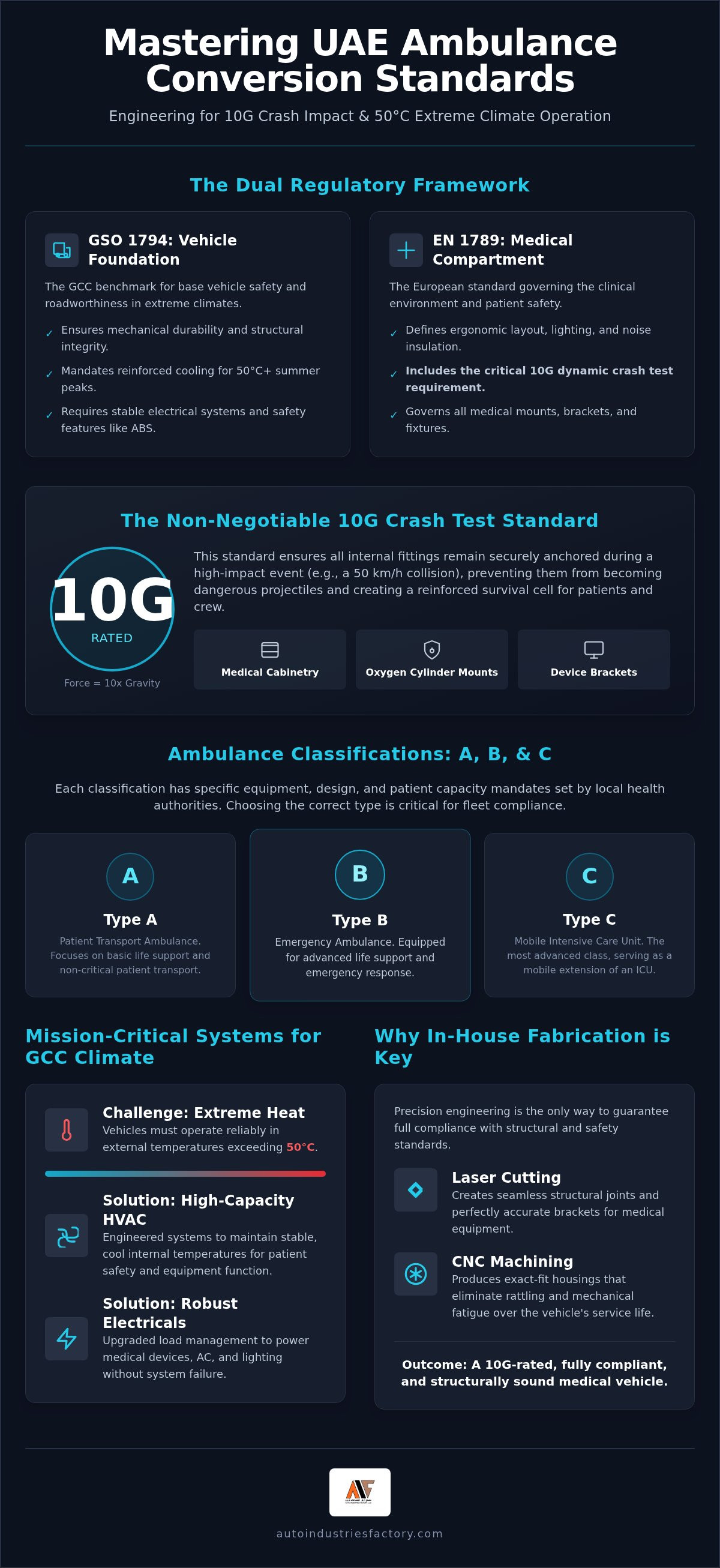
Securing a compliant fleet in the Emirates depends on a dual-layered regulatory approach. At the federal level, the GCC Standardization Organization (GSO) dictates the base vehicle roadworthiness and mechanical safety. Simultaneously, national health authorities enforce medical-specific mandates that govern the interior clinical environment. For operators, meeting the ambulance conversion standards UAE means balancing these mechanical foundations with clinical requirements that were solidified in the comprehensive 2023 regulatory updates from health authorities.
To better understand how these technical standards translate into a physical vehicle build, watch this overview of high-spec ambulance fabrication:
GSO 1794: The Foundation of GCC Vehicle Safety
GSO 1794 serves as the primary technical benchmark for emergency vehicle safety across the region. It prioritizes mechanical durability in extreme desert climates, ensuring that the base chassis can survive the rigors of high-speed response. Any compliant ambulance must feature reinforced cooling systems and electrical stability to handle 50°C summer peaks without system failure. Mandatory safety features like anti-lock braking systems and specific lighting protocols are non-negotiable. At Auto Industries Factory, we align our chassis modifications with these protocols to ensure the vehicle remains stable and reliable under the most demanding environmental conditions; for continued expert care of such specialized builds, MonacoPro Auto Garage provides comprehensive mechanical and aesthetic solutions in Dubai.
EN 1789: European Excellence in Medical Compartments
While GSO handles the automotive side, the European standard EN 1789 is the definitive framework for the medical compartment itself. This standard defines the ergonomic layout, lighting levels, and noise insulation required for effective patient care. The most critical component of this standard is the 10G dynamic crash test requirement. This mandates that every cabinet, oxygen cylinder mount, and medical device bracket must withstand ten times the force of gravity. We utilize in-house laser cutting and CNC machining to manufacture these high-strength components, ensuring they never fail during a collision or sudden maneuver.
Integrating these standards heavily influences the choice of base platforms. High-performance vehicles like the Toyota Hiace or GMC Savana are frequently selected because their structural frames allow for the heavy-duty reinforcement needed to hit these 10G ratings. Choosing a partner with specialized conversion services is the only way to guarantee that the final build passes the rigorous inspections conducted by national health authorities. These regulators verify every mount and medical gas integration before any licensing is granted for operation on UAE roads.
Structural Resilience and the 10G Crash Test Standard
In a high-speed collision, an ambulance interior becomes a hazard zone if components aren't secured. The 10G crash test standard requires all fittings to withstand ten times the force of gravity. This benchmark is a cornerstone of current ambulance conversion standards UAE. It ensures that oxygen tanks, monitors, and cabinetry remain anchored during a 50 km/h impact. Safety is non-negotiable. At Auto Industries Factory, we engineer every mount to exceed these dynamic safety requirements. Our process focuses on turning a standard van or chassis into a reinforced survival cell.
Precision Fabrication Techniques
Precision matters. We use in-house laser cutting for seamless structural joints. This technology provides the accuracy needed for complex medical equipment brackets. For 'Box Type' conversions on GMC and Toyota platforms, we add specific chassis reinforcements. This prevents structural warping and maintains the integrity of the patient cell over years of use. Using CNC machining, we create exact housings that eliminate rattling and mechanical fatigue. These specialized techniques allow us to integrate heavy medical gas systems without compromising the vehicle's structural frame.
Material Science in Ambulance Interiors
Interiors must be rugged and sterile. We utilize fire-retardant, medical-grade materials for all surfaces. Antibacterial coatings and seamless flooring are standard for infection control. We prioritize high-strength composites to keep the vehicle's weight low. This improves fuel efficiency and handling. A lower center of gravity is essential for high-speed stability during emergency responses. Weight distribution dictates high-speed safety. An imbalanced vehicle risks rolling during sharp turns or sudden lane changes. We calculate the exact placement of every heavy component, from dual battery systems to oxygen manifolds, to maintain a neutral center of gravity. If you need a build that balances these technical demands, our specialized vehicle conversion services offer the precision your fleet requires.
Medical Compartment Standards: Types A, B, and C Defined
UAE health authorities categorize ground ambulances into three distinct tiers based on the level of clinical care provided. Navigating these categories is the first step in ensuring your fleet meets the ambulance conversion standards UAE for 2026. Each classification dictates the vehicle's structural layout, the volume of medical equipment onboard, and the specific licensing it receives from national regulators. Choosing the wrong classification during the design phase can lead to fleet rejection or operational limitations.
Type A and B: Standardized Response Vehicles
Type A and B: Standardized Response Vehicles
Type C: Engineering the Mobile ICU
Type C vehicles are Mobile Intensive Care Units (MICU) engineered for advanced life support. These are the most complex transformations performed at Auto Industries Factory. They must accommodate ventilators, multi-parameter monitors, and multiple infusion pumps simultaneously. Because of the equipment volume and the need for 360-degree patient access, Type C units typically require specialized "Box Type" fabrication. Utilizing GMC or Toyota chassis-cab platforms allows us to build a wider, taller patient compartment that provides the space necessary for critical interventions.
Electrical redundancy is critical for these units. Type C builds require dual-battery systems and high-output alternators to power life-sustaining electronics without fail. We also integrate high-capacity medical gas systems with external access points for rapid cylinder exchange. These mission-critical systems are designed to operate continuously, even during the peak heat of the UAE summer. Our in-house design team ensures that all Type C builds meet the latest 2026 Department of Health requirements for advanced critical care equipment and structural crashworthiness.
Mission-Critical Systems: HVAC, Electrical, and Medical Gas
Operating an emergency vehicle in the GCC requires systems that defy environmental extremes. Standard automotive cooling and electrical setups fail when external temperatures hit 50°C. To meet the 2026 ambulance conversion standards UAE, every mission-critical system must be engineered for 100% duty cycles under extreme stress. We don't just add components; we integrate heavy-duty infrastructure into the vehicle's core to ensure absolute reliability during life-saving interventions.
Advanced HVAC for Extreme Climates
Thermal stability is the priority. We install high-capacity, independent HVAC systems that separate the driver cabin from the medical compartment. This ensures that opening the front doors doesn't compromise the sterile, cooled environment in the back. Our builds utilize high-density insulation and specialized dust filtration to maintain internal temperatures between 22 and 24°C, even in direct sunlight. This filtration is vital for keeping the patient area free from fine desert particulate matter during transit, maintaining the integrity of the clinical space. For fleet operators who maintain the same standards of hygiene in their staff quarters, professional sofa cleaning services Dubai can help ensure that upholstered furniture remains free from these same desert contaminants.
Electrical Integrity and Redundancy
Modern medical equipment draws massive current. We utilize dual-battery systems paired with high-output alternators to manage the load of ventilators, monitors, and cooling units simultaneously. Shore power integration allows the vehicle to remain mission-ready while parked, keeping medical devices charged and the cabin pre-cooled. We use specialized, fire-retardant wiring looms to prevent electrical interference with sensitive diagnostic tools. Electrical load management for ambulances in 2026 requires intelligent distribution systems that prioritize life-support equipment power over non-essential auxiliary functions.
Oxygen storage requires rigorous safety protocols to prevent catastrophic failure. We engineer custom, crash-tested oxygen manifolds with external access points for rapid cylinder exchange. These mounts are fabricated in-house to ensure they meet 10G impact requirements. Alongside gas systems, we integrate advanced communication hardware to ensure seamless connectivity with national emergency networks. This allows for real-time data transmission from the MICU to the receiving hospital, ensuring the medical team is prepared before the patient arrives. Every component we install is chosen to be fully compliant with the latest ambulance conversion standards UAE.
For a technical consultation on integrating these complex systems into your fleet, contact Auto Industries Factory today.
Engineering Compliance: Why In-House Fabrication Matters
Compliance isn't just about the final inspection. It's built into every weld, joint, and bracket. Outsourced fabrication often relies on fragmented supply chains that introduce variables and risks into specialized vehicle conversions. If a third-party bracket fails, the entire vehicle loses its certification and risks fleet rejection. At Auto Industries Factory, we eliminate these variables. By maintaining total control over the manufacturing process, we ensure every build meets the rigorous ambulance conversion standards UAE mandates for 2026.
The In-House Advantage
Our facility integrates every stage of the build to ensure technical precision. We use in-house laser cutting and CNC machining to create high-precision structural components. This allows for seamless structural joints that are essential for 10G-rated medical cabinetry and equipment mounts. We don't rely on generic kits. Instead, we fabricate custom solutions for GMC and Toyota platforms to maximize durability. This flexibility ensures your fleet meets specific mission requirements without compromising safety. You can explore our full range of specialized vehicle conversions to see how this technical precision applies across different industries.
Quality control starts with raw metal and ends with the final vehicle painting. In-house processing allows us to monitor every stage of assembly and verify the integrity of reinforced chassis mounts before the interior is installed. This end-to-end oversight is the only way to guarantee the structural resilience required by UAE health authorities. Precision engineering isn't just about passing a test today. It's about ensuring the vehicle remains safe and operational for its entire service life. Our master craftsmen oversee every detail to guarantee full compliance with ambulance conversion standards UAE.
Choosing a Long-Term Technical Partner
Choosing a converter is a long-term strategic decision for any fleet manager. You need a partner with a proven history of passing inspections by national health authorities. After-sales support and structural warranties are vital for maintaining a high ROI on your vehicle investment. A durable build reduces maintenance costs and prevents premature fleet retirement. Our engineering expertise extends beyond medical vehicles. For example, our guide to police vehicle modifications details how we apply similar high-stress engineering to law enforcement fleets. Securing your fleet's future requires a partner who understands that precision is the foundation of protection.
Securing Your Fleet with Precision Engineering
Building a compliant emergency fleet requires a deep understanding of the intersection between international safety and regional environmental demands. You've seen how 10G-rated structural reinforcement and high-capacity HVAC systems aren't just features; they're life-saving necessities. Mastering the ambulance conversion standards UAE ensures your vehicles pass rigorous health authority inspections while delivering maximum durability in the field.
At Auto Industries Factory, we leverage specialized in-house CNC and laser cutting to guarantee every build meets GSO 1794 and EN 1789 benchmarks. Our expertise in 10G-rated structural reinforcement means your crew and patients remain protected during every mission. We don't just build vehicles; we engineer mission-critical environments that survive the toughest conditions. Don't leave your fleet's compliance or safety to chance.
Request a Technical Consultation for Your Ambulance Fleet today. We're ready to engineer a solution that exceeds your operational goals and secures your investment for years to come.
Frequently Asked Questions
What is the difference between Type A, B, and C ambulances in the UAE?
Ambulances are categorized by the level of clinical care they provide. Type A is for non-emergency patient transport. Type B serves as an emergency ambulance for basic life support. Type C is a Mobile Intensive Care Unit (MICU) designed for advanced life support. Each tier requires specific medical equipment and internal space configurations. Type C often demands a box-type conversion to fit complex ventilators and monitors for critical patients.
Does an ambulance conversion need to be GSO 1794 compliant to be legal?
Yes, GSO compliance is a mandatory foundation for vehicle registration and roadworthiness in the Emirates. While GSO 1794 ensures the mechanical durability and safety of the base vehicle, it's only the first step. Every project following ambulance conversion standards UAE must also meet specific health authority requirements. This dual-layered compliance ensures the vehicle can handle extreme desert heat while providing a safe environment for medical intervention.
What is the 10G crash test standard for ambulance interiors?
The 10G standard requires all interior fittings to withstand ten times the force of gravity during a collision. This prevents medical cabinets, monitors, and oxygen cylinders from becoming dangerous projectiles. We achieve this through precision structural reinforcement of the vehicle frame. At Auto Industries Factory, our master craftsmen use high-strength materials and specialized mounting brackets to ensure that every internal component remains anchored during a high-speed impact.
Can any van be converted into a compliant ambulance in the UAE?
Not every vehicle platform is suitable for medical transformation. A compliant ambulance requires a chassis capable of supporting the significant weight of medical systems and structural reinforcement. We specialize in high-performance platforms like the Toyota Hiace, GMC Savana, and various Toyota chassis-cabs. These vehicles offer the necessary structural integrity to meet 10G ratings and ambulance conversion standards UAE while maintaining stability during emergency responses on national roads.
How does the UAE climate affect ambulance HVAC standards?
The extreme local climate requires independent, high-capacity HVAC systems for the medical compartment. Standards mandate maintaining internal temperatures between 22 and 24°C, even when external temperatures exceed 50°C. We integrate heavy-duty insulation and advanced dust filtration to protect sensitive medical electronics. These systems must operate at a 100% duty cycle. We support this massive electrical load with high-output alternators and dual-battery setups to ensure constant cooling without failure.
What medical equipment is mandatory for a UAE-spec ambulance?
Mandatory equipment depends on the vehicle's classification. Type B ambulances require AEDs, suction units, and immobilization gear for basic stabilization. Type C units must include advanced ventilators, multi-parameter monitors, and infusion pumps for critical care. All medical gas systems must feature secure oxygen manifolds with external access. We ensure all integrated devices meet the latest 2026 Department of Health requirements. Every mount is custom-fabricated to guarantee it remains secure during transit.
How long does a professional ambulance conversion typically take?
Conversion timelines vary based on the complexity of the build and the specific platform. A standard Type A van conversion is generally faster than a complex Type C box-type transformation. The process involves structural reinforcement, electrical integration, and final painting. While specific lead times depend on the fleet size, our in-house manufacturing capabilities help streamline the schedule. We focus on engineering precision to ensure the vehicle passes all regulatory inspections efficiently.
Why is laser cutting important for specialized vehicle fabrication?
Laser cutting provides the extreme precision needed for mission-critical structural joints and equipment mounts. This technology ensures that every custom component fits perfectly within the vehicle's frame, maximizing strength and reducing rattling. At Auto Industries Factory, we use in-house laser cutting to manufacture reinforced brackets that meet ambulance conversion standards UAE. This level of precision is the only way to guarantee the 10G crashworthiness required for modern emergency fleets.


