

A police vehicle tender can look complete on paper and still leave critical operational requirements open. For teams reviewing government tenders for police vehicles UAE, technical language, unclear conversion scope, and unverified supplier claims can make a compliant comparison harder than it should be.
That concern is justified. A base vehicle specification alone doesn’t explain how the finished unit must perform, what equipment or fabrication is included, or which evidence the authority expects. This guide shows you how to check tender notices through official channels, including the procurement portals named by the issuing authority, and confirm each tender’s conditions with that authority.
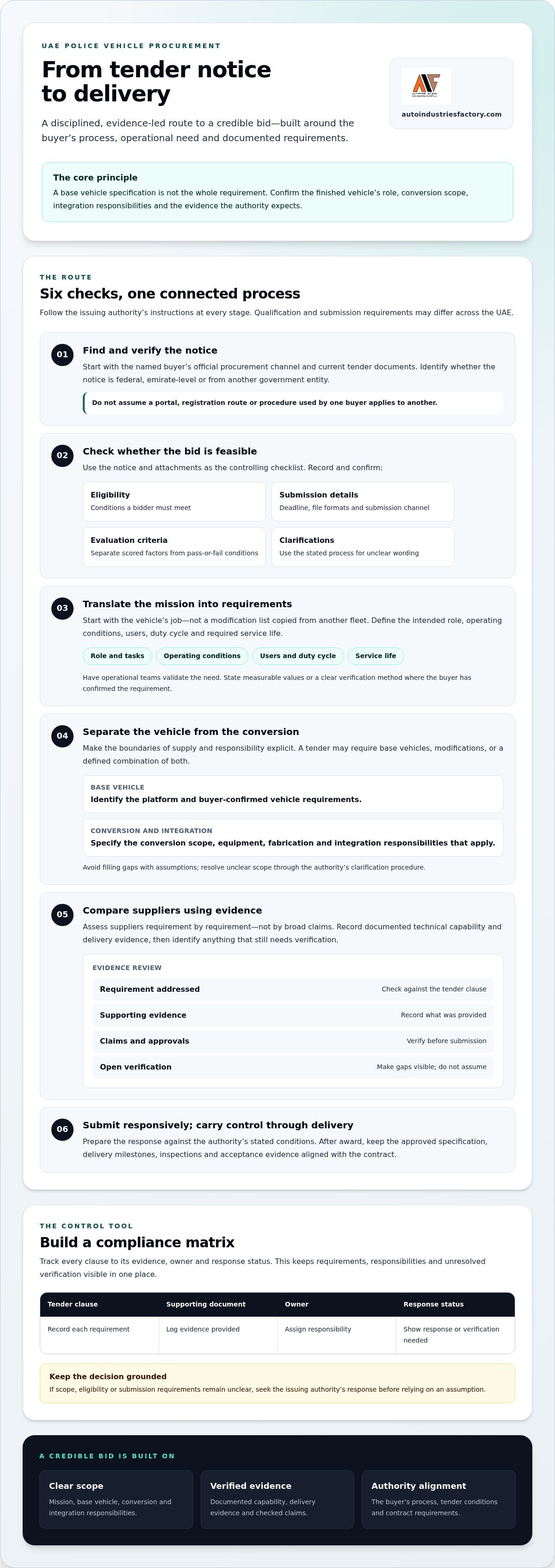
You’ll learn how to translate the stated mission into measurable conversion requirements, compare suppliers using documented technical capability and delivery evidence, and prepare a credible bid without filling gaps with assumptions. We’ll also cover which claims, approvals, and supporting documents to verify before submission. The result is a disciplined route from tender notice to bid decision, with scope and evidence at the centre.
Key Takeaways
- Map the buyer journey to the issuing authority’s own process, since qualification and submission requirements may differ across the UAE.
- Build specifications around the vehicle’s role and duty cycle, then clearly separate the base vehicle from conversion scope and integration responsibilities.
- Assess suppliers requirement by requirement, recording the evidence provided and anything that still needs verification.
- For government tenders for police vehicles UAE, use a compliance matrix to track each clause, its supporting document, its owner, and its response status.
- After award, keep the approved specification, delivery milestones, inspections, and acceptance evidence aligned with the contract.
How government tenders for police vehicles UAE work
A government tender is a formal procurement process led by a public authority to invite, assess, and select offers for a defined requirement. For police vehicles, that requirement may involve supplying base vehicles, carrying out modifications, or delivering a specified combination of both. The notice and its tender documents set the rules. There isn’t one process that automatically applies to every buyer across the UAE.
The usual journey moves from notice discovery to checking eligibility, preparing and submitting a response, evaluation, and an award decision. The issuing authority determines the details at each stage. Since police forces and government buyers operate at different levels, identify the buyer first. The overview of Law enforcement in the United Arab Emirates provides context on the country’s different police agencies.
Public-facing police fleets may attract attention, but a tender response must follow the documented operational requirement. This video offers a look at one visible aspect of police vehicles:
Where to find UAE police vehicle tender notices
Start with the named buyer’s official procurement channel and published tender documents. Some government entities use dedicated procurement portals, while federal and other government buyers may specify a different channel. Follow the process stated by the issuing authority. Before relying on a general procurement platform, verify its current scope, access requirements, and whether it carries the notice you need.
Check whether the notice is federal, issued by an emirate-level authority, or published by another government entity. Don’t assume a portal, registration, or procedure used for one buyer applies to another.
What to verify before deciding to bid
For government tenders for police vehicles UAE, treat the notice as the controlling checklist. Record the eligibility conditions, any registration steps, submission deadline, clarification process, required file formats, and submission channel. Confirm these details in the current notice and its attachments, as portal access or instructions may change.
- Mandatory conditions: Identify requirements that must be met for a bid to be considered.
- Evaluation criteria: Separate scored technical and commercial factors from pass-or-fail conditions.
- Unclear wording: Send questions through the stated clarification procedure and rely on the issuing authority’s response, not assumptions.
Proceed only when the scope, eligibility, and submission requirements are understood. This first check helps prevent avoidable non-compliance before technical work on the bid begins.
Translate UAE police operations into a precise vehicle tender specification
A tender specification should start with the job the vehicle must perform, not a list of modifications copied from another fleet. Define the intended role, operating conditions, users, duty cycle, and required service life. A routine patrol vehicle and a vehicle assigned to a specialist operational role may need different layouts, storage, access, and equipment. Ask operational teams to validate these needs before they become bid requirements.
Public fleet announcements can illustrate how operational purpose shapes vehicle choices. For example, the Emirates News Agency describes the rationale behind recent additions to a police patrol fleet. Use such examples as context, not specifications to copy: the tendering authority’s stated need is what suppliers must address.
Define patrol, response, and specialist vehicle use cases
Describe where and how the vehicle will be deployed, who will use it, and what tasks it must support. Then specify platform, seating, payload, storage, and access requirements only where the buyer has confirmed them. For each requirement, state a measurable value or a clear method of verification where practical. The related guide to police and military vehicle modifications can provide background on conversion considerations, but the tender must define its own scope.
Measurable requirements make supplier bids easier to compare because every offer can be checked against the same defined test or evidence. Avoid open-ended phrases such as “adequate storage” or “suitable for patrol” unless the tender explains how adequacy or suitability will be judged.
Specify equipment, integration, and acceptance evidence
Separate the specification into clear responsibility areas so there’s no ambiguity about who supplies, installs, integrates, tests, and documents each item:
- Base vehicle: State the buyer-approved platform and relevant performance, capacity, or configuration requirements.
- Conversion scope: List only the modifications required by the tender, with drawings or descriptions where supplied.
- Equipment and interfaces: Identify required communications, warning, electrical, storage, or protection systems only as specified. Assign responsibility for compatibility, installation, and any interfaces between systems.
- Inspection and handover: Name the authority or role responsible for acceptance, the inspection or test method, and the records required, such as test results, equipment lists, or handover documents.
For government tenders for police vehicles UAE, don’t assume a standard applies simply because it’s common in industry. Check whether the notice explicitly cites ISO 9001 or another standard, and verify the required evidence and applicability with the issuing authority. A supplier’s fabrication capabilities may be relevant, but confirm they match the exact tender scope and are supported by appropriate documentation.
Once the buyer has approved the operating requirements and responsibilities, use them as the baseline for comparing bids and managing changes. A technical discussion with a potential conversion supplier can then focus on the defined scope and the evidence available for it.
Compare police vehicle conversion suppliers using evidence, not broad claims
A polished profile can describe experience, but it doesn’t prove a supplier can meet a specific tender. Start with the buyer’s requirements and assess each supplier against the same criteria. Evidence-based supplier evaluation means matching every requirement to an attributable document or record, then marking whether it is verified, unclear, or unsupported.
For government tenders for police vehicles UAE, build a comparison matrix before scoring proposals. Keep the evidence tied to each requirement, not to general marketing statements.
| Tender requirement | Evidence to review | Status |
|---|---|---|
| Relevant conversion scope | Technical response describing the proposed work and its fit with the specified vehicle role | Verified, clarify, or unsupported |
| Fabrication capability | Process details, facility information, or records showing which work is performed in-house or by partners | Verified, clarify, or unsupported |
| Integration and installation | Responsibility matrix, interface details, and proposed installation and test approach | Verified, clarify, or unsupported |
| Quality and delivery capacity | Relevant quality documents, proposed milestones, inspection points, and current capacity evidence | Verified, clarify, or unsupported |
Assess technical capability and manufacturing scope
Ask suppliers to identify which tasks they perform in-house and which depend on partners. Review the proposed methods for structural work, electrical integration, equipment installation, and finishing against the tender’s actual scope. A supplier’s capability in one area doesn’t establish capability in another. Confirm that examples or references relate to a comparable vehicle role and conversion requirement, rather than treating broad sector experience as proof.
For instance, Auto Industries Factory LLC confirms in-house laser cutting, CNC machining, welding, and painting, as well as police and military vehicle modifications. These capabilities may be relevant to a tender’s fabrication scope, but buyers should verify the exact work proposed and supporting evidence for the specific bid.
Evaluate compliance, delivery, and support evidence
Request certificates, test records, drawings, and quality documents only where they’re specified or relevant to the tender. Check that each document is current, attributable to the supplier, and applicable to the proposed work. A company profile or unsupported claim doesn’t establish approval, certification, or compliance.
Review proposed milestones, inspection points, handover records, and any after-delivery support commitments against the tender requirements. Distinguish a documented commitment from a statement that needs clarification. If capacity, partner responsibilities, or evidence is unclear, record the gap and seek a direct response before completing the comparison. This creates a defensible basis for evaluation without assuming that an unverified claim is proof.
Prepare a responsive bid for UAE police vehicle tenders
A strong bid answers the authority’s requirements in the requested order and supports each claim with relevant evidence. For government tenders for police vehicles UAE, create a compliance matrix before drafting. Map each tender clause to a direct response, supporting document, responsible owner, and status, such as complete, pending, or clarification required. This gives the bid team a clear view of gaps before submission.
Build the tender response and evidence pack
Use the tender notice as the bid’s structure. Organize company details, qualification documents, technical responses, conversion scope, schedules, commercial information, and requested attachments according to the authority’s instructions. Follow its file formats, naming conventions, page limits, and submission channel exactly. Don’t substitute a familiar company template if the notice specifies another format.
Keep each document current and ensure the response reflects only verified capabilities. For a conversion proposal, describe the scope and responsibilities clearly, and attach only evidence that supports the specific claim. If a requirement depends on a partner, buyer-provided equipment, or an assumption, identify that dependency wherever the tender permits. Never present an assumption as confirmed compliance.
- Technical: Match each specification to the proposed response and its supporting evidence.
- Commercial: Check that pricing and any stated conditions follow the required format and align with the proposed scope.
- Qualification: Include only requested, applicable documents, and verify their status before submission.
- Clarifications: Update affected responses to reflect written answers and amendments from the authority.
Reduce avoidable submission and evaluation risks
Assign a named owner to each matrix row, then have separate reviewers check technical accuracy, commercial consistency, document completeness, and portal upload requirements. A final review should compare the assembled bid against both the original notice and the latest authority-issued clarifications. Confirm that every mandatory condition is addressed and that no file is missing, unreadable, or saved under the wrong name.
Watch for contradictions between sections. A technical schedule must not promise a scope that the commercial response excludes. Avoid unrequested substitutions and unsupported performance, capacity, certification, or delivery statements. If a clause remains unclear, use the notice’s clarification channel rather than guessing.
After checking the tender fit, buyers can review police and military vehicle modification services as a possible technical supplier discussion. Verify the exact scope and available supporting documents against the tender before making any bid commitment.
Select a conversion partner and move from tender award to delivery
Award is the start of controlled execution, not a reason to rely on verbal assumptions. Confirm the approved vehicle specification, each party’s responsibilities, milestones, inspection plan, and change-control process against the contract. Keep acceptance criteria tied to the issuing authority’s stated requirements, with clear records showing what was inspected, tested, and handed over.
For government tenders for police vehicles UAE, supplier fit still depends on the exact awarded scope. Auto Industries Factory LLC is a potential technical conversion supplier, not a tender adviser or automatically qualified bidder. Its confirmed offering includes police and military vehicle modifications, but buyers should verify scope, documentation, capacity, and any tender-specific qualifications before relying on a supplier for delivery.
Confirm supplier fit before requesting a detailed proposal
Share relevant tender extracts only through authorized channels and in line with the buyer’s confidentiality rules. Ask the supplier to map confirmed conversion capabilities against each requested deliverable, identifying gaps, dependencies, and supporting evidence. Review the company’s vehicle conversion services for relevant service categories, then check that the specific work required is within the proposed scope.
Before requesting a detailed proposal, prepare the vehicle platform, intended operational role, quantity, specification, and tender timeline. This gives the supplier a defined basis for confirming whether its capabilities and available documentation appear relevant. Don’t treat a general company profile as proof of eligibility, approvals, or past performance.
Set clear controls for build, inspection, and handover
After award, establish a controlled baseline for the approved configuration. Confirm which drawings and documents govern the build, who approves them, and who is responsible for each inspection and acceptance step. Set out the required handover records in advance, based on the contract and authority’s requirements.
- Configuration: Record approved specifications and drawings, and maintain version control.
- Inspection: Define inspection points, responsible parties, and required evidence.
- Changes: Log deviations and obtain the required approvals before implementing changes.
- Handover: Check that acceptance documents match the contract and completed vehicle configuration.
Company background can help frame a supplier discussion, but it isn’t evidence of tender qualification. Verify every capability, quality claim, and commitment against current documents that apply to the awarded work.
Make the next step practical and evidence-led
Once you’ve reviewed tender fit, discuss the defined conversion requirements with a potential supplier and request confirmation of relevant capability and supporting evidence. Contact Auto Industries Factory about police vehicle conversions to discuss a specific scope, without assuming eligibility or delivery commitments before verification.
Turn tender requirements into a confident next step
Strong bids for government tenders for police vehicles UAE start with the issuing authority’s current requirements, then connect each operational need to a clear specification and verifiable supplier evidence. Keep the base vehicle, conversion scope, responsibilities, and acceptance records aligned from bid preparation through delivery. A disciplined review helps expose gaps early and supports a response built on proof rather than assumptions.
Auto Industries Factory LLC offers police and military vehicle modifications, with in-house laser cutting, CNC machining, welding, and painting capabilities. The company serves customers nationally across the UAE. These capabilities may be relevant to a tender’s conversion scope, but buyers should confirm fit, documentation, capacity, and any tender-specific qualifications before relying on them.
Once you’ve reviewed the tender and identified a potential scope match, discuss your police vehicle conversion requirements with the team. Bring the vehicle platform, intended role, and relevant requirements so the conversation can focus on practical fit and evidence. With clear specifications and careful verification, you can move forward with greater confidence.
Frequently Asked Questions
How do I find government tenders for police vehicles in the UAE?
Start with the issuing authority’s official procurement channel and check its published tender documents. Government buyers may use different portals and procedures. Confirm the notice is current, then check its access requirements, scope, eligibility, deadlines, clarification process, and submission instructions before deciding whether to bid.
What documents are usually required to bid for a UAE government vehicle tender?
The tender notice defines the required documents, so there isn’t one checklist that fits every UAE buyer. It may request company and qualification information, a technical response, commercial forms, supporting evidence, and declarations. Use the notice’s exact list and formats. Build a compliance matrix that links each clause to its response, document, owner, and status. Include only current, applicable documents, and verify any required registration before submission.
Can an overseas supplier bid for a UAE police vehicle tender?
An overseas supplier’s eligibility depends on the specific authority and tender conditions. Check whether the notice permits foreign bidders and whether it sets registration, local representation, documentation, or other qualification conditions. Don’t assume that a UAE-based partner is either required or sufficient. If eligibility wording is unclear, submit a question through the authority’s stated clarification process and rely on its written response before committing resources to a bid.
How do I compare police vehicle conversion suppliers for a tender?
Compare each supplier against the same tender requirements, not broad claims or profile language. For every clause, record the evidence provided and mark it verified, unclear, or unsupported. Review relevant conversion scope, in-house and partner responsibilities, fabrication capability, integration approach, quality documents, proposed milestones, and capacity evidence. Check that examples relate to the vehicle role and work requested. Ask for clarification where evidence doesn’t establish a direct fit.
Are specific certifications required for police vehicle tenders in the UAE?
There isn’t enough basis to assume one certification is mandatory across every UAE police vehicle tender. Check the notice and attachments for named standards, certificates, quality systems, approvals, and the evidence the authority expects. If ISO 9001 or another certification is mentioned, confirm its scope and applicability to the requirement. Don’t infer certification or government approval from a supplier profile; verify claims using current, attributable documents.
What technical requirements should a police vehicle tender include?
Define the vehicle’s role, operating conditions, users, duty cycle, and required service life. Separate base vehicle specifications from conversion work, supplied equipment, and integration responsibilities. State measurable requirements where possible, including how each item will be tested or inspected and who will accept it. Specify only buyer-confirmed platform, seating, payload, storage, communications, electrical, warning, or protection needs. Clear criteria help suppliers prepare comparable responses and evidence.
What happens if a tender specification does not match the proposed vehicle conversion?
Identify the mismatch before submission and use the tender’s clarification procedure to ask the issuing authority how it should be handled. Don’t silently substitute equipment, alter the scope, or claim compliance without evidence. If the notice permits exceptions, state the deviation and its implications clearly in the required format. After award, document any proposed change and obtain the approvals required by the contract before implementing it.


