

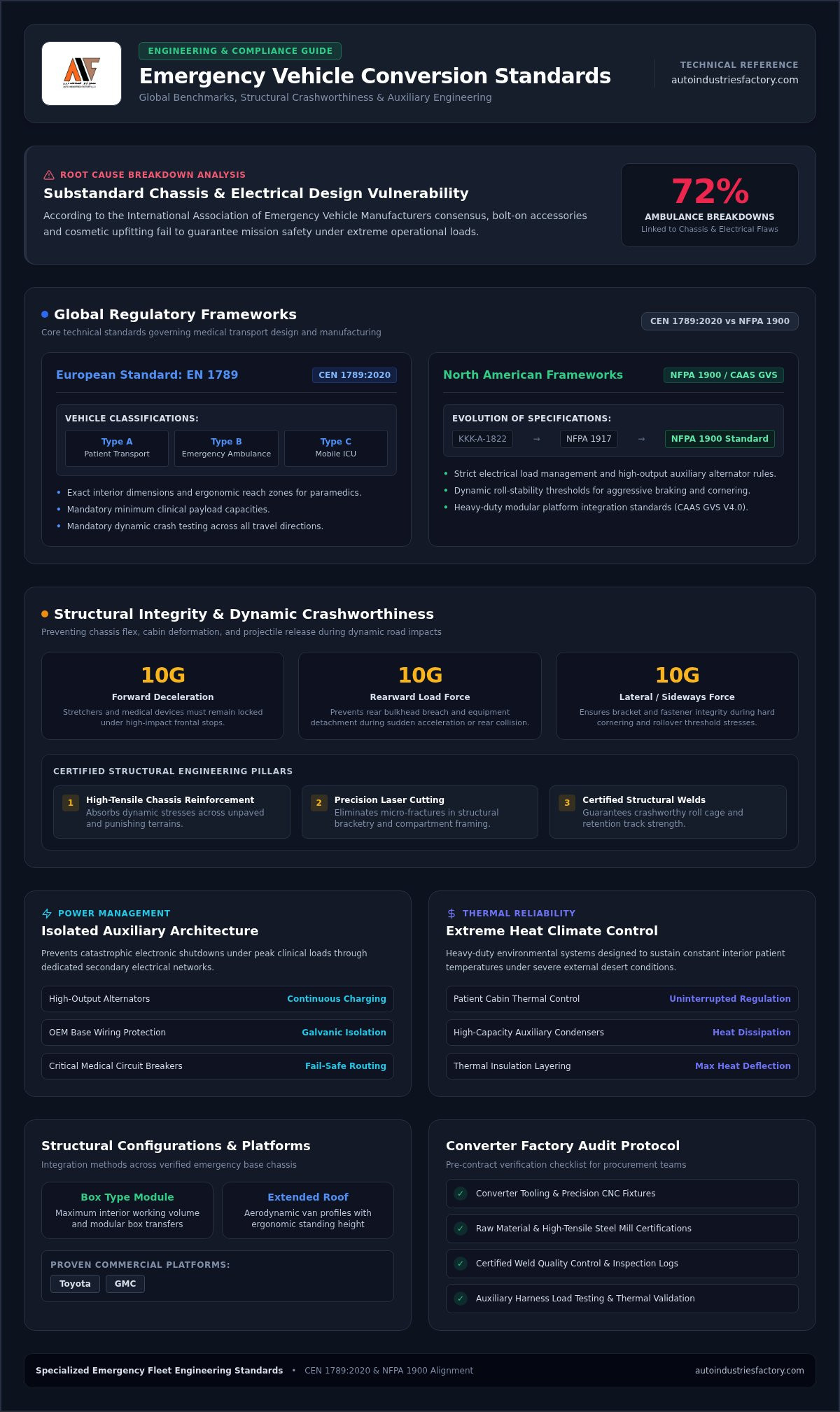
According to a 2026 consensus from the International Association of Emergency Vehicle Manufacturers, 72% of ambulance breakdowns link directly to substandard chassis and electrical system design. Bolt-on accessories and cosmetic upfitting cannot substitute for rigorous structural engineering. When lives depend on rapid response across punishing terrain and high-heat environments, meeting verifiable emergency vehicle conversion standards is the only way to prevent catastrophic failures in the field.
Fleet directors and procurement teams often struggle to reconcile competing international benchmarks like CEN 1789:2020 and NFPA 1900 while trying to verify converter claims regarding build quality and thermal reliability. You shouldn't have to guess whether your vehicles will pass dynamic crash inspections or maintain patient climate control under peak operational loads. Discover the critical structural, electrical, and clinical standards required for mission-ready emergency vehicle conversions. This guide delivers the essential engineering parameters, manufacturing quality standards, and technical specifications you need to establish uncompromising tender requirements.
Key Takeaways
- Master the critical emergency vehicle conversion standards, aligning international benchmarks like CEN 1789:2020 and NFPA 1900 with national fleet tender requirements.
- Discover how high-tensile chassis reinforcement, precision laser cutting, and certified structural welds guarantee crashworthy compartment integrity.
- Learn how isolated auxiliary electrical architectures and heavy-duty climate control systems prevent catastrophic electronic shutdowns in extreme heat environments.
- Implement a rigorous factory audit checklist to inspect converter tooling, material certifications, and quality control protocols before signing contracts.
- Evaluate structural integration techniques for box type and extended roof configurations across proven platforms like Toyota and GMC.
Emergency Vehicle Conversion Standards: Global and National Frameworks
Engineering mission-ready rescue fleets begins with establishing strict regulatory compliance. Validated emergency vehicle conversion standards establish mandatory structural, electrical, and clinical performance baselines. Without these benchmarks, modified chassis risk structural failure under sudden dynamic stresses. Fleet operators across the nation must align international manufacturing criteria with national transport mandates to ensure crew ergonomics, patient survival, and uncompromising on-road safety.
Procurement teams often face conflicting specifications when evaluating global conversion platforms. Sourcing teams can review global ambulance design and construction standards to understand how different regions regulate compartment dimensions, payload tolerances, and emergency response upfitting. Substandard modifications trigger early driveline failures, void manufacturer warranties, and expose operators to severe legal liabilities.
To see how professional fabricators translate rigorous engineering specifications into physical EMS builds, watch this detailed vehicle walkthrough:
European CEN Standards: Understanding the EN 1789 Framework
The CEN 1789:2020 standard classifies medical transport into Type A (patient transport), Type B (emergency ambulance), and Type C (mobile intensive care unit). This framework establishes exact interior working dimensions, ergonomic reach zones for attending paramedics, and minimum medical equipment payloads. Crucially, EN 1789 mandates dynamic 10g crash testing for patient stretchers, medical device mountings, and attendant seating across all travel directions.
North American Mandates: NFPA 1917 and Federal KKK-A-1822
North American emergency fleet engineering historically relied on the Federal KKK-A-1822 specification, but modern tenders increasingly mandate CAAS GVS V4.0 or NFPA standards. With NFPA 1917 consolidated into NFPA 1900, engineers must follow updated rules for electrical load management, high-output auxiliary alternators, and dynamic roll-stability thresholds. These standards govern heavy-duty modular platforms, ensuring that high-performance conversions handle aggressive braking and cornering loads safely. Fleets needing comprehensive coachbuilding can examine certified specialized conversion solutions that integrate these criteria directly into base vehicle platforms.
Structural Integrity and Crashworthiness Standards in Custom Builds
Cosmetic upfitting creates catastrophic liabilities when emergency vehicles face dynamic road impacts. Proper emergency vehicle conversion standards demand verified crashworthiness engineering that absorbs impact forces while keeping the interior compartment intact. When vehicles operate at high speeds through traffic or traverse unpaved desert corridors, chassis flex and cabin deformation can quickly jam exit doors or break life-support equipment loose. Explore the fundamentals of ambulance conversion to understand how modern fabricators reinforce chassis architectures for long-term fleet durability.
Dynamic 10G and 20G Impact Testing Protocols
Modern crashworthiness requires interior retention systems to withstand extreme deceleration loads. Under CEN 1789 and the NFPA 1917 ambulance standard (now consolidated into NFPA 1900), all installed equipment mounts must hold fast against multidirectional forces:
- 10G Multi-Axis Deceleration: Stretcher retaining tracks, oxygen cylinder brackets, and defibrillator mounts must survive 10G forces forward, rearward, and sideways without shearing fasteners.
- 20G Frontal Impact Thresholds: Forward-facing attendant seats and main structural cabinetry undergo dynamic pull tests to prevent heavy medical gear from detaching into projectiles.
Chassis Reinforcement and Roll-Over Protection (ROPS)
Structural body modifications require precision metal cutting and bending to retain factory crash safety envelopes. Cutting factory roof panels or installing an extended roof ambulance on GMC or Toyota platforms compromises unibody rigidity unless compensated with internal structural arches. Precision CNC-machined roll-over protection structures distribute impact forces along reinforced pillar anchors, preserving crucial survival space during rollover incidents.
Bulkhead Partitioning and Crew Safety Enclosures
Separating the cockpit from the patient care compartment requires heavy-duty engineering. High-tensile steel bulkheads prevent heavy tools, patient stretchers, or tactical gear from piercing the driving cab during rapid braking. These partitions must integrate certified sliding access doors, multipoint seatbelt harnesses, and flame-retardant barriers. Operators seeking fully engineered compartments can explore proven vehicle conversion capabilities to ensure their emergency fleets meet rigorous national safety baselines.
Auxiliary Electrical and Environmental Management Standards
Operational failures during critical response runs often trace back to compromised electrical harnesses or thermal collapse. Modern emergency vehicle conversion standards demand independent power segregation and heavy-duty environmental management capable of sustaining life-support devices in extreme ambient heat. Fleet operators must treat auxiliary electrical architectures not as an afterthought, but as an engineered system designed to protect both equipment and patient survivability.
Auxiliary Power Architecture and Load Management (SAE Guidelines)
Powering intensive medical hardware, tactical communications, and high-output warning lights off standard chassis wiring causes rapid alternator failure and battery depletion. Certified converters engineer isolated secondary battery banks connected through solid-state smart isolators. Automated load-shedding modules continuously monitor line voltage, instantly disabling non-essential convenience features if extended vehicle idling threatens primary battery reserves. Implementing CAN-bus multiplex systems drastically reduces wire bundle mass, replaces prone analog relays, and standardizes fault diagnostics across the entire fleet.
Electromagnetic Compatibility (EMC) and Radio Frequency Shielding
Modern emergency vehicles function as mobile communications hubs. High-draw lightbars, dual sirens, and heavy-duty inverters generate intense electromagnetic fields that can disrupt delicate clinical diagnostic tools. Conversion engineering must comply with ECE R10 standards to eliminate radio frequency pollution:
- Diagnostic Equipment Shielding: Dedicated grounding planes and shielded cabling prevent electrical noise from corrupting delicate 12-lead ECG readouts and defibrillator telemetry.
- Tactical Communications Isolation: Suppressors eliminate high-frequency whine and alternator ripple from two-way radio channels and satellite uplink systems.
Medical Gas and Oxygen Delivery Safety Standards
Storing compressed medical gas inside a enclosed cabin introduces severe physical hazards if containment fails. Conversion regulations mandate heavy-gauge steel retention brackets that lock oxygen cylinders securely against multi-axis collision forces. High-pressure distribution networks utilize seamless copper or medical-grade polymer lines routed inside dedicated maintenance channels, terminating at self-sealing quick-connect wall outlets with exterior emergency shut-off valves.
Managing extreme regional cabin temperatures also demands high-capacity dual HVAC circuits, keeping patient compartments cooled independently of engine idle loads. Review our comprehensive specialized vehicle conversion services to explore how unified electrical and climate engineering delivers dependable fleet performance under punishing field conditions.
Quality Assurance Workflows: How Fleet Managers Audit Converters
Relying on spec sheets alone exposes procurement teams to substantial operational risk. Genuine compliance with emergency vehicle conversion standards requires direct, on-site physical verification. Fleet managers must walk the factory floor to evaluate fabrication tooling, raw material certifications, and assembly protocols before awarding high-value fleet tenders. A structured audit workflow ensures converted units deliver long-term durability rather than premature maintenance headaches.
Step 1: Verifying Material Certification and In-House Fabrication
Audit the converter's raw material inventory and machining capabilities. Reliable coachbuilders do not outsource structural metalwork to unaccountable third parties; they maintain tight quality control under one roof. Verify mill test reports for structural steel and aluminum sheets used in subframes and cabinetry. Inspect active CNC bending stations, precision fiber laser cutters, and certified welding booths to confirm structural welds meet engineering tolerances. Discover our team's manufacturing philosophy on the Auto Industries Factory LLC about page to see how fully integrated fabrication guarantees compliance across custom ambulance platforms.
Step 2: Evaluating Pre-Delivery Electrical and Payload Inspections
Pre-delivery audits must confirm the vehicle operates safely under real-world operational loads. Demand documented test data covering three non-negotiable quality checks:
- Corner Weight and GVWR Analysis: Measure individual wheel loads on calibrated four-point scales to confirm proper weight distribution and prevent chassis overloading.
- Full-Load Thermal and Electrical Stress Testing: Run all emergency lightbars, sirens, auxiliary HVAC units, and onboard medical equipment continuously for at least two hours to monitor alternator temperature and voltage drops.
- High-Pressure Water Booth Testing: Subject the modified bodywork, external compartments, and roof joints to directed high-pressure spray to verify complete environmental sealing against water and fine desert sand.
Step 3: Auditing Quality Documentation and Warranty Frameworks
Every completed vehicle must leave the facility with complete technical documentation. Audit the converter's schematic packages, ensuring every circuit has unique wire color-coding and labeling matching the master fleet manual. Validate material traceability records for medical mounts, multipoint restraint belts, and flame-retardant interior panels. Confirm that nationwide warranty terms are backed by rapid parts availability. If you are preparing tender specifications for an upcoming procurement, contact our vehicle conversion engineers at Auto Industries Factory LLC to inspect our facility and review certified manufacturing standards firsthand.
Selecting a Certified Converter: Engineering Purpose-Built Fleets
Procuring purpose-built fleets demands active technical alignment between operational commanders and master fabricators. Applying emergency vehicle conversion standards to real-world operations means looking past off-the-shelf catalog parts. Converted platforms must withstand severe heat, rugged desert terrain, and relentless operational tempos without structural fatigue or systemic failure. For tactical and law enforcement fleets, consult our guide to police vehicle modifications to explore specialized security upfitting.
The Advantage of Single-Facility Engineering Control
Fragmented supply chains introduce critical points of failure. When a converter contracts metal fabrication to one shop, wiring to another, and painting elsewhere, quality controls break down. Housing laser cutting, CNC bending, structural welding, electrical integration, and vehicle color change under one roof eliminates build delays and compliance gaps. In-house engineering teams can prototype custom equipment brackets and modular storage systems rapidly, ensuring every component fits the vehicle's structural load path precisely.
Configuring Platform-Specific Emergency Conversions
Mission parameters dictate structural platform selection across national fleets:
- Urban Response Vans: Configured as agile Type A or Type B medical transport units, offering fast city maneuverability with optimized interior medical cabinetry.
- Box Type Ambulances: Built on heavy-duty cutaway chassis, a modular box type ambulance provides expansive cubic volume for complex mobile intensive care operations and heavy diagnostic equipment.
- Extended Roof Ambulance on GMC & Toyota: Raised-profile builds on proven platforms like the Toyota Land Cruiser, Hilux, or GMC deliver exceptional ground clearance combined with essential interior standing height for off-highway missions.
- Frontline Protection and Utility: Equipping vehicles with reinforced front metal bull bars, custom bumpers, brush guards, and engineered metal roof racks protects body panels during high-impact patrol operations.
Executing builds entirely in-house ensures full compliance with statutory emergency vehicle conversion standards while delivering the structural resilience your crews depend on. Fleet operators configuring purpose-built emergency units can explore our comprehensive specialized vehicle conversion services to initiate direct technical consultations.
Engineer Mission-Ready Fleet Resilience for the Road Ahead
Deploying emergency vehicles that endure punishing field operations requires uncompromising adherence to verified emergency vehicle conversion standards. From high-tensile structural rollover cages and dynamic 10G equipment restraints to isolated auxiliary power architectures, every engineering decision directly affects crew survival and patient care. Fleet procurement teams can't leave these mission-critical outcomes to chance, unverified sub-assemblies, or cosmetic upfitting shortcuts.
Partnering with a master fabricator eliminates compliance risks through complete in-house manufacturing, spanning precision laser cutting, CNC bending, certified welding, and specialized paint finishing under one roof. Auto Industries Factory delivers heavy-duty builds tailored for national emergency response, security, and healthcare operators, guaranteeing compliance with stringent international crashworthiness and electrical safety benchmarks. When you're ready to establish uncompromising technical tender specifications, request a technical consultation for your fleet conversion and build your next fleet on proven engineering excellence.
Frequently Asked Questions
What are the primary standards governing ambulance conversions?
Ambulance conversions primarily align with the European CEN 1789:2020 framework or the consolidated North American NFPA 1900 standard alongside CAAS GVS V4.0. In the United Arab Emirates, emergency vehicle conversion standards require fleets to harmonize these global baselines with national transport safety codes. These frameworks mandate precise tolerances for structural crashworthiness, electrical system segregation, fire retardancy, and clinical interior layouts to guarantee operational safety under high-speed emergency conditions.
How do dynamic 10G and 20G crash tests protect emergency vehicle occupants?
Dynamic crash testing subjects interior retaining brackets, stretcher mounts, and cabinetry to 10G multidirectional and 20G forward deceleration forces. In a collision or high-speed emergency maneuver, unsecured medical devices become lethal projectiles. Conformance to these testing benchmarks ensures that oxygen cylinders, monitor mounts, and attendant seating remain rigidly anchored to reinforced chassis points, safeguarding paramedics and patients from catastrophic blunt-force trauma inside the rear compartment.
Can standard passenger vans be converted into certified ambulances without chassis modifications?
No. Standard passenger vans lack the structural reinforcement, floor anchor points, and electrical output necessary to sustain life-support systems safely. Certified conversions require structural floor plates, roll-over protection arches, high-output alternators, and secondary battery banks. Without precision laser cutting, CNC bending, and certified chassis reinforcement, converting an unmodified passenger van creates dangerous weight imbalances, invalidates base vehicle warranties, and fails statutory fleet roadworthiness inspections.
Why is electrical load management critical in emergency vehicle conversions?
Modern emergency conversions integrate power-hungry tactical lighting, dual sirens, medical telemetry, and dedicated HVAC units. Without intelligent load management, high auxiliary electrical draws can overload the chassis alternator and drain starting batteries during extended idling. Automated load-shedding systems and isolated secondary battery architectures prioritize life-support equipment power while shedding non-critical accessories, directly preventing electrical fires and field breakdowns during urgent response calls.
What is the difference between Type A, Type B, and Type C ambulance conversions?
Under CEN 1789 definitions, Type A vehicles handle non-emergency patient transport with basic clinical monitoring. Type B ambulances serve as frontline emergency response units equipped for basic life support and rapid trauma intervention. Type C conversions represent mobile intensive care units built with expanded cubic space, advanced life-support integration, and extensive clinical ergonomics, often configured as a box type ambulance on heavy-duty truck chassis.
How do extreme summer temperatures influence emergency vehicle HVAC specifications?
Extreme ambient heat demands heavy-duty dual HVAC systems engineered to cool the medical compartment independently of standard engine operation. Converting vehicles under demanding national emergency vehicle conversion standards requires auxiliary rooftop or underbody condensers, insulated composite paneling, and high-efficiency blowers. These systems prevent temperature-sensitive medications from degrading, protect sensitive clinical electronics from overheating, and maintain a stable patient compartment even during midday desert dispatches.
What documentation should fleet managers demand prior to taking delivery of converted vehicles?
Fleet managers should require complete documentation packages before signing off on converted vehicles. Non-negotiable documents include four-point corner weight certificates verifying GVWR compliance, detailed point-to-point electrical schematics, and mill certifications for structural metals. Procurement teams must also verify pull-test certificates for equipment anchors, HVAC thermal test reports, and formal warranty documentation detailing national parts availability and in-house fabrication support.


