
Did you know that armoring a standard vehicle can add anywhere from 500 to over 2,600 pounds of dead weight to the factory frame? Most people focus on the ballistic glass thickness, but the real engineering challenge is preventing the car from collapsing under its own protection. You're right to worry about mechanical failure or sluggish handling. Without proper vehicle structural reinforcement for armoring, the added stress will eventually compromise the vehicle's integrity and safety.
At Auto Industries Factory LLC, we treat every conversion as a master engineering project. You shouldn't have to choose between a bulletproof shell and a drivable vehicle. This article explores the critical engineering processes required to reinforce a vehicle's chassis and mechanical systems to support heavy ballistic armoring. We'll preview how we recalibrate suspension, reinforce pillars, and use precision fabrication to ensure your fleet remains rugged and mission-ready across the UAE.
Key Takeaways
- Understand why adding 500kg to 1,500kg of ballistic protection requires a fundamental recalibration of your vehicle's frame to maintain mobility.
- Learn how specialized vehicle structural reinforcement for armoring secures critical joints and uses pillar bracing to prevent structural failure during a blast.
- Discover the essential mechanical upgrades, such as heavy-duty coil springs and high-performance braking systems, needed to manage extreme weight.
- Explore the precision fabrication standards, including CNC laser cutting and MIG/TIG welding, that ensure millimeter-perfect ballistic plate fitment.
- Identify the benefits of partnering with a UAE-based expert for end-to-end fabrication to ensure your fleet's long-term operational safety.
The Critical Need for Vehicle Structural Reinforcement for Armoring
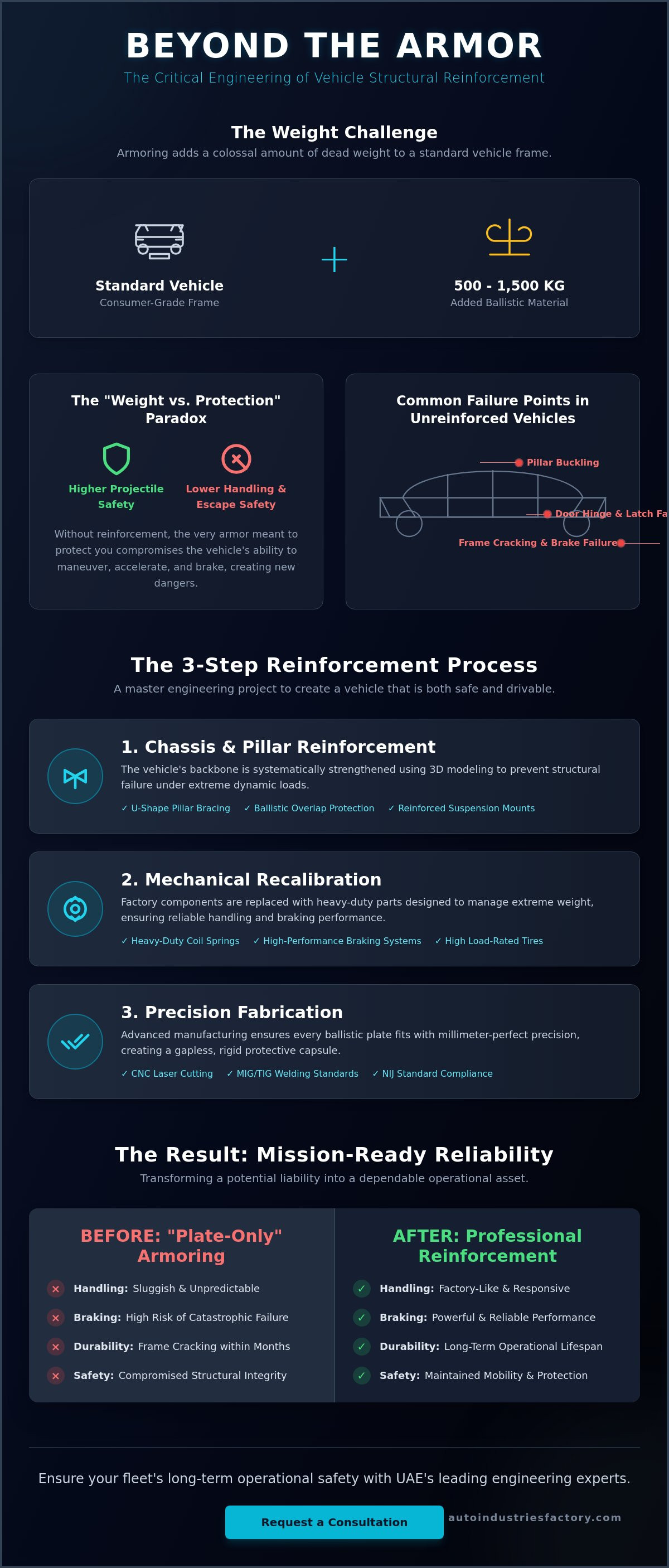
Structural reinforcement isn't just a secondary consideration in the armoring process; it's the fundamental engineering discipline that makes a protected vehicle viable. We define this process as the systematic recalibration of a vehicle's frame to support an additional 500kg to 1,500kg of ballistic material. Without vehicle structural reinforcement for armoring, a standard SUV is essentially a consumer-grade machine forced to carry the payload of a commercial truck. This imbalance leads to the 'Weight vs. Protection' paradox. While adding more armor increases a person's safety against projectiles, it simultaneously decreases safety by reducing the vehicle's ability to maneuver, accelerate, and escape a threat.
Relying on a 'plate-only' approach, where steel is simply welded into the cabin without frame modification, often results in frame cracking and catastrophic brake failure within months. The goal of a professional conversion is to provide life-saving protection while maintaining factory-like handling and long-term reliability. Achieving this requires a sophisticated understanding of the materials and design of vehicle armour to ensure every plate contributes to the vehicle's strength rather than its destruction.
To better understand the scale of this engineering challenge, watch this helpful video:
The Physics of Armored Vehicle Weight
When you add ballistic steel to the roof and thick glass to the windows, you're shifting the vehicle's center of gravity significantly higher. This change makes a standard SUV chassis behave unpredictably during high-speed turns or sudden lane changes. Static loads, such as the weight of passengers, are handled easily by factory springs; however, dynamic loads, the force exerted during sudden braking or swerving, create immense stress on the mounting points. In the context of high-velocity maneuvers, structural integrity is the ability of the frame to resist torsional twisting while keeping ballistic seals perfectly aligned.
Common Failure Points in Unreinforced Vehicles
The A, B, and C pillars are the primary stress points during high-speed turns or rollover events. In unreinforced vehicles, these pillars can buckle under the weight of the armored roof shell. Door latches also suffer catastrophic failure, as they weren't designed to hold a 200kg door shut during a blast or high-speed impact. At Auto Industries Factory LLC, we focus on reinforcing these specific weak points to prevent mechanical breakdown in the field. You can learn more about us and our engineering-first approach to tactical vehicle fabrication and safety.
Chassis and Pillar Reinforcement: The Backbone of Protection
Precision begins long before a welding torch touches the metal. At Auto Industries Factory LLC, we use advanced 3D modeling to map every stress point on a vehicle's chassis. This step is non-negotiable for effective vehicle structural reinforcement for armoring. It allows us to visualize how a heavy ballistic package will interact with the original frame of a Nissan Patrol or Toyota Land Cruiser. If the engineering isn't perfect in the digital phase, the physical result will fail under the dynamic loads described earlier.
The most critical area of this structural backbone is overlap protection. Ballistic gaps often occur where steel meets glass or where door seams align. We engineer these joints to ensure that a projectile hitting a seam is met with a secondary layer of hardened steel. Adhering to NIJ ballistic protection levels requires a gapless capsule. This isn't just about stopping bullets; it's about maintaining a rigid structure that prevents roof collapse during a rollover or a blast event.
Pillar Bracing and Door Overlaps
We use a specialized "U-shape" reinforcement technique for B-pillars. This involves wrapping the pillar in high-strength steel to double its load-bearing capacity. This bracing supports the massive weight of ballistic glass, which can be over 1.5 inches thick. We also reinforce the bulkhead, or firewall, to protect the cabin from front-impact threats. These modifications ensure the vehicle's survival cell remains intact even if the outer shell is compromised. For a deeper look at the specific steels and composites used in these layers, check our guide on Car Armouring.
Heavy-Duty Door Hinges and Latches
Factory hinges aren't designed for tactical use. They often fail within weeks when forced to carry doors that weigh an extra 150kg to 200kg. We replace these with custom-fabricated, high-strength steel hinges. These aren't just screwed into the sheet metal; they're bolted directly into the reinforced frame of the vehicle. This prevents door sagging and ensures the door remains operable after a blast. We also upgrade the latches to prevent the doors from flying open during a high-speed maneuver. If you're managing a security fleet, you can explore our full range of tactical vehicle services to see how we handle these complex modifications.
Finally, we reinforce the floor pan. Standard floors are thin sheet metal, which offers zero protection against under-vehicle threats. We add a structural sub-frame to support blast-resistant plating. This ensures the floor doesn't buckle or shear away from the chassis during an explosion. This holistic approach is what separates a truly armored vehicle from a dangerous modification.
Mechanical Recalibration: Suspension, Brakes, and Tires
Adding armor plates is only half the battle. If a vehicle can't maneuver or stop effectively, the protection becomes a liability. True vehicle structural reinforcement for armoring must include a total overhaul of the mechanical systems to handle the massive increase in kinetic energy. When you add 1,500kg to a standard SUV, the factory suspension will bottom out, and the brakes will fade almost instantly. We follow rigorous engineering principles, often aligning our builds with the U.S. Department of Justice standards for armored vehicles to ensure every mechanical component is up to the task.
Heavy-Duty Suspension for Armored Fleets
Standard suspension systems are designed for comfort, not combat. For armored fleets, we replace factory components with heavy-duty coil springs and high-pressure gas shocks. These systems are engineered with spring rates 40% to 120% higher than stock to maintain ride height and absorb the shock of uneven terrain. While off-the-shelf kits like Old Man Emu are excellent for light modifications, our custom AIF solutions are tailored for the extreme weight of B6 and B7 protection levels. We also install thickened anti-roll bars. These are vital for preventing the vehicle from tipping over during high-speed evasive maneuvers. This same reinforcement logic applies to our safari vehicle conversions, where ruggedness is key to survival in the desert.
Braking Systems and Run-Flat Technology
Stopping an armored vehicle requires significantly more force than a standard car. Increased mass generates extreme heat, which can warp factory rotors in a single hard stop. We upgrade the entire system with larger calipers, specialized high-friction brake pads, and heat-dissipating slotted rotors. These components are designed to perform under the constant stress of heavy loads without failing. You can view our full range of conversion capabilities on our services page, where we detail our end-to-end fabrication process.
Mobility after an attack is equally important. Since tires are often the first target, we integrate Run-Flat systems, such as those from Hutchinson, directly into reinforced rims. These inserts allow the driver to maintain control and travel up to 50km at 80km/h even after multiple tire strikes. In the GCC region, we also address engine cooling. The combination of 50°C temperatures and the added weight of armor puts immense strain on the powertrain. We install upgraded radiators and high-capacity oil coolers to ensure the engine doesn't overheat during a high-speed pursuit or long-duration mission. This holistic mechanical recalibration is a core pillar of vehicle structural reinforcement for armoring.
Precision Fabrication: CNC Machining and Welding Standards
High-level engineering requires physical execution that matches the digital blueprints mentioned earlier. This is where vehicle structural reinforcement for armoring moves from theory to reality. At Auto Industries Factory, we don't rely on manual cutting or "eyeballing" the fitment of plates. Every piece of ballistic steel is processed using CNC Laser Cutting technology. This level of precision provides millimeter-perfect fitment, ensuring that armor plates sit flush against the reinforced chassis. This leaves zero room for ballistic gaps that could compromise occupant safety.
The Role of CNC Laser Cutting in Armoring
Traditional cutting methods, like plasma or oxy-fuel, generate excessive heat. This creates "heat-affected zones" (HAZ) that can soften ballistic steel, making it brittle or less resistant to impacts. CNC laser cutting minimizes this risk by focusing energy on a microscopic point. This allows us to maintain the original molecular integrity of the hardened materials. We also use this technology to create custom-designed brackets for internal equipment mounting, such as tactical lighting or communication gear. Our in-house facility in Ajman is equipped with advanced laser systems and press brakes, allowing us to control every stage of the fabrication process. If you need custom metalwork for your security fleet, you can get a free estimate for our fabrication services today.
Welding and Assembly Integrity
Welding is the glue that holds the entire structural system together. We move beyond the factory's reliance on spot welds, which are designed for lightweight consumer cars. Tactical vehicle conversions require continuous MIG and TIG welding to distribute stress evenly across the frame. We often employ a "boxing" technique for the frame rails. This involves welding steel plates over the open C-channel sections of a factory frame to create a fully enclosed box. This dramatically increases torsional rigidity and prevents the frame from twisting under the weight of the armor during high-speed turns. For a look at how we apply these heavy-duty fabrication standards to larger platforms, read our definitive guide on the Armoured Personnel Carrier.
Our quality control process includes ultrasonic testing of welds to ensure there are no internal voids or weaknesses. In the UAE, we must also battle the environment. The saline air in coastal areas like Dubai and Ajman can cause rapid oxidation on exposed steel. We use a multi-stage finishing process, including heavy-duty powder coating and specialized painting, to provide long-term corrosion resistance. This ensures that the vehicle structural reinforcement for armoring remains as strong in ten years as it is on the day of delivery. By combining master craftsmanship with advanced industrial technology, we build vehicles that aren't just bulletproof, they're built for life.
Why Auto Industries Factory is the UAE Leader in Vehicle Reinforcement
Auto Industries Factory (AIF) specializes in providing the most robust vehicle structural reinforcement for armoring in the Middle East. Unlike many competitors who outsource critical stages of production, we maintain an end-to-end in-house process at our facilities in Ajman and Dubai. We control every variable from the initial 3D design and CNC laser cutting to the final specialized painting and assembly. This vertical integration is the only way to guarantee that no ballistic gaps exist and that every weld meets our rigorous internal safety benchmarks. When lives are on the line, we don't leave anything to chance or third-party contractors.
Our engineering team possesses deep experience with the specific platforms that define the UAE's security and commercial landscape. We've mastered the chassis architecture of the Toyota Land Cruiser, Nissan Patrol, and GMC Suburban. These vehicles are the workhorses of the region, and we know exactly where their factory frames require bracing to handle the weight of B6 and B7 protection levels. While we adhere to international standards like VPAM and BRV, we adapt these protocols for the unique challenges of the GCC. This includes reinforcing vehicles to survive extreme desert heat and high-salinity air that can weaken inferior builds.
Expert Solutions for Specialized Fleets
The logic we apply to vehicle structural reinforcement for armoring extends across our entire service range. For example, we use similar heavy-duty frame modifications in our Ambulance Conversions to support medical equipment and high-roof structures. Whether we're building a tactical police unit or a rugged safari vehicle, the core philosophy remains the same: the platform must be stronger than the load it carries. Our proximity to major hubs in Dubai and Sharjah allows us to provide rapid fleet support and maintenance, ensuring your mission-critical vehicles stay on the road. We invite fleet managers and security professionals to visit our Ajman factory for a technical consultation to see our master craftsmen in action.
Built for Life-Saving Reliability
At AIF, our "Built to Protect What Matters" philosophy isn't just a marketing slogan. It's an engineering mandate. We've seen the catastrophic results of "plate-only" armoring, where unreinforced pillars buckle and brakes fail during the first 10,000 miles of operation. Choosing an engineering-first approach to reinforcement is the only way to ensure occupant safety and vehicle longevity. We don't just build bulletproof cars; we build mobile fortresses that handle like factory machines. If you're ready to upgrade your fleet with precision-engineered protection, contact us for a free estimate and discover the AIF difference today.
Secure Your Fleet with Professional Engineering
Engineering a truly protected vehicle requires more than just stopping a projectile. It's about ensuring the machine remains a high-performance tool under the most extreme conditions. Effective vehicle structural reinforcement for armoring bridges the gap between a static shell and a mission-ready asset. By prioritizing chassis integrity and mechanical recalibration, you eliminate the risks of frame fatigue and catastrophic brake failure that plague unreinforced builds. This holistic approach ensures that your protection doesn't come at the cost of mobility.
Auto Industries Factory brings master-level craftsmanship to every project. Our in-house CNC laser cutting and precision fabrication ensure that your Toyota or GMC platform is built to handle the unique environmental stresses of the GCC. We're a trusted partner for security and medical fleets across the UAE, providing rugged solutions that don't compromise on handling or occupant safety. You don't have to settle for a vehicle that feels heavy and unresponsive. Our team is ready to transform your fleet into a series of reliable, mobile fortresses.
Are you ready to redefine your fleet's capabilities? Get a Free Estimate for Your Vehicle Reinforcement Project and let our engineers build a solution you can trust. We look forward to helping you protect what matters most.
Frequently Asked Questions
What is the difference between armoring and structural reinforcement?
Structural reinforcement is the process of strengthening the vehicle's frame to support the weight of the armor, which is the protective material itself. While armoring provides the ballistic shield, vehicle structural reinforcement for armoring ensures the chassis doesn't collapse. This involves boxing frame rails and bracing pillars to distribute thousands of pounds of added weight without causing metal fatigue or mechanical failure.
Can any vehicle be reinforced for armoring?
Technically yes, but body-on-frame vehicles like the Toyota Land Cruiser or Nissan Patrol are preferred over unibody cars for heavy ballistic protection. Small sedans often lack the physical space and frame thickness to support high-level armor like B6 or B7. We evaluate each platform to determine if the chassis can handle the necessary bracing without compromising occupant safety or engine performance.
Does structural reinforcement affect the vehicle's warranty?
Yes, extensive structural modifications almost always void the manufacturer's powertrain and chassis warranty. Because we cut, weld, and replace factory components, the original dealer won't cover these parts. AIF provides its own comprehensive warranty on all fabrication work and upgraded mechanical systems to ensure fleet managers have long-term peace of mind and direct technical support.
How much weight does structural reinforcement add to the vehicle?
The reinforcement components themselves add roughly 100kg to 300kg, but the total armoring package can add between 225kg and 2,220kg depending on the protection level. For example, a B6-level package on a 2024 Chevrolet Suburban can increase the vehicle's weight by as much as 4,900 pounds. This massive load is exactly why frame boxing and pillar bracing are non-negotiable for safety.
Why are upgraded hinges necessary for armored vehicles?
Factory hinges fail because ballistic glass and steel door inserts can triple the weight of a standard door. A single armored door can weigh over 150kg, causing factory hinges to sag or snap within weeks of use. We install custom-fabricated high-strength steel hinges that bolt directly into the reinforced pillar to ensure the door remains functional and secure during high-speed maneuvers.
What suspension brands are best for armored SUVs in the UAE?
We recommend specialized heavy-duty brands like Old Man Emu or custom-engineered AIF suspension systems designed for the UAE's heat and terrain. Armored SUVs require shocks with 40% to 60% increased damping forces to manage the added mass. These systems are built to withstand the fine desert sand and extreme 50°C temperatures that would cause standard consumer-grade shocks to leak or fail.
How often does an armored vehicle's reinforced suspension need servicing?
Armored vehicle suspension should be inspected every 5,000 to 7,500 kilometers due to the constant high-stress loads. Without adequate maintenance, stress fractures can appear in frame rails and shock towers after only 20,000 miles of operation. Regular checks ensure that bushings, springs, and high-pressure gas shocks are performing correctly and haven't suffered from metal fatigue or fluid degradation.
Can I armor a vehicle without upgrading the brakes?
No, armoring a vehicle without upgrading the brakes is extremely dangerous and likely to result in total brake failure. The added mass creates immense kinetic energy that factory rotors and pads can't dissipate. Proper vehicle structural reinforcement for armoring must include high-performance, heat-dissipating rotors and larger calipers to ensure the vehicle can stop reliably during an emergency pursuit or in heavy traffic.


