
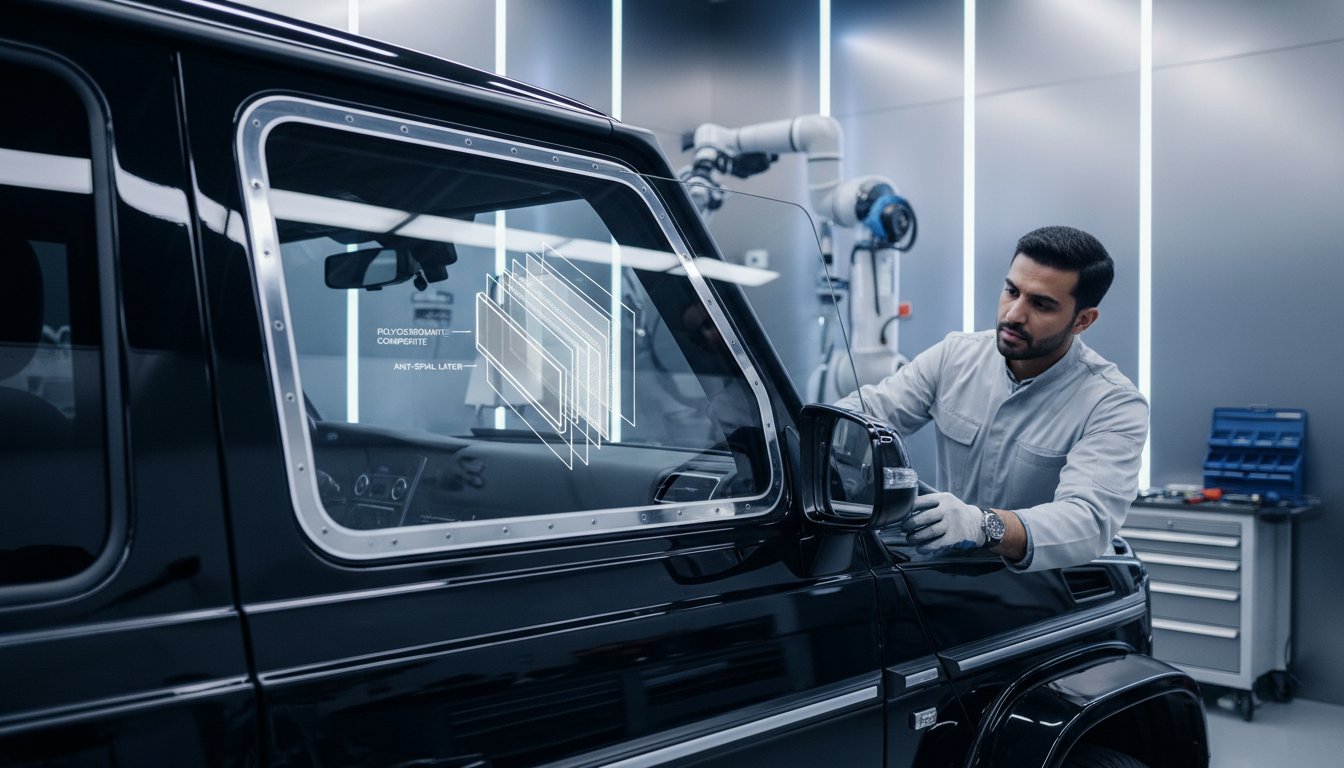
In the 50°C heat of a Dubai summer, the most dangerous threat to your security isn't always a ballistic round; it's often the invisible failure of the glass bonding itself. You already know that high-level protection is essential for high-risk transit, but you're likely concerned that an armored vehicle conversion UAE will result in "milky" glass delamination, heavy doors that sag, or dangerous optical distortion during night drives. These aren't just aesthetic issues. They're engineering failures that compromise your safety and the vehicle's operational lifespan.
Auto Industries Factory LLC (AIF) specializes in solving these technical challenges by treating ballistic glass as a complete engineering system rather than a simple parts replacement. You'll discover the precise thermal durability requirements needed to withstand the Arabian Peninsula's climate and the mechanical upgrades required to support B6 and B7 glass without destroying your door hinges. We'll also preview the SIRA-regulated certification process, ensuring your vehicle achieves a flawless, OEM-like finish that maintains total optical clarity under any lighting condition.
Key Takeaways
- Identify the critical differences between EN 1063, NIJ, and STANAG ballistic standards to ensure your vehicle meets international security certifications.
- Understand the mechanical necessity of reinforcing door pillars and frames during an armored vehicle conversion UAE to prevent hinge failure and structural sagging.
- Learn how specialized UV-resistant bonding agents protect ballistic glass from delamination and optical distortion caused by the extreme UAE heat.
- Discover the role of anti-spall shields and multi-layered polycarbonate composites in providing comprehensive protection against secondary fragments.
- Explore how precision CNC machining and expert fabrication deliver a flawless, OEM-like finish that maintains the vehicle’s original factory appearance.
Understanding Ballistic Protection: Why Bulletproof Glass is Essential in the UAE
The UAE's strategic position as a global business and diplomatic hub makes it a primary theater for high-level security operations. In this environment, Bulletproof glass serves as the most critical line of defense for occupants. It isn't just a single thick pane; it's a sophisticated multi-layered composite. By sandwiching layers of heavy-duty glass with flexible polycarbonate, engineers create a transparent shield capable of stopping high-velocity rounds. This advanced construction is vital for VIPs, diplomatic missions, and security fleets operating across the Emirates.
Reliability is everything when lives are at risk. Choosing a local engineering partner in Ajman or Dubai ensures that your armored vehicle conversion UAE remains operational despite the harsh desert conditions. Regular maintenance of ballistic seals and glass integrity is much more efficient when the factory is nearby. This proximity prevents long downtimes for specialized fleets and ensures that any signs of wear are addressed by master craftsmen who understand the local climate.
To see how the UAE is leading the way in this industry, watch this look at local manufacturing:
The Science of Transparent Armor
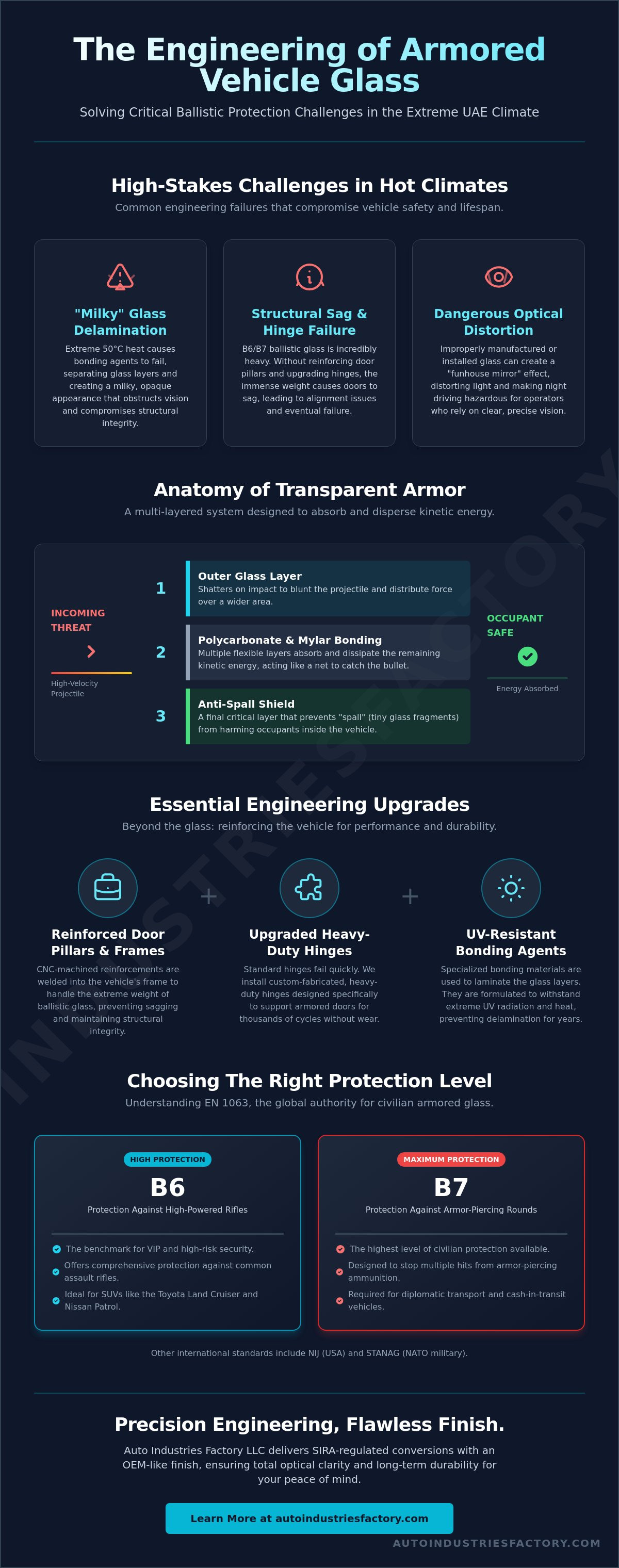
Transparent armor works by absorbing and dispersing the massive kinetic energy of a projectile. When a bullet hits the outer glass layer, the glass shatters; this blunts the bullet's tip and spreads the force across a wider area. The inner layers of polycarbonate then flex like a net to catch the remaining energy. We use premium Mylar bonding to ensure the layers maintain structural integrity even during multiple hits. A critical component in this system is the anti-spall shield. This final interior layer is designed to catch "spall," which are tiny fragments of glass that can break off the back of the window during an impact. While many people use the term "bulletproof," professionals prefer "bullet-resistant." No material is truly invincible, it's about meeting specific protection levels for a set duration of time.
Standard Applications for UAE Specialized Fleets
Specialized vehicles require tailored ballistic solutions to meet mission requirements. For instance, ambulance conversions and police units operating in high-risk zones need glass that balances maximum protection with flawless visibility. There's also a massive demand for discreetly armored civilian SUVs, particularly the Toyota Land Cruiser and Nissan Patrol. These vehicles provide high-level security without drawing unwanted attention on the streets of Dubai. Beyond personal transport, the GCC region relies on rugged ballistic glass for cash-in-transit trucks and diplomatic transport. These fleets must meet rigorous standards to move assets safely across borders. Our specialized conversion services ensure these vehicles are mission-ready and built to protect what matters.
Ballistic Standards and Certification: Choosing the Right Protection Level
Protection isn't a matter of opinion; it's a matter of physics. When planning an armored vehicle conversion UAE, selecting the appropriate ballistic rating is the most critical decision you'll make. Professionals rely on the European EN 1063 standard to categorize transparent armor. This standard ranges from BR1 to BR7, though BR4 to BR7 are the benchmarks for automotive security. While the NIJ (National Institute of Justice) standards are common in the United States and STANAG levels are used for NATO military procurement, EN 1063 remains the global authority for civilian and commercial armored glass.
The process of vehicle conversion requires a precise match between the glass thickness and the intended threat level. A B4 rating typically utilizes glass around 21mm thick, while high-level B6 protection jumps to approximately 40mm. For the extreme B7 level, thickness can exceed 70mm. These high-level certifications require more than just stopping a single bullet. To earn a B6 or B7 rating, the glass must pass a "multi-hit" test, where three shots are fired into a 120mm triangle. The glass must stop all three projectiles without any penetration or dangerous interior spalling.
B4 vs. B6 vs. B7: What Do You Actually Need?
- B4 Protection: This level is designed to defeat handgun threats, specifically the .44 Magnum. It's the standard for low-threat urban environments where carjacking or street crime is the primary concern.
- B6 Protection: This is the most popular choice for high-risk zones. It stops high-velocity rifle rounds like the 7.62x51mm NATO ball. It's essential for NGOs and private security in volatile regions.
- B7 Protection: The highest automotive grade, B7 glass stops 7.62x51mm armor-piercing (AP) rounds. This is reserved for military leaders and frontline government officials who face targeted, sophisticated attacks.
Certification and Laboratory Testing Protocols
Trust but verify. You should never accept ballistic glass without seeing its official test report from an independent laboratory. Facilities like Beschussamt in Germany or HP White in the USA are the gold standards for these tests. They subject the glass to extreme temperatures and varying shot angles to ensure zero failure. For those managing high-risk fleets, reviewing certified armored vehicle solutions is the first step toward mission security. Ballistic certification represents the only objective measure of a material's life-saving performance under fire.
The Engineering of Installation: Structural Reinforcement and Weight Management
Weight is the silent enemy of any high-level security project. While a standard Toyota Land Cruiser window is roughly 4mm thick, the glass used in a B6 or B7 armored vehicle conversion UAE swells to 40mm or even 70mm. This transformation increases the weight of a single door by up to 80kg, a load that would tear standard factory hinges from their mounts within weeks. At AIF, we don't just "fit" glass; we re-engineer the entire door architecture. We utilize in-house CNC laser cutting to ensure the new glass fits the frame with micron-level precision, which is essential for maintaining the vehicle's structural integrity and ballistic seal.
Security is often compromised at the edges where the glass meets the metal. To prevent projectiles from slipping through these vulnerable gaps, we install specialized ballistic steel 'overlap' systems. These overlaps act as a secondary barrier behind the window pillars, catching rounds that might strike the glass at an angle. This level of detail ensures the vehicle meets the rigorous performance requirements outlined in the NIJ Standard-0108.01 for Ballistic Materials, providing protection across the entire window perimeter rather than just the center of the pane.
Upgrading the Mechanical Infrastructure
- Heavy-Duty Door Hinges: These are mandatory for any car armouring project to prevent door sagging and ensure the doors can be opened quickly during an emergency.
- High-Torque Motors: For tactical units requiring operable windows, we replace OEM motors with heavy-duty window regulators capable of lifting 40kg ballistic panes smoothly.
- Suspension and Braking: We reinforce the suspension systems with heavy-duty coils and shocks to handle the increased Gross Vehicle Weight (GVW), ensuring the vehicle remains agile on the roads of Dubai or Sharjah.
Ensuring Optical Clarity and Zero Distortion
Thick glass is notoriously difficult to shape without creating visual "waves" or "double-vision." If the curvature doesn't perfectly match the OEM profile, it can lead to severe eye strain or dangerous optical distortion during night driving. Precision fabrication is the only way to avoid these flaws. Computerized bending furnaces achieve OEM curvature with zero distortion by monitoring heat levels across every square centimeter of the glass during the shaping process. This ensures that while you're protected by 40mm of transparent armor, your view of the road remains as clear as a factory-standard vehicle.
Durability in the UAE Climate: Overcoming Heat and Delamination
The 50°C summer heat in Dubai and Abu Dhabi presents a unique challenge that ballistic testing in temperate European laboratories often overlooks. When a vehicle sits under the Arabian sun, surface temperatures on the glass can exceed 80°C. This extreme thermal load is the primary cause of delamination, a failure where the glass and polycarbonate layers begin to separate. This separation creates a "milky" appearance or visible air pockets, which isn't just an aesthetic flaw; it's a structural failure that compromises the vehicle's ballistic integrity. A successful armored vehicle conversion UAE must prioritize thermal resilience as much as projectile resistance.
Preventing this failure requires advanced UV-resistant bonding agents and specialized edge sealing. These bonding layers act as a buffer, absorbing the different expansion rates of glass and plastic as they heat up. We also apply a proprietary edge seal to every pane. This seal prevents moisture and air from migrating into the laminate layers, which is a common issue in high-humidity coastal areas like Sharjah. Auto Industries Factory subjects every window system to GCC-specific thermal cycling tests, ensuring the bond remains flawless even after years of exposure to the desert sun.
The Role of the Autoclave in Long-Term Reliability
Reliability begins in the manufacturing plant, specifically inside the autoclave. This pressurized oven uses controlled heat and pressure cycles to fuse the layers into a single, optically clear unit. While standard lamination might suffice for cooler climates, high-pressure GCC-spec lamination is mandatory for the Middle East. This process forces out every microscopic air bubble that could otherwise expand in the heat. Because we control this autoclave process with surgical precision, we can offer extended warranties that competitors who use standard "off-the-shelf" glass simply cannot match.
Maintenance and Care for Armored Glass
- Cleaning Protocols: Never use standard household glass cleaners. The ammonia in these products can chemically attack the inner polycarbonate layer, causing it to crack or become brittle over time.
- Fleet Inspections: During routine maintenance, we inspect for "fogging" or tiny silver lines at the edges. These are early warning signs of edge seal failure that must be addressed before they spread.
- Thermal Stress Management: Moving a vehicle from a 20°C air-conditioned garage directly into 50°C heat creates massive internal stress. We engineer our glass composites to handle these rapid shifts without cracking.
Protecting your investment means choosing a partner who understands the local environment. If you're managing a high-risk fleet, it's time to upgrade to engineered armored solutions built for the UAE climate. Our master craftsmen ensure that your protection remains crystal clear and structurally sound, regardless of the temperature outside.
Auto Industries Factory: Precision Ballistic Solutions in Ajman and Dubai
Auto Industries Factory (AIF) specializes in specialized vehicle conversions, providing the UAE market with engineering solutions that exceed international benchmarks. While many suppliers treat ballistic glass as a standalone product, we view it as a critical component of a comprehensive armored vehicle conversion UAE project. Our facility in Ajman integrates advanced CNC machining and precision welding to ensure that every ballistic pane and steel panel fits with surgical accuracy. This in-house control allows us to maintain the vehicle’s structural integrity and driving dynamics despite the massive weight of B6 or B7 armor.
We believe in a "Total Protection" philosophy. This means we don't just stop at the glass; we reinforce the entire survival cell using high-grade ballistic steel and integrate run-flat tire systems that allow for continued mobility even after total pressure loss. Our master craftsmen manage the entire workflow, from stripping the interior to the final paint finish. We invite fleet managers and private clients to visit our Ajman factory for a technical consultation. Here, you can inspect our raw materials and witness the precision engineering that goes into every build first-hand.
Custom Fabrication for Mission-Specific Units
Tactical operations require more than just a bullet-resistant shell. We provide tailored glass thickness and framing solutions for armoured personnel carriers and specialized police units. This includes the seamless integration of heavy-duty gun ports and specialized communication mounts directly into the glass frame without compromising the ballistic seal. AIF remains committed to using only premium materials sourced from certified global ballistic suppliers, ensuring that every armored vehicle conversion UAE we deliver is mission-ready.
Get a Technical Consultation for Your Fleet
Navigating the vehicle modification regulations in the GCC requires deep local expertise. In Dubai, for example, the Security Industry Regulatory Agency (SIRA) mandates specific permits for armored assets. The current service fee for a display permit is 100 AED, plus a 10 AED Knowledge fee and a 10 AED Innovation fee, totaling 120 AED. AIF assists clients through every step of this regulatory process, from the initial engineering audit to final ballistic testing and delivery. Contact Auto Industries Factory today for a professional armored glass estimate and ensure your fleet is built for life-saving reliability.
Securing Your Mission with Precision Engineering
Selecting the right ballistic protection is a decision that demands technical rigor. It isn't just about stopping a projectile; it's about ensuring your vehicle remains a high-performance asset in the 50°C UAE heat. A successful armored vehicle conversion UAE relies on the synergy of certified B6/B7 standards and heavy-duty mechanical reinforcement. Without upgraded hinges and GCC-spec thermal bonding, even the thickest glass becomes a liability rather than a shield. We've established that engineering depth is the only way to prevent delamination and structural sagging over time.
Auto Industries Factory brings expert craftsmanship to every build. Our in-house CNC and laser fabrication capabilities ensure a flawless fit, while our advanced autoclave processes guarantee long-term optical clarity. Don't settle for "affordable" alternatives that compromise on structural integrity or thermal durability. It's time to invest in a solution that balances elite security with factory-level aesthetics and performance.
Request a Free Technical Estimate for Ballistic Glass Installation and partner with a factory that builds to protect what matters. We look forward to securing your fleet and providing the rugged reliability your mission deserves.
Frequently Asked Questions
What is the difference between B6 and B7 bulletproof glass for cars?
B6 glass is engineered to stop 7.62x51mm NATO ball rounds, while B7 protection stops 7.62x51mm armor-piercing (AP) rounds. The thickness is the most visible difference; B6 is typically 40mm thick, but B7 exceeds 70mm. This extra thickness is necessary to dissipate the massive kinetic energy of hardened steel penetrators used in AP ammunition, ensuring the round doesn't penetrate the interior cabin.
Can I install bulletproof glass in a standard passenger car in the UAE?
It's possible to install ballistic glass in standard cars, but it's rarely recommended for smaller sedans. The weight of B6 glass can exceed 150kg, which often exceeds the structural limits of unibody passenger cars. We specialize in SUVs like the Toyota Land Cruiser because their rugged body-on-frame construction handles the massive load without the risk of the chassis warping or buckling over time.
Does installing bulletproof glass affect the car's performance and handling?
Yes, the added weight of an armored vehicle conversion UAE significantly increases the center of gravity and braking distance. Without mechanical upgrades, you'll experience slower acceleration and increased body roll. We mitigate these effects by reinforcing the suspension and upgrading the braking system to ensure the vehicle remains agile and responsive under the added weight of the transparent armor.
How long does the installation process take at the Ajman factory?
A full ballistic glass installation typically takes 2 to 4 months at our Ajman factory. This duration is necessary for the precision stripping of the vehicle, custom CNC fabrication of the frames, and the complex autoclave lamination process. Each pane must be perfectly curved to match the OEM profile while maintaining total optical clarity before final delivery to the client.
Will the bulletproof glass look different from standard car windows?
High-quality ballistic glass looks nearly identical to standard windows from the exterior. While the panes are up to 70mm thick, our precision bending furnaces ensure the glass matches the original factory curvature perfectly. The only minor visual difference is the thick black ceramic band around the window edges, which hides the ballistic steel overlap system from outside view to maintain a discreet appearance.
What causes delamination in armored glass, and how can it be prevented in the UAE?
Extreme heat exceeding 50°C causes the glass and polycarbonate layers to expand at different rates, leading to separation or "milky" spots. We prevent this by using GCC-spec UV-resistant bonding agents that act as a thermal buffer. Additionally, our proprietary edge sealing process creates a vacuum-tight barrier that stops moisture and air from migrating into the laminate layers during high-humidity months.
Is it legal to drive a vehicle with bulletproof glass in Dubai and Abu Dhabi?
Yes, it's legal to drive an armored vehicle conversion UAE in Dubai and Abu Dhabi as long as you follow SIRA regulations. Owners must register the vehicle with the Security Industry Regulatory Agency and obtain the necessary permits. For example, the total fee for a display permit is 120 AED, which includes the 100 AED base fee, 10 AED Knowledge fee, and 10 AED Innovation fee.
Do I need to upgrade my car's suspension when installing ballistic glass?
Yes, upgrading the suspension is mandatory because ballistic glass can add over 150kg to the vehicle's total weight. Standard factory coils and shocks aren't designed for this constant load and will eventually fail. We replace them with heavy-duty components that prevent the vehicle from bottoming out and maintain stable handling during high-speed maneuvers or emergency evasive driving on the E11 highway.


