
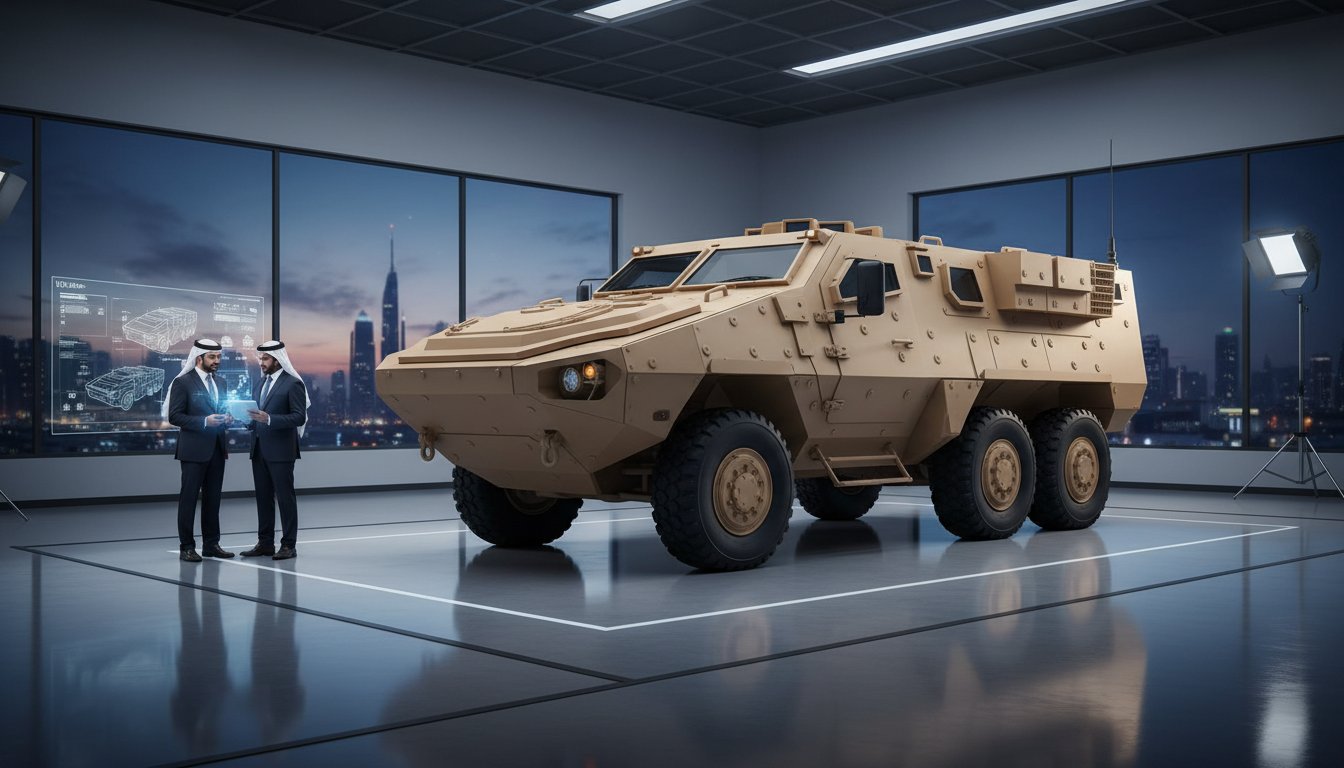
In the complex world of tactical vehicles, the lines can easily blur. Is it an APC or an IFV? What truly separates a standard transport from a mission-ready, life-saving asset? This uncertainty can lead to critical oversights in fleet procurement and deployment. Gaining a clear, foundational knowledge of the modern armoured personnel carrier is the first step toward ensuring your team has the protection and capability it needs to operate with confidence and security.
This definitive guide is engineered to provide that clarity. We will dissect the core components of APC design, from chassis and powertrain selection to understanding crucial ballistic protection levels. You will learn the distinct battlefield roles these rugged vehicles are built for and, most importantly, explore the advanced process of modification and upfitting. For decision-makers in Oman and across the region, this guide delivers the expert insights required to evaluate, upgrade, and procure vehicles that are built to protect what matters most.
What is an Armoured Personnel Carrier? Core Purpose and Evolution
At its core, an armoured personnel carrier is a military vehicle engineered for one primary mission: the protected transport of infantry across the battlefield. Its development was a direct response to the lethal realities of modern warfare, evolving from rudimentary concepts in World War I to the sophisticated, multi-role platforms that are indispensable in today's armed forces. The fundamental goal has always been to shield soldiers from shrapnel, small arms fire, and other battlefield hazards, ensuring they arrive at their objective with their combat effectiveness intact. For a deep dive into its history, the Wikipedia entry on What is an Armoured Personnel Carrier? provides a comprehensive overview of its design and operational use.
The 'Battle Taxi' Concept Explained
The most common analogy for an APC's role is the 'battle taxi'. Its purpose is not to seek out and engage the enemy in sustained combat like a main battle tank. Instead, its priority is tactical mobility and robust protection-getting a squad of soldiers from a staging area to the front line with minimal risk. This mission dictates a crucial engineering balance. The vehicle must be mobile enough to keep pace with advancing forces, armoured enough to withstand common threats like machine-gun fire and artillery fragments, yet remain cost-effective enough to be produced and maintained in large numbers.
APC vs. IFV: Understanding the Critical Difference
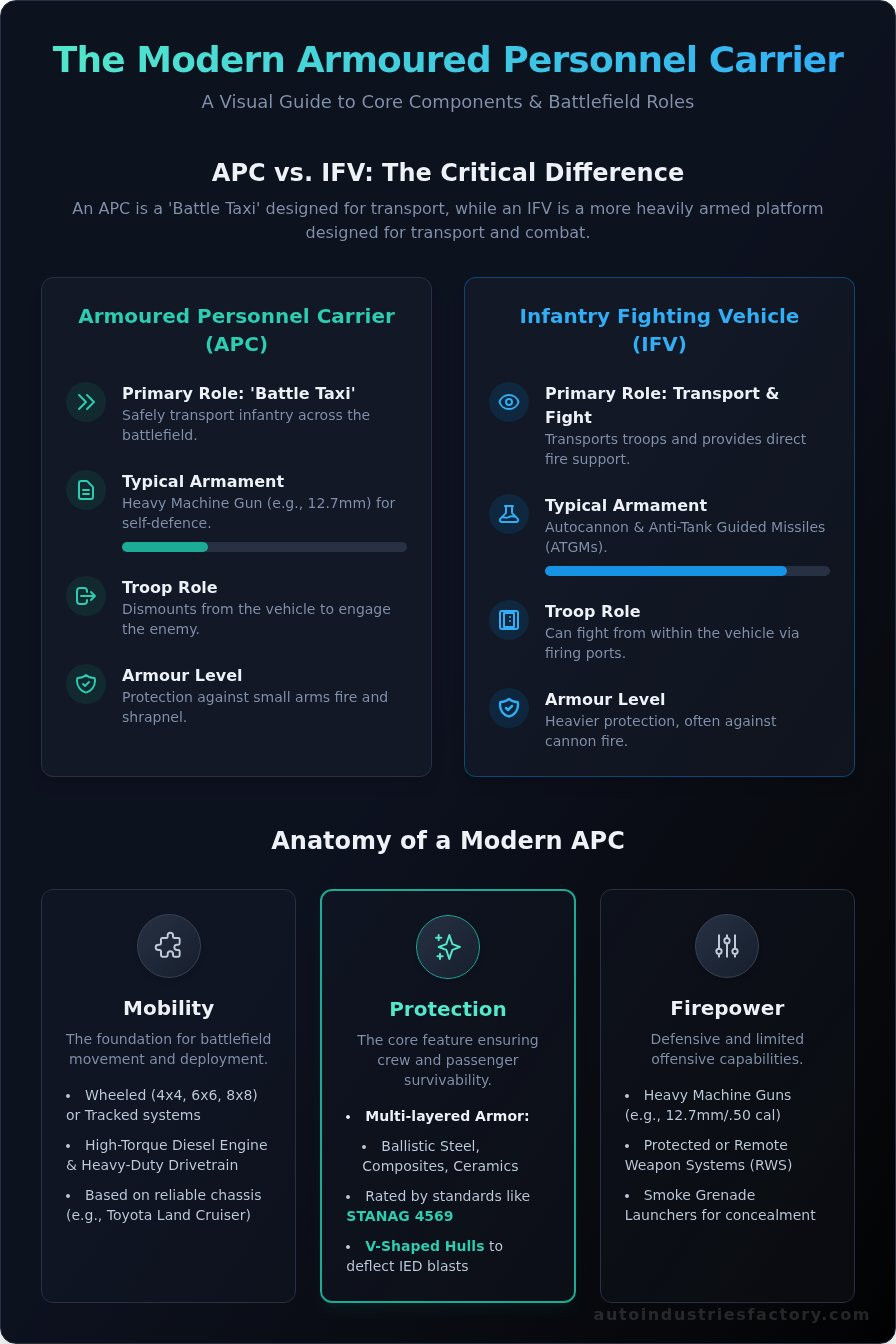
While often confused, a critical distinction exists between an Armoured Personnel Carrier (APC) and an Infantry Fighting Vehicle (IFV). An APC is primarily a transport vehicle from which troops dismount to fight. An IFV, however, is a more heavily armed evolution designed for infantry to fight from the vehicle while also providing significant direct fire support. This difference in doctrine leads to major variations in armament, armour, and cost.
| Feature | Armoured Personnel Carrier (APC) | Infantry Fighting Vehicle (IFV) |
|---|---|---|
| Primary Role | Transport troops ('Battle Taxi') | Transport troops and provide fire support |
| Typical Armament | Heavy machine gun for self-defence | Autocannon, anti-tank guided missiles |
| Troop Role | Dismounts from vehicle to engage | Can fight from within the vehicle via firing ports |
| Armour Level | Protection against small arms and shrapnel | Heavier protection, often against cannons |
Ultimately, the choice between an APC and an IFV depends entirely on operational requirements, threat environments, and budget constraints.
Anatomy of a Modern APC: Key Design Components
An armoured personnel carrier is far more than an armored box on wheels; it is a complex integration of specialized systems, each engineered for a critical role. The effectiveness of any modern APC depends on the seamless performance of its core components: mobility, protection, and firepower. Understanding these systems is essential, as they are the primary focus for mission-specific modifications and advanced capability upgrades that define a vehicle's performance in the field.
Chassis, Engine, and Drivetrain: The Foundation of Mobility
The foundation of every armoured personnel carrier is its chassis and powertrain. Many versatile APCs are built upon proven commercial platforms, such as the rugged Toyota Land Cruiser chassis, valued for extreme reliability in demanding environments like those found in Oman. The choice between wheeled (e.g., 4x4, 6x6, 8x8) and tracked systems is mission-dependent; wheels offer superior speed on roads, while tracks provide unmatched mobility over soft sand and rough terrain. A high-torque diesel engine and a robust, heavy-duty transmission are non-negotiable, delivering the immense power needed to move tonnes of armor, personnel, and equipment.
Armor and Survivability: The Core of Protection
Protection is the vehicle's defining feature. Modern armor has evolved beyond simple ballistic steel to include advanced, multi-layered solutions that enhance survivability without adding excessive weight. Key materials include:
- Ballistic Steel: The traditional foundation, offering cost-effective and durable protection.
- Composite Armor: Layers of materials like Kevlar and specialized polymers that absorb and dissipate projectile energy.
- Ceramic Plates: Extremely hard plates integrated into armor arrays to shatter incoming rounds.
Protection levels are typically rated by standards like STANAG 4569, a NATO benchmark that classifies a vehicle's resistance to threats from small arms fire to artillery fragments and mine blasts. Advanced survivability designs, such as V-shaped hulls, are now standard for deflecting the lethal force of IEDs away from the crew compartment.
Weapon Systems: Defensive and Offensive Capabilities
While its primary role is transport, an APC must be able to defend its occupants and support dismounted troops. Armaments typically include a heavy machine gun, such as the ubiquitous 12.7mm (.50 cal), for suppressing enemy threats. The evolution of armoured personnel carriers has seen weapon mounts advance significantly from simple, exposed pintle mounts to protected weapon stations or fully Remote Weapon Systems (RWS). These advanced turrets allow the gunner to accurately engage targets while remaining safely inside the vehicle's armored hull. For added defense, most APCs are equipped with smoke grenade launchers to provide rapid visual concealment for tactical maneuvering.
Common APC Types and Their Specialized Roles
The term armoured personnel carrier covers a wide spectrum of vehicles, each engineered for distinct operational demands. The true strength of a modern APC platform lies not just in its primary function of troop transport, but in its profound adaptability. A single, robust chassis can be expertly converted to fulfill a multitude of battlefield roles, maximizing fleet efficiency and mission capability.
Wheeled vs. Tracked APCs
The most fundamental design choice is between a wheeled or tracked chassis, a decision dictated by the intended operational environment. For a varied landscape like Oman's, with its extensive modern highways and rugged desert interiors, each configuration offers distinct advantages.
- Wheeled APCs: These vehicles, such as the Patria AMV, excel on roads and hard-packed terrain. They offer superior strategic mobility for rapid deployment, are generally easier to maintain, and have lower operational costs, making them ideal for peacekeeping and urban operations.
- Tracked APCs: Platforms like the classic M113 or modern variants provide unparalleled off-road performance. Their design distributes weight over a larger area, granting superior mobility in soft sand, mud, and challenging terrain, which is critical for maneuverability in undeveloped regions.
Specialized Mission Variants
Beyond mobility, the core utility of an armoured personnel carrier is its potential for custom conversion. A standard troop-carrying platform serves as the foundation for a family of specialized vehicles, each tailored for a specific mission-critical task. This modular approach allows armed forces to build a versatile fleet. However, selecting the right platform and its variants involves a complex analysis of doctrine and future threats. As detailed in a study on Key Considerations for APC Procurement by the US Army War College Press, balancing capability with lifecycle costs is a paramount challenge for defense planners.
Common mission-specific conversions include:
- Command & Control (C2): Outfitted with advanced communications suites, mapping displays, and battle management systems to serve as a mobile command post.
- Medical Evacuation (MEDEVAC): Transformed into an armored ambulance with space for stretchers and life-support equipment to safely extract and treat casualties under fire.
- Mortar Carrier: Integrated with a heavy mortar system (e.g., 81mm or 120mm) to provide rapid and responsive indirect fire support for ground troops.
- Anti-Tank Guided Missile (ATGM): Equipped with a turret or pop-up launcher armed with guided missiles to counter enemy tanks and fortified positions from a safe distance.
The APC Conversion Process: From Standard Vehicle to Tactical Asset
An armoured personnel carrier doesn't always begin life on a dedicated military production line. Many of the most reliable and versatile tactical vehicles are born from the robust chassis of proven commercial trucks and 4x4s. This conversion is a meticulous process of engineering and fabrication, transforming a standard vehicle into a mission-ready asset. It demands precision, advanced materials, and an unwavering commitment to quality control at every stage.
Step 1: Chassis Selection and Reinforcement
The foundation of any durable APC conversion is the base chassis. We select proven platforms known for their rugged reliability in demanding environments across Oman and the wider region, such as the Toyota Land Cruiser or Nissan Patrol. The vehicle is first stripped down to its bare frame. From there, our engineers systematically reinforce the chassis and install a heavy-duty suspension system, upgrading brakes and powertrain components to flawlessly manage the significant weight of ballistic armor and tactical equipment.
Step 2: Armor Fabrication and Integration
This is where the vehicle's protective shell is forged. Using advanced technology like CNC laser cutters and press brakes, high-strength ballistic steel is precisely shaped to form the components of the armored hull. Expert welders then construct a monocoque body, ensuring every seam provides complete, gap-free ballistic integrity. This process includes the careful integration of:
- Certified multi-layered ballistic glass
- Reinforced door hinges and locking mechanisms
- Secure roof hatches for observation or egress
- Strategically placed, protected gun ports
Step 3: Systems Installation and Outfitting
With the armored structure complete, the focus shifts to outfitting the vehicle for its specific mission. The interior is configured with custom seating arrangements, safety harnesses, and specialized storage. We then integrate critical operational systems, including secure communications equipment, surveillance cameras, advanced climate control, and fire suppression systems. The final stage involves applying a durable, mission-specific paint finish before the vehicle undergoes a battery of stringent quality assurance tests to validate its performance and protection levels.
This multi-stage process, governed by expert engineering, turns a capable commercial vehicle into a formidable armoured personnel carrier built to protect what matters. See how we transform vehicles for tactical applications and discover the engineering behind our advanced solutions.
Key Considerations for APC Procurement and Modernization
Selecting or upgrading an armoured personnel carrier is a critical investment in operational capability and personnel safety. Moving beyond specifications on a datasheet requires a strategic approach. To ensure a vehicle is not just capable but perfectly suited for its intended role, procurement officers must ask targeted questions that reveal a manufacturer's true expertise and the vehicle's long-term viability. This positions you as an informed partner, ensuring the final product delivers maximum value and mission reliability.
Defining Mission Requirements
The foundation of any successful procurement is a precise mission profile. Before discussing armour thickness or engine power, an expert partner will ask: What is the vehicle's primary function-rapid troop deployment, urban patrol, or internal security? What is the expected operational environment, from the streets of Muscat to the rugged desert terrain of Oman? Finally, what is the required capacity for both personnel and essential equipment?
Assessing Threat Levels
A vehicle's survivability is paramount. The right questions ensure protection is matched to realistic threats, not just generic standards. Key inquiries include:
- What level of ballistic protection is required against small arms fire, shrapnel, and IEDs?
- Is enhanced underbelly protection against mines and ambushes a priority, necessitating MRAP-style V-hull designs?
- Does the mission profile call for advanced active defense systems (ADS) to counter guided threats, or is robust passive armour sufficient?
Lifecycle and Logistical Support
The most advanced armoured personnel carrier is ineffective if it cannot be maintained in the field. Long-term operational readiness depends on logistical foresight. Crucial questions to ask a fabricator are: How readily available are spare parts for the base chassis and powertrain within the region? How has the vehicle been designed for ease of maintenance and field repair with minimal specialized tools? Beyond the initial purchase price, what is the projected total cost of ownership in USD, factoring in fuel, maintenance, and potential upgrades over its service life?
Answering these questions transforms a simple purchase into a strategic partnership. It ensures your fleet is durable, mission-ready, and sustainable for years to come. For expert guidance tailored to your specific operational needs in Oman, we invite you to request a consultation on your fleet modernization needs.
From Blueprint to Battlefield: Mastering Your APC Strategy
As this guide has detailed, the modern armoured personnel carrier is a testament to sophisticated engineering-a versatile platform whose effectiveness is defined by its specific design, role, and modifications. From understanding its core anatomy to appreciating the nuances of different specialized types, it is clear that an APC is not a one-size-fits-all solution. Strategic procurement and a clear modernization pathway are essential for transforming a standard vehicle into a formidable tactical asset that ensures personnel safety and mission success.
Executing this vision requires a partner with deep technical expertise and proven reliability. For governmental and private security clients in Oman and the wider region, Auto Industries Factory stands as a leading specialist in military and police vehicle modification. Our state-of-the-art facility handles every stage of the process, from in-house design and precision fabrication to seamless systems integration, guaranteeing a flawless, mission-ready final product based on our proven experience serving clients across the UAE and beyond.
Take the decisive step to enhance your fleet's capabilities. Discuss your custom armored vehicle project with our engineers. Let our experience become your strategic advantage.
Frequently Asked Questions About the Armoured Personnel Carrier
What is the main difference between an Armoured Personnel Carrier and an Infantry Fighting Vehicle?
The primary distinction lies in their intended combat role. An Armoured Personnel Carrier (APC) is engineered primarily to transport infantry safely to the front lines, typically armed with only a heavy machine gun for self-defense. In contrast, an Infantry Fighting Vehicle (IFV) is designed not only to transport troops but also to provide direct fire support. IFVs are equipped with heavier armaments like autocannons and anti-tank missiles, enabling them to engage enemy armour and fortifications directly.
How much does an armoured personnel carrier cost?
The cost of an armoured personnel carrier varies significantly based on the base chassis, protection level, and mission-specific systems. In Oman, a custom conversion of a heavy-duty truck chassis can range from approximately 150,000 OMR to over 500,000 OMR. Factors influencing the final price include the quality of ballistic steel and glass, turret systems, communication equipment, and interior configuration. Purpose-built military APCs from major global defence contractors will cost substantially more.
What are the most common vehicles used as a base for APC conversions?
For reliable and rugged APC conversions, heavy-duty commercial truck chassis are the preferred platforms. Models from manufacturers like MAN, Mercedes-Benz, and IVECO provide the robust frame and high payload capacity required for heavy armour. For lighter, more agile protected vehicles, proven 4x4 platforms such as the Toyota Land Cruiser 70 Series and Nissan Patrol Y61 are frequently utilized due to their exceptional off-road performance and durability in demanding environments common in the region.
What does STANAG 4569 protection level mean?
STANAG 4569 is a NATO standardization agreement that classifies the protection levels of armoured vehicles against kinetic energy threats (bullets), artillery fragments, and mine blasts. The standard is divided into levels; for example, Level 1 protects against standard 7.62mm rifle rounds, while higher levels like Level 4 can defeat heavy machine gun armour-piercing rounds. This system provides a clear, internationally recognized benchmark for a vehicle's defensive capabilities, ensuring it meets specific operational requirements.
Can a standard truck or SUV be converted into a functional APC?
Yes, but it is a complex engineering process far beyond simple armour plating. A successful conversion requires a complete re-engineering of the base vehicle. This includes reinforcing the chassis and suspension to handle the immense weight of the armour, upgrading the engine and braking systems for reliable performance, and fabricating a fully sealed, protected crew capsule. A standard vehicle's frame is not designed for this load, so professional modification is critical for safety and mission reliability.
How long does it take to build or convert an armoured personnel carrier?
The timeline for converting or building an armoured personnel carrier is dictated by the project's complexity and the required protection level. A straightforward conversion of a pre-existing chassis to a basic protection level may take 3 to 5 months. However, a fully custom build with advanced weapon systems, high-level STANAG protection, and bespoke interior layouts can require 8 to 12 months or more from initial design approval to final delivery and rigorous field testing.


