

The ambulance with the lower odometer reading may still be the riskier fleet choice. When deciding when to replace vs refurbish an ambulance, age alone won’t show whether it can remain safe, dependable, and ready for its assigned missions.
It’s understandable that fleet teams want to extend the value of a vehicle they already own. But recurring faults, limited equipment space, or extended downtime can make refurbishment a poor fit, even when the vehicle appears serviceable. The decision needs to account for the ambulance’s condition and operational demands, not just the next repair bill.
This guide lays out consistent criteria for comparing refurbishment with replacement. You’ll assess vehicle condition, mission readiness, downtime exposure, and lifecycle costs, then identify the evidence needed to support a recommendation. It also explains how refurbishment differs from remounting and why configuration needs matter when planning a replacement. Before acting, confirm applicable UAE vehicle approval, registration, and operational requirements with the relevant authorities. The aim is a practical decision grounded in safety, availability, and long-term fleet value.
Key Takeaways
- To decide when to replace vs refurbish an ambulance, compare documented vehicle condition and mission requirements rather than relying on age or odometer readings alone.
- Assess the chassis and powertrain separately from the body, electrical systems, and medical equipment to identify where risks and costs may sit.
- Compare refurbishment and replacement across work scope, downtime, mission fit, uncertainty, and expected lifecycle value.
- Document the decision with inspection findings, dispatch availability, fleet redundancy, staffing needs, and equipment compatibility.
- If replacement is the stronger option, prepare a mission-specific conversion brief covering fleet role, capacity, equipment, electrical needs, operating conditions, and timeline.
When should a fleet replace vs refurbish an ambulance?
A fleet decision often starts with a practical tension: keep the current ambulance in service, or take it out of rotation and invest in another unit? Refurbishment means work on the existing vehicle to address identified condition or configuration needs. Replacement means retiring that unit and acquiring another vehicle. A remount is different: it transfers an existing patient compartment to a new chassis, so it shouldn’t be treated as a simple refurbishment.
Age alone can’t answer when to replace vs refurbish an ambulance. A younger vehicle may have serious reliability or mission-fit problems, while an older one may still meet its role if its condition is sound and the required work is clear. Base the decision on inspection evidence, service history, downtime, and whether the vehicle can credibly return to safe, dependable operation for its assigned duties. Consider replacement when safety, reliability, or mission needs can’t be credibly restored.
An ambulance’s intended role shapes its configuration. For a basic overview of ambulance types and their functions, see Ambulance. The fleet’s own requirements and applicable UAE approval, registration, and operational rules still need to be verified with relevant authorities.
What does ambulance refurbishment include?
Refurbishment can range from targeted repairs to broader interior or system updates. First separate work on the base vehicle, such as chassis and powertrain repairs, from work on the ambulance body, electrical systems, and medical equipment. A vehicle can be mechanically serviceable yet still have body or electrical issues that affect its operational role.
A qualified assessment should identify feasible work, define its scope, and confirm which requirements apply. If the issues are extensive, difficult to estimate, or unlikely to resolve mission-readiness gaps, refurbishment may leave the fleet with continued uncertainty rather than a dependable unit.
What does replacing an ambulance involve?
Replacement means planning for the current unit’s retirement and specifying a suitable vehicle for the role it must perform. The brief should cover medical layout, equipment, electrical demand, communications, and how the new unit will integrate with fleet operations. Capacity and working conditions also matter: a configuration that suits one service may not fit another.
Conversion requirements depend on the intended service and applicable rules, so confirm UAE requirements before finalising specifications. Specialist conversion capability can help translate operational needs into a practical brief. Auto Industries Factory LLC provides ambulance conversions, including box type and extended-roof configurations on GMC and Toyota platforms. Its in-house capabilities include laser cutting, CNC machining, welding, and painting. These capabilities relate to conversion, not refurbishment or general vehicle repair.
Which ambulance condition and readiness signals should you assess?
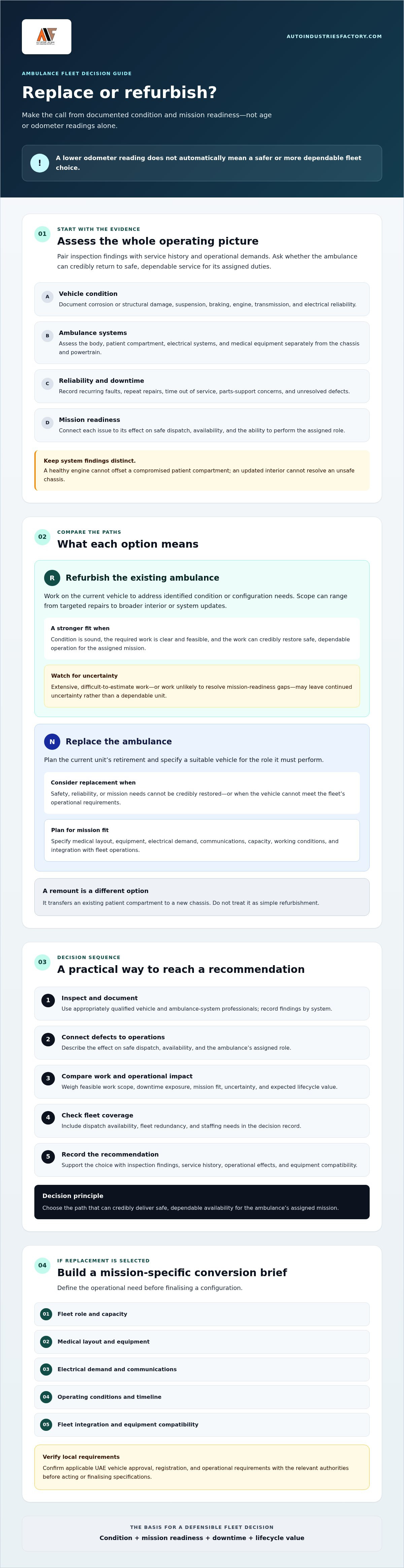
A sound decision starts with evidence, not a general impression. Arrange an inspection by appropriately qualified vehicle and ambulance-system professionals, and keep findings separate by system. A healthy engine cannot offset a compromised patient compartment, just as an updated interior cannot resolve an unsafe chassis.
Review the vehicle’s maintenance history alongside inspection results. Record recurring faults, repeat repairs, time out of service, parts-support concerns, and unresolved defects. Connect each issue to its operational effect: does it prevent safe dispatch, disrupt availability, or leave the ambulance unable to perform its assigned role? This creates a traceable basis for comparing repair scope with remaining mission readiness.
No single odometer reading or vehicle age proves an ambulance is fit for continued service. Condition, usage, fault history, and system performance must be assessed together.
How do chassis, powertrain, and structure affect the decision?
Ask the inspector to assess corrosion and structural damage, then examine suspension, braking, engine, transmission, and electrical reliability. The operating record can reveal patterns a single inspection may miss. Repeated faults that affect safe dispatch or predictable availability deserve particular scrutiny.
Have findings documented by severity, likely operational impact, and repair feasibility. If defects affect multiple connected systems, ask whether the proposed work can address underlying causes or only individual symptoms. That distinction helps show whether continued use is a credible option.
Are the ambulance systems still fit for the mission?
Assess the patient compartment as a working system. Check whether the layout supports the assigned role, equipment is securely accommodated, lighting and climate control function as needed, and access remains practical. Then review medical equipment, power supply, communications, and compatibility with current operational procedures.
Standards and approvals depend on jurisdiction and vehicle use. The NFPA 1900 ambulance standards provide a reference for ambulance construction, but fleets in the UAE should confirm which requirements apply to their vehicle and operations with the relevant authorities. Don’t assume a standard from another jurisdiction establishes local compliance.
Bring vehicle and system findings together before deciding. A repairable chassis may still be a poor refurbishment candidate if the compartment, electrical system, or equipment compatibility cannot support the mission. Conversely, isolated, clearly scoped defects may leave room for a practical intervention. If the assessment points toward a new configuration, ambulance conversion capabilities can help fleet teams consider how operational requirements translate into a replacement brief.
Refurbishment vs replacement: how do the options compare?
The right choice depends on whether the ambulance can return to dependable service and continue meeting its assigned mission. Refurbishment is more plausible when the base vehicle is sound and inspection findings support a clearly defined scope. Replacement deserves stronger consideration when defects recur, downtime threatens coverage, or the current configuration can’t meet requirements with confidence.
| Decision factor | Refurbishment | Replacement |
|---|---|---|
| Condition | Base vehicle is serviceable, with manageable defects. | Structural or mechanical risks undermine dependable use. |
| Scope | Required work can be identified and documented. | Extensive or uncertain work makes the outcome harder to predict. |
| Downtime | Plan around the time needed for assessment, work, parts, and testing. | Plan for procurement and conversion, plus transition to the new unit. |
| Mission fit | Existing layout and systems can be brought in line with operational needs. | A new specification can address documented limitations more directly. |
| Uncertainty | Hidden defects or parts delays may expand the scope. | Specification, delivery, and integration still need to be managed. |
| Lifecycle value | Weigh current work against expected future maintenance and availability. | Consider acquisition, conversion, equipment compatibility, and ongoing operating needs. |
When can refurbishment be the stronger option?
Refurbishment may be defensible when qualified inspection confirms a serviceable chassis and powertrain, the required work is defined, and the completed vehicle can meet its mission and applicable requirements. Compare the full scope, including parts, labour, testing, and the effect of taking the ambulance out of service. Set a contingency for hidden defects, parts delays, or added downtime before approving the work.
When is replacement the more defensible choice?
Replacement becomes stronger when structural or mechanical risks compromise dependable fleet use, or recurring repairs and downtime weaken dispatch readiness and coverage. Compare a replacement specification with the current unit’s documented limitations, not just its visible condition. Include procurement and conversion planning, equipment compatibility, transition needs, and expected future maintenance in the lifecycle review.
To determine when to replace vs refurbish an ambulance, compare both options across the same period and operational assumptions. Include inspection and repair work, parts, downtime and fleet coverage, replacement acquisition and conversion, equipment integration, and future maintenance. Use documented estimates rather than assumed savings. The defensible choice is the one that best supports safe, reliable mission readiness, with risks and trade-offs clearly recorded.
How can a fleet make and document the ambulance decision?
A repeatable process turns a difficult fleet choice into a reviewable decision. Start with the operational need, then assess the vehicle, compare options, secure approval, and plan the transition. This sequence helps decision-makers explain when to replace vs refurbish an ambulance using documented evidence rather than assumptions.
- Define the need: Record the ambulance’s role, required capacity, and readiness expectations.
- Gather evidence: Compile inspection findings, maintenance records, downtime logs, and recurring repair history.
- Compare options: Evaluate a defined refurbishment scope against a replacement specification using the same lifecycle categories.
- Review operational impact: Check dispatch availability, fleet redundancy, staffing, and equipment compatibility under each option.
- Approve and transition: Record the decision owner, approval, risks, and actions required to maintain coverage and return a vehicle to service.
What information should the decision file contain?
Keep the evidence in one decision file. Include inspection reports, maintenance and repair records, downtime details, current mission requirements, and equipment needs. Note requirements that still need confirmation, including applicable UAE vehicle approval, registration, or operational requirements. Compare both options across consistent categories, such as work scope, downtime, future maintenance, equipment integration, and expected fleet availability.
Make the reasoning auditable. Record assumptions, unresolved questions, identified risks, decision owners, approval dates, and follow-up actions. If the recommendation depends on a parts estimate or expected repair outcome, identify that dependency rather than presenting it as certain.
How should the fleet manage downtime and transition?
Before a unit leaves service, plan temporary coverage. Confirm which vehicles can absorb its workload, whether staffing is available, and whether required equipment can be transferred or needs to be integrated. For replacement, coordinate procurement, conversion, equipment installation, testing, and staff familiarisation as linked steps, not separate tasks.
Agree in advance who is responsible for acceptance checks and authorising return to service. Coordinate those checks with the relevant vehicle, conversion, and equipment specialists, and verify applicable local requirements before operation. Record outstanding issues and who will close them. A transition plan should protect dispatch readiness while making clear when the replacement or refurbished unit is ready for its assigned role.
Once fleet teams have established decision criteria, they can discuss replacement configuration needs with Auto Industries Factory LLC’s ambulance conversion team. A clear brief connects the intended fleet role with vehicle and conversion requirements.
What should you do next if the ambulance needs a new configuration?
A replacement decision is only the start. The next step is a clear, mission-specific vehicle and conversion brief that turns operational needs into requirements a specialist can review. It should explain what the ambulance must do, how the crew will use it, and which needs are essential rather than preferred.
What should a replacement ambulance brief specify?
Build the brief with input from fleet, operations, clinical, equipment, and procurement stakeholders. Cover the intended fleet role and capacity, patient-care configuration, equipment placement, storage, access, and crew workflow. Include electrical demand, communications, structural considerations, vehicle-platform requirements, operating conditions, and the expected timeline.
- Fleet role and capacity: Define the service function and the people or equipment the vehicle must accommodate.
- Layout and workflow: Identify access points, storage needs, equipment positions, and how crew members need to move through the compartment.
- Systems and platform: Describe electrical and communication needs, relevant structural requirements, and vehicle-platform preferences.
- Operating conditions: Note the environments and duty patterns the vehicle is expected to handle.
- Priorities: Separate mandatory requirements from preferences, and flag any approval or operational requirements that need verification in the UAE.
Specifics matter. For example, “more storage” is difficult to assess without knowing what must be stored and where it needs to be accessed. A well-defined brief also helps keep the replacement aligned with the limitations identified during the when to replace vs refurbish an ambulance assessment.
How can a conversion specialist support the next step?
Share the brief with a specialist in ambulance conversions to discuss vehicle configuration and custom requirements. Auto Industries Factory LLC works on ambulance conversions, with in-house capabilities that include design, laser cutting, CNC machining, welding, and painting. These capabilities can inform conversion discussions, but they don’t by themselves establish regulatory approval or guarantee a particular outcome. Confirm applicable UAE approval, registration, and operational requirements with the relevant authorities and specialists.
Include the fleet role, capacity, equipment list, electrical and communications needs, operating conditions, and timeline in the brief. Auto Industries Factory LLC handles ambulance conversions, including box type and extended-roof ambulance configurations on GMC and Toyota platforms.
Make the Next Fleet Decision with Confidence
A defensible ambulance decision starts with evidence. Assess the chassis, powertrain, body, electrical systems, and equipment separately, then compare refurbishment and replacement using consistent measures for mission fit, downtime, risk, and lifecycle value. That is the practical way to decide when to replace vs refurbish an ambulance, rather than relying on age or mileage alone.
If the current unit cannot reliably meet its mission, use the replacement process to define a precise vehicle and conversion brief. Set out the fleet role, capacity, equipment, electrical and communication needs, operating conditions, and requirements that need verification in the UAE. A clear specification helps stakeholders review the decision and gives conversion specialists a useful starting point.
Ambulance conversions are a priority offering at Auto Industries Factory LLC, supported by in-house design, laser cutting, CNC machining, welding, and painting capabilities. To discuss a mission-specific configuration, contact Auto Industries Factory LLC about your ambulance conversion requirements.
Frequently Asked Questions
Is it better to refurbish or replace an ambulance?
Neither option is automatically better. Decide when to replace vs refurbish an ambulance by matching inspection evidence to its mission. Refurbishment may fit when the base vehicle is sound, the work is clearly scoped, and the unit can meet operational needs afterward. Replacement is more defensible if safety, reliability, or mission fit can’t be restored with confidence. Review maintenance history, downtime, and lifecycle implications with qualified specialists, not age alone.
When should an ambulance be replaced?
Consider replacement when documented structural, mechanical, or system issues create unacceptable operational risk, or the vehicle can’t meet its fleet’s mission requirements. Repeated faults and extended downtime may also affect dispatch readiness and coverage. There’s no universal age or mileage threshold that applies to every ambulance. Have qualified vehicle and ambulance-system professionals assess its condition, then verify applicable approval, registration, and operational requirements in the UAE before deciding.
Can an ambulance be refurbished instead of replaced?
It may be possible if a qualified assessment finds the base vehicle suitable and defines the required repairs or upgrades. The scope should address both vehicle condition and ambulance-specific systems, then be checked against the fleet’s operational needs and applicable requirements. Before approving the work, confirm expected downtime, parts support, and how unexpected defects will be handled. A clear contingency plan helps decision-makers understand the risks if the scope expands.
How do you compare ambulance refurbishment with replacement?
Compare both options using the same criteria: condition, safety, mission fit, work scope, parts support, downtime, uncertainty, and expected lifecycle value. For replacement, include procurement, conversion, equipment integration, and transition needs. Don’t compare only the immediate work scope. Record assumptions and have relevant specialists validate technical findings. Confirm jurisdiction-specific compliance requirements with the appropriate UAE authorities or qualified advisers before treating them as established facts.
Does ambulance age determine when it needs replacing?
No. Age provides context, but it doesn’t establish whether an ambulance is safe, reliable, or suitable for continued service. Review inspection findings, maintenance and fault history, operating conditions, downtime, and mission requirements. A newer vehicle can have serious defects, while an older unit may remain serviceable. Base the decision on documented evidence and a professional assessment rather than a single age or mileage figure.
What should an ambulance refurbishment inspection cover?
An assessment should review the chassis, structure, powertrain, suspension, brakes, electrical systems, patient compartment, equipment securement, and mission-critical features. It should also consider maintenance records, recurring faults, parts support, and downtime. The precise scope depends on the vehicle and its intended service. Use qualified vehicle and ambulance-system professionals, and verify which standards, approvals, and operational requirements apply in the fleet’s jurisdiction.
How can a fleet reduce downtime when replacing an ambulance?
Plan the transition before the existing unit leaves service. Confirm temporary coverage, procurement timing, conversion scope, equipment and communications needs, testing, and staff familiarisation. Assign owners to each step and document acceptance checks and return-to-service responsibilities with the relevant specialists. The schedule depends on the fleet and project scope, so don’t assume a fixed turnaround without a confirmed plan from the suppliers involved.


