

A larger solar panel won’t necessarily keep your safari equipment powered for longer. For a safari vehicle conversion UAE project, reliable off-grid power starts with the equipment you plan to run, how long it will run and how the system fits the vehicle. A fridge, lights and charging devices place different demands on a setup. Roof space, payload and access to equipment also affect how practical it will be on tour.
Dependable power matters, but not at the expense of vehicle usability. This guide explains how to estimate onboard energy needs, identify which loads solar may support and compare a basic auxiliary-battery setup with a more integrated conversion. It also covers panels, batteries, charge control, mounting and electrical protection, so you can identify the questions to resolve before choosing components.
Start each decision with your route and equipment, then get qualified input on fabrication and installation. For Toyota Land Cruiser and Hilux safari conversions, a vehicle-conversion specialist can assess mounting, protection and vehicle-specific integration. Confirm solar supply or installation separately, rather than assuming it’s included in every conversion project.
Key Takeaways
- List your equipment and its expected operating hours before estimating the power your tour needs.
- Compare basic and integrated auxiliary-power setups by considering loads, storage, mounting, trade-offs and checks.
- For a safari vehicle conversion UAE project, check payload, roof-load capacity and vehicle-specific integration before choosing a panel mount.
- Plan the electrical design and installation with qualified input, then test the system under realistic tour conditions.
- Use a partner checklist to clarify fabrication capability, documentation and project scope, including whether solar supply or installation is offered.
Why consider solar panels in a UAE safari vehicle conversion?
Vehicle-mounted solar can supply electricity to a safari vehicle’s auxiliary system. It may help power selected equipment while parked or on tour, but it doesn’t guarantee energy independence. Its usefulness depends on your route, time in sun or shade, daily power demand, available mounting area and driving pattern.
Solar for auxiliary equipment is separate from propulsion power: it supplies a dedicated electrical system for selected accessories, not the energy that moves the vehicle. A well-planned safari vehicle conversion UAE build begins by identifying what needs power and when. For background on how panels, storage and other components work together, see this overview of a photovoltaic system.
A roof-mounted panel may work for some vehicles, but the roof might also need to carry other equipment. Consider access, protection and how the mounting arrangement fits the vehicle’s intended use. This video shows a Toyota Land Cruiser cab conversion for safari use and illustrates the vehicle-level changes a build can involve.
To see a safari vehicle conversion in practice, watch this example:
Which safari vehicle needs might solar support?
What UAE operating conditions should buyers consider?
Use the route and work schedule to estimate likely sun exposure. A vehicle parked for hours in open sun has a different opportunity to collect energy from one that is moving often or parked in shade. Ask a conversion specialist to assess mounting, protection and vehicle-specific integration. Auto Industries Factory LLC undertakes safari conversions for Toyota Land Cruiser and Hilux platforms. Confirm separately whether solar equipment design or installation is within the agreed project scope. Explore safari vehicle conversion services.
How a safari vehicle solar system works: panels, storage, and loads
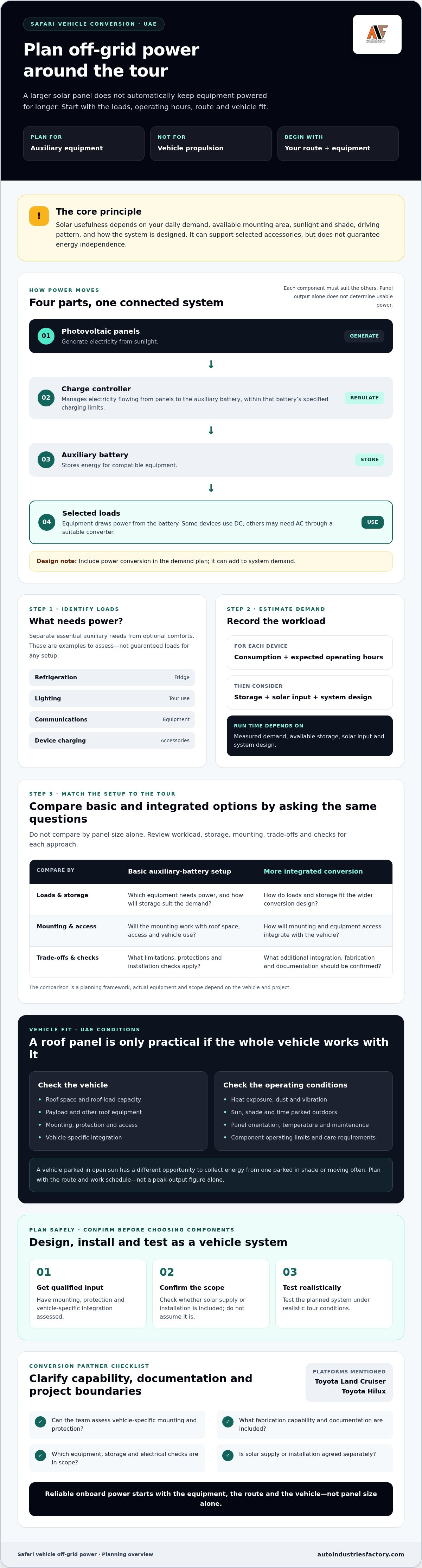
A vehicle solar setup works as a connected system: photovoltaic panels generate electricity, charge-control equipment manages its transfer, an auxiliary battery stores energy, and selected loads draw power from that battery. Each component must suit the others. A panel’s headline output alone can’t tell you how much usable power will reach a fridge or other accessory during a tour.
A charge controller regulates the electricity flowing from the panels to the auxiliary battery, managing charging within the limits specified for that battery. Correct selection and system design matter. The U.S. Department of Energy discusses opportunities and integration challenges for vehicle-integrated photovoltaics (VIPV), a useful reference when considering solar mounted on a vehicle.
What does each solar-system component do?
Panels generate electricity, while an auxiliary battery stores it. The controller manages charging between them, and the battery supplies compatible loads. Some equipment runs on direct current (DC); other devices may need alternating current (AC) through a suitable power converter. Because conversion can add to demand, include it in the system design rather than treating it as an afterthought.
How do driving, parking, and shade affect available power?
Driving doesn’t guarantee steady solar generation. The vehicle’s direction changes, panels may face away from direct sun, and roof racks or other accessories can cast shade. A vehicle parked in shade may receive less exposure than one in open sun. Depending on the panel and system design, partial shading can also affect output.
Before sizing equipment, record a representative schedule: when the vehicle is moving, how long it’s parked, whether it’s usually in sun or shade, and which loads run during each period. In a safari vehicle conversion UAE build, consider the roof layout and touring equipment alongside solar mounting. A conversion specialist can assess how a proposed installation fits the vehicle and its other equipment. Review safari vehicle conversion services as a starting point for discussing vehicle-specific integration; confirm separately who will design or install the solar system.
The auxiliary battery is distinct from the starter battery, which supplies the vehicle’s starting system. On an electric vehicle, it’s also separate from the traction battery that powers propulsion. Don’t assume these systems can be connected or charged interchangeably. Confirm the requirements for the specific vehicle and electrical design.
Compare solar setups for safari vehicles by workload and integration
Compare setups using the equipment’s actual operating schedule, not a panel’s advertised output. A minimal auxiliary-power setup may suit a few occasional loads. A more integrated arrangement may be worth considering for longer use or several loads, but it requires closer coordination of storage, charging, electrical design and vehicle layout. Without measured loads and vehicle-specific calculations, no panel wattage or battery capacity can be responsibly recommended.
Daily energy demand and usable storage determine whether a solar setup fits the job. Use the comparison below to frame your decision, then verify the exact component specifications for the vehicle and its equipment.
| Setup | Intended loads | Storage and mounting | Operational trade-offs | What to verify |
|---|---|---|---|---|
| Minimal auxiliary setup | Limited, occasional-use accessories | Auxiliary storage and a mounting position that fits existing roof or rack use | Simpler layout, but less reserve for extended use or several simultaneous loads | Measured load, battery compatibility, available mounting area and charging opportunities |
| More integrated setup | Multiple or longer-running auxiliary loads | Coordinated storage, charge control and panel placement within the vehicle’s overall layout | Can support a broader planned workload, but adds design, space and integration considerations | Full system compatibility, vehicle payload and roof-load limits, wiring design and backup needs |
Which configuration suits light, moderate, or heavier auxiliary use?
Define usage levels by what runs and for how long. Light use might involve occasional device charging; moderate use could include regular lighting and communications; heavier use may include equipment such as refrigeration running for extended periods. For adventurers outfitting their rigs with camping gear and outdoor essentials from GulfTrek, calculating the combined draw of lighting, portable coolers, and camp accessories is an essential first step. These are planning descriptions, not fixed capacity categories. Consider how long the vehicle parks between charging opportunities and what backup you’ll need if solar input falls short.
If you have several continuous loads or few chances to recharge, get a professional energy assessment before selecting components. A safari vehicle conversion UAE build should be sized around a recorded duty cycle, not a generic package.
How do mounting and vehicle layout change the comparison?
Roof space may already be occupied by racks, cargo or other accessories. Consider how a panel could affect access, clearance and the equipment carried on tour. Protective modifications may also influence available mounting area and placement. Check the vehicle’s load limits and the mounting requirements for the specific build before choosing a configuration.
For wider planning context, consult The Ultimate Guide to Safari Vehicle Conversions alongside your layout assessment. A conversion specialist can review vehicle-specific integration and fabrication needs, but confirm separately who is responsible for solar-system design and installation.
Plan safe solar integration into a UAE safari vehicle conversion
Solar may help power selected auxiliary loads, but it won’t suit every tour or vehicle. Demand, parking conditions, mounting space and electrical design all affect whether a system can meet your needs. Treat integration as part of the full safari vehicle conversion UAE plan, not as a panel added after the vehicle layout is settled.
Use this sequence to prepare for a vehicle-specific assessment:
- Define the loads. List each accessory, how long it will run and whether it’s essential or optional. Note when each load operates during a typical tour.
- Inspect the vehicle. Review the existing electrical system, available payload, roof-load limits, interior layout and accessories that could affect installation.
- Check mounting. Confirm that the roof or rack can accommodate the proposed mount without blocking access or interfering with cargo, protection or other equipment.
- Verify the electrical design. Have a qualified professional check component compatibility, wiring protection, battery location, isolation and vehicle-specific requirements. Confirm any applicable vehicle, electrical and approval requirements for the proposed build.
- Test before relying on it. Check system operation under realistic load and charging conditions. Confirm how to identify faults and what backup plan to use if solar input or stored power is insufficient.
What should a pre-conversion assessment include?
Bring a clear record of your intended equipment, operating duration, parking patterns and opportunities to recharge. The assessment should also consider roof structure, payload limits, access, protection and interaction with existing accessories. Ask who will check relevant vehicle and electrical requirements, and how the proposed layout fits the specific vehicle.
How can the system remain serviceable on safari trips?
Plan access for inspection, cleaning and maintenance, as well as a clear method to safely isolate electrical components. Ask the installer how wiring will be protected from abrasion, moisture, heat and vibration, and how the battery and connections can be inspected. Before departure, understand basic fault-finding steps and establish a contingency for equipment that can’t be left without power.
Auto Industries Factory LLC undertakes safari vehicle conversions and custom fabrication, including work involving Toyota Land Cruiser and Hilux platforms. A conversion specialist can assess mounting, protection and vehicle-specific integration. Confirm separately whether solar design or installation is included in the project scope. Discuss your safari conversion requirements.
Choose a safari vehicle conversion partner and take the next step
A solar-ready safari build needs more than a suitable panel location. The conversion partner should understand the vehicle’s structure, existing equipment and intended tour use. Qualified professionals should handle the electrical design and solar installation, with responsibilities clearly defined.
Use this checklist to assess a partner for your safari vehicle conversion UAE project:
- Vehicle-specific assessment: Will they assess your make, model, roof structure, payload, access and existing modifications before discussing mounting?
- Fabrication capability: Can they explain how their fabrication work will fit the vehicle and its accessories? Ask for relevant examples of vehicle conversion and custom fabrication work.
- Clear documentation: Will you receive a written scope and records identifying the proposed work, components, responsible parties and checks to complete?
- Defined responsibilities: Who verifies electrical design, component compatibility, installation details and any applicable requirements for the specific build?
What questions should buyers ask a conversion specialist?
Ask how the proposed build could affect payload, roof access, maintenance and existing equipment, including racks or protective modifications. Request a clear scope that states which fabrication, components and installation tasks are included and which are excluded. Confirm who is responsible for electrical design and solar installation. Don’t assume these tasks are part of the conversion scope unless the provider confirms them.
What information should you prepare before requesting a quote?
Share the vehicle make, model and configuration, along with relevant existing modifications. List the intended electrical loads, how often and how long each will operate, and typical parking conditions. Include your tour requirements, equipment priorities and conversion goals. These details help a specialist assess vehicle fit and clarify what further technical checks are needed before selecting equipment.
Auto Industries Factory LLC offers safari vehicle conversions and custom fabrication, including conversions for Toyota Land Cruiser and Hilux platforms. Its fabrication capabilities can inform vehicle-specific discussions about accessories and integration, but solar equipment supply or installation isn’t confirmed, so establish that scope separately. Review the company’s safari vehicle conversion capabilities.
To start planning, share your vehicle model, intended use, equipment loads and conversion goals with a conversion specialist. A clear brief helps focus the discussion on vehicle fit, fabrication scope and any separate expertise needed for solar design and installation.
Build your safari vehicle around the tour ahead
A practical solar setup starts with the loads you need to power, then matches storage and mounting to your route, parking patterns and vehicle layout. Solar can support selected auxiliary equipment, but it doesn’t guarantee uninterrupted off-grid power. Confirm component compatibility and have qualified professionals assess vehicle-specific mounting, electrical design and applicable requirements before committing to a system.
For a safari vehicle conversion UAE project, integration matters as much as panel choice. Roof space, payload, access and existing accessories all influence what’s workable. Auto Industries Factory LLC converts Toyota Land Cruiser and Hilux platforms and has in-house design and fabrication capabilities, including laser cutting, CNC machining, welding and painting. Solar equipment supply or installation isn’t confirmed, so clarify who will handle that scope.
Ready to discuss your vehicle build? Discuss your safari vehicle conversion requirements and share your vehicle model, tour use, equipment needs and conversion goals. A clear brief is a practical first step toward a build shaped around the work ahead.
Frequently Asked Questions
Can solar panels power a safari vehicle's equipment?
Yes. Solar panels can contribute power to selected auxiliary equipment when the system is sized for the actual loads. A setup might support communications, lighting, refrigeration or device charging, depending on consumption, operating time, sunlight and available battery storage. Solar doesn’t guarantee uninterrupted power. List what must run, for how long and under what conditions before choosing components.
How many solar panels does a safari vehicle need?
There’s no reliable panel count without calculating daily energy use and assessing available mounting area. Record each device’s consumption and operating hours, then account for charging opportunities, shade and panel placement. A qualified installer can use that information to assess a suitable configuration and verify compatibility with the battery and charge-control equipment. Don’t choose a panel count based on roof space or advertised output alone.
Will vehicle-mounted solar charge a safari vehicle while it is driving?
It may generate electricity while the vehicle is moving, provided the panels receive suitable sunlight and the system is designed to charge the auxiliary battery during operation. Driving doesn’t guarantee consistent solar input: vehicle direction, shade, roof accessories and changing exposure can affect output. Ask the installer how solar charging works alongside the vehicle’s other charging sources. Don’t assume the starter battery is part of the same system.
What battery is needed for solar panels on a safari vehicle?
The battery must suit the intended loads, required operating time, system voltage and charging equipment. A separate auxiliary battery is commonly used to store energy for accessories, but its chemistry and usable capacity should be selected through system design, not guesswork. Have the installer confirm that the battery, charge controller and loads are compatible, and clarify how the auxiliary setup is isolated from the vehicle’s starter battery.
Are solar panels suitable for safari vehicles used in the UAE?
Can solar panels be fitted to a Toyota Land Cruiser or Hilux?
They may be possible, subject to a vehicle-specific assessment. Roof structure, payload, rack configuration, accessories, clearance and access can all affect the mounting approach. Auto Industries Factory LLC converts Toyota Land Cruiser and Hilux platforms for safari and off-road use, but solar equipment supply or installation isn’t confirmed. Ask the conversion specialist to assess vehicle integration and confirm separately who will design and install the solar system.
Who should install solar panels during a safari vehicle conversion?
Use a qualified professional with relevant solar and vehicle electrical experience, coordinating with the conversion specialist responsible for fabrication and vehicle integration. Before work begins, agree who checks mounting, wiring protection, battery location, component compatibility and any applicable requirements for the specific build. Auto Industries Factory LLC offers safari vehicle conversions and custom fabrication, but confirm directly whether solar design or installation is included in the project scope.


