

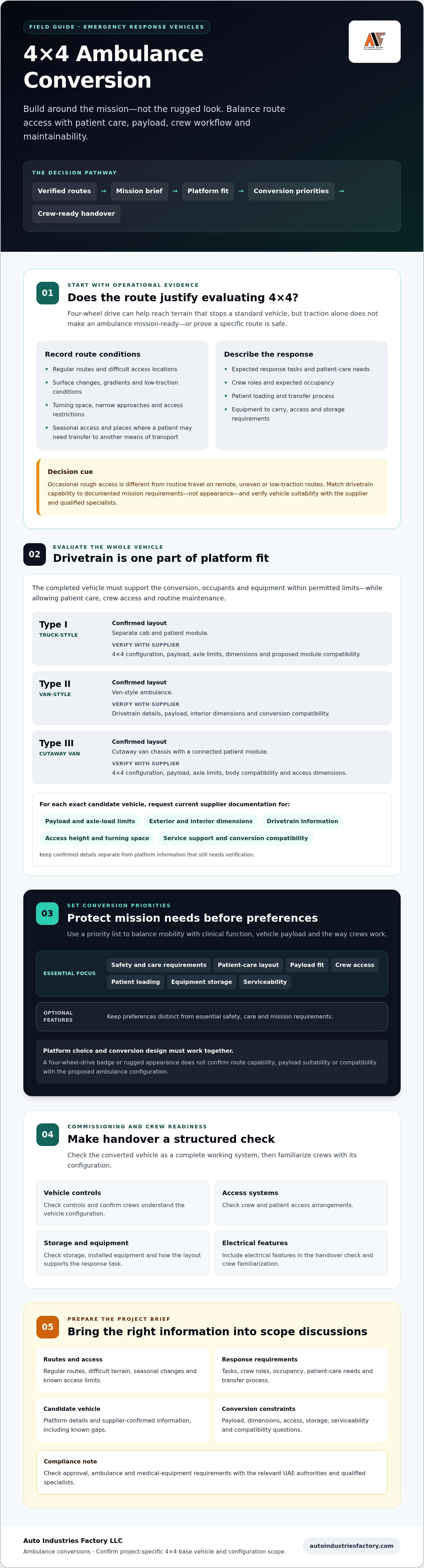
A 4x4 ambulance can reach terrain that stops a standard vehicle, but extra traction alone doesn’t make it mission-ready. A successful 4x4 ambulance conversion must balance route demands with patient-care space, equipment, vehicle payload and crew workflow.
If you’re unsure whether your routes justify four-wheel drive, or how to make room for off-road capability without compromising clinical needs, start with the operating brief, not the vehicle platform. This guide explains how to document terrain and response requirements, compare conversion priorities and prepare crews to use the vehicle confidently.
We’ll look at how truck-style and van-style bases shape a conversion, what to assess before choosing a donor vehicle, and how mobility, patient care and crew readiness fit together. Approval, ambulance and medical-equipment requirements also need to be checked with the relevant UAE authorities and qualified specialists. Auto Industries Factory LLC provides ambulance conversions. Confirm whether a particular 4x4 base vehicle and configuration are within scope for your project.
Key Takeaways
- Use route records, terrain, seasonal access and patient-transfer needs to decide whether four-wheel drive is operationally justified.
- Assess each candidate base vehicle against mission tasks, patient-care layout, crew access and maintainability. Verify any missing platform data with suppliers.
- Build a 4x4 ambulance conversion priority list that separates essential safety and care requirements from optional features.
- Plan commissioning as a structured handover. Check vehicle controls, access systems, storage, electrical features and installed equipment, then familiarize crews with the configuration.
- Prepare a project brief with routes, response tasks, crew and patient needs, candidate vehicle details and known constraints before discussing conversion scope.
When does a 4x4 ambulance conversion make operational sense?
A 4x4 ambulance conversion adapts a medical-response vehicle for demanding access conditions, such as remote sites, uneven ground or low-traction surfaces. Four-wheel drive alone doesn’t establish that a vehicle is suitable or safe for a particular route. The complete vehicle specification and the conditions it will face both matter.
Match drivetrain capability to verified mission requirements, not appearance. Start with route records rather than assumptions. Document where vehicles respond, the surfaces they encounter, when access changes seasonally, expected response tasks and how patients are transferred from the scene. A rugged appearance doesn’t prove that a vehicle can meet the fleet’s access, care or operating requirements.
For background on common ambulance layouts and chassis, see Ambulance design and types. General vehicle layout is only a starting point. The intended mission should guide the conversion.
Which terrain and response conditions justify evaluating 4x4?
Occasional rough access is different from routine travel on remote, uneven or low-traction routes. Describe the conditions specifically rather than simply calling them “off-road.” Record gradients, surface changes, turning space, narrow approaches and access restrictions. Include seasonal variations and locations where an ambulance may need to stop so a patient can be transferred to another means of transport.
This information can help determine whether four-wheel drive merits evaluation, but it doesn’t prove that a particular vehicle can handle the route. Suitability depends on the complete vehicle specification, its loaded condition, the route and how the vehicle is operated. Verify capability with the vehicle supplier and qualified specialists.
What should a fleet define before choosing a conversion?
Set the operational brief before discussing layouts. Define patient-care tasks, crew roles, expected occupancy and the equipment the team needs to carry. Then specify requirements for crew access, patient loading, equipment storage and serviceability. These decisions shape how the vehicle works in the field, not just how its interior looks.
- Routes: Document regular routes and difficult access conditions.
- Response: Describe the task, crew roles and patient-transfer process.
- Vehicle use: List occupancy, equipment, access and storage needs.
- Constraints: Record known limits and details that still need supplier verification.
Use the brief to compare candidate platforms and separate essential mission needs from preferences. Auto Industries Factory LLC lists ambulance conversion services, but a specific 4x4 base vehicle and configuration should be confirmed for the project. Check vehicle compatibility, drivetrain constraints and payload before settling on a conversion plan.
How the 4x4 base vehicle and ambulance conversion work together
A capable drivetrain is only one part of the vehicle. The base platform must carry the completed conversion, occupants and equipment within its permitted limits, while supporting patient care, crew access and routine maintenance. Drivetrain selection addresses traction. Whole-vehicle suitability depends on how the platform, conversion and mission work together.
Compare candidate vehicles against the tasks they must perform, not just their model name or four-wheel-drive badge. For each platform, request current supplier documentation and distinguish confirmed details from those that still need checking.
| Candidate layout | Confirmed attribute | Verify with supplier |
|---|---|---|
| Type I | Truck-style chassis with a separate cab and patient module | 4x4 configuration, payload, axle limits, dimensions and proposed module compatibility |
| Type II | Van-style ambulance | Drivetrain details, payload, interior dimensions and conversion compatibility |
| Type III | Cutaway van chassis with a connected patient module | 4x4 configuration, payload, axle limits, body compatibility and access dimensions |
How to compare 4x4 platforms without assuming capability
Ask suppliers for verified payload and axle-load limits, exterior and interior dimensions, and drivetrain information for the exact candidate vehicle. Confirm access height, turning space, service support and compatibility with the proposed body. A platform name or badge doesn’t confirm that the vehicle can carry the completed ambulance or negotiate your intended routes. Mark unavailable specifications as “verify” rather than treating them as established facts.
Assess the vehicle in its loaded condition, too. Conversion mass, medical equipment, crew and other occupants all contribute to the total load. Confirm how the finished configuration compares with the vehicle’s documented limits, and have qualified specialists assess the proposed build. The Ground Vehicle Standard (GVS) offers a U.S. ambulance-manufacturing reference. Confirm which approval and construction requirements apply to the intended vehicle in the UAE.
How patient-care layout affects vehicle and conversion choices
Map patient movement from loading to the intended care position. Mark crew working positions, equipment access points and restraint locations. Check whether staff can reach essential items and perform expected tasks without obstructing movement or reducing usable space. Have qualified specialists assess how proposed fittings affect safe operation and the completed layout.
Use equipment lists and layout drawings to test these decisions before committing to a platform. Auto Industries Factory LLC lists ambulance conversions, but a specific 4x4 base vehicle and configuration should be confirmed for each project. Review its ambulance conversion services as a starting point for discussion, and verify donor-vehicle compatibility, drivetrain constraints and payload directly.
Which conversion priorities matter most for a 4x4 ambulance?
A useful conversion brief ranks operational needs before appearance. For a 4x4 ambulance conversion, assess safety, dependable access, patient-care workflow, secure storage, maintainability and verified vehicle limits as connected priorities. A feature that improves one area can create a compromise elsewhere. Additional fittings can use patient-compartment space, while structural changes and equipment can add mass and affect access or upkeep.
Separate essential mission requirements from optional preferences. Mark each item as essential, desirable or out of scope, and note what evidence is needed before approving it. Avoid specifying medical systems, protection levels or terrain ratings without project-specific information from the appropriate vehicle suppliers and qualified specialists.
A decision matrix keeps discussions practical. The responsible reviewer may vary by fleet, so identify the role or qualified specialist expected to confirm each item.
- Requirement: Safe patient entry, exit and handling. Evidence: Reviewed access and patient-movement layout. Trade-off: Door access and workspace can compete for room. Reviewer: Fleet and patient-care stakeholders.
- Requirement: Crew movement and usable workspace. Evidence: Proposed positions and task review. Trade-off: More fittings can restrict movement. Reviewer: Crew representatives and qualified technical stakeholders.
- Requirement: Secure, accessible equipment storage. Evidence: Equipment list, locations and access review. Trade-off: Storage takes space and contributes to vehicle mass. Reviewer: Fleet and relevant equipment specialists.
- Requirement: Serviceability and vehicle limits. Evidence: Supplier-confirmed specifications and maintenance considerations. Trade-off: Added features can increase complexity. Reviewer: Vehicle supplier and qualified conversion specialists.
How to assess access, workspace, and equipment integration
Review the full sequence: crew entry, patient handling, movement to working positions and access to carried equipment. Give each item a defined, secure location and check that fittings suit the selected vehicle and intended use. Keep unresolved choices visible in the brief. Have the fleet, conversion specialist and other qualified technical stakeholders review those decisions before settling the configuration.
How to compare trade-offs without over-specifying the vehicle
Compare alternatives against the fleet’s written mission criteria, not a universal “best” build. For each proposed addition, ask how it affects usable space, mass, access and upkeep. Request supplier-confirmed information wherever limits or compatibility are uncertain. Don’t rely on generic performance promises or assumed industry defaults. A leaner configuration may suit one mission, while another may call for different priorities.
How to plan commissioning and train staff on new vehicle features
Commissioning gives the fleet a chance to assess the completed vehicle and prepare crews to use it confidently. For a 4x4 ambulance conversion, don’t treat handover as a quick walk-around. Compare the build with the agreed brief, review vehicle documentation, demonstrate features and record acceptance and training actions. Confirm applicable approval, clinical protocol and training requirements with the relevant authorities and qualified specialists for the operating jurisdiction.
What should a practical crew handover cover?
Assign clear responsibilities. Vehicle specialists should explain vehicle-specific controls and documented operating limits. Fleet representatives should confirm operational procedures, while qualified clinical stakeholders should address patient-care practices where applicable. Tailor familiarization to each crew role. Use supervised demonstrations and realistic scenarios rather than relying on manuals alone.
- Review the configuration: Compare the completed vehicle and its documentation with the agreed specification. List discrepancies and unresolved items.
- Inspect key features: Walk through vehicle controls, compartment access, storage locations, electrical features and installed equipment. Explain relevant limits using supplier documentation.
- Demonstrate routine tasks: Practise access, loading, equipment retrieval and other role-specific tasks under supervision. Keep practice within approved procedures.
- Record acceptance and training: Document attendance, competency checks, questions, follow-up actions and the manuals or vehicle records provided at handover.
- Schedule refresher familiarization: Revisit features when procedures change, staff need further support or the vehicle configuration is altered.
Record what was reviewed and what remains open. An unresolved question isn’t evidence that crews understand a feature. Assign an owner and confirm how the answer will be documented and shared.
How can fleets compare training and commissioning approaches?
Compare supplier-led familiarization, internal instruction and qualified third-party support by scope, not by label. Ask who demonstrates each feature, who provides manuals, how role-specific practice is handled and who answers follow-up questions if the configuration changes. Check that fleet and clinical stakeholders review the areas within their responsibility, and confirm that training records meet the fleet’s requirements.
Before the vehicle enters service, confirm that the relevant people have reviewed the configuration, understood the documented limits and completed required familiarization. Auto Industries Factory LLC lists ambulance conversions, but the supplied information doesn’t confirm a 4x4 configuration or crew-training service. Review the company’s vehicle conversion services and confirm whether your selected base vehicle and project scope are within its capabilities.
From 4x4 Ambulance Brief to Conversion Enquiry
A clear project brief helps a conversion specialist assess the intended scope before detailed discussions begin. For a 4x4 ambulance conversion, separate confirmed information from assumptions. If a vehicle specification, approval question or operating requirement is unknown, mark it for verification rather than treating it as settled.
What information should a fleet prepare before requesting a review?
Use this checklist to assemble a concise brief that can be reviewed. Attach supporting documents where available, and identify who can answer outstanding questions.
- Mission and routes: Describe intended use, terrain, route conditions, response profile and expected operating schedule.
- People and patient care: Note crew roles, expected occupancy, patient-care tasks and the process for loading and transfer.
- Candidate vehicle: Provide the make, model, year and available drivetrain, dimensional, payload and axle-load data. Clearly mark unconfirmed details.
- Conversion inputs: Include layout drawings, equipment lists, storage needs and known operating constraints.
- Questions to resolve: List project-specific questions about vehicle compatibility, applicable approvals, crew training, maintenance and delivery expectations.
This information gives a specialist a basis for discussing feasibility and identifying what needs further technical review. It doesn’t confirm that a particular base vehicle can be converted, that a 4x4 configuration is available, or that the finished vehicle will meet specific approval requirements. Verify those points with the relevant suppliers, authorities and qualified specialists.
How to assess a conversion partner's proposed scope
Ask for a written proposal that separates included work from assumptions, exclusions and open questions. Clarify which design, fabrication, installation and verification activities are included, who is responsible for each, and what information the fleet must provide. Request relevant drawings or specifications, and confirm how changes to the vehicle or equipment list could affect the agreed scope.
Auto Industries Factory LLC lists ambulance conversions and describes in-house fabrication capabilities, including laser cutting, CNC machining, welding and painting. A specific 4x4 ambulance configuration isn’t confirmed, so ask whether the selected donor vehicle and intended project are within scope. Review its conversion services and company background as part of your assessment.
Once your brief and supporting documents are ready, share them with a conversion specialist for a project-specific scope discussion. Focus the initial review on confirmed requirements, vehicle data and questions that still need qualified verification.
Build Your 4x4 Ambulance Plan Around the Mission
A capable 4x4 ambulance conversion starts with verified routes and response tasks, not appearance. Match the base vehicle and conversion to patient-care workflow, crew access, storage needs and documented vehicle limits. Then plan commissioning and crew familiarization so the completed configuration is understood before it enters operation.
Auto Industries Factory LLC lists ambulance conversions as a primary service and describes in-house design, laser cutting, CNC machining, welding and painting capabilities. A specific 4x4 configuration isn’t confirmed, so discuss your donor vehicle, intended use and requirements to establish whether the project is within scope. Confirm applicable vehicle, ambulance and equipment requirements with the relevant UAE authorities and qualified specialists.
Discuss your ambulance conversion requirements with your project brief and available vehicle information. A clear starting point helps turn operational needs into a focused scope. Plan carefully, verify what matters and move forward with confidence.
Frequently Asked Questions
What is a 4x4 ambulance conversion?
A 4x4 ambulance conversion adapts a four-wheel-drive base vehicle for medical-response use and demanding access conditions. The finished vehicle must suit more than the route: patient-care layout, crew access, equipment storage and loaded vehicle limits matter, too. There’s no single configuration that fits every fleet. Define the intended missions first, then verify the donor vehicle and proposed conversion against those requirements with suppliers and qualified specialists.
When does an ambulance need four-wheel drive?
An ambulance may need four-wheel drive when documented routes regularly include conditions where additional traction is an operational requirement. Review actual surfaces, gradients, seasonal access, turning space and response tasks rather than relying on general labels such as “off-road.” Occasional rough access may not call for the same vehicle choice as routine remote or low-traction travel. Confirm the complete vehicle’s capability for the intended conditions with the supplier and qualified specialists.
Can any 4x4 vehicle be converted into an ambulance?
No. A four-wheel-drive system alone doesn’t make a vehicle suitable for ambulance use. Assess the donor vehicle for payload, axle limits, dimensions, drivetrain constraints, patient-compartment layout and compatibility with the proposed conversion. Added structure, equipment, crew and occupants all affect the completed vehicle. Request specifications for the exact vehicle and have qualified specialists review the intended build. Confirm project-specific approval requirements with the relevant authorities.
What should a 4x4 ambulance conversion include?
The configuration should reflect the fleet’s mission, not a generic feature list. Define patient-care tasks, crew positions, patient movement, equipment storage, vehicle access and maintenance needs. Confirm that fittings and equipment locations support the intended workflow without exceeding verified vehicle limits. Requirements depend on the operation and jurisdiction, so review the proposed configuration with qualified vehicle and clinical stakeholders rather than assuming specific systems or ratings are standard.
How do you choose a base vehicle for a 4x4 ambulance?
Compare candidate vehicles against documented routes, response duties, patient-care layout, crew access and serviceability. Request confirmed payload, axle-load, dimensional and drivetrain information for each exact platform. Check turning space, access height and compatibility with the proposed body, then assess the completed vehicle in its loaded configuration. Don’t infer suitability from a model name or four-wheel-drive badge. Verify unresolved specifications with the supplier before selecting a platform.
How should staff be trained on a converted ambulance?
Plan a documented handover before crews use the vehicle. Demonstrate vehicle controls, compartment access, storage locations, electrical features, installed equipment and documented operating limits. Use supervised, role-appropriate practice, and record attendance, competency checks, questions and the manuals provided. Assign training responsibilities to relevant fleet, vehicle and clinical stakeholders. Confirm applicable training requirements and clinical protocols for the operating jurisdiction, and provide refresher familiarization when procedures or vehicle features change.
What information should I prepare before requesting a 4x4 ambulance conversion?
Prepare a brief covering intended routes and terrain, response tasks, patient-care needs, crew roles, occupancy and operating schedule. Include candidate vehicle details, available payload information, drawings and equipment lists, plus known constraints. Note open questions about approvals, training and maintenance so they can be verified. Auto Industries Factory LLC lists ambulance conversions, but confirm whether a specific 4x4 vehicle and configuration are within scope for your project.


