

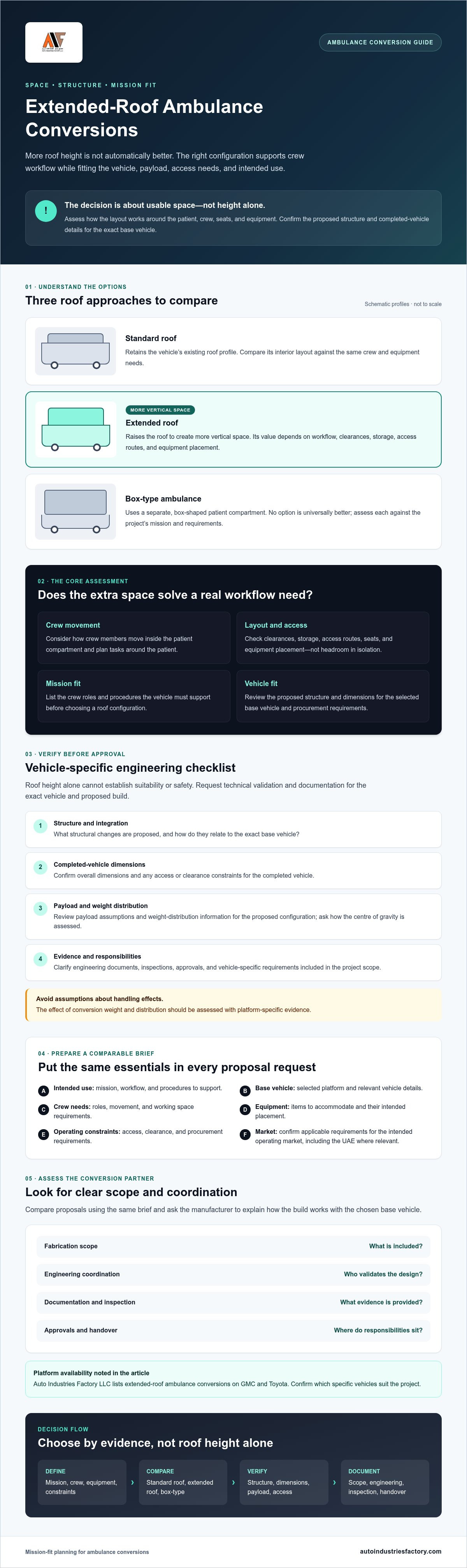
More roof height isn’t automatically better. An extended roof ambulance conversion should provide the working space a clinical team needs while remaining suited to the vehicle’s intended use. Added height can affect the patient-compartment layout and how the conversion integrates with the base vehicle, so the right choice depends on more than headroom alone.
It’s reasonable to ask whether extra space will make it easier for staff to work without creating new concerns about structure, payload, handling, or safety. The answers depend on the specific vehicle and build. Auto Industries Factory LLC lists extended roof ambulance conversions on GMC and Toyota, and offers in-house fabrication capabilities that can support project coordination.
This guide covers what an extended roof is intended to achieve, the trade-offs to assess, and the details to confirm with a conversion manufacturer. You’ll learn what to include in a project brief, what to verify about the roof structure and vehicle configuration, and how to check applicable requirements for the intended operating market in the UAE. This groundwork can help you compare proposals and decide whether an extended roof fits your needs.
Key Takeaways
- An extended roof ambulance conversion is a mission-fit decision. Assess how added height supports crew workflow and usable interior space.
- Confirm vehicle-specific structural requirements and validate payload, centre of gravity, dimensions, and access before choosing a configuration.
- Compare standard- and extended-roof options against the same criteria, then review how the proposed design works with the selected base vehicle.
- Prepare a clear project brief covering intended use, base vehicle details, crew needs, equipment, and operating constraints.
- Evaluate a conversion partner by how clearly it explains fabrication scope, engineering coordination, documentation, inspection, and handover responsibilities.
What Is an Extended Roof Ambulance Conversion, and Who Needs One?
An extended roof ambulance conversion modifies a vehicle to increase roof height and create more vertical space inside. The goal is to shape the patient compartment around the vehicle’s mission and crew workflow, not to add height for its own sake. The design needs to be checked against the specific base vehicle and conversion requirements.
A standard-roof configuration retains the vehicle’s existing roof profile. A box-type ambulance uses a separate, box-shaped patient compartment. Neither approach is universally better. For an overview of common vehicle categories, see Ambulance types.
This video shows an ambulance being converted for a different use. Treat it as a visual example of vehicle modification, not as guidance on clinical layout or compliance.
What operational need can a raised roof address?
Headroom can affect how crew members move within the patient compartment and plan tasks around the patient, seats, and equipment. But extra height alone doesn’t guarantee a functional interior. Clearances, storage, access routes, and equipment placement all determine how useful the space will be.
Before choosing a roof configuration, list crew roles, equipment, and the procedures the vehicle must support. Use that brief to assess the complete layout, rather than treating roof height as a stand-alone measure.
Which ambulance projects may consider an extended roof?
A fleet may consider a raised roof when its intended workflow calls for more vertical working space. The right configuration depends on the mission, base vehicle, and procurement requirements. Confirm the proposed structure and dimensions for the selected platform. Auto Industries Factory LLC lists extended roof ambulance conversions on GMC and Toyota; confirm which specific vehicles suit your project.
Compare configurations against the same operational brief, then review the vehicle-specific details with the conversion manufacturer. For broader planning considerations, use this professional ambulance conversion guide as a starting point for discussing a conversion’s scope and requirements.
How Does an Extended Roof Conversion Affect Ambulance Engineering?
Raising a roof changes more than the vehicle’s outline. An extended roof ambulance conversion must be assessed against the exact base vehicle because structural modifications, interior fit-out, and vehicle systems need to work together. A generic height increase doesn’t establish whether a particular platform is suitable.
Roof height alone cannot establish vehicle suitability or conversion safety. Separate confirmed project specifications, such as the selected base vehicle and intended layout, from questions that require technical validation. Before approving the build, ask the conversion engineer to document the proposed structure, materials, dimensions, payload assumptions, and vehicle-specific requirements.
What should buyers verify about structure and vehicle dynamics?
Ask how the roof modification will integrate with the selected vehicle, and request supporting engineering documentation. Review the completed-vehicle specification, not just the original chassis figures. The conversion’s weight and distribution may affect payload capacity and the centre of gravity, while overall dimensions can affect clearance and access. Don’t assume the direction or scale of any handling effect without platform-specific evidence.
Ask for clarity on:
- The structural changes and how they relate to the exact base vehicle.
- Completed vehicle dimensions and any access or clearance constraints.
- Payload and weight-distribution information for the proposed configuration.
- Which engineering documents, inspections, and approvals are included in the project scope.
The NFPA’s NFPA 1917 ambulance design standards can serve as a reference point for design discussions. Confirm which standards and approval processes apply to the intended operating market in the UAE rather than assuming a US reference governs the project.
How do electrical and interior systems fit into the design?
Map each planned item to the proposed layout before design approval. Account for equipment, storage, lighting, and electrical needs, then check how each item will be mounted, powered, accessed, and serviced. A taller compartment won’t resolve conflicts between equipment placement and crew movement on its own.
Record which items are specified, which remain undecided, and who is responsible for confirming their integration. Review routing and mounting details with the conversion team early enough to resolve access or serviceability issues before fabrication. Don’t treat example equipment as included unless it appears in the written project specification.
Auto Industries Factory LLC lists extended roof ambulance conversions on GMC and Toyota, but suitable models and configuration details need to be confirmed for each brief. Use the company’s ambulance conversion information as a starting point for a vehicle-specific discussion.
Extended Roof vs. Standard Roof: How to Compare Ambulance Configurations
Compare configurations against the work the vehicle must support, not roof height in isolation. An extended roof ambulance conversion may provide more vertical room for crew tasks and interior equipment. A standard roof may be a better fit if the additional room isn’t needed or the vehicle must meet specific access or dimensional constraints.
Use this table as a screening tool, not a specification. The comparison is directional: actual outcomes depend on the base vehicle, interior plan, and engineered configuration.
| Factor | Standard roof | Extended roof | What to verify |
|---|---|---|---|
| Usable headroom | Works within the standard roof profile. | Creates the possibility of additional vertical space. | Measure usable space in the proposed completed layout. |
| Interior planning | Requires equipment and tasks to fit the available compartment. | May allow more vertical room for crew workflow and equipment planning. | Review clearances, movement paths, storage, and access together. |
| Vehicle constraints | Retains the standard roof profile, but other vehicle limits still apply. | Changes the vehicle’s overall height and requires platform-specific assessment. | Confirm completed dimensions, payload, and deployment access. |
| Project verification | Confirm the vehicle and interior meet the mission brief. | Confirm roof integration and the complete configuration meet the brief. | Review the completed-vehicle specification and applicable requirements. |
When might an extended roof be worth evaluating?
Consider it when crew movement, planned tasks, or specified equipment indicate that more vertical working space could be useful. Before reviewing proposals, document the space required and show how crew, equipment, and tasks fit into the intended layout. Treat a raised roof as an option to assess, not an automatic upgrade.
When may a standard roof be the better fit?
A standard roof may suit a project if the workflow fits the available space or the deployment environment makes overall vehicle dimensions a key constraint. Compare actual routes, access points, and operational requirements with the proposed completed-vehicle specification. Extra space has value only if the complete vehicle remains fit for purpose.
For procurement, ask which requirements apply to the intended operating market. The CAAS Ground Vehicle Standard (GVS) is one reference buyers may encounter; confirm whether it applies to your project rather than assuming. Auto Industries Factory LLC lists ambulance conversions, including extended roof options on GMC and Toyota. Review its ambulance conversion options as a starting point for a vehicle-specific comparison.
How to Specify an Extended Roof Ambulance Conversion
A clear brief helps a fleet compare proposals on the same basis. For an extended roof ambulance conversion, describe the required work and identify decisions that still need technical confirmation. Keep confirmed requirements separate from assumptions, especially around vehicle compatibility, roof structure, payload, and applicable approvals.
What information belongs in the initial project brief?
Give the conversion team enough detail to assess the mission and base vehicle. Include the make, model, year, configuration, and available technical documentation. Then describe who will use the compartment and how they need to work in it.
- Mission and crew: State the intended use, crew roles, and routine tasks.
- Interior needs: List specified equipment, storage, access routes, and essential clearances. Identify undecided items rather than treating them as confirmed.
- Vehicle details: Provide base vehicle records and note any platform or configuration preferences. Confirm that the exact vehicle can support the proposed conversion.
- Operating constraints: Record relevant access, deployment, and procurement requirements, along with delivery expectations.
- Applicable requirements: Identify the intended operating market and ask which technical requirements, inspections, and approvals need verification. Don’t assume one standard applies everywhere.
This brief gives manufacturers a common reference point. If you’re considering GMC or Toyota, specify the exact vehicle details; suitability must be confirmed for the requested configuration.
What should a conversion proposal make clear?
Ask for a written scope that separates included work from exclusions. It should explain the proposed roof modification, interior integration, fabrication scope, and any items supplied or specified by others. Auto Industries Factory LLC identifies in-house fabrication capabilities including laser cutting, CNC machining, welding, and painting. Ask the proposal to state which capabilities apply to your project.
Before approval, clarify how design decisions will be documented, who reviews changes, and how revisions affect the specification. Request written confirmation of:
- Proposed completed-vehicle dimensions and configuration.
- Payload and weight-distribution information, where available for the specified build.
- Testing or inspection activities included, and who is responsible for each.
- Handover documents, approvals, and any unresolved items.
Review the final completed-vehicle specification against the original brief before accepting the proposal. To discuss a vehicle-specific brief and fabrication scope, explore Auto Industries Factory LLC’s specialized vehicle conversion services.
Choosing an Extended Roof Ambulance Conversion Partner
A capable conversion partner should make the engineering and project scope clear, not rely on broad claims about quality or experience. For an extended roof ambulance conversion, assess how the manufacturer handles your specific base vehicle, explains technical decisions, documents the build, and coordinates work from fabrication through handover.
What questions should a buyer ask a conversion manufacturer?
Ask for examples of relevant projects and clarify which details can be verified, such as the base vehicle and work included. An example can help you understand a manufacturer’s experience, but it doesn’t prove that a different platform or configuration is suitable.
- Can you confirm the proposed base vehicle is suitable for this roof configuration?
- What technical requirements and operating-market approvals need to be confirmed?
- Which team members coordinate design decisions, fabrication, and interior system integration?
- What is included in the project scope, and what remains the buyer’s responsibility?
- Which inspection records, technical documents, and handover items will be provided?
- How are design changes reviewed, approved, and recorded during the project?
Request clear answers in writing. That makes it easier to compare proposals by responsibilities and deliverables, rather than marketing language alone.
How can Auto Industries Factory LLC support a project discussion?
Auto Industries Factory LLC lists ambulance conversions, including extended roof options on GMC and Toyota, and identifies in-house design, laser cutting, CNC machining, welding, and painting capabilities. These capabilities provide a basis for discussing project coordination and fabrication scope, but don’t establish compatibility, certification, or compliance for a particular build. Confirm the exact vehicle, proposed work, applicable requirements, and supporting documents directly with the conversion team.
For context on the company and its stated capabilities, review its vehicle conversion company background. Then prepare a brief with your base-vehicle details, intended use, crew requirements, equipment plan, operating constraints, and procurement specifications that need checking.
To begin evaluating a project, share your requirements through the Auto Industries Factory LLC website and ask which details are needed to assess the proposed GMC or Toyota configuration.
Move Forward with a Clear Conversion Brief
An extended roof ambulance conversion is a mission-fit decision, not an automatic upgrade. Compare roof options against crew workflow, equipment needs, vehicle dimensions, payload, and operating constraints. Then ask the conversion manufacturer to verify the proposed structure, platform suitability, applicable requirements, and completed-vehicle specification.
A precise project brief makes proposals easier to compare. Include the intended use, base vehicle details, crew needs, equipment, and procurement requirements. Confirm what the conversion scope includes, how decisions and changes will be documented, and which inspection and handover records to expect.
Auto Industries Factory LLC lists extended roof ambulance conversions on GMC and Toyota. Its stated in-house capabilities include design, laser cutting, CNC machining, welding, and painting. Confirm the exact vehicle configuration and project scope directly before proceeding.
Ready to discuss your requirements? Share your ambulance conversion requirements with Auto Industries Factory and take the next step with a clear, vehicle-specific brief.
Frequently Asked Questions
What is an extended roof ambulance conversion?
An extended roof ambulance conversion modifies a vehicle’s roof to create a different interior height and layout. The aim is to support a defined ambulance workflow, not simply to make the vehicle taller. The appropriate configuration depends on the base vehicle, crew tasks, equipment, and applicable requirements. Before making a procurement decision, ask the conversion manufacturer to explain the proposed design and confirm its engineering for the exact vehicle.
Is an extended roof ambulance better than a standard roof?
No. An extended roof isn’t automatically better. It may be worth evaluating if planned crew tasks or specified equipment call for more interior height. A standard roof may better fit a mission with different space needs or vehicle constraints. Compare the proposed completed vehicle’s interior layout, payload, dimensions, access, and applicable requirements. The better option is the one that meets documented operational needs, not the one with the taller roof.
Can any vehicle be converted to an extended roof ambulance?
No. Compatibility shouldn’t be assumed. Suitability depends on the vehicle’s make, model, year, configuration, structure, and intended completed-vehicle requirements. Auto Industries Factory LLC lists extended roof ambulance conversions on GMC and Toyota, but that doesn’t confirm every model or year is suitable. Provide the exact vehicle details and request a vehicle-specific assessment before committing to a design, purchase, or procurement specification.
What should I include in an extended roof ambulance conversion brief?
Include the base vehicle’s make, model, year, and configuration, along with available technical documents. Describe the intended mission, crew workflow, equipment, storage, interior access needs, and operating constraints. Identify procurement or regulatory requirements that need confirmation for the intended market. Mark which specifications are fixed and which remain open. Ask the manufacturer to document the conversion scope, exclusions, required approvals, testing, and handover items.
Does an extended roof conversion affect payload or vehicle handling?
It can affect vehicle characteristics, but the result depends on the exact base vehicle and engineered conversion. Roof height alone can’t establish payload capacity or predict handling. Ask for relevant completed-vehicle specifications and technical documents, including payload and weight-distribution information for the proposed build. Have the conversion team address these points for the chosen platform, then compare the documented figures with the project requirements before approving the configuration.
How do I evaluate an ambulance conversion manufacturer?
Assess relevant project experience, vehicle-specific engineering communication, fabrication and integration scope, documentation, and handover arrangements. Ask for examples that match your intended configuration, and clarify which details can be verified. Confirm who is responsible for each project stage and which requirements apply in the operating market. A clear written proposal should identify the base vehicle, included work, exclusions, buyer decisions, and the technical records or handover documents you’ll receive.
Does an extended roof ambulance conversion include medical equipment?
Not necessarily. Equipment inclusion depends on the agreed project specification, so don’t assume particular equipment, electrical systems, or accessories are part of the conversion. List required items, locations, mounting needs, and power requirements in your brief. Then request a written scope stating what the manufacturer will supply, install, integrate, or exclude. This helps distinguish confirmed deliverables from items the buyer or another supplier must provide.


