

What if the biggest risk in an APC-1 enquiry is choosing a vehicle before confirming what the designation means? Search results can mix vehicle names, technical terms and unrelated products. Here, APC-1 is treated as an illustrative project label, not a confirmed model or official military designation. That distinction matters because the vehicle name, base platform and conversion scope are separate parts of a procurement brief.
A sound evaluation starts with the intended mission, passenger and crew needs, operating conditions, protection requirements and integration priorities. Verify these requirements against authoritative project documents rather than assuming they from a search result or unconfirmed specification. This creates a clearer basis for comparing platforms and discussing feasibility.
This guide explains how to confirm what APC-1 means in your procurement context, distinguish an armoured personnel carrier from an infantry fighting vehicle, and build a practical comparison framework. It also outlines what a specialist vehicle conversion partner needs before discussing a project, including the proposed base vehicle, defined requirements and known constraints. The objective is a grounded brief focused on the mission and the work required.
Key Takeaways
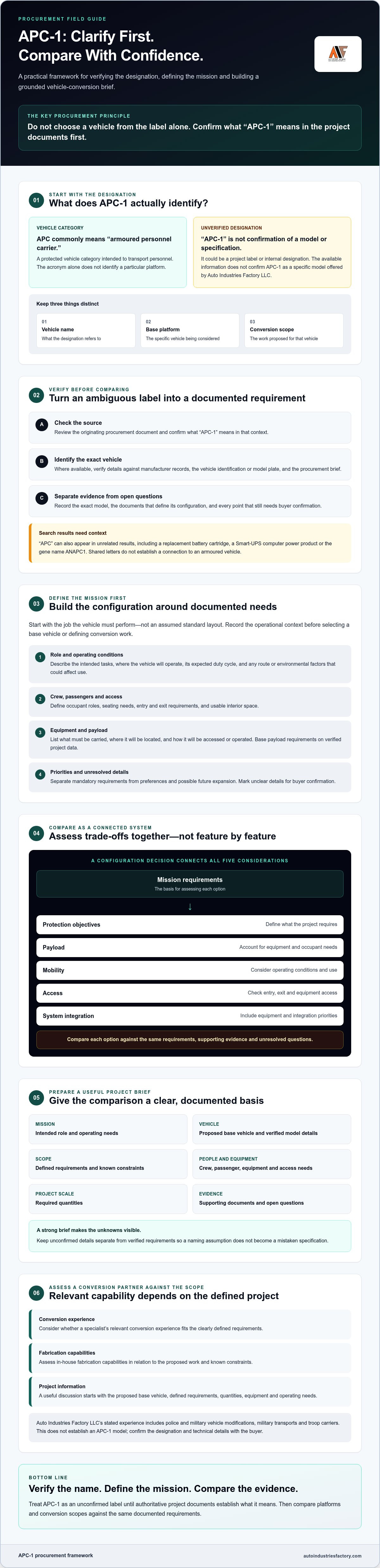
- Verify what “apc-1” means in your procurement documents before treating it as a vehicle model or specification.
- Use a consistent comparison framework to record each option’s requirements, supporting evidence and unresolved questions.
- Assess protection objectives, payload, mobility, access and system integration as connected trade-offs, not isolated features.
- Prepare a project brief with the intended role, proposed base vehicle, quantities, equipment and operating needs.
- Consider how a specialist’s relevant conversion experience and in-house fabrication capabilities may fit a clearly defined project scope.
APC-1: What the designation may mean before you compare vehicles
Searches for APC-related terms can lead to unrelated products or biology. In a vehicle context, APC commonly means an armoured personnel carrier, a protected vehicle intended to transport personnel. The Armoured personnel carrier (APC) reference provides background on the vehicle category, but the acronym alone doesn’t identify a particular platform.
In vehicle procurement, an APC is a personnel-transport category; “APC-1” by itself does not verify a model, configuration or technical specification. Treat the designation as a starting point for clarification, not evidence of a vehicle’s capabilities. The available information does not confirm APC-1 as a specific model offered by Auto Industries Factory LLC.
Does APC-1 identify a specific armoured personnel carrier?
Not without supporting documentation. APC-1 could be a project label or internal designation rather than a manufacturer’s model name. Check the originating document and, where available, confirm details against the manufacturer’s records, vehicle identification or model plate, and procurement brief. Don’t infer a platform or specification from the label alone.
Record unclear points for confirmation with the buyer. These may include what APC-1 means, the exact vehicle model, and which technical documents define the required configuration. Keeping unresolved details visible helps prevent a naming assumption from becoming a mistaken procurement requirement.
Why APC searches return unrelated results
The acronym is used in different fields and for different products. Schneider Electric’s RBC1 result refers to an APC replacement battery cartridge, while an APC-branded listing on Amazon.ae concerns a Smart-UPS computer power product. Neither is an armoured vehicle. ANAPC1, meanwhile, is the name of a gene, not a vehicle designation.
These results show why acronym matches need context. A product page may accurately use “APC” while answering a different question. Before relying on a result, check whether its source discusses vehicles, procurement or the relevant manufacturer. Shared letters alone don’t establish a connection.
Make searches more precise by adding terms such as “armoured personnel carrier,” “military vehicle,” the verified manufacturer, or the documented platform name. Then compare claims with authoritative project records. For a prospective conversion, distinguish the base vehicle from the work proposed for it. Auto Industries Factory LLC’s stated experience includes police and military vehicle modifications, military transports and troop carriers, but this does not establish an APC-1 model. Confirm the designation and technical details with the buyer before comparing vehicle options or defining a conversion scope.
How mission requirements shape an APC vehicle configuration
A useful configuration starts with the job the vehicle must perform, not a presumed standard layout. An armoured personnel carrier is a military vehicle category, but its specific arrangement depends on documented mission needs. For an APC-1 project, define the intended role, crew and occupant requirements, operating conditions, duty cycle and payload before selecting a base vehicle or conversion scope.
Select a vehicle configuration to meet documented mission requirements, and check each proposed feature against its effect on payload, access, mobility and integration. This keeps the brief grounded and avoids assuming a standard capacity, interior arrangement or protection level that procurement documents don’t specify.
Which operational questions should buyers answer first?
Describe the tasks the vehicle must perform and the conditions in which it will operate. Record the expected duty cycle and any route or environmental factors that could affect its use. Then identify who travels in it, their roles, and what equipment must be carried, accessed or operated during the mission.
- Occupants and access: Define seating, entry and exit needs, and usable interior space based on the actual crew and passenger roles.
- Equipment and payload: List the equipment, where it will be located and how it will be used. Establish payload requirements from verified project data rather than estimates.
- Priorities: Separate mandatory requirements from preferences and possible future expansion. Flag unresolved details for buyer confirmation.
This sequence can expose conflicts early. Additional equipment or structural changes, for example, may affect available payload or interior space. Assess those effects against the mission rather than treating each requested feature in isolation.
How should buyers compare vehicle platforms?
Compare candidate platforms against the same requirements, then request verified manufacturer data for each proposed base vehicle. A consistent basis makes information gaps visible and reduces the risk of choosing a platform based on its name or broad category alone.
- Payload and dimensions: Check documented limits against the intended occupants, equipment and proposed conversion.
- Serviceability: Assess support and maintenance considerations relevant to the planned operating conditions and duty cycle.
- Integration: Confirm whether the vehicle can accommodate required equipment and access arrangements. Identify assumptions that need technical review.
The APC-1 label alone cannot establish platform suitability. A specialist conversion partner can review a defined, vehicle-specific scope. Auto Industries Factory LLC’s confirmed work includes police and military vehicle modifications. Buyers can review its vehicle modification services when considering a project discussion.
APC-1 comparison: assess protection, payload, and integration together
Compare proposals against the same documented requirements, not a designation or headline claim. The label APC-1 doesn’t prove that two vehicles share a platform, protection capability or equipment fit. For each option, record what’s required, what’s proposed, what evidence supports the proposal and what remains unresolved.
How do protection and payload affect the comparison?
Protection requirements should be specific enough to evaluate, but don’t infer a rating from the vehicle category or conversion description. Ask suppliers to identify the exact requirement their proposal addresses and provide supporting documentation. Check any stated rating, standard or test result against the project’s authoritative requirements.
Reinforcement and added equipment can affect payload and vehicle performance. Compare the complete proposed configuration, not just the base vehicle. Request evidence showing how the supplier has accounted for those changes, and mark unverified claims for independent review.
Which conversion systems need to work together?
Electrical and communication equipment, occupant arrangements and carried systems can compete for space or affect access. Evaluate them as a coordinated package. Ask how fabrication changes interface with the vehicle structure and whether equipment can be reached for operation and servicing. A proposal should explain how it addresses requirements rather than rely on unsupported headline claims.
Use an armoured personnel carrier design and modification guide as a framework for organizing questions, but confirm every technical requirement against project documentation. For a practical comparison, pair each requirement with the proposed solution, evidence and open questions. This makes trade-offs visible and gives a specialist conversion partner a clearer basis for reviewing a vehicle-specific scope.
What to include in an APC-1 conversion project brief
A well-structured brief helps a conversion specialist assess the project against confirmed needs, not assumptions attached to the APC-1 label. Build it in sequence, and mark unknowns rather than filling gaps with estimates.
- Verify the designation. State what APC-1 means in the procurement context and attach the originating brief or other reference. Flag naming details that still need buyer confirmation.
- Define the intended role and operating needs. Describe the vehicle’s tasks, operating conditions, expected duty cycle, occupant roles and access needs.
- Identify the base vehicle and quantity. Provide the confirmed make, model, configuration and required number of vehicles. Include available manufacturer documentation.
- Specify equipment and conversion requirements. Describe payload, interior, structural, armoring, electrical and communication requirements. Separate mandatory needs from preferences and possible future additions.
- Set evidence and acceptance criteria. Identify the documents, test evidence or applicable standards needed for review, without assuming which standards govern. Define how proposed work will be assessed and accepted.
Attach drawings, technical documents and project requirements where available. Record assumptions, exclusions, approval responsibilities and open questions as well. These details help each party understand the requested scope and which decisions remain with the buyer.
What technical information helps a conversion specialist?
Use verified vehicle information, not a category label. Include the make, model, configuration and available manufacturer data, then explain the required structural changes, armoring, electrical and communication systems, interior arrangement and equipment fit. If a particular standard or type of evidence applies, cite the project source. If it’s uncertain, mark it for confirmation rather than treating it as settled.
How can buyers compare supplier proposals fairly?
Issue the same scope, assumptions and evidence request to each supplier. Compare what each proposal includes, which fabrication tasks it covers, who is responsible for system integration, and how the work will be verified. A vehicle conversion services overview can help frame a discussion with Auto Industries Factory LLC. Its confirmed capabilities include in-house laser cutting, CNC machining, welding and painting. These capabilities don’t establish an APC-1 model or confirm a specific project’s feasibility.
Once the requirements are documented, the available vehicle documents, quantities and defined scope provide a useful basis for discussing the conversion project with Auto Industries Factory LLC.
Discussing an APC-1 project with a specialist conversion partner
A specialist conversion partner can help assess a defined vehicle and project scope. Auto Industries Factory LLC works on specialized vehicle conversions, including police and military vehicle modifications, military transports and troop carriers. However, the supplied information does not confirm an APC-1 named product. Treat the designation as a project reference until its meaning, base vehicle and requirements are verified.
For buyers, a useful starting point is a brief that explains the intended role, confirmed vehicle details, requested modifications and evidence needed to assess the proposed work. Auto Industries Factory LLC's specialized vehicle conversion services provide context for its stated work, while its company background and capabilities offers further information about the business.
What capabilities can support a defined vehicle conversion?
The company’s stated capabilities include structural reinforcement and armoring, alongside in-house laser cutting, CNC machining, welding and painting. These fabrication processes may support work within a defined conversion scope, but they don’t establish that a specific requirement can be met or guarantee a particular outcome.
Ask how each proposed change relates to the vehicle structure and documented requirements. Clarify which fabrication steps are included, what vehicle information the assessment relies on, and what evidence will be used to verify the completed work. Keep protection levels, compatibility and performance claims subject to project-specific confirmation.
What should happen before a project proposal?
Before requesting a proposal, confirm the APC-1 designation with the buyer and assemble the information that defines the project:
- Vehicle: Confirm make, model, configuration and available manufacturer documentation.
- Mission: State the intended role, operating needs, occupants and equipment.
- Conversion scope: Describe required structural, armoring, electrical, communication or interior work, and separate mandatory items from preferences.
- Verification: Attach drawings, applicable requirements and acceptance criteria where available. Identify open questions and who is responsible for approvals.
This gives a specialist a clearer basis for discussing scope and identifying details that need confirmation. It also helps distinguish documented information from assumptions. Don’t present an unverified model name, protection rating or technical claim as established fact.
When the vehicle and scope are clear, the specialized vehicle conversion services page provides information for a project discussion with Auto Industries Factory LLC.
Turn your APC-1 requirements into a clear project brief
A sound armoured vehicle procurement starts with confirmation, not assumptions. Verify what apc-1 means in your documents, then compare candidate vehicles against the mission, payload, protection objectives and integration needs. Keep evidence, open questions and acceptance criteria visible so each proposal can be assessed against the same requirements.
A clear brief also gives a specialist conversion partner a practical basis for discussion. Include the confirmed base vehicle, intended role, quantities, equipment and operating needs, along with relevant drawings and technical documents. Auto Industries Factory LLC works on specialized vehicle conversions, including structural reinforcement and armoring. Its in-house capabilities include laser cutting, CNC machining, welding and painting. The supplied information does not confirm an APC-1 named product, so verify the designation and project scope before making vehicle-specific assumptions.
To discuss your documented vehicle conversion requirements with Auto Industries Factory LLC, contact the company and share the relevant project information.
Frequently Asked Questions
What does APC-1 mean?
In a vehicle context, APC commonly means armoured personnel carrier, a vehicle category for transporting personnel under protection. The “-1” suffix doesn’t establish a standard model or specification by itself. It may be a project label or internal designation, so check the procurement brief, manufacturer documentation or other originating source before using it to identify a particular vehicle or configuration.
Is APC-1 a specific armoured personnel carrier model?
APC-1 is not confirmed here as a specific armoured personnel carrier model. A designation alone doesn’t establish the manufacturer, base platform, configuration or capabilities. Check the originating document and confirm the model against authoritative vehicle records, such as manufacturer documentation or the model plate. If the name or technical details remain unclear, record them as open questions for the buyer to verify.
How do I compare armoured personnel carrier conversion proposals?
Compare proposals against the same documented requirements. For each one, record the requested protection objective, payload, mobility, access and system integration needs, then note the proposed solution, supporting evidence and unresolved questions. Ask suppliers to explain how reinforcement and added equipment affect the specific vehicle. Verify ratings, standards and test evidence against authoritative project documents instead of treating a vehicle category or headline claim as proof of equivalent capability.
What information should I provide for an APC conversion quote?
Provide the intended role, confirmed base-vehicle make and model, configuration, quantity and operating needs. Include occupant and equipment requirements, requested structural, armoring, electrical or communication changes, and available manufacturer documents, drawings and technical requirements. State applicable verification or acceptance criteria if known. Separate mandatory requirements from preferences, and identify assumptions, exclusions, approval responsibilities and unresolved questions so a specialist can assess the defined scope.
Can a standard vehicle be converted into an armoured personnel carrier?
Potentially, but suitability depends on the specific vehicle and project requirements. A specialist needs to assess the platform, structure, available payload, space, access and compatibility with proposed equipment. Reinforcement or added systems may affect vehicle performance, so don’t assume any standard vehicle can meet a particular mission or protection objective. Confirm feasibility against manufacturer information and project documentation before treating a platform as suitable.
Which standards apply to an APC-1 vehicle conversion?
There isn’t one standard that can be assumed to apply to every project. STANAG 4569 addresses occupant protection for logistic and light armoured vehicles, while STANAG 4754 concerns vehicle electronic architecture. Whether either is relevant depends on the procurement requirements and vehicle scope. Ask the buyer to identify governing requirements, then verify their applicability and any claimed compliance using authoritative project documentation.
What fabrication capabilities matter for a military vehicle conversion?
Relevant capabilities depend on the defined scope. Buyers may ask whether a conversion partner has the fabrication processes needed for the work, such as laser cutting, CNC machining, welding and painting. Structural reinforcement and armoring may also form part of a project, but capability statements alone don’t prove that a particular vehicle or requirement can be supported. Request project-specific information and verification evidence for the proposed work.
Does Auto Industries Factory sell a vehicle called APC-1?
No APC-1 named product is confirmed in the available company information. Auto Industries Factory LLC is a vehicle fabrication and conversion specialist with experience in police and military vehicle modifications, including military transports and troop carriers. Its stated in-house capabilities include laser cutting, CNC machining, welding and painting. Buyers should confirm the APC-1 designation, base vehicle and technical scope before discussing a specific conversion project.


