

A vehicle that clears the garage door can still be wrong for the mission. That’s why ambulance size can’t be reduced to one universal length, width, or height. Figures vary by base vehicle and conversion, and a configuration that works on the road may not fit a hospital bay, loading area, or tight route.
Comparisons are difficult when chassis dimensions and conversion details are presented separately. Assess exterior measurements alongside operational needs, including patient-compartment space, crew movement, equipment storage, access, and turning requirements. Standards matter too: AIF’s BLS, ALS, ICU, Neonatal, and 4×4 off-road ambulances meet EN1789, ISO, GCC standards, KKK-A-1822, and WHO guidelines.
This guide explains which dimensions to review, how ambulance configurations differ, and how to plan for the vehicle’s intended duties and operating environment. You’ll also see how mission-specific requirements shape a fit-for-purpose build, rather than relying on a figure that may not apply to your fleet. AIF’s ambulance fabrication and in-house capabilities support this practical, precision-engineered approach.
Key Takeaways
- Ambulance size varies by base vehicle, conversion, and mission, so don’t treat one model’s measurements as a universal standard.
- Compare overall length, width, height, wheelbase, and interior headroom as separate measurements to build a clear, like-for-like view.
- Label every figure in a comparison with its vehicle model, configuration, unit, and source to avoid misleading chart comparisons.
- Plan around real operating conditions: map routes and check entrances, turning areas, covered bays, storage, and patient loading zones.
- AIF’s BLS, ALS, ICU, Neonatal, and 4×4 off-road ambulance conversions meet EN1789, ISO, GCC standards, KKK-A-1822, and WHO guidelines.
What Does Ambulance Size Mean? The Dimensions Fleet Planners Need
Ambulance size varies by vehicle model, chassis, and mission-specific conversion. A base vehicle’s published measurements describe its original configuration; the completed ambulance may have different exterior dimensions and interior space after the body and equipment are fitted. AIF’s BLS, ALS, ICU, Neonatal, and 4×4 off-road ambulances meet EN1789, ISO, GCC standards, KKK-A-1822, and WHO guidelines. Exact dimensions depend on the selected vehicle and completed build.
Quotable definition: “Ambulance size is the combined set of exterior and interior measurements for a specific converted vehicle, not one figure that describes every ambulance.” That distinction matters in fleet planning. Overall dimensions help establish whether a vehicle can park or pass through an access point, while interior working space helps determine how the crew can work around the patient.
Which ambulance dimensions matter most?
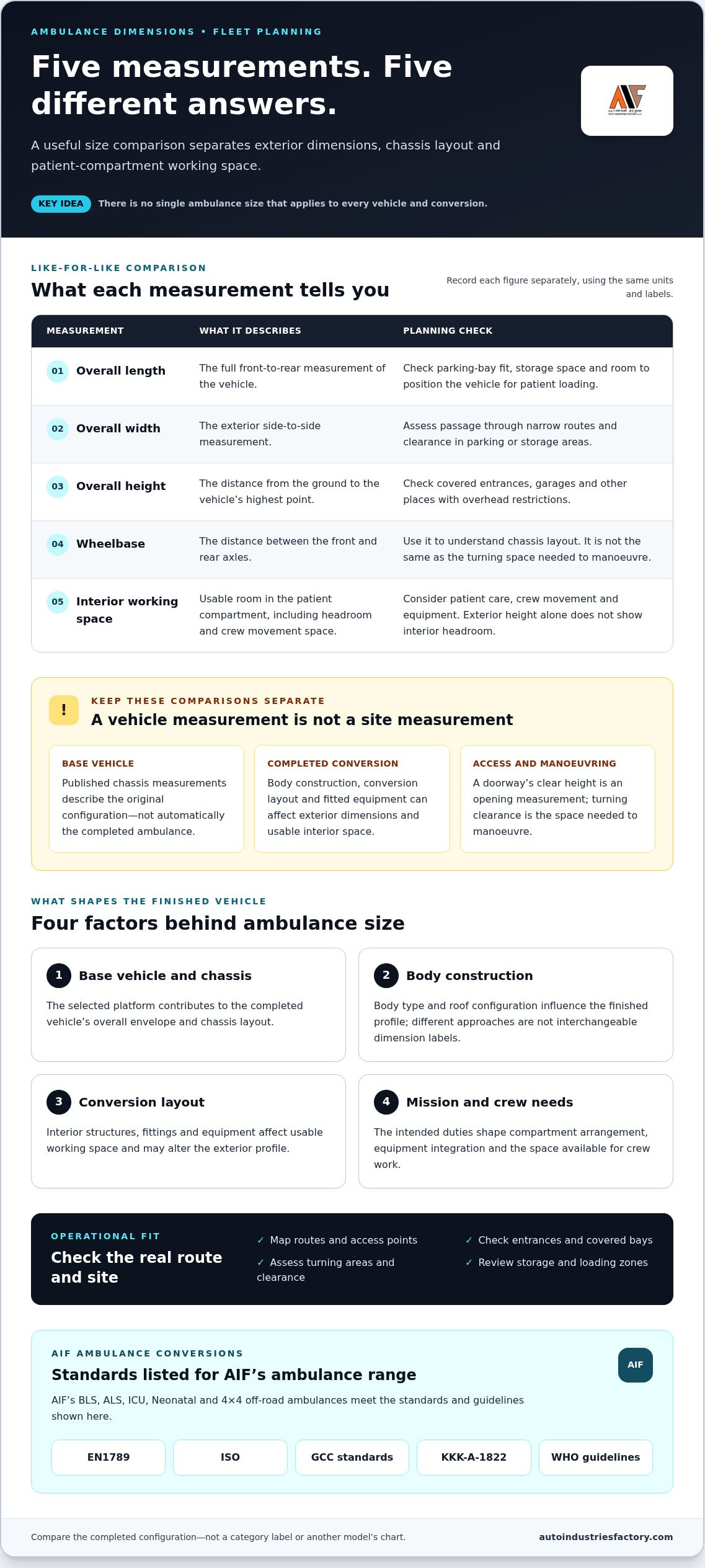
Record these measurements as separate data points, not interchangeable descriptions:
- Overall length: The vehicle’s full front-to-rear measurement. It affects parking-bay fit, storage space, and the room needed to position the vehicle for loading.
- Overall width: The exterior side-to-side measurement. It informs access through narrow passages and the clearance available in parking or storage areas.
- Overall height: The vehicle’s height from the ground to its highest point. It matters at covered entrances, garages, and other places with overhead restrictions.
- Wheelbase: The distance between the front and rear axles. It describes the chassis layout, but it isn’t the same as the turning space needed to manoeuvre.
- Interior working space: The usable room inside the patient compartment, including headroom and space for crew movement and patient care. Exterior height alone doesn’t reveal how much headroom is available inside.
Compare like with like: use the same units and measurement labels, and identify whether a figure describes the base vehicle or the completed conversion. For a general overview of designs and uses, see Ambulance types and their general characteristics.
Why is there no single standard ambulance size?
The chassis, body construction, and conversion layout all influence the finished vehicle. A manufacturer’s model data can be a useful starting point, but it doesn’t automatically represent the converted ambulance’s final length, width, height, or interior headroom. Equipment and the mission-specific layout also affect the usable working area.
Keep vehicle dimensions separate from site-access measurements. A doorway’s clear height is an opening measurement, not the ambulance’s height. Turning clearance describes the space needed to manoeuvre, not a vehicle dimension such as wheelbase. Check the actual route, entrance, bay, and loading zone against the completed vehicle’s data rather than relying on a general rule or another model’s chart. AIF’s ambulance fabrication and conversion solutions are tailored to the vehicle and its intended duties.
What Determines an Ambulance's Final Dimensions?
An ambulance’s completed dimensions reflect three elements working together: the base vehicle, the body construction, and the conversion layout. Each choice affects the vehicle’s exterior envelope and the space available inside. That’s why two ambulances intended for similar duties can still differ in height, length, or usable working area. Assess the completed configuration rather than inferring ambulance size from a chassis name or category label alone.
Roof height and interior headroom are related, but they aren’t the same measurement. Exterior roof height describes how tall the vehicle is outside. Interior headroom describes the usable vertical space within the patient compartment, which can be affected by the roof structure, ceiling finish, and installed equipment. A tall exterior profile doesn’t automatically mean the crew has equivalent clear space inside.
How chassis and body design affect ambulance size
The selected chassis establishes the platform and contributes to the finished vehicle’s overall envelope. Body construction and roof configuration then shape the conversion. A box-type body and an extended-roof conversion, for example, are different construction approaches, not interchangeable dimension labels. Their effects depend on the specific vehicle and completed build, so don’t transfer measurements from one model or configuration to another.
Manufacturer data is useful for understanding the original vehicle, but it may not describe the final ambulance. A conversion can alter the exterior profile and add interior structures or fittings. For an accurate comparison, identify whether each measurement refers to the unconverted chassis, the body, or the fully converted vehicle. Keep the method and units consistent, and distinguish overall exterior height from interior headroom.
How the ambulance mission shapes usable space
The mission influences how the patient compartment is arranged and what must fit inside it. Medical layouts and equipment integration can occupy space or affect where the crew can work, even when the vehicle’s external dimensions remain unchanged. Plan around the intended tasks and movement inside the compartment rather than treating its total volume as fully usable.
- BLS: Layout planning centres on the intended basic life support configuration and its working area.
- ALS: The arrangement must account for the intended advanced life support setup and equipment.
- ICU: A mobile intensive care configuration calls for planning around its specific care and equipment requirements.
- Neonatal: The conversion is organized for neonatal transport needs and the associated working space.
- 4×4 off-road: Planning must account for the selected off-road vehicle configuration and its intended operating environment.
These labels describe mission and configuration, not a guaranteed set of dimensions. AIF’s ambulance fabrication and conversion solutions match the build to its intended duties, supported by in-house fabrication capabilities and a precision-engineered approach.
How to Compare Ambulance Sizes Without Misreading Model Charts
A model chart is useful only when each figure describes a comparable vehicle and measurement. For example, a chassis-only height can’t be compared directly with the finished height of a converted ambulance. Before ranking options, identify the model, conversion configuration, unit, and source behind every measurement.
Comparison rule: “Use the final vehicle specification, not a generic ambulance-size estimate.” This keeps fleet decisions grounded in the vehicle that will actually be operated. If a figure is missing, mark it as unavailable rather than filling the gap with a typical value or an estimate from another model.
Which figures belong in an ambulance comparison table?
Separate exterior vehicle measurements from interior working dimensions and site-clearance needs. Length, width, height, and wheelbase describe the vehicle; interior headroom describes usable space inside. Doorway height and turning clearance describe the operating site, so record them separately instead of presenting them as vehicle specifications.
Comparison template
Length: [value and unit] | Model: [exact model] | Configuration: [conversion] | Source: [document or page]
Width: [value and unit] | Model: [exact model] | Configuration: [conversion] | Source: [document or page]
Height: [value and unit] | Model: [exact model] | Configuration: [conversion] | Source: [document or page]
Wheelbase: [value and unit] | Model: [exact model] | Configuration: [conversion] | Source: [document or page]
Interior headroom: [value and unit] | Model: [exact model] | Configuration: [conversion] | Source: [document or page]
Use one unit system throughout the comparison, or clearly convert and label each value. Preserve the source wording where possible: “overall height” and “interior headroom” aren’t interchangeable. If the source doesn’t state whether a measurement is for the base chassis or completed conversion, flag that limitation rather than treating the figure as final.
How to compare ambulance types and configurations
Compare vehicles by intended duty as well as dimensions. BLS, ALS, ICU, Neonatal, and 4×4 off-road identify different mission configurations, but none guarantees a fixed exterior envelope or identical interior layout across models. The chassis and conversion details still matter. AIF’s ambulance categories meet EN1789, ISO, GCC standards, KKK-A-1822, and WHO guidelines.
- Match the duty: Compare configurations intended for similar operations before judging their dimensions.
- Check the completed build: Don’t treat a chassis specification as the final ambulance measurement.
- Keep evidence with the figure: Record the source and configuration for each value so the comparison remains traceable.
This method exposes gaps that a quick scan of model charts can hide. Two vehicles with the same category label may use different chassis or conversion layouts, so their dimensions may differ. Compare documented specifications rather than assuming category names make vehicles physically identical.
How to Plan Ambulance Size for Routes, Bays, and Daily Operations
A vehicle can suit its mission yet still conflict with a route, entrance, covered bay, storage area, or patient loading zone. Plan around the exact intended vehicle configuration, not a generic ambulance size estimate. A structured review helps fleet teams identify access constraints before selecting or completing a conversion.
What should a fleet measure before selecting an ambulance?
Start with the places the vehicle must reach and occupy. Include routine routes as well as fixed operating sites, and record each measurement with its location, source, unit, and measurement method. Clear opening height is different from a building’s stated doorway height, just as turning space is different from a vehicle’s wheelbase.
- Routes: Note narrow passages, tight turns, ramps, and other access points along regular operating journeys.
- Entrances: Measure the clear width and height of gates, doors, and covered approaches.
- Turning areas: Record the usable manoeuvring space at entrances, yards, and other constrained locations.
- Covered bays and storage: Check the available space where the ambulance will be parked or stored, including overhead clearance.
- Loading zones: Assess the space needed to position the vehicle and access the patient loading area.
Use a repeatable method and keep the original source with each site figure. This makes later reviews clearer, especially when facilities or routes have different limits.
How should teams validate vehicle fit?
Follow this sequence. Each step narrows the decision from operational needs to a fit assessment based on documented dimensions.
- Map operations: Identify regular routes, destinations, parking and storage locations, and patient loading areas.
- Identify constraints: Record access openings, covered parking, ramps, turning areas, and any other fixed site limits.
- Obtain exact vehicle data: Use documented measurements for the intended model and completed conversion. Keep exterior height and body measurements tied to that configuration.
- Check clearances: Compare each vehicle measurement with the corresponding site measurement, using the same units and accounting for how each figure was measured.
Access criteria depend on the specific facility and operating environment, so don’t apply a turning-space figure from another setting as a universal rule. Assess the actual route and site constraints against the vehicle configuration being considered.
Include ambulance standards in the specification review, alongside the exact conversion data used for fit planning. For a build tailored to the mission and operating conditions, explore AIF’s ambulance conversion solutions.
AIF Ambulance Fabrication: Match the Build to the Mission
AIF’s Ambulance Fabrication & Conversions provide a mission-specific vehicle solution. Instead of treating ambulance size as a universal figure, the build considers the intended duty, vehicle configuration, and operating environment together. This connects dimensional planning to how the ambulance will be used, without relying on unsupported assumptions about measurements that vary by vehicle and conversion.
How AIF approaches a mission-specific ambulance build
The starting point is the ambulance’s intended role. AIF’s categories include BLS, ALS, ICU, Neonatal, and 4×4 off-road configurations. Each describes a different mission or vehicle arrangement, not a guaranteed set of exterior dimensions or interior measurements. The chosen configuration informs the conversion plan, while the vehicle and its intended operating conditions remain central to dimensional planning.
These standards and guidelines are part of the specification discussion; they don’t mean every ambulance category has identical dimensions. The relevant measurements belong to the particular vehicle and completed conversion.
In-house capabilities support customized vehicle solutions under one roof, from design through final inspection. CNC laser cutting, bending, welding, machining, and painting form part of AIF’s fabrication capabilities. This integrated process supports precision across the conversion and connects the vehicle configuration to its intended use. AIF’s ambulance fabrication is engineered for safety, reliability, and on-time delivery.
What to prepare for an ambulance conversion discussion
A clear project brief brings mission requirements and physical operating constraints into the same conversation. Prepare the information that will guide the vehicle configuration and specification review:
- Intended duty: Identify the role the ambulance must perform and the category under consideration, such as BLS, ALS, ICU, Neonatal, or 4×4 off-road.
- Operating environment: Describe regular routes and the conditions where the vehicle is expected to operate.
- Access constraints: Record relevant entrance openings, covered parking, turning areas, storage locations, and patient loading spaces.
- Vehicle information: Note the intended base vehicle and any existing documentation, keeping chassis data distinct from completed-conversion specifications.
- Specification priorities: List the measurements and requirements that matter to the fleet, and retain their sources for review.
This preparation gives the conversion discussion a firm operational basis. AIF’s ambulance fabrication and conversion work brings the mission, vehicle configuration, and dimensional planning together. For a precision-engineered build focused on reliability, safety, and on-time delivery, explore AIF’s ambulance conversion services.
Turn Your Fleet Requirements Into a Clear Conversion Plan
Turn operational needs into a concise project brief. Identify the ambulance’s intended role, the vehicle configuration under consideration, and the routes and facilities it must serve. Include site measurements that could affect access, parking, storage, or patient loading. This gives dimensional planning a practical foundation and keeps decisions tied to the vehicle’s actual working environment.
With that brief in hand, you can discuss a conversion built around your fleet’s priorities instead of relying on a generic figure. AIF’s ambulance fabrication brings mission requirements and in-house capability together in a precision-engineered approach focused on safety and reliability.
Ready to define the right ambulance size for your operation? Discuss a mission-specific ambulance conversion and take the next step toward a vehicle planned for its intended duties. A well-prepared brief helps move your fleet toward a confident, fit-for-purpose solution.
Frequently Asked Questions
Are all ambulances the same size?
No, ambulances don’t all share the same dimensions. A van conversion, a box-type body, and an off-road configuration can have different space and access needs. Even two vehicles assigned similar duties may differ because they use different base vehicles or conversion layouts. For fleet planning, treat each completed vehicle as its own case and don’t assume a measurement from one ambulance applies to another.
What are the main dimensions used to describe an ambulance?
The main measurements are overall length, overall width, overall height, wheelbase, and interior headroom. Length and width help assess parking and passage; height matters for overhead access; wheelbase describes the distance between axles. Headroom is an interior measurement. For a useful record, note the measurement unit and whether each figure describes the original vehicle or the completed conversion.
How do ambulance dimensions vary by vehicle model and conversion?
They vary because the base vehicle and conversion can change the completed vehicle’s body, roof profile, and usable interior. A manufacturer’s chassis data alone may not reflect the ambulance after conversion. Compare the exact completed configuration, and retain the source with each figure. AIF’s BLS, ALS, ICU, Neonatal, and 4×4 off-road ambulances meet EN1789, ISO, GCC standards, KKK-A-1822, and WHO guidelines; this doesn’t make every configuration dimensionally identical.
Can an ambulance fit in a standard garage or covered parking bay?
It depends on the specific ambulance and the clear space available at the site. A bay’s advertised size may not account for a low beam, sloped approach, door hardware, or room needed to enter and park. Measure the usable opening and interior clearance, then compare them with documented data for the completed vehicle. Include the actual approach and manoeuvring area, not just the parking space.
Does ambulance height include roof-mounted equipment?
Not necessarily. A height figure may describe the vehicle body alone or the vehicle with equipment fitted, depending on how the source defines it. Don’t assume roof-mounted equipment is included. For overhead-access planning, use a documented height that identifies the configuration and its highest point, including installed items. Compare that figure with the lowest obstruction on the route or at the parking location.
What is the difference between ambulance exterior dimensions and interior working space?
Exterior dimensions describe the vehicle’s outer boundaries; interior working space is the usable area within the patient compartment. Interior fittings and equipment can affect how much room is available for crew movement and patient care. For example, a vehicle’s exterior height doesn’t tell you the clear headroom beneath its finished ceiling. Review interior layout information separately from body measurements when assessing operational suitability.
Do BLS, ALS, ICU, Neonatal, and 4×4 ambulances have different size requirements?
Their intended duties can call for different layouts and equipment arrangements, but category names alone don’t provide a fixed dimension set. Compare the actual vehicle configuration and its documented measurements rather than assuming two ambulances in one category will match.


