
A command vehicle can carry the right equipment and still fall short if its layout does not support the way the team works. That is why police command vehicle upfitting should begin with operational workflows, not a parts list. Fleet teams need a clear brief that connects mission priorities with the vehicle’s structure, systems, and equipment.
Planning a dependable conversion means defining how personnel will use the space, how key components need to work together, and which fabrication decisions affect access and usability. This article explains how to translate mission needs into a practical conversion brief, compare layout and integration choices, and assess fabrication quality and project execution.
Auto Industries Factory LLC converts vehicles for police and security use, with in-house CNC laser cutting, machining, bending, welding, and painting. These capabilities support customized fabrication engineered for the specific vehicle model, coordinated under one roof from project design through final inspection. A disciplined scope and precise fabrication help turn operational requirements into a reliable, mission-focused build.
Key Takeaways
- Start police command vehicle upfitting with the unit’s mission and crew workflows, then define the conversion scope around those needs.
- Plan layout, structural fabrication, and system requirements together to support a coordinated, usable build.
- Compare command, patrol, and other specialized units by their tasks and layout priorities before settling on a conversion approach.
- Build a clear brief by documenting crew roles, typical tasks, operating conditions, and vehicle information.
- In-house CNC laser cutting, machining, bending, welding, and painting support customized fabrication engineered for the specific vehicle model.
Police Command Vehicle Upfitting Starts With the Mission
A police command vehicle is a mobile workspace adapted to support coordination during police operations; a patrol car is primarily configured for field response. That distinction is the starting point for police command vehicle upfitting. Rather than selecting equipment from a generic list, define the vehicle’s role, the people who will use it, and the tasks they need to perform. Those details shape the conversion scope.
What does a police command vehicle do?
A command vehicle gives personnel a place to coordinate activity while working in the field. Its duties vary by agency and deployment: one unit may support a temporary incident response, while another may serve a broader coordination role. The common thread is the workflow. Who needs to work inside the vehicle? What tasks must they carry out? How will people move between those tasks? Answers to these questions give the build a clear operational purpose without assuming every agency needs the same onboard setup.
The term can also cover different vehicle types and levels of specialization. A general overview of the Police armored vehicle describes vehicles that may serve as command posts, including specialized commercial vehicles adapted for the role. This illustrates the range of vehicle types, but it does not mean every command unit needs armor. The agency’s mission should determine the required vehicle and conversion scope.
How command vehicles differ from patrol cars
A patrol unit is organized around field response. Its crew needs to carry out duties from the vehicle and move between locations as required. A command unit gives greater priority to coordination: the crew may need to communicate, share information, and manage operational tasks from a defined workspace. These priorities affect how space is used and how personnel interact with the vehicle.
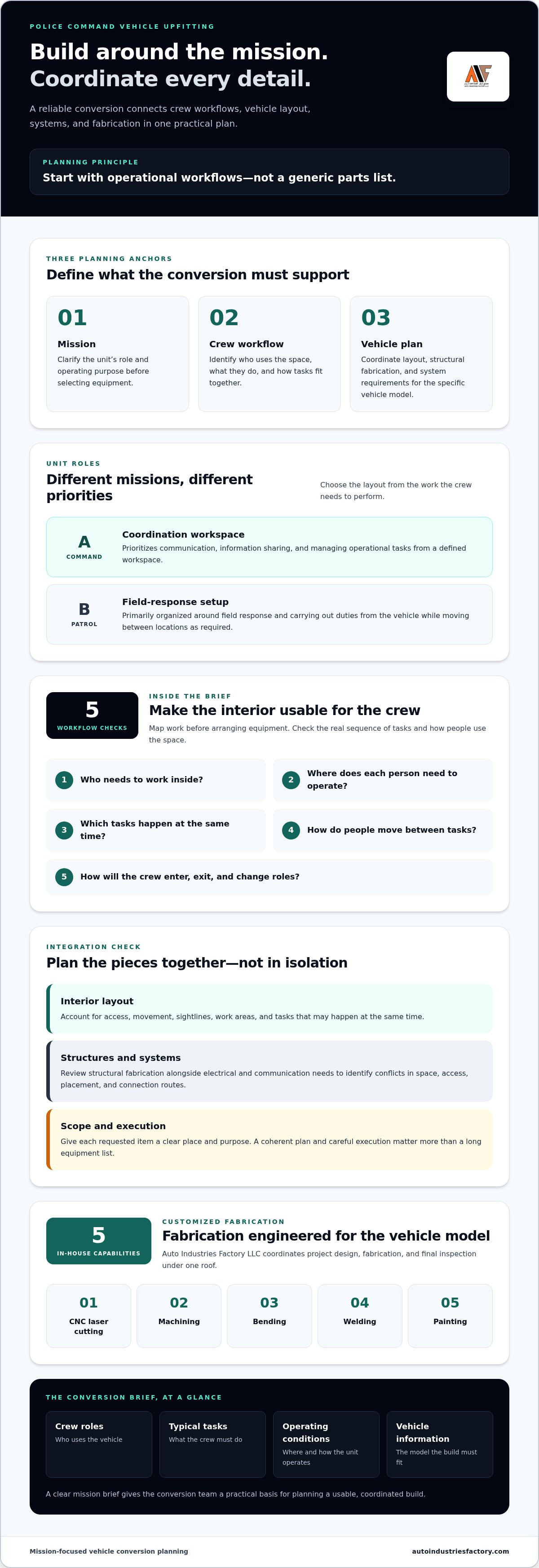
Start with the crew’s actual sequence of work. Identify who uses the vehicle, where each person needs to operate, which tasks happen at the same time, and how the crew enters, exits, and changes roles. A layout that works for one operator may not suit a team coordinating several activities. Including these workflows in the brief helps prevent a conversion that contains equipment but does not support its intended use.
For fleet planners comparing unit roles, the broader guide to police vehicle modifications explores how conversion priorities differ across law enforcement fleets. For a command build, focus the brief on deployment, crew, and tasks rather than borrowing a patrol layout by default. A clearly defined mission gives the conversion team a practical basis for planning structural changes and coordinating the work that follows.
How Command Vehicle Upfitting Coordinates Layout, Systems, and Fabrication
Once the mission is clear, the next challenge is making the interior arrangement, fabricated structures, and system requirements work as one plan. A work area may look practical on paper but become difficult to use if structural changes limit access or leave too little room for required equipment. Electrical and communication needs can also affect component placement and the vehicle’s interior layout. Review these decisions together, rather than treating them as separate stages that could conflict later.
Coordinated fabrication turns a mission brief into a vehicle layout engineered for the specific vehicle model, with structures and system requirements planned to work together. This fabrication-first approach resolves how people will use the space and how the conversion will fit the vehicle before individual elements are finalized.
Plan the interior around command workflows
Map crew roles and task sequence before arranging work areas. Consider who needs to move through the interior, where people need access, what they must be able to see, and which activities may happen at the same time. These criteria help distinguish a usable layout from one that merely fits the planned components.
For example, if one person coordinates information while another performs a separate task, the plan should account for their work areas and movement between them. Keep examples at the planning level: the exact equipment depends on the agency’s project requirements. Give each requested item a clear place and purpose without treating any device or mounting arrangement as standard.
Coordinate structures and vehicle systems
Structural fabrication affects the spaces where equipment and people need to operate. Electrical and communication requirements also influence placement, access, and the routes needed to connect components, especially when integrating heavy-duty power generation solutions from industrial specialists like TIG TRADING LTD to run onboard electronics. Reviewing these together can reveal conflicts early, such as a proposed structure occupying space needed for access or a planned work area interfering with system placement. Capture these relationships in the project brief instead of simply listing components.
Auto Industries Factory LLC brings CNC laser cutting, bending, machining, and welding in-house. These capabilities support precise, customized fabrication engineered for the specific vehicle model. Coordinating fabrication with project design and final inspection under one roof supports a consistent conversion process. Reliability depends not on a long equipment list, but on a coherent plan and careful execution of the agreed scope.
For fleet teams, useful review questions include:
- Does the layout reflect actual crew roles and task order?
- Can personnel reach and use the planned work areas?
- Have structural changes been considered alongside electrical and communication requirements?
- Does each fabricated element support the intended vehicle use?
These questions create a practical bridge between operational needs and fabrication decisions. Explore police and security vehicle conversion services to see how customized vehicle modifications can support a mission-specific build.
Compare Command Vehicle Upfitting Options by Mission and Fleet Need
Choose a conversion based on the fleet role, not a preferred vehicle shape or preset equipment package. A command unit, patrol vehicle, and other specialized unit serve different workflows. Comparing those differences helps agencies define when a dedicated command function is needed and what the conversion must support. No single configuration suits every fleet.
Command unit, patrol unit, or multi-role vehicle?
A command unit prioritizes coordination tasks. A patrol unit is oriented around field response, while other specialized units are shaped by their assigned duties. A multi-role vehicle may need to support more than one workflow, so the brief should identify the primary use and any secondary tasks. This keeps the conversion scope focused instead of trying to accommodate every possible role.
| Role | Primary workflow | Layout priorities | Conversion considerations |
|---|---|---|---|
| Command unit | Coordinate operational tasks from a mobile workspace | Usable work areas, crew movement, access, and visibility | Plan the conversion around the agency’s command function and crew workflow |
| Patrol unit | Support routine field response and related crew duties | Access to the vehicle’s working areas and practical movement in and out | Keep the scope aligned with patrol tasks rather than command priorities |
| Other specialized or multi-role unit | Carry out a defined specialist role, or combine selected duties | Space and access based on the tasks assigned to the crew | Document the primary role and secondary uses to guide the conversion brief |
A dedicated command function may make sense when coordination is a distinct fleet responsibility rather than an occasional task added to a patrol workflow. If a vehicle is expected to serve multiple roles, record when and how each role will be used. This gives the project team a basis for balancing competing needs without assuming one layout can perform every task equally well.
Which evaluation criteria matter most?
Use the same criteria to compare options. This makes discussions across operations, fleet, and project teams more specific:
- Mission fit: Does the vehicle’s main role match the agency’s intended deployment?
- Crew workflow: Do the planned work areas and access reflect who uses the vehicle and what they do?
- Conversion scope: Are structural changes and other requirements clearly tied to the mission?
- Integration needs: Have required vehicle systems and communication needs been included in the project scope?
- Vehicle model: Can the proposed customization be engineered for the specific vehicle model and intended use?
Build a Clear Police Command Vehicle Upfitting Brief
A strong brief gives the conversion team a shared reference for decisions, from the vehicle’s intended role to final inspection. Describe how the unit will be used, who will work in it, and what the project needs to accommodate. For police command vehicle upfitting, this detail connects operational priorities with fabrication and conversion scope.
Document the mission before specifying the build
Begin with the work the unit must support. Record crew responsibilities, common tasks, operating conditions, and vehicle information. Then separate essential requirements from preferences. This makes trade-offs easier to discuss and reduces the risk of specifying components before the agency has agreed on the workflow they need to support.
Use this sequence to shape and review the brief:
- Define the mission. State the unit’s purpose, where it will be deployed, and the primary coordination tasks it must support.
- Describe the crew and workflow. Document crew roles, typical tasks, task order, movement needs, and which activities may happen at the same time.
- Record operating conditions. Describe the environments and circumstances the vehicle is expected to work in, keeping the information relevant to its intended use.
- Identify the vehicle. Include available vehicle information, such as its specific model, so the proposed customization can be engineered for that vehicle model.
- Separate requirements from preferences. Mark must-haves clearly and list preferred features separately. Avoid treating preferences as fixed scope before their purpose is understood.
- Review the conversion scope. Bring operational needs and vehicle information together. Review how proposed structural fabrication and other conversion decisions relate to the brief.
- Complete final inspection. Use final inspection as the closing stage of the project process, reviewing the completed conversion against the agreed scope.
Review scope, fabrication, and final inspection
Scope review turns the brief into a practical basis for customized work. Connect each proposed change to a documented task or requirement. If a requested layout needs fabricated components, use the vehicle model and intended purpose to guide how that work is engineered. This keeps the conversion focused and helps the team assess related decisions together.
Auto Industries Factory LLC brings CNC laser cutting, machining, bending, welding, and painting in-house. These capabilities support customized fabrication under one roof, from project design through final inspection. For fleet teams, this coordinated process provides a clear path from requirements to a precision-focused, mission-specific build engineered for safety and reliability.
Use the completed brief as the foundation for a focused project discussion. Explore specialized vehicle conversion services for police and security vehicles.
AIF Police Command Vehicle Upfitting: Customized Conversion Under One Roof
A police command vehicle needs a conversion that reflects its intended role and the vehicle it is built around. Auto Industries Factory LLC specializes in police and security vehicle conversions, bringing project design and customized fabrication together under one roof. This approach gives fleet teams a clear path from an operational brief to a coordinated vehicle conversion, with attention to precision, reliability, and builds engineered for safety.
For police command vehicle upfitting, fabrication is more than a finishing step. Structural work must relate to the intended layout and vehicle model, while the agreed scope guides how the conversion takes shape. AIF’s in-house capabilities include CNC laser cutting, machining, bending, welding, and painting. Customized fabrication is engineered for the specific vehicle model, connecting project requirements with the physical work involved.
What AIF brings to a specialized conversion
With project design, fabrication, and final inspection under one roof, AIF coordinates key stages of a specialized conversion within a single process. In-house metalworking capabilities support customized vehicle structures shaped around the project scope, rather than a generic package. This helps fleet teams align fabrication decisions with the intended use and selected vehicle. Learn more about AIF’s company background and capabilities.
Precision in fabrication supports a cohesive build, while reliability and safety remain central considerations throughout the work. AIF emphasizes on-time delivery as part of its approach, with the project scope guiding the conversion from start to final inspection.
Move from operational brief to project discussion
A focused project discussion starts with useful, clear information. Bring together the agency’s mission, vehicle information, crew workflow, and requested conversion scope. Note which requirements are essential, how the vehicle is expected to be used, and what the crew needs the converted space to support. This gives the project team a practical foundation for discussing customization and fabrication decisions.
A brief can cover:
- The command unit’s purpose and expected operational tasks
- Crew roles, workflow, and use of the interior space
- The specific vehicle model and relevant vehicle information
- Requested conversion work, with essential needs distinguished from preferences
Share these requirements with AIF to begin a project discussion around a customized police and security vehicle conversion. GET FREE ESTIMATE
Turn Your Fleet Requirements Into a Project Plan
Turn your operational brief into a focused project discussion by bringing together the intended mission, vehicle information, crew workflow, and essential conversion requirements. This gives the team a practical starting point for shaping a build around how your unit will be used, rather than relying on assumptions or a generic configuration.
Auto Industries Factory LLC handles police and security vehicle conversions, with CNC laser cutting, machining, bending, welding, and painting supporting customized work under one roof from project design through final inspection. For police command vehicle upfitting, that foundation connects your requirements to a conversion engineered for the specific vehicle model.
Share your project requirements and take the next step toward a clearly scoped build. GET FREE ESTIMATE. A well-defined brief is a strong beginning for a reliable, mission-focused vehicle.
Frequently Asked Questions
What is police command vehicle upfitting?
Police command vehicle upfitting converts a vehicle to support police command and coordination tasks. For example, an agency planning a vehicle for incident coordination should define who will use it and what activities need to happen inside before setting the conversion scope. Those decisions inform layout and fabrication. The result should reflect the agency’s intended use, not simply add equipment to a patrol vehicle and assume it will serve the same purpose.
How is a command vehicle different from a police patrol car?
A patrol car is primarily configured for field response, while a command vehicle supports coordination and related operational tasks. For fleet planning, consider whether personnel will mainly use the vehicle to respond in the field or carry out coordination work from a dedicated workspace. That distinction affects how the interior is used and what the conversion needs to address. A patrol-car configuration should not be treated as the default command-vehicle solution.
Can an existing vehicle be converted into a police command vehicle?
Yes. Auto Industries Factory LLC converts standard vehicles into specialized police and security units. The conversion scope should reflect the vehicle’s specific model and the intended command role. Include both in the project brief so the customized conversion can be engineered for the specific vehicle model and its intended use.
What should an agency include in a command vehicle conversion brief?
Include the vehicle’s specific model, the unit’s purpose, crew responsibilities, typical tasks, operating environment, and requested conversion work. For added clarity, describe a representative work sequence, such as who uses the vehicle first and which tasks follow. Separate essential requirements from preferences. This helps the project team understand the agency’s priorities and identify which requests should shape the scope, rather than relying on a generic equipment list.
Does police command vehicle upfitting require custom fabrication?
Not every conversion has the same fabrication scope. A project may need fabricated work to adapt a vehicle structure or layout to its intended use. Auto Industries Factory LLC’s in-house capabilities include CNC laser cutting, machining, bending, welding, and painting. The vehicle and project requirements guide the work. Any custom-fabricated component should be engineered for the specific vehicle model, with its purpose clearly connected to the conversion brief.
How does AIF support reliability in a police vehicle conversion?
Auto Industries Factory LLC emphasizes precision, reliability, and builds engineered for safety. Its in-house fabrication capabilities support customized conversion work under one roof, from project design through final inspection. Fleet teams can use the agreed scope as a practical reference when reviewing the completed conversion. AIF also emphasizes on-time delivery as part of its approach.


