

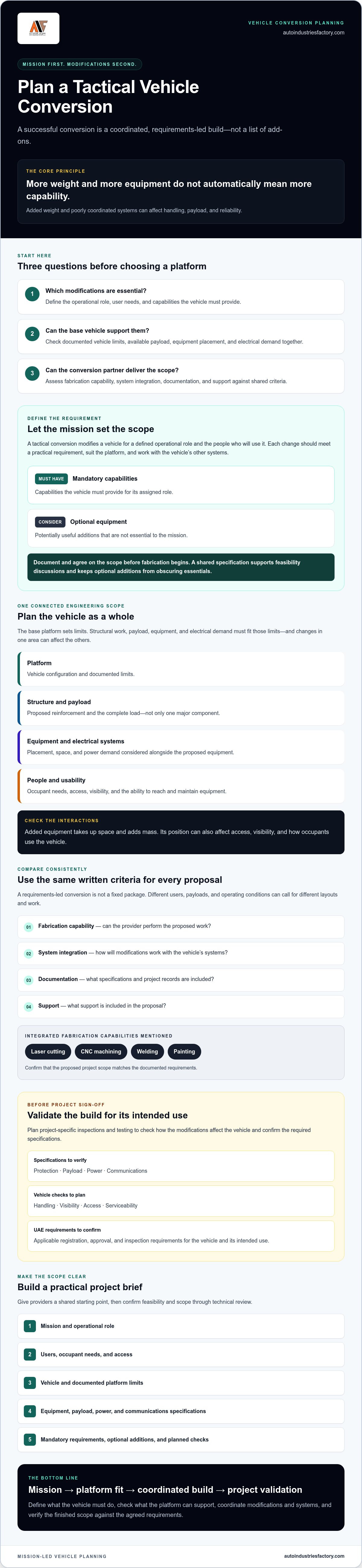
A heavier vehicle with more equipment isn’t automatically a more capable one. Added weight and poorly coordinated systems can affect handling, payload, and reliability. A successful tactical vehicle conversion starts with the mission, not an add-on list.
If you’re planning to turn a standard vehicle into a tactical platform, start by asking three questions: Which modifications are essential? Can the base vehicle support them? How will you assess a conversion partner’s fabrication capability? This guide explains how to define requirements before choosing a platform, account for its limits, and coordinate structural work, equipment, electrical systems, and usability.
You’ll also learn what to verify during project validation, including specifications for protection, payload, power, and communications, as well as applicable UAE registration, approval, and inspection requirements for the vehicle and its intended use. Finally, we’ll cover how integrated capabilities such as laser cutting, CNC machining, welding, and painting can support a coordinated conversion scope, and what to include in a clear project brief.
Key Takeaways
- Define the vehicle’s operational role and user needs before considering modifications. Let mission requirements guide the scope.
- Assess platform limits, payload, equipment placement, and electrical demands together when planning a tactical vehicle conversion.
- Compare provider proposals against the same written criteria, including fabrication capability, system integration, documentation, and support.
- Plan project-specific inspections and testing to check how modifications affect handling, visibility, access, and serviceability.
- Prepare a clear brief covering the mission, vehicle, equipment, and required specifications, then confirm feasibility and scope through technical review.
What Does Tactical Vehicle Conversion Involve, and What Should It Achieve?
A tactical vehicle conversion modifies a vehicle for a defined operational role and the needs of the people who will use it. The aim isn’t to make a vehicle look more rugged or add equipment simply because it’s available. Each change should meet a practical requirement, suit the platform, and work with the vehicle’s other systems.
“Tactical vehicle conversion is the structured modification of a vehicle to meet documented user, payload, operating, and mission-equipment requirements.” Those requirements determine what the vehicle must carry, how it will be used, and which onboard systems it must accommodate. For context on purpose-built military vehicle types and their original roles, see this overview of the Armoured Fighting Vehicle (AFV).
A visual example can help illustrate how a purpose-built platform may differ from a standard vehicle:
Which operational requirements should guide the conversion?
Start with the vehicle’s users and expected duty cycle. Record where it will operate, the terrain and conditions it must handle, the payload it needs to carry, and the onboard systems essential to its role. Include occupant needs and access, along with how users will reach and maintain equipment during routine operation.
Before requesting proposals, separate requirements into two groups:
- Mandatory: capabilities the vehicle must provide for its assigned role.
- Optional: equipment that may be useful but isn’t essential to the mission.
Document and agree on this scope before fabrication begins. A shared specification gives the buyer and conversion provider a consistent basis for discussing feasibility, trade-offs, and proposed work. It also keeps optional additions from obscuring essential requirements.
How does a tactical conversion differ from a general military modification?
A tactical conversion is a requirements-led project, not a fixed package. Similar vehicles may need different equipment, layouts, or structural work because their users, payloads, and operating conditions differ. For each proposed change, ask which requirement it serves and how it affects the rest of the vehicle. Detailed weapon, security, and operational-tactics planning is outside the scope of this vehicle-planning discussion.
Buyers comparing police-focused requirements can also review the guide to police vehicle modifications. Police and military vehicle work may involve coordinated fabrication and system installation. Auto Industries Factory LLC lists in-house laser cutting, CNC machining, welding, and painting capabilities. Confirm that the proposed project scope matches your documented requirements.
How Do Platform, Structure, and Systems Shape a Tactical Conversion?
A vehicle conversion is a connected engineering scope. The base platform sets limits, and structural work, added payload, equipment, and electrical demand must fit within them. Changes in one area can affect others. For example, added equipment takes up space and adds mass, while its position can affect access, visibility, and how occupants use the vehicle.
“Platform suitability depends on the intended use and verified vehicle limits, not on the vehicle’s reputation or appearance.” The U.S. Army’s discussion of a dual approach to replacing the Humvee illustrates how platform choices can reflect different mission and procurement needs, rather than a single universal answer. Read its perspective on cost-effective tactical vehicle programs.
How should buyers assess a base vehicle and its payload?
Ask the conversion partner to check the base vehicle’s specifications and available payload against the proposed build. Consider the complete load, not just the weight of one major component:
- Platform: vehicle configuration and documented limits.
- Structure: proposed reinforcement or other physical modifications.
- Payload: occupants, carried equipment, and conversion components together.
- Equipment: size, location, access, and mounting needs.
- Electrical systems: power requirements and integration with onboard systems.
Don’t choose a base vehicle based on category alone. A platform that appears suitable may not have verified capacity for the planned combination of people, equipment, and modifications. Confirm project-specific payload and protection specifications before agreeing on the scope.
How are structural, electrical, and communication needs coordinated?
Plan reinforcement, storage, electrical systems, and communications as one integrated layout. Equipment placement should support user workflow and allow practical access for inspection, maintenance, and routine operation. A component may fit physically but still cause access or serviceability problems if it conflicts with another system.
Fabrication capability matters because coordinated work connects the specification to the physical build. Laser cutting and CNC machining can prepare components; welding supports assembly, and painting can form part of the fabrication scope. These processes need to align with the vehicle’s structure and planned system installation. Auto Industries Factory LLC lists these in-house capabilities alongside structural reinforcement, armouring, and electrical and communication system installation. To review its relevant vehicle conversion services, compare the listed scope with your project requirements.
Keep the review specific to the vehicle and its intended use. Before fabrication begins, confirm how proposed changes affect load, placement, access, and system compatibility.
How Can Buyers Compare Tactical Vehicle Conversion Options?
Compare proposals against the same written requirements, not headline claims such as “complete package” or “mission-ready.” Those phrases don’t explain what work is included, what remains unconfirmed, or how the proposed modifications fit the vehicle. Reviewing proposals side by side can reveal gaps before they lead to scope disagreements.
Use the same comparison framework for each provider. Ask them to respond to the same scope and identify which statements are confirmed, assumed, or subject to technical review.
| Compare | What to check in each proposal |
|---|---|
| Scope | Which modifications, materials, systems, and project interfaces are included? What is excluded? |
| Fabrication capability | Which relevant cutting, machining, welding, and finishing work is handled within the proposed scope? |
| System integration | How will structural work, equipment, electrical systems, and communications be coordinated? |
| Documentation | What vehicle data, specifications, approvals, or customer-supplied equipment are still needed? |
| Support and open items | What follow-up or handover information is defined, and which details need confirmation? |
What should a conversion proposal clearly specify?
Request a documented scope that names the proposed modifications, systems, materials, and interfaces with the base vehicle or supplied equipment. The proposal should identify what information is needed from you, including vehicle data and details of customer-supplied components. It should also state exclusions, assumptions, and items that require technical review. Clear boundaries make proposals easier to compare and refine.
For example, listing electrical system installation doesn’t confirm that a particular device, power demand, or vehicle interface has been assessed. Treat unverified details as open questions, not included capabilities. Separately confirm the applicable UAE registration, approval, and inspection requirements for the specific vehicle and intended use.
How can buyers assess an integrated fabrication partner?
Ask how the provider coordinates each relevant stage, from cutting and machining through welding, finishing, and installation. Confirm which capabilities apply to your proposed scope and how handoffs between fabrication and system integration are managed. In-house laser cutting, CNC machining, welding, and painting can support coordination, but the proposal should still specify what is included in your project.
Auto Industries Factory LLC lists police and military vehicle modifications alongside these fabrication capabilities. Review its specialized vehicle conversion services against your requirements, then ask for clarification on project-specific scope and open items. Track questions through to resolution so assumptions don’t quietly become expectations.
How Can a Tactical Vehicle Conversion Address Safety and Reliability Concerns?
Added equipment can change vehicle behavior and how people use the vehicle. Its weight and position may affect balance, handling, visibility, access, and the payload available for occupants or other equipment. Installation can also make routine servicing harder if components block inspection points or connections. Consider these effects together, rather than assessing each add-on in isolation.
“A stated design goal describes intent; it is not proof of independently verified vehicle performance.” Ask what has been inspected or tested, what evidence is available, and which results apply to the completed vehicle and its intended configuration. Plan project-specific inspections and testing. Don’t assume one universal certification covers every conversion.
What should be checked before a converted vehicle enters service?
Use the agreed scope as an inspection checklist. Confirm that specified equipment is present, installations are complete, and relevant electrical and communication systems operate as intended. Check practical user access, visibility, and access to vehicle controls and service points. Review the vehicle documentation and any project-specific inspection or test evidence provided.
Keep unresolved questions visible. Ask the conversion provider to identify open items rather than treating them as completed checks. Verify applicable registration, approval, and inspection requirements for the specific vehicle and intended use with the competent UAE authorities or qualified local advisers.
How can conversion planning protect long-term serviceability?
Reliability depends on more than the initial installation. Consider whether technicians can reach routine inspection points, whether components can be replaced without disturbing unrelated systems, and how the vehicle’s maintenance routines may change. If equipment could be updated later, clarify which access or interfaces the planned layout preserves.
- Access: Can service points and installed systems be reached for inspection?
- Replacement: Are components positioned so they can be removed or changed practically?
- Routine care: Have changes to servicing access or procedures been identified?
- Future changes: Is there a documented process for reviewing new equipment against the existing configuration?
Discuss these questions during scope review and record agreed answers in project documentation. Auto Industries Factory LLC describes vehicle conversion work alongside fabrication capabilities. To learn more about its background, review vehicle fabrication capabilities and company background as part of your provider assessment.
How Do You Prepare a Tactical Vehicle Conversion Brief and Choose a Partner?
A focused brief gives a conversion partner enough information to identify questions, assess the requested scope, and explain what needs further review. It doesn’t confirm feasibility, schedule, or final scope. Those depend on technical review of the vehicle, requirements, and project interfaces.
What information belongs in a first conversion brief?
Prepare the brief in a sequence that moves from purpose to practical constraints:
- Describe the intended use: State the vehicle’s role and who will use it. Keep the description focused on vehicle requirements.
- Identify the vehicle: Provide make, model, year, configuration, and available vehicle documentation.
- Describe users and conditions: Note occupant needs, duty cycle, operating conditions, and terrain relevant to the project.
- List payload information: Share known vehicle limits and the expected occupants, equipment, and conversion components.
- Specify onboard systems: Identify required systems, customer-supplied equipment, and known installation or interface details.
- Record delivery and compliance questions: State preferred completion requirements, and list registration, approval, documentation, and inspection matters that need confirmation.
Separate mandatory needs from preferences. If information is unknown, mark it as unconfirmed rather than guessing. This helps the provider distinguish firm requirements from details that need technical review.
What should buyers ask a prospective conversion partner?
Ask which fabrication and integration capabilities fit the requested work, and who is responsible for each project interface. Auto Industries Factory LLC lists police and military vehicle modifications, with in-house laser cutting, CNC machining, welding, and painting. Its stated conversion capabilities also include reinforcement, armouring, and installation of electrical and communication systems. Confirm which capabilities apply to your project rather than assuming they are all included.
Request clear answers about assumptions, exclusions, review stages, required customer information, and equipment supplied by your team. Ask how unresolved payload, protection, electrical, communications, and UAE approval questions will be identified and addressed. For further context on military vehicle modifications, review the company’s service information.
A sound partner discussion starts with defined requirements, not a promise made before the vehicle and scope have been reviewed. Share your project brief with Auto Industries Factory LLC to discuss whether its conversion and fabrication capabilities align with the work you’re planning.
Move from Mission Requirements to a Defined Project
A sound tactical vehicle conversion starts with a clear operational brief, then matches the proposed work to the vehicle’s verified limits. Compare providers against the same requirements, and confirm how structure, equipment, electrical systems, and user access fit together. Before the vehicle enters service, define project-specific checks and verify applicable UAE registration, approval, and inspection requirements.
Fabrication capability matters when these elements need to work as one build. Auto Industries Factory LLC lists in-house laser cutting, CNC machining, welding, and painting, alongside specialized vehicle conversion work that includes structural reinforcement and systems installation. Confirm which capabilities apply to your project and what still needs technical review.
Ready to turn your requirements into a project brief? Discuss your tactical vehicle conversion requirements with Auto Industries Factory LLC. A clear starting point helps make the next steps practical, informed, and focused on the vehicle’s intended role.
Frequently Asked Questions
What is tactical vehicle conversion?
Tactical vehicle conversion is the modification of a vehicle to meet a defined operational role and user requirements. Depending on the project, work may involve structural changes, storage, equipment installation, and electrical or communication systems. It isn’t a standard package: the vehicle, payload, occupants, operating conditions, and required systems all shape the scope. A clear brief helps distinguish essential capabilities from optional additions.
Which vehicles can be converted for tactical use?
Different vehicle types may be candidates, but suitability depends on the intended use and the specific vehicle’s verified limits. A conversion partner should review the vehicle’s configuration, payload capacity, available space, and compatibility with proposed modifications and equipment. Don’t select a platform based on appearance or a general category alone. Confirm that it can accommodate the intended occupants, equipment, and conversion work before finalizing the project scope.
How is tactical vehicle conversion different from armouring?
Armouring focuses on adding protective materials or components to a vehicle. Tactical vehicle conversion is broader: it modifies a vehicle around an operational role, which may or may not include armouring. Depending on documented requirements, a conversion could involve structural reinforcement, equipment or storage installation, and electrical or communication systems. Specify and review protection requirements for the particular vehicle and project rather than assuming them from the term “tactical.”
What should I consider before converting a vehicle for a specific mission?
Define the users, intended role, duty cycle, terrain, occupants, payload, and essential onboard systems first. Record known vehicle limits and identify customer-supplied equipment, mandatory capabilities, and optional items separately. Consider how equipment placement affects access, visibility, usability, and servicing. Also list documentation, inspection, registration, and approval questions that require confirmation for the vehicle’s intended use in the UAE. Use these requirements to evaluate platform suitability and provider proposals.
Can a converted tactical vehicle remain road legal?
Possibly, but road legality can’t be assumed from the conversion scope alone. Requirements may depend on the specific vehicle, modifications, and intended use. Before work proceeds, ask which registration, approval, and inspection questions apply, then verify them with the competent UAE authorities or a qualified local adviser. Request relevant vehicle and conversion documentation, and resolve open compliance questions before using the vehicle on public roads.
How is safety checked after a tactical vehicle conversion?
Use a project-specific inspection and testing plan based on the agreed scope. Checks can cover whether specified equipment is installed, systems operate as intended, and users can reach controls and equipment. Review how added mass and equipment placement affect payload, visibility, handling, and service access. Ask what evidence is recorded and which items remain unresolved. A stated safety goal isn’t the same as independently verified performance or universal certification.
How long does a tactical vehicle conversion take?
There isn’t a reliable timeframe without reviewing the vehicle and project scope. Duration can depend on the required structural work, fabrication, equipment and system integration, availability of vehicle data, and any inspection or approval steps that need confirmation. Ask the provider to assess these factors before discussing a schedule, and clarify which customer decisions or supplied components affect planning. Treat any early estimate as provisional until technical review confirms the scope.


