

A matching set of headline measurements can still describe two very different APCs. Length, width and height answer the first question, but apc dimensions alone do not show how much usable interior space remains, what payload the vehicle can carry or how installed equipment changes its profile.
A useful comparison starts with the exact model and configuration, not just figures in a specification table. This guide explains which measurements matter, why they vary between variants and equipment setups, and how to compare them without treating unlike vehicles as equivalent. It also shows how to turn dimensional data into a practical project brief covering clearances, interior needs, payload and equipment fit. For police and military vehicle modifications or troop-carrier planning, that clarity helps connect vehicle requirements with conversion and fabrication work, including laser cutting, CNC machining and welding.
Key Takeaways
- Read apc dimensions as measurements tied to a specific vehicle variant and configuration, not as one universal size.
- Look beyond length, width and height to assess how the vehicle’s measurements affect fit, access and intended use.
- Compare specifications using the same units and measurement definitions, with matching equipment and production configurations.
- Validate figures against manufacturer documentation or authoritative technical records, and record the source for each measurement.
- Turn verified measurements into a practical conversion brief that defines the vehicle role, interior needs, equipment and acceptable external envelope.
What Do APC Dimensions Mean, and Why Do They Vary?
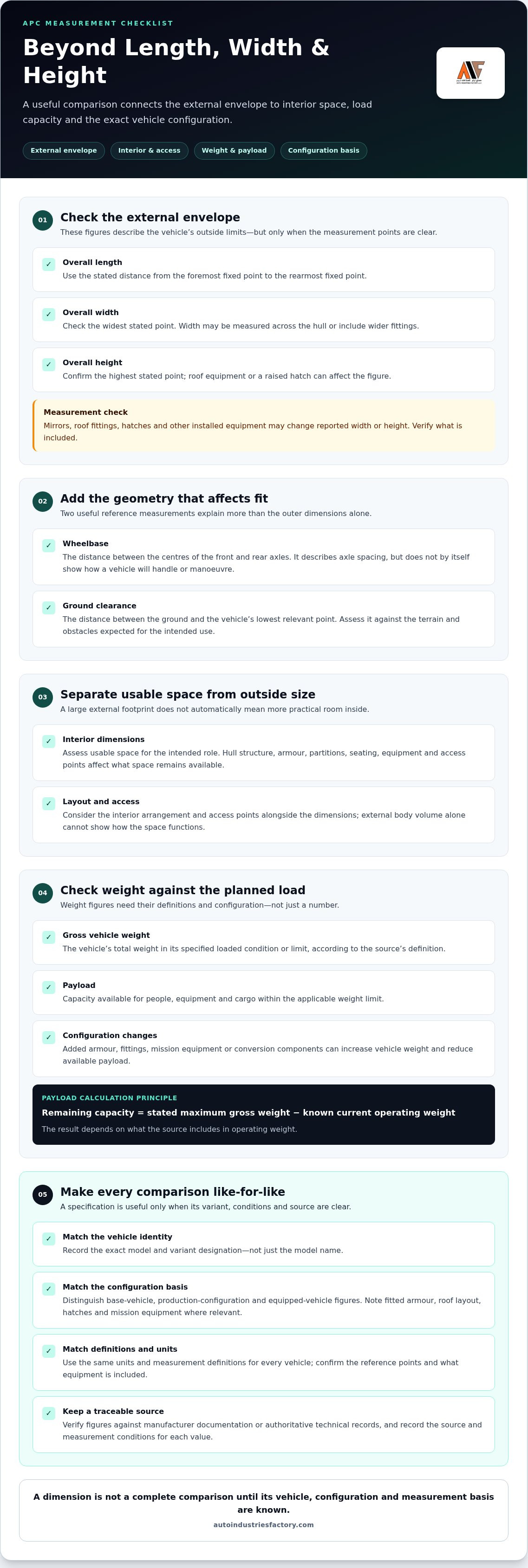
APC dimensions are a set of measurements for a specific armoured personnel carrier variant and configuration, not one universal size. Overall length, width and height describe the vehicle’s external envelope. Ground clearance, wheelbase and interior measurements help explain how it may fit and function. Figures can change with the model, variant, armour, roof layout, installed equipment and intended mission.
A manufacturer’s figures usually describe a defined specification. They may differ from measurements of a vehicle after modifications or with operational equipment fitted. For a useful comparison, identify both the exact variant and the measurement conditions rather than relying on a model name alone.
For a visual sense of how vehicle types and sizes compare, watch this overview:
Which measurements are usually included in an APC specification?
Length, width and height establish the basic external envelope. Check how each is defined: width may be measured across the hull or include wider fittings, while height can depend on roof equipment or a raised hatch. Ground clearance is the space between the lowest part of the vehicle and the ground. Wheelbase is the distance between the centres of the front and rear axles.
Interior dimensions indicate usable space, which external figures cannot show. Gross vehicle weight describes the vehicle’s total permitted or specified weight under the relevant definition. Payload is the capacity available for people, equipment and cargo. The M59 armoured personnel carrier dimensions page illustrates how a historical vehicle’s dimensions and mass may appear alongside other specifications.
Why can two APCs of the same model have different dimensions?
Variants may have different roof layouts, hatches or mission equipment. External fittings can also affect measured width or height. Armour additions and other modifications may change the vehicle’s external profile, weight and available payload. Keep a base-vehicle specification distinct from figures for a modified or operational configuration.
Before comparing figures, record the exact variant designation and whether the measurement describes the base vehicle, production configuration or an equipped vehicle. Note the source and measurement conditions too. Without that context, apparently precise apc dimensions can describe different configurations and produce an unreliable comparison.
The APC Measurements That Matter Beyond Length, Width, and Height
External size is only one part of the picture. A vehicle’s measurements establish its physical envelope, but interior layout, weight and load capacity help determine whether its configuration suits a project. Treat each figure as a specification with a defined measurement method and equipment state. That makes apc dimensions more useful for planning than headline length, width and height alone.
Exterior envelope, wheelbase, and ground clearance
For a consistent comparison, use overall length from the foremost fixed point to the rearmost fixed point, width across the vehicle’s widest stated point, and height from the ground to the highest stated point. Reference points matter: mirrors, roof fittings, hatches and other installed equipment may alter reported width or height. Check whether the specification includes them. For an example of dimensions presented with related vehicle data, see Army Technology’s Humvee dimensions and specifications.
Wheelbase is the distance between the centres of the front and rear axles. It describes axle spacing, but does not by itself show how a vehicle will handle or manoeuvre. Ground clearance is the distance between the ground and the vehicle’s lowest relevant point. Assess it against the terrain and obstacles expected for the intended use rather than assuming one clearance value suits every operation.
Interior space, payload, and vehicle weight
Exterior body volume is not the same as usable interior space. Hull structure, armour, partitions, seating and equipment occupy space, while the usable area depends on the interior layout and access points. A larger outside footprint does not automatically provide more practical room for people or equipment. External dimensions describe the vehicle’s envelope; interior dimensions describe the space available for its intended use.
Gross vehicle weight is the total weight of a vehicle in its specified loaded condition or limit, according to the source’s definition. Payload is the capacity available for additional load within the applicable weight limit. For example, if a vehicle has a stated maximum gross weight and a known current operating weight, the remaining capacity is the difference between those figures. The calculation depends on what the source includes in operating weight.
Added armour, fittings, mission equipment or conversion components can increase vehicle weight and reduce available payload. Record both figures for the exact configuration, along with the measurement basis, before planning a fit-out. For projects with defined space and fit requirements, specialized vehicle modifications connect dimensional needs with practical fabrication planning.
How to Compare APC Dimensions Across Vehicles and Configurations
A reliable comparison uses the same units, measurement definitions and configuration basis for every vehicle. Otherwise, figures may look comparable while describing different variants or equipment states. Treat each value as a traceable specification, not a standalone number.
Build a like-for-like APC dimensions comparison
Set up a comparison sheet with one vehicle variant per row and consistent fields. A practical structure is:
- Identity: model, exact variant and production configuration.
- Exterior: length, width and height in the same unit, with measurement reference points noted.
- Mobility: wheelbase and ground clearance, where reliable figures are available.
- Usable capacity: interior measurements, gross vehicle weight and payload, with each source’s definitions recorded.
- Evidence: source title, publication or revision date, and whether the figures describe the base vehicle or an equipment-fitted configuration.
For scale, the research sources report the M1283 General Purpose AMPV at 6.00 m long, 3.7 m wide and 3.1 m high; the Stryker M1126 at 6.95 m long, 2.72 m wide and 2.64 m high; and the BTR-82A at 7.65 m long, 2.9 m wide and 2.8 m high. These figures come from different source sets, including BAE Systems, General Dynamics Land Systems and Army Technology. Treat them as examples, not a direct ranking, unless the measurement basis and equipment state align.
Do not fill gaps by estimating. Mark a value “not stated” or “not comparable” when its definition or source is unclear. Verify model-specific figures against manufacturer documentation or authoritative technical records, and record the source and date beside each value.
Match vehicle size to transport and operating constraints
Use project requirements to test fit rather than choosing the smallest or largest vehicle by default. Record relevant access, storage, transport and route limits, then compare them with the vehicle’s actual envelope. A published height may exclude roof equipment; a width figure may omit external fittings. Confirm the reference points before treating either measurement as a clearance figure.
Consider size alongside usable interior capacity, payload, ground clearance and mission equipment. A compact exterior may not provide the required interior layout, while a larger configuration may exceed an access limit. A clear comparison of apc dimensions gives a stronger basis for vehicle modification planning and a precise project brief. Auto Industries Factory LLC specialized vehicle modification work connects defined fit requirements with practical fabrication.
How to Verify APC Dimensions Before Planning a Project
Before dimensions guide a purchase, transport plan or conversion, make each figure traceable to the exact vehicle it describes. Use this workflow to distinguish published specifications from measurements taken on a particular vehicle.
- Identify the vehicle. Record the manufacturer, model, exact variant and production configuration. A model name alone may cover versions with different layouts or equipment.
- Locate the strongest source. Start with current manufacturer documentation, then compare critical values with authoritative technical records. Treat unsourced summaries as leads, not final evidence.
- Record the document details. Note the specification title, revision or publication date, and source of each measurement. This makes later updates and checks more reliable.
- Check definitions and conditions. Confirm the units, measurement reference points, and whether the stated dimensions include fitted equipment. Distinguish base-vehicle data from an equipped or modified configuration.
- Cross-check and flag gaps. Compare critical figures against another authoritative record. If definitions conflict or a value cannot be verified, mark it unresolved rather than selecting a convenient number.
A practical checklist for validating a specification sheet
For every figure, capture the variant, value, unit, measurement definition, included equipment, source and document date. Check that comparisons use the same basis. If one source reports width across the hull and another includes external fittings, label the figures as incomparable until the difference is resolved. This keeps the final apc dimensions record precise and auditable.
When physical measurements are needed
Published dimensions describe a specified configuration. They are not a substitute for measuring the actual vehicle when clearance or component fit is critical, particularly after modifications. Record the vehicle’s equipment state and use consistent reference points. Include protrusions, roof equipment, access points and conversion components that affect the envelope. For interior fit, document usable space separately from exterior body measurements.
Keep physical measurements distinct from manufacturer figures in project notes. This helps the team see whether a difference reflects a different configuration, a different measurement method or an unresolved discrepancy. A clear measurement record also supports fabrication planning, from space requirements to component fit.
Turning APC Dimension Requirements Into a Conversion Brief
Verified measurements become useful when they’re translated into clear requirements for a specific vehicle and role. A conversion brief gives the project team a shared reference for space, access, equipment fit and the acceptable external envelope. It also connects the intended configuration with practical fabrication decisions.
What to include in an APC modification brief
Start with the base vehicle and exact variant, then state the intended role and required configuration. Record the source and measurement basis for key figures so the brief distinguishes confirmed specifications from project targets. Do not treat an unverified payload or capacity figure as a design allowance.
Include these requirements in a structured list:
- Vehicle identity: make, model, variant and current configuration.
- External envelope: maximum acceptable length, width and height, with reference points and relevant fittings identified.
- Interior use: usable space needed, layout priorities, and access required to enter, exit or reach equipment.
- Equipment: items to be installed, their intended positions, and any space or access they need.
- Operating constraints: relevant route, storage, transport and site clearances supplied for the project.
- Load requirements: intended occupants, equipment and cargo, with payload limits treated as figures to verify for the chosen configuration.
Separate non-negotiable limits from preferences. For example, identify a maximum external height as a hard constraint, while marking an interior layout preference as adjustable. This makes trade-offs visible before fabrication planning begins.
From dimensional requirements to engineered fabrication
Plan modifications around the specified vehicle and brief, not a generic model outline. Defined space and fit requirements can guide component selection and fabrication. In-house laser cutting and CNC machining support component preparation, while welding and painting are part of the broader fabrication workflow. Each step is tied to the vehicle configuration and project requirements.
A precise brief gives the conversion team a basis for assessing clearances and component placement. Auto Industries Factory LLC provides specialized vehicle modification services, including police and military vehicle modifications. The Auto Industries Factory homepage provides more information about the company and its services.
Used this way, apc dimensions become practical inputs to a conversion plan, not just figures in a specification sheet.
Put Verified Dimensions to Work
Reliable apc dimensions are more than length, width and height. They’re measurements tied to an exact variant and equipment configuration, supported by traceable sources and interpreted alongside usable interior space, clearance and payload. Compare equivalent specifications, then turn the findings into a conversion brief that sets out the vehicle’s role, access needs, equipment and acceptable external envelope.
That brief gives fabrication planning a clear foundation. Auto Industries Factory LLC brings specialized vehicle conversion and military vehicle modification capabilities together with in-house laser cutting, CNC machining, welding and painting. These capabilities support work guided by defined vehicle dimensions and project requirements.
Ready to move from measurements to a practical plan? Discuss your specialized vehicle modification project.
Frequently Asked Questions
What are the dimensions of an APC?
There’s no single set of dimensions for every armoured personnel carrier. Figures depend on the vehicle model, variant and configuration, and commonly include length, width and height. For example, the M1283 General Purpose AMPV is reported at 6.00 m long, 3.7 m wide and 3.1 m high. Compare figures only after checking that they describe equivalent variants and equipment states.
How long and wide is an armoured personnel carrier?
An APC’s length and width vary by model and configuration. The Stryker M1126 is reported at 6.95 m long and 2.72 m wide, while the BTR-82A is listed at 7.65 m long and 2.9 m wide. These are model-specific examples, not universal dimensions. Check whether a width figure includes external fittings, and verify both measurements against authoritative documentation for the exact variant.
What is the height of an APC?
APC height depends on the model, variant and installed equipment. The M1283 General Purpose AMPV is reported at 3.1 m high, while the Stryker M1126 is listed at 2.64 m. A specification may describe a base vehicle or a configuration with roof equipment. Before using a height for clearance planning, identify the measurement reference points and whether fittings or raised components are included.
Do APC dimensions include armour and equipment?
Not necessarily. Published dimensions apply to the configuration described in the source, which may be a base vehicle or a version with specified armour and equipment. External fittings, roof layouts and other additions can affect overall width or height. Record the equipment state alongside each figure, then distinguish manufacturer specifications from measurements of a modified or operational vehicle. This prevents unlike configurations from appearing directly comparable.
What is the difference between APC dimensions and payload?
Dimensions describe physical measurements, such as the vehicle’s length, width, height or interior space. Payload describes the capacity available for occupants, equipment and cargo within the applicable weight limit. Gross vehicle weight refers to the total vehicle weight under the source’s specified definition. Added equipment can affect remaining payload, so use figures for the exact configuration rather than inferring load capacity from external size.
How can I compare dimensions between two APC models?
Compare the exact variants using identical units and equivalent measurement definitions. Put length, width, height, wheelbase and ground clearance in separate fields, and add interior measurements and weight data only when reliable sources define them. Record each source and document date. If one figure includes external equipment and another does not, mark them as incomparable rather than treating the difference as a meaningful size advantage.
How do I verify APC dimensions before a vehicle modification?
Identify the manufacturer, model, exact variant and current configuration first. Prioritise manufacturer specifications and authoritative technical records, then record the source date, units, measurement definitions and included equipment. Cross-check critical values and flag discrepancies rather than estimating. If a fit or clearance depends on the actual vehicle, measure its current configuration and document relevant fittings and access points separately from published dimensions. Use verified requirements to guide the modification brief.


