

A perfectly cut metal part can still fail to fit the finished assembly if its bends were not planned with the cut profile. When comparing metal cutting and bending services UAE, look beyond each operation on its own. Consider the component’s dimensions, formed shape, mounting points and intended use together.
Dimensions and material are important parts of a project brief, but so are bend locations, clearances and the way adjoining parts meet. A useful brief connects the flat profile to the formed component and explains what the finished part needs to do.
This guide explains how cutting and bending work as a fabrication workflow, what to include in an enquiry, and how to assess whether a fabricator’s process fits your project. Auto Industries Factory LLC provides metal cutting and bending alongside in-house laser cutting, CNC machining, welding and painting for vehicle-related fabrication, including ambulance, police, military and safari conversions.
Use the checkpoints below to prepare a brief around the part, its application and its fit in the larger assembly.
Key Takeaways
- Understand how a cut profile and formed bends work together to shape a component for an assembly.
- Follow a practical fabrication workflow, from communicating the drawing to considering the part’s fit.
- Compare metal cutting and bending services UAE by their process scope and how related fabrication stages fit your project.
- Prepare a project brief with the details a fabricator needs to understand the part and its application.
- See how Auto Industries Factory LLC’s in-house capabilities support custom vehicle fabrication.
What Metal Cutting and Bending Services in the UAE Actually Deliver
Metal cutting and bending are connected steps in making a component for a particular application. Cutting shapes flat stock to a specified outline. Bending forms the cut piece into required angles or profiles. Together, these operations can turn sheet or plate into a part with defined dimensions and formed edges, ready to fit into an assembly.
This differs from selecting a standard, already-formed component. A standard part may suit a common application, while custom fabrication is shaped around the required part and its use. The appropriate process depends on the project brief, material requirements and the component’s role. Auto Industries Factory LLC provides metal cutting and bending services as part of its vehicle fabrication work.
How cutting and bending contribute to a finished component
A cut profile establishes the component’s base geometry. Depending on its intended use, it could become a mounting bracket, shaped panel or part of an enclosure. Bending then forms selected areas to create returns, flanges or angled faces. For an overview of this forming step, see this explanation of the metal bending process.
Fit depends on the relationship between the outline and the bends. A bend in the wrong location can shift an edge or hole relative to a mating part. A different angle can affect clearance or the way two components meet. In fleet equipment, for example, a panel may need to align with mounting points or an enclosure may need to fit its designated space. Drawings and clear dimensions communicate the target geometry, while details about the assembly explain why that geometry matters.
Where UAE buyers may use custom metalwork
How Metal Cutting and Bending Work as a Fabrication Workflow
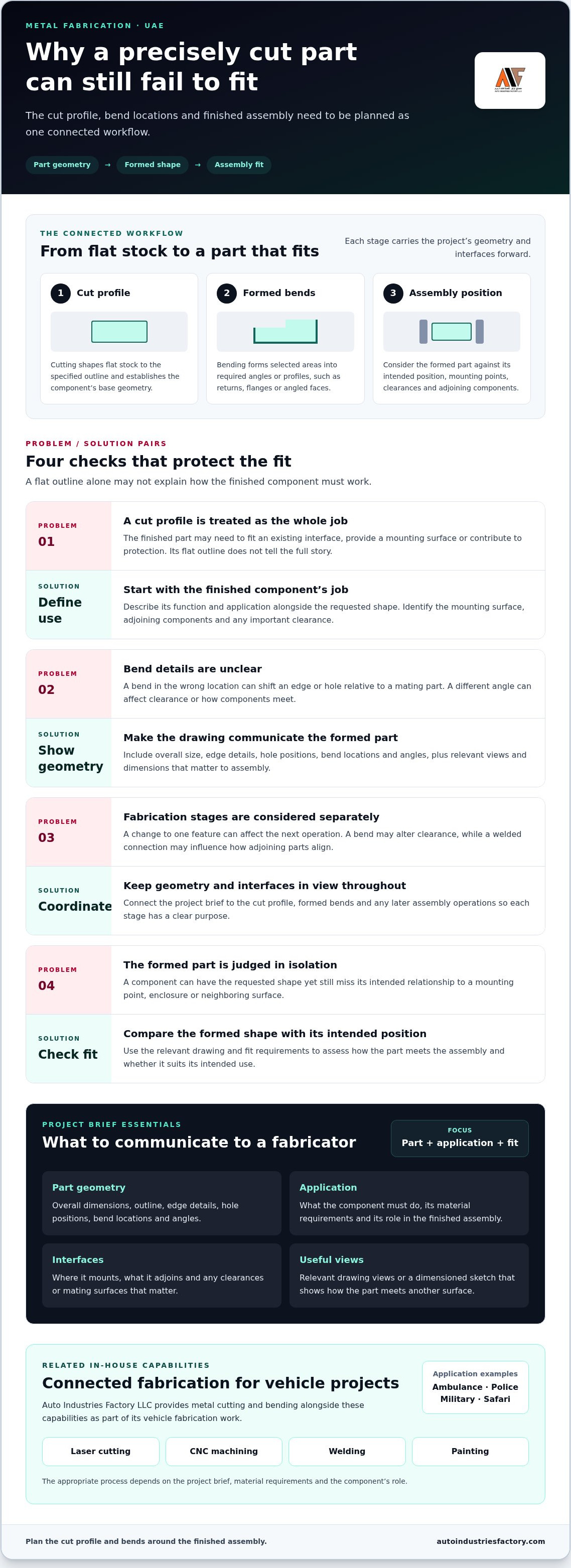
A useful fabrication workflow starts with the finished part, not just the machine operation. Define what the component must do and how it connects to the rest of the assembly. Then establish its geometry, cut the material, form the bends and consider the part against its intended position. This gives each stage a clear purpose.
Drawings turn the project requirements into practical instructions. A dimensioned drawing or sketch can show overall size, edge details, hole positions, bend locations and angles, and interfaces with adjacent parts. Include relevant views and identify the dimensions that matter to assembly. For a fleet project, showing where a component mounts or meets another surface can communicate more than a flat outline alone.
Coordinating fabrication stages keeps the component’s geometry and interfaces in view from the initial cut through assembly. A change to one feature can affect the next operation. A bend may alter clearance, while a welded connection may influence how adjoining parts align.
From project brief to cut profile
Describe the part’s function, application and interfaces before settling its geometry. A drawing or dimensioned sketch can show the outline and the features that need to line up with the vehicle or equipment. Laser cutting is one of Auto Industries Factory LLC’s in-house capabilities and can form part of the cutting stage. Clear source drawings help keep the intended component shape visible as the work progresses.
For metal cutting and bending services UAE, make the brief relevant to the real assembly. Identify the mounting surface, adjoining components and any important clearance. The Fabricators and Manufacturers Association provides information on metal forming and fabrication practices, offering broader context for how coordinated operations fit within manufacturing.
From formed part to fabrication assembly
After cutting, the specified bend geometry shapes the component for its intended position. Bend locations, angles and formed edges can affect clearances and interfaces, so consider the part in relation to the assembly rather than in isolation. Compare the formed shape with the relevant drawing and fit requirements to assess whether it matches the intended use.
Additional operations may follow, depending on the project. CNC machining can support features that need machining, welding can join components into an assembly, and painting can provide a finishing stage. Auto Industries Factory LLC handles laser cutting, CNC machining, welding and painting in-house as part of its vehicle fabrication work. These connected capabilities support projects where metalwork is part of a larger conversion. Learn more about the company’s metal fabrication and vehicle services.
How to Compare Metal Cutting and Bending Services for Your Project
Look beyond a headline such as “precision bending.” The key question is whether the workflow suits your part, its material and geometry, the required quantity, and its function in the finished vehicle or assembly. A cut-and-bend job may involve different considerations from forming pipe or tube, or shaping a structural section. These are distinct workpiece formats, so a general capability claim does not establish suitability for every part.
Use these criteria to compare a fabrication approach with your project:
Which project details change the fabrication approach?
Consider the complete set of project variables, not one headline capability. A flat panel with defined folds has different geometry from a curved pipe or a structural section. Material information, dimensions, bend locations, mounting points and adjoining surfaces all help describe the part. Intended use and quantity also shape the brief. A component for a specialized fleet conversion may have different assembly needs from a one-off accessory or a repeated part. Avoid assuming one specification suits every job.
Why integrated capabilities matter beyond bending
A formed part may be one stage in a larger vehicle project. Cutting establishes the profile. CNC machining, welding and painting may be relevant later, depending on the assembly and finish required. Considering these stages together keeps the project requirements in view across the workflow, without implying a specific outcome. Auto Industries Factory LLC coordinates metalwork with in-house fabrication capabilities for vehicle-related projects. For an example of a component category used in vehicle fabrication, see this custom bull bars and bumpers guide.
Environmental considerations can also be part of manufacturing decisions. The EPA’s metals-production guidance describes a United States regulatory context and should not be treated as a statement of UAE requirements. For related vehicle fabrication and metalwork, explore Auto Industries Factory LLC’s metal fabrication services.
What to Include in a Metal Cutting and Bending Project Brief
A clear brief gives the fabrication team a practical picture of the part, its function and its place in the larger project. For metal cutting and bending services UAE, provide the information you have and identify technical details that are still undecided. Do not guess at material grades, tolerances or other specifications. Mark open points for project-specific discussion.
Drawings and application details make a fabrication brief more actionable by connecting the requested geometry to the part’s purpose. Use this checklist to prepare yours:
- Drawings or sketches: Attach a dimensioned drawing if available. Otherwise, provide a clear sketch and reference photographs.
- Part geometry: Show the outline, bend locations, angles or profiles, and any openings or cut-outs that matter.
- Dimensions: Record known measurements and identify those essential for installation or alignment.
- Application: Explain what the part does and where it will be installed, such as within a vehicle conversion or as an accessory.
- Interfaces: Note mounting points and adjoining components, including the surfaces or edges the part must meet.
- Material and quantity: State the known material specification and number of parts required. Mark undecided details clearly.
- Welding and finish: Describe any known joining, painting or finishing needs within the wider project scope.
Drawings, dimensions, and application details
For example, when describing a bracket, identify what it mounts, where it sits and which adjacent parts or surfaces affect its position. This helps distinguish essential fit requirements from details that are only illustrative. If a measurement or bend angle is unknown, say so instead of inserting an assumed value.
Material, quantity, and finishing requirements
Include the material information available in your project documents, along with the requested quantity. If either is undecided, state that clearly. Material and production quantity can influence how a project is planned, so separate known requirements from open questions. Avoid assuming a particular material or production volume will suit the part.
Record whether the component is expected to be welded into an assembly, painted or finished as part of broader vehicle fabrication. These details frame the work beyond the initial cut and bend. Auto Industries Factory LLC provides in-house welding and painting alongside metal cutting and bending for vehicle-related fabrication.
Have a custom component in mind? Explore Auto Industries Factory LLC’s metal fabrication services.
Auto Industries Factory’s Metal Cutting and Bending for Custom Fabrication
Auto Industries Factory LLC’s metal cutting and bending support a wider scope of vehicle fabrication and conversion work. The component is considered in context: what it needs to do, where it fits, and how it relates to the finished vehicle or accessory. This is useful for fleet projects where a part is one element of a broader modification rather than an isolated shape.
The company’s in-house fabrication capabilities include:
- Laser cutting and metal bending for custom metalwork.
- CNC machining for related project requirements.
- Welding and painting as stages within broader fabrication work.
These capabilities support customized vehicle-related projects, including ambulance conversions, police and military vehicle modifications, and safari vehicle conversions. They also connect to custom vehicle accessories such as metal canopies, roof racks, bull bars and bumpers. The component, material information, quantity and intended use shape the project requirements. No single specification applies to every fleet application.
A fabrication partner for specialized vehicle projects
Specialized vehicle work can involve components designed for a particular conversion or accessory installation. Depending on the project brief, custom metalwork may form part of a vehicle modification, equipment support or protective feature. Auto Industries Factory LLC’s specialized vehicle fabrication includes ambulance, police, military and safari vehicle projects, placing metal fabrication in the context of practical vehicle applications.
Next steps for a UAE fabrication enquiry
Gather available drawings or sketches, dimensions, the part’s application, known material information, quantity and details of the interfaces it must meet. Include relevant welding or painting requirements. Mark technical details that are still open rather than guessing. This gives the project discussion a clear starting point and connects the fabrication scope to the part’s role in the wider vehicle project.
For fleet buyers researching metal cutting and bending services UAE, a brief grounded in the actual application helps focus the discussion on useful project requirements. Review Auto Industries Factory LLC’s metal fabrication services and share the drawings and details for your custom fabrication project.
Move Your Fleet Fabrication Project Forward
Turn the need for a custom component into a clear project direction. Before procurement or fabrication begins, align the people responsible for the vehicle, equipment and installation on what the part needs to achieve. This keeps decisions focused on the application, particularly when a modification is part of a broader fleet requirement.
Choosing metal cutting and bending services UAE is about finding a fabrication approach that fits the job, not relying on a broad claim or an assumed specification. Keep the intended use at the centre of the discussion and treat open technical questions as part of defining the project scope. A practical, well-framed enquiry gives the work a clear starting point.
Ready to move your project forward? Share your metal fabrication requirements with Auto Industries Factory LLC.
Frequently Asked Questions
What is the difference between metal cutting and metal bending?
Cutting creates the component’s outline, while bending forms the cut piece into a required shape. For example, cutting establishes a panel’s perimeter, and bending can form an edge that helps the panel meet an adjacent surface. The operations address different features, so communicate both the flat profile and the formed shape needed for the part’s application.
Can cutting and bending be handled as part of one fabrication project?
Yes. Cutting and bending can be coordinated as stages of one project, with the cut profile prepared for the required bends and the formed component considered alongside later assembly work. This is useful when a part will be joined to other components or fitted into a vehicle conversion. Auto Industries Factory LLC provides metal cutting and bending as part of its broader vehicle fabrication work.
What information should I provide for a metal cutting and bending enquiry?
Share the part’s purpose, available drawings or sketches, dimensions, known material details, required quantity and how it connects to other parts. Identify critical measurements, the component’s orientation and any areas that need clearance for nearby equipment or fittings. Include photographs if they clarify the installation. Mark unknown technical details as undecided rather than estimating them.
How do bend locations affect the final component?
Bend locations determine where the flat piece changes direction, which can affect the part’s reach, clearance and connection points. A bend near a mounting hole, for example, may affect how that hole lines up with its fixing point. Show bend positions in relation to the component’s edges and interfaces, and identify which surfaces face outward or meet neighbouring parts.
Is laser cutting suitable for every metal fabrication project?
No single cutting method should be assumed suitable for every project. The part’s shape, material information and intended requirements all matter when determining an appropriate approach. Laser cutting is an in-house capability at Auto Industries Factory LLC, and its suitability depends on the specific job. Include available material details and a drawing so the cutting requirements can be considered in context.
Can metal cutting and bending support custom vehicle components?
Yes. Custom cutting and forming can support vehicle-related components designed for a particular application. Examples include metal canopies, roof racks, bull bars and bumpers, as well as parts used in ambulance, police, military or safari vehicle conversions. The required shape and interfaces depend on the project. Describe where the component will be used and what it must connect to in your enquiry.
What happens if I only have a sketch rather than a finished drawing?
A sketch can communicate the basic shape and project context. Add known dimensions, mark intended bend lines and connection points, and note any uncertain measurements. Photographs of the installation area or a reference component can provide additional context. Auto Industries Factory LLC can discuss the fabrication requirements using the information provided. Treat an informal sketch as a starting point, not a final technical specification.


