

What if choosing the right modification starts with the job the vehicle must do, not the parts you want fitted? For commercial vehicle modification UAE projects, that distinction matters: a configuration that overlooks the operation’s real demands can affect usable payload, access, safety, and day-to-day performance.
Turning an operational need into a practical specification takes more than a list of equipment. Vehicle platform limits, fabrication requirements, system integration, and applicable approvals all need to be considered together. A clear brief makes those decisions easier before fabrication begins.
This guide explains how to scope and assess a mission-led modification project across the UAE. You’ll learn how to define operating requirements, weigh vehicle and payload constraints, compare fabrication and integration capabilities, and prepare for the next steps. It also shows how disciplines such as laser cutting, CNC machining, welding, and painting support specialist conversions, including ambulances, police and military vehicles, and safari vehicles. The aim is a project direction based on the vehicle’s purpose, not a standard fit-out.
Key Takeaways
- Start with the vehicle’s operational mission, rather than appearance alone, when writing a modification brief.
- Assess usable space, access, payload, and system integration before settling on a vehicle platform or scope.
- Understand how laser cutting, CNC machining, welding, and painting support vehicle-specific fabrication.
- Plan a commercial vehicle modification UAE project by documenting the mission, platform, systems, fabrication needs, and approval questions.
- Auto Industries Factory brings specialist vehicle conversions together with in-house fabrication capabilities.
What Should Commercial Vehicle Modification in the UAE Achieve?
Appearance-focused work may involve changing colour or adding branding. Mission-led modifications may involve structural fabrication, equipment fit-out, or electrical and communication systems. The broader idea of vehicle modification includes changes to a vehicle’s body and performance, but commercial projects should be scoped around operational requirements first.
For a visual example of a vehicle-specific canopy installation, watch this video:
Start by describing the vehicle’s duties, routes, operating conditions, and users. A vehicle used for long road journeys has different demands from one used on rough tracks or in stop-start urban operations. Heat, dust, equipment access, and the people who operate or use the vehicle can all influence its layout and specification. A commercial vehicle modification UAE project is more likely to meet its purpose when these realities shape the brief from the outset.
Which commercial operations benefit from a modified vehicle?
Different missions need different layouts and equipment. An ambulance conversion calls for a planned interior arrangement and space for mission equipment. Auto Industries Factory provides ambulance conversion services for this specialist vehicle category. Police and military applications may place greater emphasis on equipment storage, access, and protection requirements. Safari vehicles need purpose-built features suited to passenger access and travel on varied terrain. These are distinct use cases, not interchangeable fit-outs.
What belongs in a mission-led project brief?
Record the tasks, operating environment, user roles, equipment, and expected vehicle use. Separate essential functions from preferences and possible future additions. This prevents secondary requests from obscuring the core requirements and gives the conversion scope a useful foundation.
- Mission: What work must the vehicle perform?
- Conditions: Which routes, surfaces, and environmental factors will it face?
- Users and equipment: Who will use it, and what must it carry or support?
- Priorities: Which requirements are essential, optional, or intended for a later phase?
A clear brief connects operational needs to a practical conversion scope. It also gives you a stronger basis for assessing the vehicle platform and fabrication requirements.
How to Assess Vehicle Platform, Payload, and Modification Fit
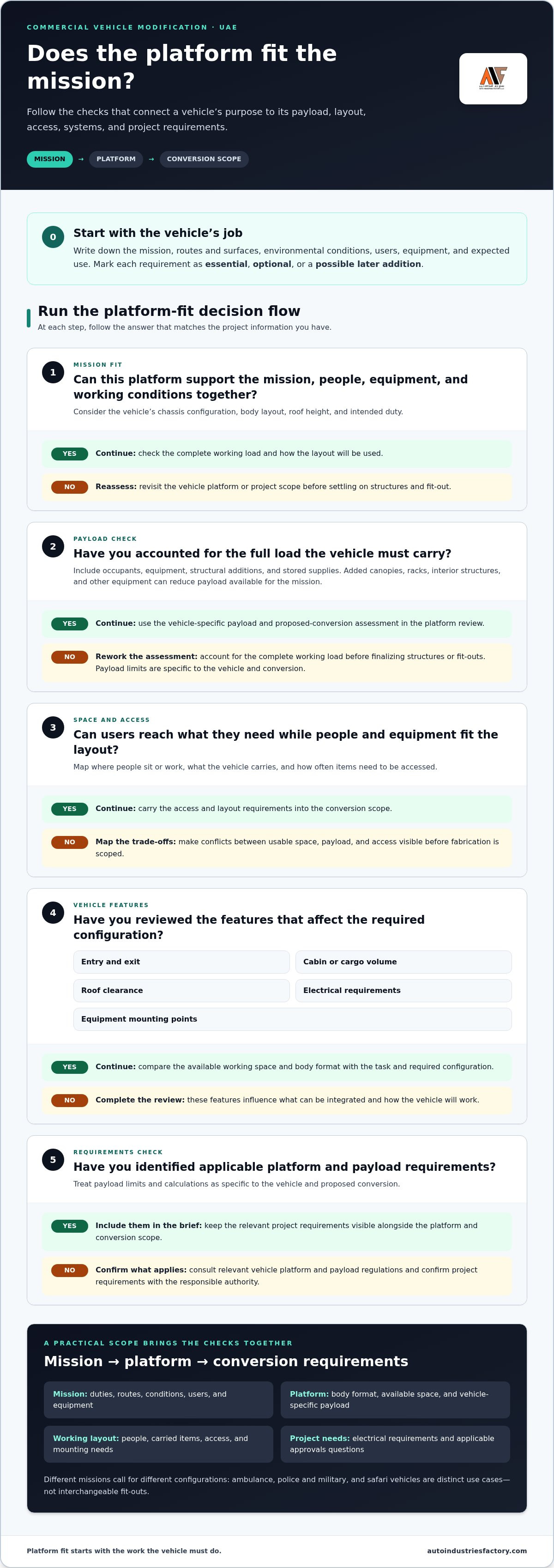
A suitable platform must do more than accommodate a conversion. It needs to support the mission, people, equipment, access requirements, and working conditions as one practical package. For a commercial vehicle modification UAE project, assess the base vehicle before finalizing structures or fit-outs. Chassis configuration, body layout, roof height, and intended duty all influence what can be integrated and how the vehicle will work.
Pay close attention to payload, the carrying capacity available after accounting for the vehicle’s own mass. Occupants, equipment, structural additions, and stored supplies all contribute to the load. Added canopies, racks, interior structures, and other equipment can reduce the payload available for the mission. Treat payload limits and calculations as specific to the vehicle and proposed conversion, not as universal figures. For official guidance relevant to transport vehicles, consult the applicable vehicle platform and payload regulations and confirm project requirements with the responsible authority.
How do payload and vehicle layout affect the conversion?
Consider the complete working load, not just fixed equipment. A conversion may leave adequate room on paper but still be impractical if users cannot reach stored items or equipment competes for space. Map where people sit or work, what the vehicle must carry, and how often items need to be accessed. This makes trade-offs between usable space, payload, and layout visible before fabrication is scoped.
Which vehicle features matter for specialist fleet use?
Review entry and exit, cabin or cargo volume, roof clearance, electrical requirements, and equipment mounting points. A Toyota Land Cruiser and a Hilux, for example, have different body formats and available working space. The right fit depends on the task and required configuration. Police fleet applications bring their own equipment and access considerations; explore police vehicle modification services as a specialist category.
Use this comparison to structure a platform review:
| Operational need | Vehicle consideration | Question for project scoping |
|---|---|---|
| Carry people and equipment | Payload, seating, cargo layout | What must travel together on a typical duty cycle? |
| Reach equipment quickly | Door access, mounting positions, storage arrangement | Who needs access, and from which side or area? |
| Support electrical systems | Power requirements and equipment integration | Which systems need power, and when will they operate? |
| Work across varied routes | Chassis, body configuration, and intended duty | What surfaces and operating conditions will the vehicle face? |
Use the answers to narrow the platform and conversion scope together. Reviewing commercial vehicle conversion capabilities helps connect these requirements to suitable fabrication options.
Which Fabrication and Integration Capabilities Matter Most?
A successful conversion depends on more than making a component fit. Fabrication must suit the vehicle’s shape and intended duty, while equipment and systems need to work together in the space available. For a commercial vehicle modification UAE project, assess fabrication and integration as parts of one scope, rather than separate tasks to resolve at the end.
Each capability has a distinct role:
- Design: Translates the mission brief into a workable vehicle layout and component requirements.
- Laser cutting: Shapes metal parts for vehicle-specific adaptations and fabricated components.
- CNC machining: Produces components from defined designs to support a consistent fit.
- Welding: Joins fabricated metal parts into assemblies suited to the conversion requirements.
- Painting: Finishes fabricated components and vehicle adaptations.
These disciplines can be coordinated within one project. Auto Industries Factory brings design, laser cutting, CNC machining, welding, and painting together with specialist vehicle conversions. Buyers can also refer to this UAE vehicle standards and regulations overview for background on the national standards and conformity-assessment landscape.
How does in-house fabrication support a vehicle project?
How should equipment and vehicle systems be integrated?
Map equipment locations, user access, power requirements, and workflow before finalizing the layout. Electrical systems, communications, medical equipment, and other mission-specific items can compete for space or affect how users move through the vehicle. Their priorities differ: an ambulance, police or military vehicle, and safari vehicle each serves distinct users and tasks.
Consider system integration during initial design, because equipment placement, access, and power needs shape the vehicle layout from the outset. Record what each system must do, who uses it, and when it is needed. For medical-vehicle projects, explore ambulance conversion services as a starting point for understanding the conversion category and its fabrication requirements.
How to Prepare a UAE Commercial Vehicle Modification Project
A productive project discussion starts with clear vehicle information and an ordered set of requirements. For a commercial vehicle modification UAE project, use these five steps to turn operational needs into a brief that can be assessed and scoped:
- Define the mission: Describe the vehicle’s day-to-day role, operating conditions, routes, and users.
- Identify the platform: Record the make, model, configuration, and relevant existing features or equipment.
- Specify the systems: List required equipment, electrical needs, storage, access, and user workflow.
- Scope the fabrication: Separate essential structural or component work from optional features and future additions.
- Prepare for review: Organize the brief, supporting materials, and open technical or approval questions.
Describe the intended outcome in practical terms. For example, specify which equipment needs to be accessible, what the vehicle must carry, and how users move through or around it. This gives the project team a clearer basis for assessing platform constraints, fabrication, and system integration.
What information should buyers assemble before discussing a project?
Build a concise project file before the first discussion. Include the vehicle make, model, body or chassis configuration, existing equipment, and intended operating role. Add the operating environment, expected users, storage needs, required equipment, and functional priorities. Drawings, reference images, or fleet standards can clarify layouts and requirements that are difficult to describe in words.
- Mark each requirement as essential, preferred, or a possible future addition.
- Note how users access equipment and carry out routine tasks.
- Identify existing vehicle features that the conversion must retain or work around.
This preparation separates core functions from preferences, helping the project scope reflect the vehicle’s actual duties rather than an unranked wish list.
How can buyers keep requirements and compliance aligned?
Flag structural changes, electrical systems, payload considerations, and registration questions for project-specific review. Applicable UAE approval and registration requirements depend on the vehicle and proposed modification. Requirements can vary, so verify current information with the relevant official authority before relying on it. A general checklist does not confirm that a particular conversion will receive road approval or meet every applicable requirement.
With the brief assembled, the next discussion can focus on the vehicle, required functions, fabrication scope, and open questions. Discuss your commercial vehicle modification project with Auto Industries Factory LLC.
Why Choose Auto Industries Factory for Commercial Vehicle Modification?
Auto Industries Factory LLC is a UAE vehicle fabrication and conversion specialist for commercial and mission-specific vehicles. Its work includes ambulance conversions, police and military vehicle modifications, and safari vehicle conversions. Each application has different operational demands, so the vehicle’s mission, platform, and required systems shape the project scope.
The company’s in-house fabrication capabilities include design, laser cutting, CNC machining, welding, and painting. Together, these disciplines support custom vehicle components and adaptations within a conversion project. Fabrication choices are considered in relation to the intended use, equipment, and vehicle systems rather than applied as a generic fit-out.
Explore vehicle modification services to see the specialist conversion categories and fabrication work.
What makes an integrated conversion partner valuable?
When design and fabrication are considered together, custom components can be scoped around the selected vehicle and mission brief. Laser-cut and CNC-machined parts, welded assemblies, and painted finishes each play a role in vehicle adaptation. Coordinating those elements with layout, user access, and system requirements keeps the project focused on operational fit. Learn more about Auto Industries Factory’s background and specialist focus.
For commercial vehicle modification UAE projects, an integrated approach gives buyers a clear way to discuss the vehicle, its duties, and the fabrication involved. It keeps project decisions grounded in practical requirements.
What are the next steps for a fleet buyer?
Prepare a concise project brief before the discussion. Include:
- Vehicle make, model, and configuration.
- Intended use, operating conditions, and user roles.
- Required equipment, storage, access, and system needs.
- Priority requirements, optional features, and any reference drawings or images.
This information helps frame the scope and identify project-specific questions about the platform, fabrication, and integration. Share the requirements through the relevant service enquiry route to discuss practical next steps for the conversion.
Discuss a commercial vehicle modification project with Auto Industries Factory.
Turn Your Vehicle Requirements Into a Clear Project Plan
The right modification starts with the vehicle’s mission. Define its duties, users, equipment, and operating conditions before settling on a platform or fabrication scope. Then consider payload, access, and system integration together so the finished configuration supports practical use.
For commercial vehicle modification UAE projects, coordinated capabilities matter. Auto Industries Factory brings in-house design, laser cutting, CNC machining, welding, and painting to specialist ambulance, police, military, and safari vehicle conversions. These disciplines connect custom fabrication with each vehicle’s intended role.
Bring your vehicle details, priority requirements, and project brief into the next discussion. A clear starting point helps turn operational needs into a tailored conversion plan. Discuss your commercial vehicle modification project with Auto Industries Factory.
Frequently Asked Questions
What does commercial vehicle modification include?
Commercial vehicle modification adapts a vehicle to a defined operational role. Depending on the project, work may include structural changes, custom-fabricated components, equipment installation, electrical systems, or interior alterations. The scope depends on the vehicle platform and its intended duties. For commercial vehicle modification UAE projects, treat each conversion as a project-specific brief, not a standard accessory package, and account for how the changes work together.
Can commercial vehicles be modified for different fleet operations?
Yes. Commercial vehicles can be adapted for distinct operations, including ambulance, police, military, and safari applications. Each mission brings different requirements for space, equipment, access, and vehicle systems. Start by identifying who will use the vehicle, the tasks it must perform, and the equipment it needs to support. Those details help shape a suitable platform and conversion scope instead of a one-size-fits-all configuration.
How do I choose a vehicle for a commercial modification project?
Start with the mission, then compare vehicle platforms against its practical demands. Consider intended use, usable space, access, payload, and equipment integration. Confirm technical limits using information specific to the vehicle and proposed conversion. For specialist fleet work, a clear operational brief connects platform choice to the required modifications. A Toyota Land Cruiser and Hilux, for example, have different body configurations, so suitability depends on the task.
Will vehicle modifications affect payload or vehicle performance?
They can. Added structures, equipment, stored supplies, and occupants all need to be considered when assessing available payload, and some modifications may affect how the vehicle operates. The impact depends on the base platform and conversion specification, so generic figures are not a reliable substitute for project-specific calculations. Include payload and vehicle limits in the assessment, and evaluate them against the exact vehicle and proposed configuration before finalizing the scope.
Do modified commercial vehicles need approval in the UAE?
Approval and registration requirements depend on the vehicle, type of modification, and applicable process. Do not assume a single rule covers every conversion or use case. Make regulatory questions part of the project brief, then verify current requirements with the relevant official UAE authority for the specific vehicle and proposed work. This keeps planning grounded in applicable information without treating a general guide as confirmation of road approval.
What should I include in a vehicle modification enquiry?
Include the vehicle make, model, and configuration, then describe its intended role and operating conditions. Explain who will use it, what equipment it must carry, and any storage, access, electrical, or workflow requirements. Separate essential functions from preferences. Reference images, drawings, or existing fleet specifications can clarify the brief. These details help frame a tailored modification scope and make the project discussion more focused.
Does Auto Industries Factory modify specialized commercial vehicles?
Yes. Auto Industries Factory LLC works on specialist conversions for ambulance, police, military, and safari vehicles. Its in-house capabilities include design, laser cutting, CNC machining, welding, and painting, supporting custom fabrication within vehicle projects. The appropriate scope depends on the platform and mission requirements. For commercial vehicle modification UAE projects, prepare the vehicle details, intended use, equipment needs, and priorities to support a focused discussion about the conversion.


