

What if the most capable APC equipment on paper becomes a liability once it’s fitted to the vehicle? A system that adds protection or electronics can also affect weight, mobility, power demand, crew space, and integration. Choosing the right apc equipment means considering those trade-offs before installation.
Choosing equipment is rarely as simple as selecting components from a list. Start by identifying what the mission requires, what is specific to the vehicle’s role, and how each item will work with the platform. That balance is central to a practical conversion.
This guide explains how to build an equipment specification around mission priorities, then compare options using consistent criteria: protection, mobility, power, crew needs, and vehicle integration. It also shows how communications, situational awareness, seating, and protective systems can shape a conversion as a whole.
Whether the priority is protected troop transport or a more specialised operational role, start with the mission and the vehicle’s constraints. Planning fabrication, structural reinforcement, and system installation together helps align the finished vehicle with how it must perform.
Key Takeaways
- Start with the mission, crew tasks, operating environment, and vehicle platform to establish what the conversion needs to support.
- Assess apc equipment as an integrated system, considering how protection, electrical, communication, and crew-use components interact.
- Compare equipment options by mission fit, integration needs, maintainability, and impact on the vehicle rather than relying on a one-size-fits-all package.
- Turn operational needs into a clear specification by separating mandatory requirements from preferred features and future options.
- Plan fabrication, armouring, and system installation together to align the conversion with the vehicle platform and intended role.
What APC equipment does a mission-ready vehicle need?
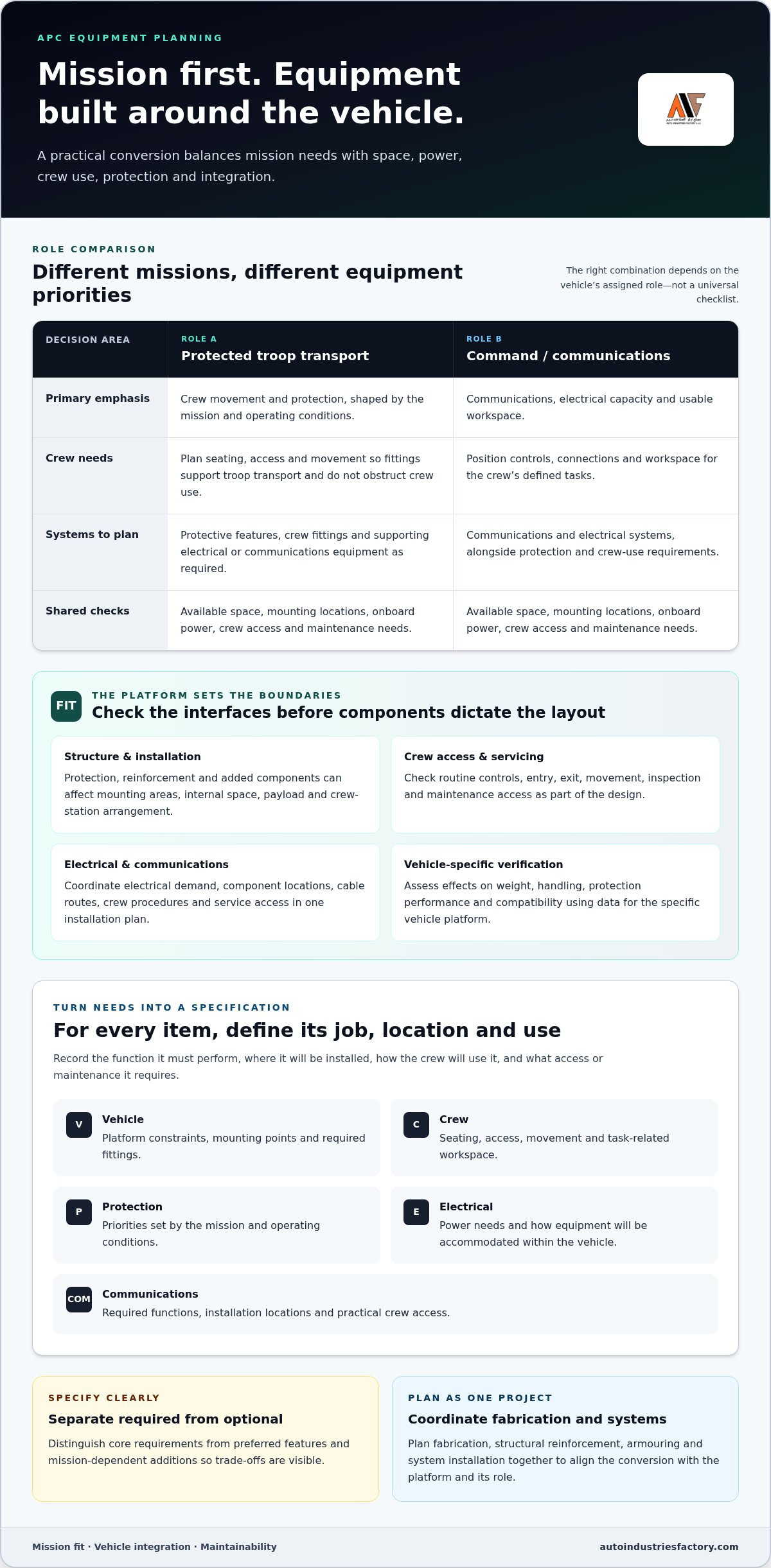
APC equipment includes the systems, fittings, and supporting components selected to help an armoured personnel carrier perform its assigned role. It can include crew fittings, protective features, electrical systems, and communications equipment. The right combination depends on the mission, not a universal checklist. An APC intended for protected troop transport has different priorities from one configured for command or communications duties.
The vehicle sets important boundaries. Available space, mounting locations, onboard power, crew access, and maintenance needs all affect which systems can be integrated effectively. Use this overview of the Armoured Personnel Carrier (APC) to review the vehicle’s purpose, design, protection, and mobility. These fundamentals help frame equipment decisions around the platform and its intended role.
Which mission requirements should guide APC equipment selection?
Define what the vehicle and crew must do before selecting components. Record crew roles, operating conditions, expected duty cycle, and the tasks the vehicle must support. These details shape priorities. A transport role may emphasise crew movement and protection, while a command role may place greater demands on communications, electrical capacity, and usable workspace.
Operating conditions matter too. They influence the balance between protection, mobility, visibility, and onboard systems. Assess each against the mission rather than assuming that adding more equipment automatically improves capability.
What belongs in an APC equipment specification?
Organise the specification into clear categories. For each item, state the function it must perform, where it needs to be installed, how the crew will use it, and what access or maintenance it requires.
- Vehicle: platform constraints, mounting points, and required fittings.
- Crew: seating, access, movement, and task-related workspace.
- Protection: the protection priorities set by the mission and operating conditions.
- Electrical: power needs and how equipment will be accommodated within the vehicle.
- Communications: required functions, installation locations, and crew access.
Separate core requirements from optional or mission-dependent additions. This makes trade-offs visible and helps prevent equipment being specified without accounting for its effect on the vehicle. Auto Industries Factory LLC brings fabrication, structural reinforcement, armouring, and system installation together in specialised vehicle conversions. Planning those elements as one project helps align components with the platform and mission. The goal is a specification that balances capability, fit, and maintainability, not simply a longer equipment list.
Which APC equipment systems need to work together?
APC systems share the same structure, space, power supply, and crew workspace. A protection feature can affect where equipment is mounted. Electrical and communications components need practical cable routes and service access. Crew-use fittings must remain reachable without obstructing movement. Planning these elements as separate purchases can create conflicts during installation or maintenance.
Integrated APC equipment planning coordinates protection, electrical, communications, and crew-use systems around the vehicle’s mission and platform. Consider interfaces and trade-offs early, before individual components dictate the layout.
How do protection and mobility requirements affect equipment choices?
Assess equipment placement alongside the vehicle structure and its intended protection. Reinforcement or armouring may affect available mounting areas and internal space, while added components can influence payload, access, and the arrangement of crew stations. These factors are connected, even when equipment serves different functions.
Map installation areas and identify potential conflicts. Can crew members reach routine controls? Do fittings obstruct entry, exit, or movement? Is access to components needed for inspection or servicing? Treat the answers as design inputs, not late-stage adjustments. Any claim about weight, handling, protection performance, or compatibility must be based on the specific vehicle platform and verified engineering data. Do not assume that a result on one configuration applies to another.
How should electrical and communication equipment be integrated?
Start with the functions the crew needs and the procedures they will follow. Then plan electrical demand, component locations, cable routing, and maintenance access as one installation. A communication system should support defined crew tasks, with controls and connections positioned for practical use. Its layout also needs to account for other equipment competing for space and routing paths.
A coordinated review can identify installation constraints before fabrication begins. Auto Industries Factory LLC’s in-house metalwork and vehicle modification capabilities help align mounting provisions, structural work, armouring, and electrical or communications installation with the conversion plan. The company’s specialised vehicle modification services bring these capabilities into complete vehicle projects.
- Map interfaces: Note where systems share space, mounting points, power, or crew access.
- Plan service access: Preserve practical routes to components that need inspection or maintenance.
- Validate technical claims: Use documentation for the specific platform before stating compatibility or performance.
How should buyers compare APC equipment packages?
Compare configurations against the same criteria, not by counting components. More equipment can add capability, but it can also increase installation demands, occupy crew space, complicate maintenance, or affect the vehicle. The stronger choice is the one that supports the required tasks, fits the platform, and remains practical to operate and service.
An APC equipment package is effective only when its components match the mission, the vehicle, and the crew’s ability to use and maintain them.
Use a baseline as a planning reference, not as a universal or standard package. It represents the vehicle systems and fittings needed for the defined role. Assess mission-specific additions individually.
What criteria make an APC equipment comparison useful?
Assess each proposed item by its required function, installation complexity, crew usability, maintenance access, and effect on existing systems. Include likely interactions with payload and interior layout. Technical requirements, including protection and platform compatibility, depend on the project and should be supported by documentation for the specific vehicle.
| Comparison criterion | Baseline configuration | Mission-specific additions |
|---|---|---|
| Mission fit | Supports the vehicle’s defined primary role. | Adds functions needed for a particular task, such as command or communications. |
| Integration needs | Accounts for available space, mounting locations, and existing systems. | Requires review of interfaces, installation work, and crew access. |
| Maintainability | Preserves access to components needed for routine inspection and service. | Can introduce new access or servicing requirements that must be planned. |
| Vehicle impact | Establishes a reference for layout and onboard system demands. | May affect payload, interior arrangement, and vehicle operation. Verify impacts against platform data. |
How do equipment priorities change by mission profile?
Different roles shift the emphasis. A transport-focused configuration may prioritise crew movement, usable space, and protection requirements. A command role may place more emphasis on workspace and mission systems. A communications-focused role may require careful planning for equipment locations, power, and crew access. These are illustrative priorities, not fixed configurations.
Compare protection options against the intended role and verified vehicle information rather than assuming one arrangement fits every mission. Separate required functions from preferred additions, then assess each proposed component against the same criteria. This makes trade-offs clearer and prevents a longer equipment list from being mistaken for greater operational value.
How do you turn APC equipment needs into a workable specification?
A workable specification turns operational needs into clear requirements for the vehicle conversion. It helps the project team distinguish essential functions from preferences, identify installation constraints early, and review how proposed systems fit the vehicle as a whole. Make each requirement specific enough to assess, but do not assume a component will suit every platform.
What information should buyers define before conversion planning?
Begin with the mission. Document the vehicle’s tasks, crew roles, operating conditions, and how often each system will be used. Then record the existing vehicle constraints, preferred equipment, and maintenance expectations. For example, define the crew function and installation location for a communication unit instead of listing it without context.
Separate requirements into three groups:
- Mandatory: Functions the vehicle must support for its assigned role.
- Preferred: Features that add value but can be weighed against integration demands.
- Future options: Potential additions to consider without treating them as current requirements.
Flag protection, regulatory, or platform-specific requirements for verification against the project’s applicable standards and technical documentation. Do not include ratings or compatibility claims in the specification until they have been checked for the actual vehicle and configuration.
How can a conversion team check equipment integration?
Translate the requirements into a vehicle-level review. Assess mounting locations and structural needs alongside equipment placement, cable routing, crew access, maintenance access, and the space available for the intended layout. Review power and payload implications against verified platform data. This helps identify conflicts before fabrication and installation decisions are fixed.
Coordination matters. Structural reinforcement or armouring can affect where components fit, while electrical and communication systems need planned routes and usable positions for the crew. Auto Industries Factory LLC brings fabrication and installation planning together, using capabilities such as metal cutting, CNC machining, and welding to align mounting provisions with the vehicle conversion. Document the decisions, open verification points, and any items reserved for later.
Use this process to make apc equipment requirements traceable from mission need through installation review. Auto Industries Factory LLC’s specialised vehicle conversion services combine fabrication, armouring, and system installation planning within a complete project.
Why choose an integrated APC equipment conversion approach?
APC equipment has to fit the vehicle as a working system. Fabrication, armouring, and equipment installation can affect the same structure, interior space, mounting points, and access routes. Planning those elements together gives the conversion team a clearer view of how the proposed layout supports crew use and maintenance.
An integrated approach does not guarantee a particular operational outcome. Its value depends on the vehicle platform, mission requirements, selected systems, and verified engineering information. It can help identify practical conflicts during planning, such as a mounting location that interferes with access or a cable route that complicates servicing.
What does an integrated vehicle conversion contribute?
Structural work and custom fabrication can be coordinated with the placement of protective, electrical, and communications systems. Planned mounting provisions, for example, can be considered alongside component locations and crew access rather than addressed as isolated installation tasks. This coordination can support usability and maintainability, depending on the project layout and requirements.
Auto Industries Factory LLC’s in-house capabilities include laser cutting, CNC machining, welding, painting, structural reinforcement, armouring, and vehicle system installation. These capabilities support specialised vehicle modifications where fabrication and system placement need to be considered together. Claims about protection levels, compliance, or platform performance still require project-specific verification and supporting technical documentation.
What should buyers prepare for a project discussion?
A focused discussion starts with the vehicle and its intended role. Bring the information that connects the mission to conversion decisions:
- Vehicle platform: Identify the vehicle and share available technical documentation.
- Mission and crew: Summarise intended tasks, crew roles, and how the vehicle will be used.
- Equipment priorities: Separate mandatory functions from preferred features and future options.
- Known constraints: Note space, access, mounting, electrical, payload, or maintenance considerations.
- Technical requirements: Provide applicable project standards or protection requirements for review and verification.
This preparation helps frame the conversion around practical needs rather than a disconnected component list. Auto Industries Factory LLC modifies specialised vehicles, including military vehicles and troop carriers, as part of its specialised vehicle work.
For a mission-specific vehicle conversion, bring the vehicle platform, intended role, and equipment priorities together in a clear project brief.
Build Your APC Conversion Around the Mission
The right apc equipment specification starts with the vehicle’s role, crew tasks, and platform constraints. Compare options by mission fit, integration needs, maintainability, and impact on the vehicle, then separate essential requirements from preferred features. Treat protection, compatibility, and performance claims as project-specific and verify them against relevant technical documentation.
An integrated conversion brings structural work, fabrication, armouring, and system installation into the same planning process. Auto Industries Factory LLC modifies specialised vehicles and provides in-house laser cutting, CNC machining, welding, and painting, alongside experience integrating structural, electrical, and communication systems. These capabilities help shape a conversion around its defined requirements.
Start with the vehicle platform, intended mission, crew needs, equipment priorities, and available technical documentation. Discuss your mission-specific vehicle conversion with Auto Industries Factory to plan fabrication, armouring, and system installation around the vehicle’s intended use.
Frequently Asked Questions
What equipment is typically installed in an APC?
Typical APC equipment may include protective features, crew seating and fittings, electrical systems, communications equipment, and mounts or storage for mission-related components. The exact configuration depends on the vehicle’s role and platform. A troop transport, for example, may prioritise protected crew space and access, while a command vehicle may require more communications equipment. These are functional categories, not a universal standard package.
How do I choose equipment for an armoured personnel carrier?
Choose equipment by defining the vehicle’s mission, crew tasks, operating conditions, and expected use first. Then compare options by function, installation needs, crew access, serviceability, and effect on existing systems. Separate mandatory requirements from preferred features and possible future additions. Check platform-specific compatibility and technical claims against relevant vehicle documentation before including them in the specification.
Does APC equipment affect vehicle weight and mobility?
Yes. Added equipment can affect payload and available space, and may influence vehicle operation depending on its location and the platform. The impact varies with the vehicle and configuration, so do not assume that figures or performance claims for one setup apply to another. Review equipment additions against verified platform data and project engineering assessments, including relevant payload and mobility considerations.
How are electrical and communication systems integrated into an APC?
Electrical and communication systems are integrated by planning their functions, power requirements, component locations, cable routes, and service access as part of the vehicle layout. Communication equipment should support defined crew tasks and operating procedures, with controls positioned for practical use. Installation planning also needs to account for other systems competing for space and mounting points. Platform-specific technical information guides compatibility and performance decisions.
Can APC equipment be customised for different missions?
Yes. Equipment selection can be tailored to different mission priorities, such as troop transport, command functions, or communications support. Customisation should begin with crew tasks and vehicle constraints, then map the required systems to suitable locations and installation provisions. Auto Industries Factory LLC modifies specialised vehicles, including military vehicles and troop carriers, with fabrication, armouring, and vehicle system installation considered within the conversion project.
What should an APC equipment specification include?
An APC equipment specification should describe the mission, crew roles, operating conditions, required functions, and vehicle platform. Group requirements by vehicle, crew, protection, electrical, and communications systems. For each item, record installation constraints, access needs, maintenance expectations, and relevant technical documentation. Mark requirements as mandatory, preferred, or future options, and flag protection, regulatory, or compatibility claims for project-specific verification.
Why use an integrated conversion approach for APC equipment?
An integrated approach considers fabrication, structural work, armouring, and system installation together rather than treating each component as an isolated purchase. This can help the project team coordinate layout, mounting, routing, crew access, and maintenance needs. The practical benefits depend on the vehicle and project requirements. Auto Industries Factory LLC brings in-house laser cutting, CNC machining, welding, and painting to specialised vehicle conversion and modification work.


