

The most heavily protected automotive apc isn’t always the right fit for a mission. Added protection can affect mobility, payload, and usable interior space, so a useful comparison starts with operational priorities, not headline claims.
Choosing a configuration is difficult when requirements haven’t been turned into clear vehicle specifications. The platform, protection priorities, and mission equipment all shape the finished unit. If modifications aren’t coordinated, they can limit the space or capacity needed for the vehicle’s role.
This guide offers a practical way to compare options against your operating needs. You’ll learn how to weigh protection against mobility and payload, compare purpose-built platforms with conversions based on commercial chassis, and plan equipment integration around the mission.
Auto Industries Factory LLC converts specialised vehicles, including troop carriers and military units. In-house capabilities such as laser cutting, CNC machining, and welding support coordinated modifications. Structural reinforcement, armouring, and integration of electrical and communication systems help align each conversion with its operational brief.
Key Takeaways
- Start an automotive apc specification with its operational role, then translate that mission into practical vehicle requirements.
- Compare platforms by personnel space, payload, mobility, protection, and integration rather than relying on a single feature.
- Assess how protection and mission equipment affect vehicle demands, interior usability, and working space.
- Build a clear conversion brief by documenting users, protection priorities, required systems, and scope.
- In-house fabrication, structural reinforcement, armouring, and system integration support troop-carrier conversions tailored to the project brief.
What Should an Automotive APC Buying Decision Start With?
Definition: An automotive APC is an armoured personnel carrier configured for a defined operational role. The vehicle platform provides the base, while the mission determines the layout, protection priorities, and equipment.
That distinction matters. A standard passenger-vehicle purchase usually centres on existing features and specifications. A conversion starts with the work the vehicle must perform, then coordinates structural changes, armouring, interior use, and installed systems around that task. For background on APC types and development, see this overview of the Armoured personnel carrier (APC).
Describe the deployment before compiling a generic feature list. An automotive APC used to move personnel between sites may need a different configuration from one intended for longer deployments or more demanding conditions. There is no single layout for every role.
Which operational requirements belong in the initial brief?
Record who will use the vehicle, how many people it must accommodate, where it will operate, and how long each deployment may last. Describe the routes and conditions, such as paved roads, rough ground, heat, or dust, when they apply to the intended use. These details help establish practical priorities without assuming one configuration suits every mission.
Next, sort requested functions into essentials and options. Identify the communications equipment or storage needed for the mission, for example, and separate it from additions that would be useful but aren’t critical. This keeps the specification focused and makes later decisions easier to compare.
How do protection and mobility affect the brief?
Protection and mobility need to be considered together. Protective materials and added equipment contribute to the vehicle’s overall demands, while payload, dimensions, and operating conditions influence what the finished unit needs to accommodate. Prioritising one factor can affect the space or capacity available for another.
Make these trade-offs visible in the brief. Record protection priorities, personnel and equipment needs, operating conditions, and mobility requirements in the same document. This gives the conversion team a basis for coordinating reinforcement, armouring, layout, and integration rather than treating each modification as a separate decision.
- Mission: What task must the vehicle perform?
- Users: Who will travel in it, and what must they carry?
- Conditions: Where and for how long will it operate?
- Priorities: Which functions are essential, and which are optional?
How Do APC Platforms, Protection, and Capacity Compare?
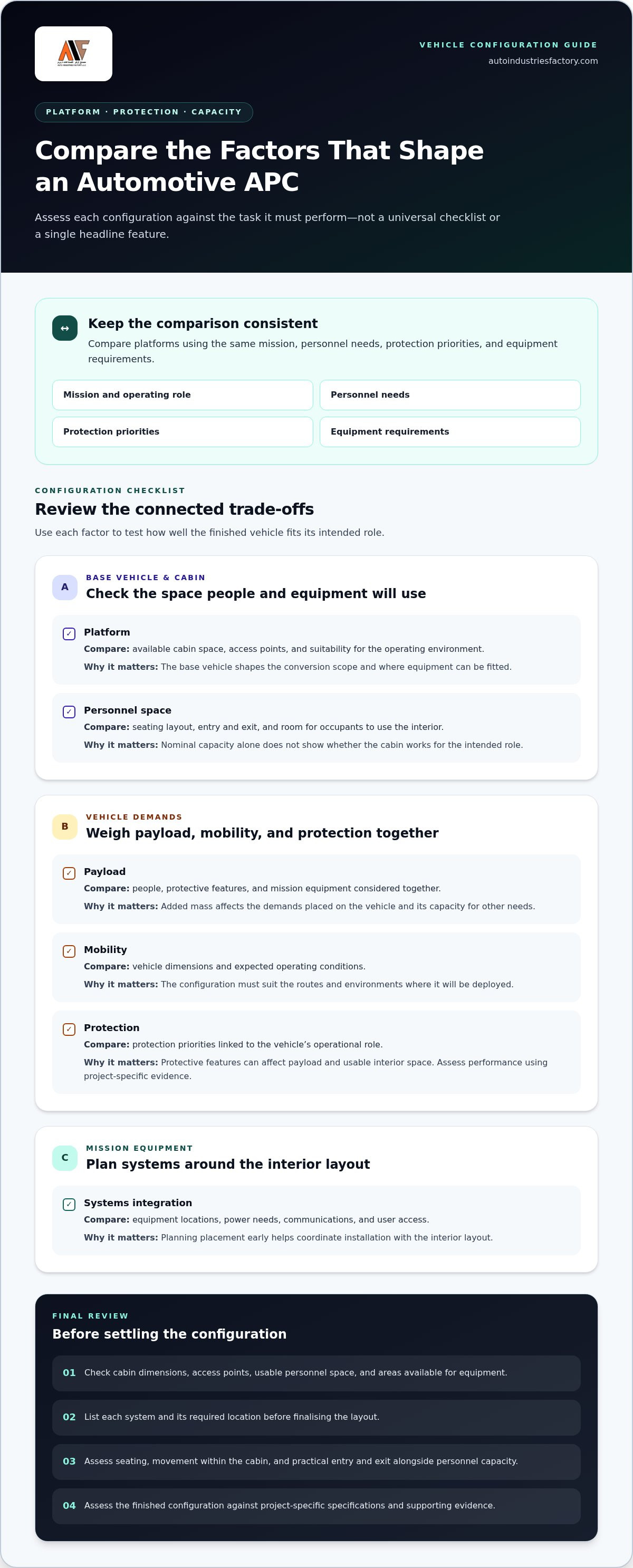
Compare configurations against the task they must perform, not a universal checklist. An APC comparison is useful only when each platform is assessed against the same mission, personnel needs, protection priorities, and equipment requirements. The framework below highlights the trade-offs to document before choosing a conversion direction.
| Factor | What to compare | Why it matters |
|---|---|---|
| Platform | Available cabin space, access points, and suitability for the operating environment | The base vehicle shapes the conversion scope and where equipment can be fitted. |
| Personnel space | Seating layout, entry and exit, and room for occupants to use the interior | Nominal capacity alone doesn’t show whether the cabin works for the intended role. |
| Payload | People, protective features, and mission equipment considered together | Added mass affects the demands placed on the vehicle and capacity for other needs. |
| Mobility | Vehicle dimensions and expected operating conditions | The configuration must suit the routes and environments where it will be deployed. |
| Protection | Priorities linked to the operational role | Protective features can affect payload and usable interior space. Performance requires project-specific evidence. |
| Systems integration | Equipment locations, power needs, communications, and user access | Planning placement early helps coordinate installation with the interior layout. |
Which vehicle-platform factors should buyers compare?
Start with the physical arrangement. Compare cabin dimensions, access points, personnel space, and areas available for equipment. Then consider the operating environment: the platform and conversion must work together for the intended routes and conditions. Because equipment placement can affect the conversion scope, list each system and its required location before settling the layout. Don’t rely on a platform name alone. Assess how usable space and payload fit the project.
How should protection and personnel capacity be assessed together?
Set protection priorities according to the vehicle’s role, then assess how much of the interior remains usable. Consider seating positions, movement within the cabin, and practical entry and exit alongside the number of personnel to be carried. Protective features and equipment can reduce available space and add demands to the vehicle. Don’t infer capacity or protection performance from appearance. Assess the finished configuration against project-specific specifications and supporting evidence.
These factors are linked in a conversion. Auto Industries Factory coordinates military vehicle modifications with fabrication, armouring, and system integration. Explore its specialised vehicle modification services when shaping a mission-specific automotive apc brief.
What Trade-Offs Should You Weigh Before Selecting an Automotive APC?
More protection isn’t automatically a better fit. An automotive apc must balance protection priorities with mobility, payload, vehicle dimensions, and usable interior space. Added protective features or mission equipment can increase demands on the vehicle and reduce room for personnel or other systems. Compare these compromises against the role the vehicle must perform.
Assess the complete configuration, not each feature in isolation. Added equipment may need dedicated mounting locations, electrical supply, communications connections, and room for users to operate it. Introducing these needs late can affect the interior layout and conversion scope. Define priorities early, then compare how each proposed configuration supports the mission. Maximum protection alone doesn’t determine the best fit.
How can equipment integration change the configuration?
List the systems required for the mission, such as communications and electrical equipment, and specify where they need to be used. Placement affects access, working space, and how equipment fits alongside seating and protective features. Auto Industries Factory integrates advanced electrical and communication systems into specialised vehicles, alongside armouring and in-house fabrication. Coordinating these elements helps align the conversion with project requirements.
What does a realistic comparison table need to show?
Compare options using the same criteria. Record project-specific specifications that still need evidence as “to be verified.” This keeps assumptions out of the decision and separates an intended benefit from a confirmed capability.
| Criteria | Potential advantage to assess | Compromise or detail to verify |
|---|---|---|
| Mission | Configuration tailored to the intended role | Whether every proposed feature serves that role |
| Personnel needs | Seating and access suited to intended users | Usable space after equipment and protection are installed |
| Platform | Base vehicle aligned with operating conditions | Available space, payload, dimensions, and conversion scope |
| Protection priorities | Features selected for the operational requirement | Supporting specifications or testing evidence for performance claims |
| Payload | People and mission equipment accommodated as planned | Combined demands of occupants, protective features, and systems |
| Integrated systems | Communications and electrical equipment placed for practical use | Power requirements, access, and impact on interior layout |
Use the comparison to identify trade-offs that need a decision, not to declare a universal winner. Recording priorities, compromises, and specifications that still need verification gives the conversion team a clearer basis for refining the configuration.
How Can Buyers Turn APC Requirements Into a Clear Conversion Scope?
A useful project brief turns mission needs into decisions the conversion team can act on. For an automotive apc, state the operational role first, then document users, protection priorities, required systems, and the intended vehicle platform. A broader overview of APC roles and designs can help frame those choices, but the brief should reflect the specific deployment rather than a generic vehicle template.
- Define the mission: Describe the vehicle’s role, deployment context, operating conditions, and expected duration of use.
- Document the users: Record personnel needs, seating expectations, entry and exit requirements, and equipment they must carry.
- Prioritise protection: State the operational priorities and note any specifications or evidence that require technical review.
- Specify systems: List electrical and communication equipment, its intended location, and the access users need.
- Scope the conversion: Separate essential requirements from adaptable preferences, then identify the fabrication and integration work the project calls for.
What information should an APC project brief include?
Make the brief specific enough to guide layout and fabrication. Include the intended role, operating conditions, personnel requirements, equipment, and access needs. Mark each item as fixed or flexible. Required system locations might be fixed, for example, while some storage arrangements could remain adaptable. Flag unknown technical specifications for engineering review rather than filling gaps with assumptions. This reduces ambiguity and gives the conversion discussion a clear starting point.
How should buyers assess conversion capability?
Assess whether the conversion scope coordinates structural reinforcement, armouring, fabrication, and system installation. These elements affect one another: structural work and protective features need to be considered alongside equipment placement and usable interior space. Auto Industries Factory LLC brings in-house laser cutting, CNC machining, welding, and painting capabilities to its vehicle conversions, supporting coordinated fabrication for military vehicles and troop carriers.
A clear scope also helps define how the brief becomes a finished vehicle. Auto Industries Factory connects project requirements with fabrication, reinforcement, armouring, and integrated electrical or communication systems. Review the vehicle conversion services relevant to a mission-led project brief.
How Does Auto Industries Factory Deliver a Mission-Led APC Conversion?
Auto Industries Factory LLC modifies military vehicles and converts vehicles into troop carriers, aligning the project scope with the intended operational role. A defined brief sets a clear direction for the conversion: what the vehicle must do, who will use it, and which protection and equipment priorities shape the finished configuration.
Coordinated fabrication connects the vehicle structure, protective features, interior layout, and integrated systems to one project brief. These elements interact. Structural reinforcement and armouring need to be considered alongside personnel space and equipment placement, rather than treated as isolated additions. The aim is a project-specific vehicle conversion, not a generic feature package.
Which in-house capabilities support a coordinated conversion?
Auto Industries Factory brings together in-house design and fabrication capabilities, including laser cutting, CNC machining, welding, and painting. These processes support vehicle modification work, while structural reinforcement and armouring address project-specific requirements. System integration can include electrical and communication equipment, as well as medical systems where relevant to the vehicle’s intended role.
Connecting these requirements helps the conversion scope account for fabricated components and system placement. For example, a project brief can identify where equipment must be accessible and how it fits within the intended interior layout. This gives the team a practical basis for coordinating fabrication and integration without assuming every APC needs the same arrangement.
What is the next step for an APC project?
Prepare a concise brief before starting the project discussion. Include:
- The vehicle’s mission and operating conditions
- Intended users and personnel requirements
- Protection priorities and any technical specifications requiring review
- Priority electrical, communication, or other mission systems
- Essential layout and access requirements, plus preferences that can be adapted
This information helps define the conversion scope and focus the discussion on the choices that shape the finished automotive apc. Auto Industries Factory’s specialised vehicle conversion services include military vehicle modifications and troop-carrier conversions.
Have a defined APC requirement? Share your mission brief, user needs, and priority systems with Auto Industries Factory to start a project discussion.
Turn Your APC Brief Into a Purpose-Built Conversion
The right automotive apc is defined by its mission, not a feature list. Compare protection priorities with mobility, payload, personnel space, and equipment needs, then put those requirements into a clear conversion brief. This gives each configuration a practical basis for comparison.
Execution matters too. Auto Industries Factory LLC converts military vehicles and troop carriers, with in-house design, laser cutting, CNC machining, welding, and painting. Structural reinforcement, armouring, and system integration connect the project scope to the vehicle’s layout and intended use.
Bring your mission details, user requirements, and priority systems into the project discussion. Discuss your specialised vehicle conversion requirements with Auto Industries Factory and take the next step toward a vehicle configured around the job.
Frequently Asked Questions
What does APC mean in automotive and military vehicle contexts?
APC means armoured personnel carrier: a vehicle configured to transport personnel with protection suited to its intended role. In automotive and military contexts, the term describes the vehicle’s function, not one universal design or platform. An APC’s layout, protection priorities, and equipment depend on its operational requirements. The abbreviation can have other meanings in different industries, so context matters when interpreting it.
How do I choose the right automotive APC configuration for a mission?
Choose an automotive APC configuration by defining the mission before comparing features. Document who will use it, how many personnel it must accommodate, operating conditions, deployment duration, and required equipment. Then weigh protection priorities against payload, mobility, vehicle dimensions, and usable interior space. Separate essential requirements from preferences, and record specifications that need technical review. This approach helps compare options against the actual role rather than a generic checklist.
What is the difference between an APC and an armoured vehicle?
An APC is a type of armoured vehicle intended to transport personnel, while “armoured vehicle” is a broader term for vehicles built or modified for different roles. The distinction is functional: an APC’s configuration centres on carrying personnel, whereas another armoured vehicle may be arranged for a different operational purpose. Protection features and layouts vary by project, so the category alone doesn’t establish a specific capability.
Can an APC be customised for specific personnel and equipment requirements?
Yes. An APC conversion can be scoped around intended users, personnel needs, interior layout, access, and mission equipment. Auto Industries Factory LLC modifies military vehicles and converts specialised vehicles, including troop carriers. Its capabilities include structural reinforcement, armouring, and integration of electrical and communication systems. Separating fixed requirements from adaptable preferences helps guide fabrication and equipment placement around the vehicle’s role.
How does adding protection affect APC payload and mobility?
Added protective features contribute to the demands placed on a vehicle and may affect available payload, mobility, dimensions, or interior usability. The actual impact depends on the platform and finished configuration, so it shouldn’t be assumed without project-specific specifications or evidence. Compare protection priorities alongside personnel and equipment needs, and assess the complete vehicle configuration rather than judging protection in isolation.
What information should I provide when requesting an APC conversion?
Provide the intended mission, operating conditions, expected deployment duration, personnel requirements, and access needs. List mission equipment, including communication and electrical systems, and note where users need to reach or operate it. Identify protection priorities and separate mandatory features from preferences. If a technical specification is unknown, mark it for review rather than guessing. A clear brief gives the conversion discussion a practical starting point.
How are communication and electrical systems integrated into an APC?
System integration starts by identifying the equipment the mission requires and how personnel need to access it. The layout should account for equipment placement, available space, and electrical requirements alongside seating and other vehicle modifications. Auto Industries Factory LLC integrates electrical and communication systems into specialised vehicles as part of its conversion capabilities. Defining these needs in the project brief helps coordinate integration with fabrication, armouring, and the intended interior layout.


