
The best choice in a comparison of Inkas armored vehicles vs. local UAE options depends on the protection requirement and how closely the vehicle must be tailored to its role, not simply where it is built. CEN 1063 is one standard used to define ballistic resistance for armored vehicle glass and steel. Compare the materials, the documented protection level, and the full customization scope before weighing the options.
It’s reasonable to focus first on armor, but the finished vehicle also needs to suit its operating conditions and mission. This guide explains how ballistic materials and CEN 1063 relate to protection, what customization can cover, and how additional options affect the build. You’ll get a practical framework for comparing imported and locally modified vehicles, including the factors that shape cost, so you can assess the complete solution rather than a single specification.
Key Takeaways
- Compare an imported vehicle’s total landed cost with a local build by accounting for the vehicle, delivery, import-related expenses, and customization.
- Assess ballistic materials alongside the protection standard and level documented for the complete vehicle, including its glass and steel.
- Match vehicle configuration and additional protection options to the intended role instead of choosing on the model name alone.
- Compare lead times, warranty coverage, after-sales support, parts access, and servicing needs as part of the ownership decision.
- Use the article’s comparison factors to identify which questions matter most for your operating requirements and budget.
How much do INKAS armored vehicles cost, including UAE delivery and import costs?
There is no responsible single price for an INKAS armored vehicle delivered to the UAE without a defined build and shipment scope. The price depends on the vehicle, protection specification, configuration, shipping terms, and applicable import charges. A base vehicle and a completed armored vehicle are different cost comparisons, so assess the same scope on both sides.
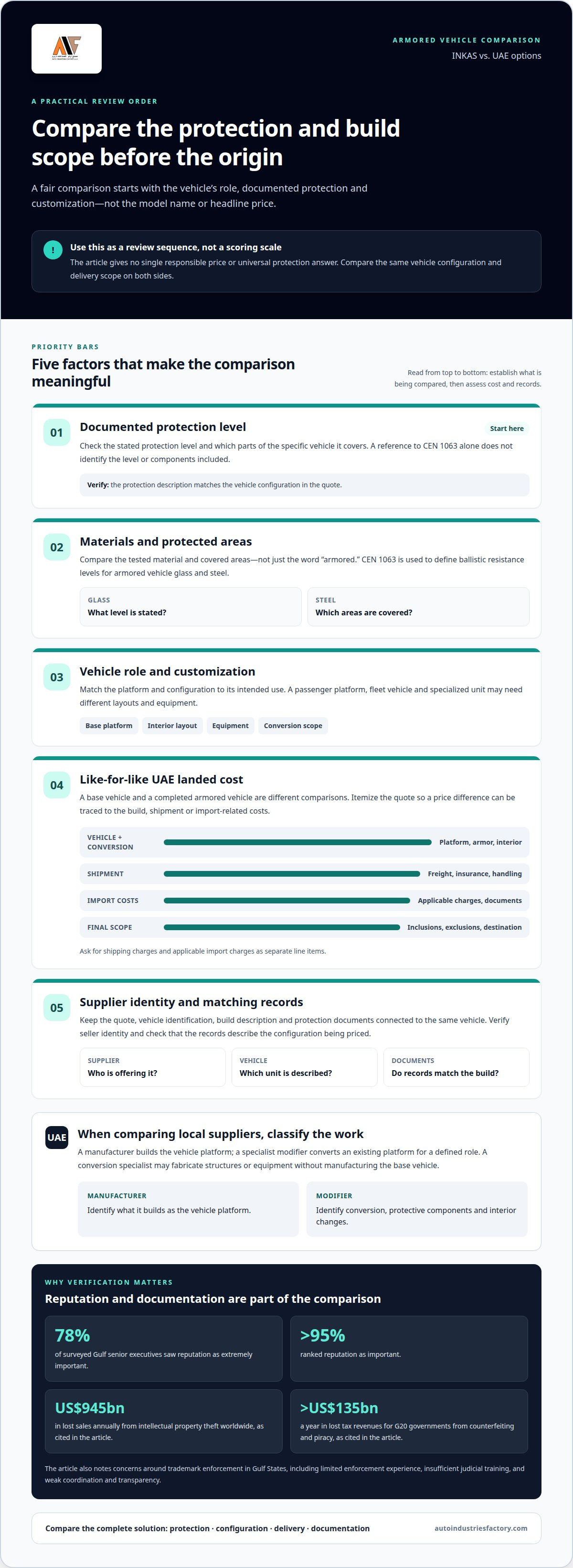
Start with the vehicle configuration and intended role. A passenger platform, fleet vehicle, and specialized unit can require different layouts and equipment. Protection materials and coverage also affect the build. For example, a requirement focused on protected glass differs from one that specifies armored steel coverage as well. Check what the quote includes rather than comparing headline prices alone.
Separate UAE delivery costs from vehicle and conversion costs. The shipping quote should itemize freight, cargo insurance, handling, and documentation charges included in its total. Show applicable import charges as separate line items. This makes it easier to see whether a price difference comes from the armored build, shipping arrangement, or delivery route.
- Vehicle and conversion: platform, armor materials, protected areas, and interior configuration.
- Shipment: freight method, insurance, handling, and delivery destination in the UAE.
- Import-related costs: applicable charges and documentation listed separately from freight.
- Final scope: included equipment, exclusions, and the quoted delivery point.
Protection documentation matters alongside the cost. CEN 1063 is an international standard used to define ballistic resistance levels for armored vehicle glass and steel. A reference to CEN 1063 alone does not show which level or components are included in a particular vehicle. Compare the stated level, tested material, and covered areas against the protection requirement in the quotation.
INKAS warns that counterfeit armored vehicle offers have increased in Dubai, UAE. Documentation and seller identity are therefore important parts of the purchasing decision, not administrative details. Keep the quote, vehicle identification, build description, and protection documents linked to the same vehicle. If the records describe different configurations, the price comparison may not represent equivalent protection.
For a practical comparison, request an itemized quote for the exact vehicle and delivery destination. Match each line against an equivalent UAE option: vehicle, protection scope, customization, shipping, and import charges. Then compare what is included and what falls outside the quoted total. This gives you a useful landed-cost comparison without relying on a broad estimate that may describe a different build.
For a practical comparison, weigh seller credibility and documentation alongside the quoted total. In a survey of Gulf senior executives, 78% saw reputation as extremely important, and over 95% of respondents ranked reputation as important. Intellectual property theft costs legitimate businesses worldwide US$945bn in lost sales annually, while counterfeiting and piracy cost G20 governments more than US$135bn a year in lost tax revenues.
A WIPO survey links ineffective enforcement of trademark protections in Gulf States to issues such as ineffective legislative drafting, limited enforcement experience, insufficient judicial training, and weak coordination and transparency. These concerns reinforce the value of verifying the seller, vehicle identity, and protection records before comparing offers.
Which UAE-based companies manufacture or modify armored vehicles?
In the UAE, distinguish a vehicle manufacturer from a specialist modifier before comparing suppliers. A manufacturer builds the vehicle platform, while a modifier converts an existing platform for a defined role. These terms describe different work, not interchangeable credentials. A conversion specialist may fabricate vehicle structures or equipment without manufacturing the base vehicle.
For a local shortlist, classify each supplier by the work it performs. Identify whether its scope covers vehicle conversion, protective components, or both. A provider that modifies police or military vehicles has a different operational focus from one converting safari vehicles. This distinction helps match a supplier’s capabilities to the vehicle’s intended use.
“Armored” can describe different protection scopes. CEN 1063 is an international standard used to define ballistic resistance levels for armored vehicle glass and steel. A reference to the standard doesn’t establish that every component or the complete vehicle meets the same level. Compare the documented protection scope with the vehicle’s intended role, including which areas are covered.
Use a consistent review process for each UAE-based company:
- Classify the work: vehicle manufacture, vehicle modification, or a combination.
- Define the platform: identify the base vehicle and intended operating role.
- Map the conversion: note the protective materials, covered areas, and interior changes.
- Review documentation: connect the protection description to the specific vehicle configuration.
- Compare deliverables: separate fabrication, installation, finishing, and any stated after-sales scope.
For example, a fleet vehicle that needs a specialized working layout may require extensive conversion even if its protection scope is limited. A vehicle with a defined ballistic protection requirement may need a different materials and documentation review. In either case, identify who modifies the vehicle and who provides its protection documentation.
Local fabrication can also cover operational equipment beyond ballistic materials. Metal canopies, roof racks, bull bars, and custom bumpers are vehicle modifications, but they do not demonstrate ballistic protection. Keep these categories separate when comparing offers. Do not treat a vehicle fitted with protective equipment as armored unless its protection scope is clearly documented.
Compare the UAE options by each supplier’s actual role and the recorded build scope, not by a broad “local manufacturer” label. For a police or military configuration, prioritize relevant modification capability; for a safari vehicle, assess the conversion requirements. Then compare local work with an imported build on equivalent vehicle, protection, and customization terms.
Auto Industries Factory LLC provides police and military vehicle modifications and safari vehicle conversions. These services are relevant when the requirement centres on a specialized vehicle role and its conversion scope. Explore vehicle modification services as a next step in considering a local conversion.
What armored vehicle models and protection levels are available locally in the UAE?
Compare local armored vehicle options by platform, intended role, and documented protection scope. A model name identifies the base vehicle, not the completed conversion. For example, an SUV configured for passenger transport and a pickup adapted for field operations have different layouts. The model alone does not tell you which areas are protected or what materials the build uses.
Record the exact make, model, year, and body style in each quote. Separate those details from conversion choices such as seating layout, cabin access, storage, and protective coverage. This prevents different vehicle classes from appearing to offer a direct protection comparison. For buyers weighing Inkas armored vehicles vs local UAE options, matching the platform and conversion scope makes the assessment more useful.
Protection levels need their own comparison. CEN 1063, UL 752, and NIJ are international standards used to define ballistic resistance levels for armored vehicle glass and steel. A standard name alone doesn’t describe the full vehicle specification. The quote should connect the stated level to the material and component it covers, such as glass or steel, and show how that scope fits the intended use.
- Platform: record the exact vehicle make, model, year, and body style.
- Protection scope: distinguish glass coverage from steel coverage and identify protected areas.
- Standard: note whether the documentation refers to CEN 1063, UL 752, or NIJ.
- Configuration: compare cabin layout, seating, storage, and mission equipment separately.
Two vehicles built on the same model can differ in glass coverage, steel protection, and interior configuration. Different models may also be specified for comparable protection scopes. Compare the written build descriptions component by component, rather than treating model names or a general “armored” label as proof of equivalent protection.
Ask the supplier’s quote to specify the protection level for each material and component. Match that description to the vehicle identification and conversion scope. This creates a clear record of what the build includes. It also distinguishes ballistic protection from other modifications, such as a canopy, roof rack, or exterior finish, which serve different functions.
When comparing Inkas armored vehicles vs local UAE options, focus on documented builds, not an assumed standard UAE model range. Confirm the platform and intended role first, then compare protection documents and customization. If one option provides a detailed component-level specification and another gives only a broad protection category, the quotes do not provide an equivalent basis for evaluation.
The section describes SUVs configured for passenger transport and pickups adapted for field operations. Protection documentation may refer to CEN 1063, UL 752, or NIJ for glass and steel; the specific level and protected components should be confirmed in each quotation.
The page describes Gulf States’ trademark protection frameworks as generally aligned with the TRIPS agreement. This is separate from comparing vehicle models and protection scopes.
What are the lead times, warranty terms, and after-sales support for INKAS versus UAE suppliers
Compare INKAS and UAE suppliers using written schedules and support terms, not assumed timelines. An imported vehicle’s schedule includes its build, preparation for shipment, international transport, and UAE delivery. A locally modified vehicle’s schedule includes platform availability, conversion work, and handover. Origin alone does not establish which option will be ready first.
Use the same project milestones for both quotes. Record when the schedule begins, what marks the start of production, and which stages come before handover. For an INKAS vehicle, separate manufacturing from transport. For a UAE conversion, separate base-vehicle sourcing from modification and final preparation. A schedule listing only an estimated delivery date hides these distinctions.
Customization changes the sequence. A standard configuration and a vehicle requiring a different interior, protective coverage, or mission equipment involve different scopes of work. Production planning also depends on the selected platform and required materials. Compare schedules only after both quotes describe the same vehicle role and conversion scope; otherwise, a shorter timeline may simply include fewer tasks.
- Schedule: identify build, conversion, shipment, and handover milestones.
- Starting point: record the event that starts the stated lead time.
- Dependencies: note platform sourcing, selected materials, and customization stages.
- Handover: identify the documents and vehicle condition included at delivery.
Read warranty terms component by component. Separate coverage for the base vehicle from coverage for armor materials, glass, conversion workmanship, and installed equipment. The written terms should state the coverage period, start date, covered components, exclusions, and claims process. A general warranty statement does not show whether every part of the build receives the same coverage.
A concern involving armored glass differs from one involving the base vehicle or a fitted interior component. The warranty should identify which party handles each claim and what records support it. Compare INKAS and UAE supplier documents using the same categories. Coverage boundaries and claims handling matter more than a broad warranty label.
After-sales support is a defined scope, not just a location. Compare how each supplier handles technical questions, replacement components, warranty claims, and scheduled service. For an imported INKAS vehicle, the support arrangement should explain communication and parts coordination across borders. A UAE supplier’s terms should describe the local support process and its limits.
Before choosing, compare the timeline, warranty, and support terms alongside the vehicle specifications. Check that every document refers to the same configuration and protection scope. This exposes gaps between the build quote and ownership support, helping you assess the full commitment rather than delivery timing alone.
Maintenance, parts, and service costs in the UAE
Ownership costs depend on the base vehicle, armor configuration, replacement parts, and service approach. For an INKAS import, distinguish standard vehicle servicing from work on the armored conversion. For a UAE-modified vehicle, separate the base platform from locally fabricated or installed components. This breakdown shows which costs relate to ordinary upkeep and which relate to specialized equipment.
Start with the maintenance schedule for the exact base vehicle. Engine, transmission, braking, and other routine servicing follow that vehicle’s requirements, not its armored status alone. Added mass and vehicle use can affect wear patterns, so a fleet vehicle used in urban conditions and one used on rough terrain may need different attention. Record usage and service history for each unit.
Armored components may require additional inspection. Glass, steel panels, door mechanisms, and seals are examples of areas that may need attention after damage or heavy use. Repairing protective materials differs from replacing an ordinary trim part. The service record should identify the affected component, work performed, and any documentation associated with the repair.
Parts access is another UAE cost factor. A standard part for a widely available base model may follow a different sourcing route from a specialized armored component. Imported parts can involve shipping and coordination, while locally fabricated items may require production and fitting. These routes affect lead time and labour, so compare the parts source and work scope, not just the component description.
- Base vehicle: identify the model and its routine service requirements.
- Armor components: separate glass, steel, seals, and mechanisms from standard parts.
- Parts route: distinguish locally sourced components from imported or custom-fabricated items.
- Labour: identify whether a task involves routine servicing, specialist repair, or refitting.
Compare service estimates by matching the same maintenance task and parts scope. For example, an estimate for an ordinary door mechanism should not be compared with one covering a protective door assembly. Ask each quote to distinguish inspection, replacement parts, labour, and any transport or sourcing charges. In the UAE, the final service cost depends on those specific parts and work requirements, and is provided after a quote request.
For fleet planning, keep a record for each vehicle of its base model, conversion configuration, service dates, replaced components, and parts source. This helps identify recurring needs and supports more accurate budgeting. It also gives service teams a clear reference when a future repair involves both standard vehicle systems and specialized protective components.
Before choosing between an imported INKAS vehicle and a local option, compare maintenance scope and parts pathways alongside purchase and delivery. A lower initial quote may not mean lower ownership costs if it excludes servicing specialized components. Use matched service scenarios and documented parts categories to make the comparison meaningful.
Auto Industries Factory LLC
Auto Industries Factory LLC is a practical next step when your UAE project involves adapting a vehicle for a specialized role. Its work includes police and military vehicle modifications, safari vehicle conversions, and metal canopies and roof racks. These options address vehicle configuration and fabricated equipment, while ballistic protection documentation must be assessed separately.
For a local project, define the base vehicle, its operating role, and the modifications required. Auto Industries Factory LLC supports conversion work with in-house fabrication, including metal cutting, bending, welding, and painting. This is relevant when comparing a locally modified platform with an imported vehicle and deciding which configuration best suits your operational needs.
Contact Auto Industries Factory LLC to discuss your vehicle modification requirements.
Turn your vehicle requirements into a clear next step
Choose a vehicle based on its operating role, then define the conversion and protection scope that role requires. When comparing INKAS armored vehicles and local UAE options, translate those needs into a written vehicle specification. Separate ballistic protection requirements from mission configuration, and ensure each quote describes the same intended use.
Auto Industries Factory LLC supports specialized vehicle projects through ambulance conversions, police and military vehicle modifications, and safari vehicle conversions. These services suit requirements for a locally adapted vehicle configuration. They address conversion needs, while ballistic protection levels should remain tied to documentation for the specific vehicle and components.
Bring your intended role, base vehicle, and required modifications together before planning the next stage. Clear inputs help keep the project discussion focused on practical requirements and build scope. Contact Auto Industries Factory LLC to discuss your vehicle conversion needs and take the next step with confidence.
Frequently Asked Questions
Which option is better suited to UAE heat, desert driving, and local security needs?
Choose the option whose configuration, documented protection scope, and equipment match the vehicle’s operating conditions and intended security role. Compare the complete build rather than choosing by origin or model name alone.
How do INKAS vehicles compare with UAE options for ballistic protection, build quality, and performance?
Compare documented protection levels, materials, and covered areas for equivalent vehicle configurations. A standard name alone does not establish the protection of the complete vehicle. Assess customization and recorded build scope alongside lead times, warranty, after-sales support, parts access, and servicing needs.


