

A GMC badge alone doesn’t define an ambulance build. A custom built ambulance on GMC chassis is configured around the chassis and powertrain, cab layout, crew requirements, patient-area interior, and equipment access. Each decision affects how the finished vehicle functions as a whole.
Start with those fundamentals before choosing fittings and finishes. The right configuration depends on the crew’s operating needs and how they will use the ambulance, not just the vehicle platform.
This article covers key chassis and powertrain considerations, cab and crew layouts, interior planning, and equipment access. Understanding how these decisions connect helps you create a practical build brief for your team in the UAE.
Key Takeaways
- Match the chassis and powertrain to the ambulance’s intended use, then plan the build around the vehicle as a complete system.
- Understand how Type I and Type III cab layouts differ, including the style of connection between the cab and patient module.
- Plan the interior around crew movement, essential equipment, and clear access to stored items.
- Consider how cab and crew configuration affects space and day-to-day workflow before settling the layout.
- See how custom ambulance conversions and bull bars can contribute to a purpose-built vehicle configuration.
Type I ambulance chassis and configuration options
GMC ambulance layouts can use a truck-chassis Type I body or a cutaway-van-chassis Type III body. This choice defines the connection between the cab and patient area and guides the finished unit’s configuration.
For a custom built ambulance on GMC chassis, define the body style alongside the cab layout, crew needs, and equipment access requirements.
Type I and Type III body configurations
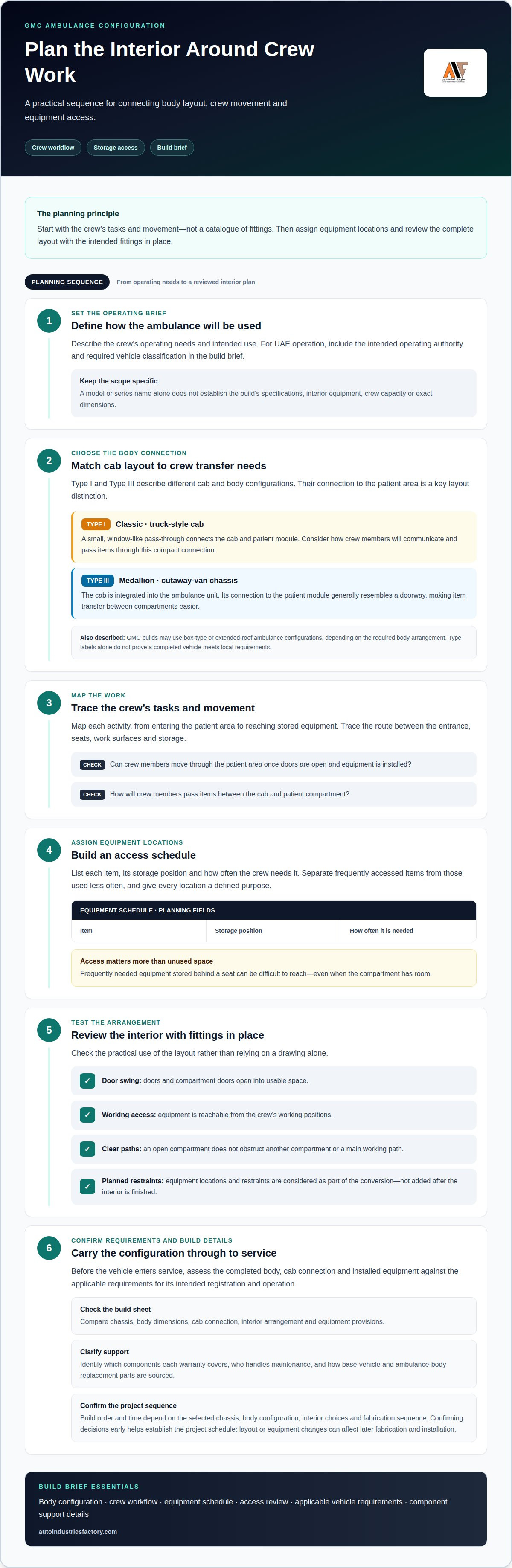
A Type I Classic ambulance has a truck-style cab, similar in appearance to a pickup. A small, window-like pass-through connects the cab and patient module. Consider how the crew will communicate and pass items between compartments, since this compact connection is a defining layout feature.
A Type III Medallion uses a cutaway-van chassis, with the cab integrated into the ambulance unit. Its connection to the patient module generally resembles a doorway, making it easier to transfer items between the driver and patient compartments. GMC builds may also use box-type or extended-roof ambulance configurations, depending on the required body arrangement.
Type I and Type III describe different body and cab configurations. They do not, by themselves, specify a finished ambulance’s interior equipment, crew capacity, or exact dimensions.
Safety and Construction Standards
For use in the UAE, the applicable ambulance safety and construction standards depend on the vehicle’s intended registration and operation. Type I Classic and Type III Medallion are configuration labels, not proof that a completed vehicle meets local requirements.
Include the intended operating authority and required vehicle classification in the build brief. Before the vehicle enters service, assess the completed body, cab connection, and installed equipment against the applicable requirements.
Model details and support considerations
A series name alone does not establish the specifications of a particular build. Compare the build sheet for its chassis, body dimensions, cab connection, interior arrangement, and equipment provisions. This same approach helps distinguish one Type III ambulance chassis option from another.
Custom GMC ambulance builders are specialist vehicle converters who work with GMC chassis. The key question is whether a builder’s specific configuration suits the required body type and operating needs. A model or series name alone does not identify every manufacturer or establish a build’s details.
Warranty, maintenance, and parts support depend on the chassis and conversion components. Clarify which components each warranty covers, who handles maintenance, and how replacement parts for the base vehicle and ambulance body are sourced. A mismatch between the chosen chassis and the body’s intended layout can limit the conversion, so assess compatibility before finalizing the build.
When discussing warranty, maintenance, and parts, identify the Type I Classic configuration clearly. Its pickup-style cab and window-like pass-through are distinctive layout details that help specify which build the support applies to. Relate coverage, service arrangements, and parts information to the actual ambulance configuration, rather than relying on the model label alone. Keep these details with the build information for reference when support is needed.
Custom ambulance interiors and equipment access
Plan the interior around the crew’s tasks, not a catalogue of fittings. Map each activity, from entering the patient area to reaching stored equipment, then position work surfaces, seats, and storage to support that sequence. On a custom built ambulance on GMC chassis, the body layout and access points should work with the team’s actual workflow.
GMC, Ford, and Mercedes-Benz ambulance builds can’t be ranked by badge alone. Compare each proposed build against the same requirements: body configuration, crew workflow, interior arrangement, and equipment access. A consistent brief makes the differences easier to assess without assuming one chassis suits every operation.
Plan the interior around the work
List the equipment the crew needs to reach during a call. Separate frequently accessed items from those used less often, then assign each a clear storage location. Place frequently used items where the crew can reach them without blocking movement through the patient area. Make sure storage doors and compartments open into usable space, not against a seat or main working path.
Next, map the crew’s movement through the interior. Trace the route from the patient-area entrance to seating, work surfaces, and storage. A layout that looks spacious on a drawing may feel constrained when doors open and equipment is installed. Review access at each stage, including how crew members pass items between the cab and patient compartment. Type III layouts have a doorway-like connection, while Type I designs use a smaller pass-through.
Build the equipment-access plan
Create a simple equipment schedule showing each item, its storage position, and how often the crew needs it. This exposes potential conflicts between storage, seating, and movement. For example, an item that the crew frequently needs but stores behind a seat is difficult to access, even if the compartment has room. Tie the schedule to the interior plan so every location has a defined purpose.
Review the layout with all intended fittings in place. Check door swing, access from the crew’s working positions, and whether an open compartment obstructs another. This practical design review does not replace applicable vehicle requirements. Plan equipment locations and restraints as part of the conversion, rather than adding them after the interior is finished.
Build schedule and UAE registration steps
The order and build time depend on the selected chassis, body configuration, interior choices, and fabrication sequence. Confirming these decisions early helps establish a project schedule. Changes to the layout or equipment plan can affect later fabrication and installation stages.
For a UAE project, the working sequence is to define crew and equipment needs, settle the chassis and body layout, outfit the interior, prepare vehicle documentation, and complete the applicable registration process. Registration requirements depend on the vehicle’s intended classification and operating authority. Keep the build records aligned with the finished configuration so the vehicle can be presented consistently.
A clear interior brief gives the conversion team a practical basis for planning storage, movement, and equipment access. These decisions connect the chosen body layout with the crew’s day-to-day work.
Ambulance chassis, engines, and transmissions
The GMC chassis, engine, and transmission must suit the finished body and its intended operating conditions. For payload and dimensions, use the exact GMC model-year specifications and measurements of the completed conversion. Payload depends on the chassis rating and finished vehicle weight, including the body, equipment, and occupants.
There is no universal specification for every GMC ambulance chassis. The relevant dimensions and weight limits depend on the model, wheelbase, cab configuration, and conversion choices. A build sheet should identify the exact chassis and document the completed vehicle’s weight and exterior measurements. This gives the conversion team a specific basis for assessing whether the planned body and equipment will fit.
Match the chassis to the finished build
Begin by defining the body style and intended equipment load. A box-type body and an extended-roof body have different packaging needs, so select the chassis before finalizing interior placement. The conversion plan should account for the body, installed equipment, crew, and any other carried load together. Treating the base vehicle’s payload as entirely available for equipment overlooks the weight added by the conversion.
Give dimensions the same attention. Record the planned body length, width, and height, then compare them with the selected chassis and completed configuration. Include access doors and external fittings, which can affect practical clearance and service access. For a custom built ambulance on GMC chassis, these measurements link the platform choice to the space the crew will actually use.
Choose the powertrain around operating demands
Consider the engine and transmission as a matched powertrain, not as isolated options. Start with the vehicle’s expected duty cycle, route conditions, carried load, and body configuration. These factors shape the demands on the powertrain in regular operation. Rather than choosing by engine label alone, assess the completed ambulance and its working conditions together.
Have the build specification name the selected engine and transmission alongside the chassis model. This makes the configuration clear when reviewing service needs or planning future parts support. If the conversion changes the vehicle’s weight or intended use, assess the entire powertrain against the finished build rather than relying on the unconverted chassis description.
Review the build information before fabrication
Use a clear review sequence: identify the GMC model and model year, confirm the chassis specifications, define the body and equipment plan, then document the finished dimensions and weight. Record the engine and transmission selected for that configuration as well. This sequence can catch mismatches early, such as a body plan that requires more payload than the completed vehicle can accommodate.
Keep the chassis data and conversion records together. Tying specifications to an exact build helps fleet teams distinguish ambulance configurations and plan operations around the vehicle they have received.
Custom ambulance cab and crew configurations
The cab configuration determines who travels in the driver compartment and how the crew moves between compartments. For a GMC ambulance, plan the driver’s position, passenger seating, entry points, and cab-to-patient-area connection together. This ties the cab layout to the crew’s actual operating sequence.
Set the cab layout around crew roles
Begin with a crew-role plan. Identify the driver, the front passenger, and the team members working in the patient compartment. Then map each person’s movement from boarding to their working position. A configuration suited to a driver and front passenger may not work as well for a team that needs frequent communication across compartments.
Review the cab as a working area, not just a place to sit. The driver needs clear access to vehicle controls, while the passenger position may need to support communication and coordination. Keep these functions distinct in the layout plan. Before fabrication proceeds, confirm seat positions and access routes against the selected GMC cab and ambulance body.
- Driver position: preserve practical access to driving controls and the cab exit.
- Passenger position: consider how the occupant communicates with the driver and patient-area crew.
- Cab entry: map how each crew member boards without disrupting another person’s movement.
- Compartment connection: include the pass-through or doorway in the crew’s communication and transfer plan.
Coordinate the cab with the patient compartment
The cab and patient module function as connected work zones. In a Type I Classic, the small pass-through shapes how crew members communicate and pass items. In a Type III Medallion, the doorway-like connection makes it easier to transfer items between driver and patient compartments. Use the chosen connection as a fixed point when planning crew movement and handoffs.
For example, trace a routine sequence from vehicle entry to the patient compartment. Note where a crew member needs to speak with the driver, retrieve an item, or move between zones. If the route crosses a seat or blocks a cab exit, revise the layout before the conversion advances. A simple movement review can reveal conflicts that a seating diagram alone misses.
Confirm the configuration before build
Record the planned crew positions, cab access, and compartment connection in one configuration brief. Tie each decision to the selected GMC chassis and body type. This gives the conversion team a shared reference for fabrication and helps prevent late changes to seating or access arrangements.
Finally, review the completed cab against the brief. Confirm that each crew position and movement route matches the intended use. A defined layout makes it easier to assess the finished configuration as one coordinated ambulance.
Which GMC chassis are available for custom-built ambulances?
No single GMC chassis designation fits every ambulance conversion. The suitable platform depends on the chosen body configuration, cab arrangement, crew needs, and finished vehicle requirements. For a UAE build, identify the exact GMC model and model year first, then match the conversion plan to that platform’s documented specifications.
GMC is the make, not a complete chassis specification. A useful build brief names the vehicle model, model year, cab configuration, and intended ambulance body. It should also state whether the build calls for a box-type body or an extended-roof arrangement. These details give the conversion team a defined starting point without assuming every GMC platform can carry every body style.
Define the platform by the body configuration
Start with the body type. A Type I Classic uses a truck-style cab, while a Type III Medallion uses a cutaway-van chassis. These are distinct configurations, not interchangeable descriptions. Select the body arrangement first, then identify a GMC chassis whose documented configuration matches the intended build.
Next, bring the chassis specifications and conversion plan together. Compare the planned body dimensions with the platform information, accounting for the weight added by the conversion and installed equipment. The completed ambulance’s payload and dimensions depend on the exact chassis and build, not the GMC name alone. Keep this review specific to one model year and one configuration.
Use a build brief to narrow the choice
A practical brief should record the intended body type, cab layout, crew arrangement, equipment plan, and operating conditions in the UAE. Each affects the platform decision. For example, box-type and extended-roof bodies require different packaging plans, so choose the chassis to suit the intended body.
Document the selected GMC model and year alongside the planned body configuration. Then assess how the proposed dimensions and added weight align with the vehicle’s specifications. This keeps chassis selection grounded in the actual ambulance rather than a generic model label or an assumption about availability.
Before fabrication, align the chassis information with the body drawings and conversion records. Resolve any mismatch between the selected platform and planned configuration before the build proceeds. For fleet planning, record each vehicle’s model year and configuration separately so replacement or repeat builds can be specified accurately.
To move from platform choice to a defined build, share your GMC ambulance configuration requirements with the conversion team.
Auto Industries Factory: Custom Bull Bars and Bumpers
Auto Industries Factory LLC offers ambulance conversions, as well as custom bull bars and bumpers for specialist vehicles. Once you have defined the GMC chassis, body configuration, and crew requirements, its conversion service can turn those decisions into a purpose-built ambulance.
Custom bull bars and bumpers can form part of the vehicle’s exterior configuration. Their design and fit should suit the selected vehicle and intended build. Auto Industries Factory LLC also modifies police and military vehicles and converts safari vehicles, using its fabrication capabilities to work with specialist platforms.
If your GMC ambulance project needs a conversion or custom bull bars and bumpers, contact Auto Industries Factory LLC to discuss the build.
Auto Industries Factory LLC provides ambulance conversions for GMC-based builds.
Turn your build brief into a clear next step
Shape the project around the crew’s operating priorities. A focused brief can outline the intended role, preferred GMC platform, body configuration, crew arrangement, and equipment needs. This gives the conversion discussion a practical starting point and keeps decisions connected as the build takes shape.
A custom built ambulance on a GMC chassis is a specialist vehicle project, and the conversion should suit its intended use. Auto Industries Factory LLC offers ambulance conversions, alongside Police & Military Vehicle Modifications and Safari Vehicle Conversions. If you need a custom bull bar or bumper, include it in the build discussion.
Share the project requirements and the decisions your team has already made. Contact Auto Industries Factory LLC to discuss your build and take the next step toward a configuration shaped around your crew.
Frequently Asked Questions
How do custom GMC ambulances compare with Ford and Mercedes-Benz ambulance builds?
Compare GMC, Ford, and Mercedes-Benz builds against the same requirements: body configuration, crew workflow, interior arrangement, and equipment access. The badge alone does not determine which build suits an operation.
How long does it take to order and build a custom GMC ambulance?
The order and build schedule depend on the selected chassis, body configuration, interior choices, and fabrication sequence. Confirming these decisions early helps establish a schedule, while later changes to the layout or equipment plan can affect fabrication and installation.


