
Fabricated metalwork can change a vehicle’s appearance and function. Custom vehicle accessory fabrication in the UAE includes tailored bodywork, metal accessories, and off-road additions. Any changes to the vehicle’s frame or structure need careful planning to suit its overall setup.
It’s natural to focus first on appearance: a stronger profile, added protection, or equipment suited to how you use your vehicle. The right solution also accounts for fit, materials, and driving conditions. A modification should work as a complete setup, not just look striking.
This guide explains how bodywork and frame changes differ, what metal fabrication can achieve, and how accessories such as bull bars, canopies, and roof racks can change a vehicle. It also covers practical considerations for off-road modifications and how Auto Industries Factory LLC’s fabrication and conversion services can support your project.
Key Takeaways
- Learn how bodywork and frame changes can alter a vehicle’s appearance and configuration, and why changes should be planned as a complete build.
- Explore how bull bars, bumpers, canopies and roof racks can serve practical needs in off-road setups.
- See which UAE driving conditions to consider when planning a vehicle build, including the terrain and how the vehicle will be used.
- Understand how cutting, bending, welding and finishing contribute to precise, durable fabrication.
- Discover how Auto Industries Factory’s custom bull bars and bumpers can fit projects that need purpose-built metalwork.
Custom bodywork and frame modifications
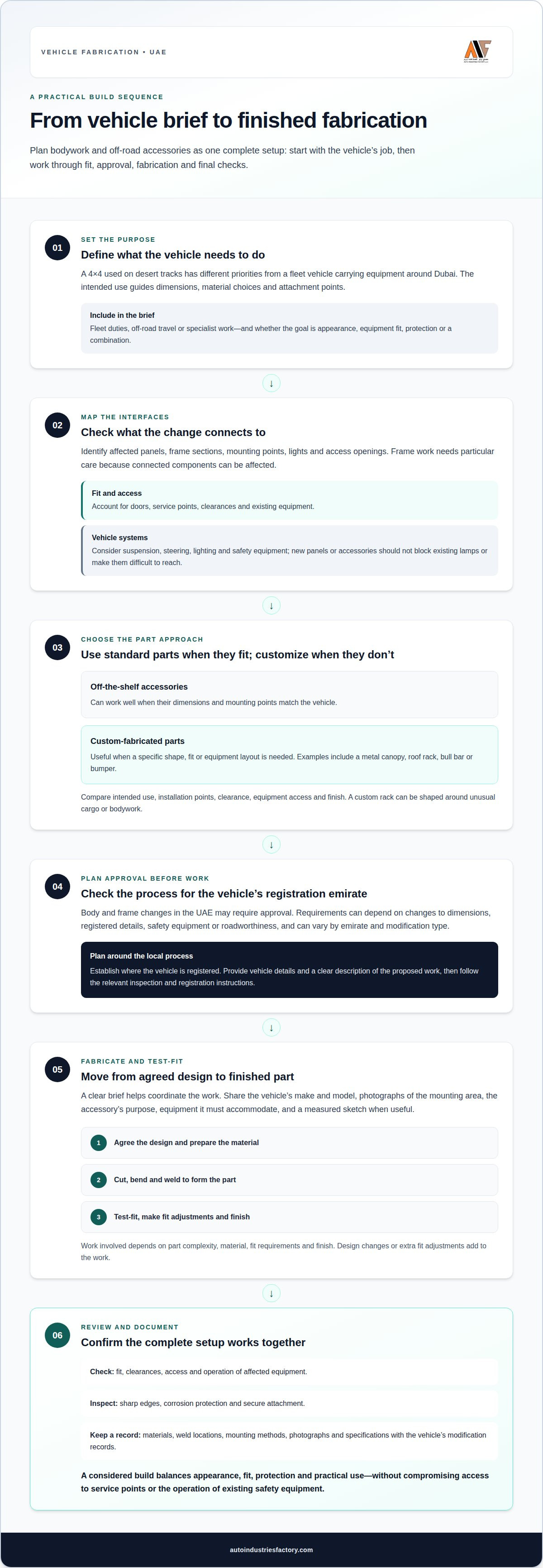
Bodywork changes can reshape a vehicle’s profile, add purpose-built protection, or support specialist equipment. A revised front end, reinforced mounting points, or altered rear body panel each changes how parts fit together. Start by defining the vehicle’s job: a 4×4 used on desert tracks has different priorities from a fleet vehicle carrying equipment around Dubai. That purpose guides the dimensions, material choices, and attachment points.
In the UAE, body and frame changes may require approval. Requirements can depend on whether the work affects the vehicle’s dimensions, registered details, safety equipment, or roadworthiness. Requirements vary by modification, so document the proposed changes and intended use before work begins.
For approval in Dubai or Abu Dhabi, start with the vehicle modification and inspection process in the emirate where the vehicle is registered. Provide the vehicle details and a clear description of the proposed body or frame work, then follow the relevant inspection and registration instructions. The process can vary by emirate and modification type, so establish where the vehicle is registered before planning the work.
A 4×4 off-road vehicle modification should preserve practical access and avoid unnecessary interference with existing systems. For example, a custom bumper may need mounting points that suit the vehicle’s front structure, while a body change should account for doors, lights, and service access. Lighting placement also matters: a new panel or accessory shouldn’t block existing lamps or make them difficult to reach.
Car modification services can involve visual changes, functional fabrication, or both. A vehicle color change updates the exterior finish, while formed metal panels or a new bumper alter its shape and protection layout. Define whether your goal is appearance, equipment fit, off-road use, or a combination. A clear scope helps coordinate the fabrication and fitting work.
- Set the use case: Specify whether the vehicle serves fleet duties, off-road travel, or specialist work.
- Map affected areas: Identify panels, frame sections, mounting points, lighting, and access openings.
- Plan approval: Establish the registration emirate’s inspection steps before fabrication starts.
- Review the completed build: Check fit, clearances, access, and the operation of affected equipment.
Frame work calls for particular care because it can affect several connected components. A mounting change for a bumper, for instance, should be planned around the supporting structure, not treated as a cosmetic alteration alone. A written scope that records the intended use, affected parts, and finish gives the fabrication team at Auto Industries Factory LLC a clear basis for building and inspection.
Modifications often impact multiple components at once, so confirm how proposed changes interact with suspension, steering, and other equipment before starting custom vehicle accessory fabrication UAE projects. Ask the workshop to record materials, weld locations, and mounting methods, and inspect the finished work for sharp edges, corrosion protection, and secure attachment. Keep photographs and specifications with the vehicle’s modification records; they can help explain the work during inspection or later servicing.
Industry data reports thousands of modified cars in Dubai. For any individual build, however, popularity is no substitute for checking the vehicle’s specific requirements. Agree on the intended use, fabrication scope, and inspection plan with the workshop before work starts, and avoid changes that compromise access to service points or the operation of existing safety equipment.
Off-road accessories and parts
Choose off-road accessories to suit the vehicle’s purpose, mounting points, and equipment layout. A vehicle built for desert tracks may need different parts from a fleet vehicle used across mixed terrain.
Custom-Fabricated Off-Road Parts
Custom fabrication creates parts shaped for a particular vehicle or task, such as a metal canopy, roof rack, bull bar, or bumper. Check fit, mounting points, clearance, and access to existing equipment. For example, a rack designed to carry tools should secure the cargo without blocking doors or service points. Custom dimensions are useful when standard parts don’t suit the vehicle or its intended setup.
Custom Versus Off-the-Shelf Accessories
Off-the-shelf accessories can work well when their dimensions and mounting points match the vehicle. Custom parts are useful when you need a specific shape, fit, or equipment layout. Compare the intended use, installation points, access, and finish. A standard rack may suit a typical setup, while a custom rack can be shaped around unusual cargo or bodywork.
For custom vehicle accessory fabrication in the UAE, give the fabricator a clear brief before production. Include the vehicle’s make and model, photographs of the mounting area, the accessory’s purpose, and any equipment it must accommodate. A sketch with measurements can clarify the required shape. These details help plan cutting, bending, welding, fitting, and finishing as connected steps.
Fabrication time depends on the part’s complexity, material, fit requirements, and finish. A simple bracket requires fewer steps than a multi-part canopy or bumper with several mounting points. The work typically follows the agreed design, material preparation, fabrication, test fitting, and finishing. Design changes or extra fit adjustments add to the work involved.
UAE customers can use specialist vehicle fabrication workshops for one-off parts and purpose-built vehicle equipment. For example, a fleet operator may need matching racks across several vehicles, while a 4×4 owner may need one part shaped around a particular setup. Share the vehicle details and intended use so the fabrication team can define the part’s dimensions and build process.
- Define the job: State what the accessory must carry, protect, or support.
- Identify fit points: Show the vehicle areas the part must attach to or leave accessible.
- Set the finish: Specify the desired surface and how the part should integrate with the vehicle.
For purpose-built vehicle equipment, consider the fabrication capabilities available and whether the proposed work suits your vehicle and operating needs.
Vehicle builds for UAE off-road conditions
A capable UAE 4×4 build starts with the route, not a catalogue. A vehicle crossing soft sand needs a different setup from one carrying equipment over gravel tracks.
For off-road customization, match each change to the vehicle’s role. A Toyota Land Cruiser used for family trips has different priorities from a Nissan Patrol carrying work gear. Consider ground clearance, approach angles, cargo, passenger space, and how often you drive on paved roads. These factors help determine whether you need body protection, storage, or a different equipment layout.
Desert driving also calls for practical choices around heat, dust, and recovery. Keep essential controls and lights accessible after installing equipment. Consider how cargo is secured, where recovery gear sits, and whether any parts obstruct visibility. Roof-mounted loads, for example, affect how equipment is arranged and accessed. A planned layout is easier to use than a collection of unrelated upgrades.
Land Rover, Toyota, and Nissan offer different vehicle platforms, and even body shapes and fittings within a model range can affect accessory fit. Identify the exact model and body configuration before planning custom work. A part designed for one Land Cruiser configuration may need different dimensions or mounting points to fit another.
Start off-road planning with a defined route and payload. List the usual terrain, passengers, cargo, and equipment before choosing modifications. Prioritize changes that solve a real operating need. For a vehicle carrying tools on gravel access roads, storage and protection may matter more than visual additions. Comfort and usability also matter on longer drives.
Modifications can create risks if they obstruct lighting, reduce visibility, interfere with vehicle systems, or compromise secure mounting. Warranty coverage and insurance treatment depend on the applicable written terms, so the type and effect of each modification matter.
- Define the route: Separate soft sand, gravel, and regular road use.
- Set the load: Include passengers, tools, and recovery equipment.
- Map access: Keep doors, lights, controls, and storage reachable.
- Match the platform: Use the exact model and body configuration.
For a fleet or private 4×4, record the intended use before fabrication begins. A Safari vehicle conversion, for example, needs a layout suited to its passenger and operating requirements. A staged plan helps keep appearance, access, and function aligned, instead of adding parts that solve separate problems.
Fabrication workmanship and build quality
Build quality shows in how a fabricated part fits, joins, and is finished. On a custom roof rack, accurate measurements help align mounting points and preserve access to doors. Smooth edges, consistent welds, and an even finish also affect the part’s appearance and everyday use. Each detail should serve the vehicle’s purpose.
Choosing a vehicle accessory fabricator in the UAE starts with reviewing relevant metalwork and vehicle-conversion examples. Look for a clear process covering measurement, cutting, bending, welding, fitting, and finishing. A capable team should explain how it will accommodate the vehicle’s shape, mounting locations, and equipment access. Those specifics matter more than broad claims about quality.
Precision starts before the first cut. The fabrication team measures the vehicle and checks those dimensions against the accessory layout. For a custom bumper, this means planning its position around the front structure, lamps, and other components. Test fitting can reveal alignment problems before final finishing, when adjustments are easier to make.
Fabrication methods should match the part. Cutting creates the required profiles, bending forms panels or brackets, and welding joins components. After assembly, the finish should cover the intended surfaces and suit the vehicle. A canopy, for example, needs clean joins and practical access points, not just an exterior shape that looks right.
Build quality affects everyday use. Poorly placed supports can make a rack harder to load, while sharp edges can catch straps or equipment. Interior modifications should preserve comfort and access to controls. For a vehicle conversion, consider how passengers, drivers, and maintenance staff will use each modified area.
- Fit: Check that mounting points align with the vehicle and don’t obstruct access.
- Joining: Review weld consistency and the finish around joined sections.
- Function: Confirm that doors, lights, controls, and equipment remain accessible.
- Finish: Inspect edges, surface coverage, and how the part meets adjacent panels.
Before fabrication, provide the vehicle model, the part’s purpose, and any access requirements. The fabrication team can use these details to plan measurements and the build sequence. During fitting, alignment can be assessed and adjusted before the finish is completed. This process gives the component a clear purpose and helps coordinate its appearance, function, and fit.
For UAE fleet work, consistency matters across repeated parts. A written specification for a batch of matching brackets or racks helps maintain the same layout on each vehicle. Record mounting locations, dimensions, and finish requirements so production and installation follow a common reference. A final visual and fit review can then identify differences before the vehicles return to service.
Custom metal and aluminum fabrication
Custom metalwork turns a vehicle requirement into a part shaped for its fit and function. A canopy, roof rack, bumper, or bracket can be measured, cut, bent, joined, and finished for a specific vehicle. Precision at each stage matters: an inaccurate panel can misalign with adjoining parts or complicate installation.
No single material suits every accessory exposed to heat and sand. Choose based on the part’s load, shape, mounting points, exposure, and intended use. Aluminum is lighter than steel, but the right material also depends on how the component will be formed, joined, and finished.
Begin with the job the part must perform. A roof rack carrying equipment needs a different design brief from a bumper intended to protect the vehicle’s front end. Record the vehicle configuration, attachment locations, cargo or equipment, and required access. These details give the fabricator a practical basis for material selection and dimensions.
Metal cutting and bending shape flat stock into panels, brackets, and structural forms. Welding joins compatible components into an assembly. A canopy, for example, may combine formed panels with a frame and access openings. Its design should account for door movement, cargo loading, and access to existing vehicle equipment.
Aluminum fabrication also requires careful planning of the component’s shape and joints. A shaped panel and a load-bearing support serve different purposes, so they aren’t interchangeable. A rack, for example, needs supports positioned around its mounting points. The design and joining method should suit the loads and intended use.
Include heat and blowing sand in the fabrication brief. A vehicle used on desert tracks may face different exposure from one driven mainly on paved roads. The finish, shape, and position of a part affect how it is exposed and maintained. Describe the intended use clearly rather than assuming one material or finish suits every vehicle.
- Define function: State what the part carries, covers, or protects.
- Measure the vehicle: Record dimensions and mounting locations.
- Choose material by use: Consider load, exposure, shape, and joining needs.
- Review the fit: Check clearances, access, and alignment before finishing.
For custom vehicle accessory fabrication in the UAE, a clear brief helps connect material choice with fabrication steps. Explore vehicle fabrication services for metalwork and conversion requirements.
Auto Industries Factory LLC: Custom Bull Bars and Bumpers
Auto Industries Factory LLC fabricates custom bull bars and bumpers for vehicles that need purpose-built metalwork. This can be a practical solution when a standard accessory doesn’t match the vehicle’s fit, mounting points, or intended use. A clear brief about the vehicle and required function helps define the work.
For broader specialist builds, Auto Industries Factory LLC also handles safari vehicle conversions, police and military vehicle modifications, and ambulance conversions. Each project is planned around the vehicle’s operational role.
If your project needs a custom bull bar, bumper, or specialist conversion, contact Auto Industries Factory LLC to discuss the requirements.
Plan the next stage of your vehicle build
Before starting fabrication, define the vehicle’s role and the changes that matter most. Note its intended use, the equipment it must carry, and the features that need to remain accessible. For custom vehicle accessory fabrication in the UAE, a focused brief helps turn those priorities into a practical project scope.
Auto Industries Factory LLC specializes in Ambulance Conversions, Police & Military Vehicle Modifications, and Safari Vehicle Conversions. These services support projects where a vehicle’s configuration must serve a specific operational purpose. A clear brief helps connect that purpose to the appropriate conversion or modification.
Whether you’re planning a fleet build or preparing a 4×4 for a defined role, make the next step a conversation about the vehicle and its requirements. Contact Auto Industries Factory LLC to discuss your project and move toward a build plan with purpose.
Frequently Asked Questions
Can I change the look of my car with a car fabrication service?
Yes. Fabricated metal parts can change a vehicle’s exterior profile, while a color change updates its finish. A custom bull bar or bumper, for example, can give the front end a more purposeful appearance. Auto Industries Factory LLC also offers vehicle color changes and custom bull bars and bumpers. The right approach depends on whether you want a visual change, a functional accessory, or both, and how the new part fits the vehicle.


