
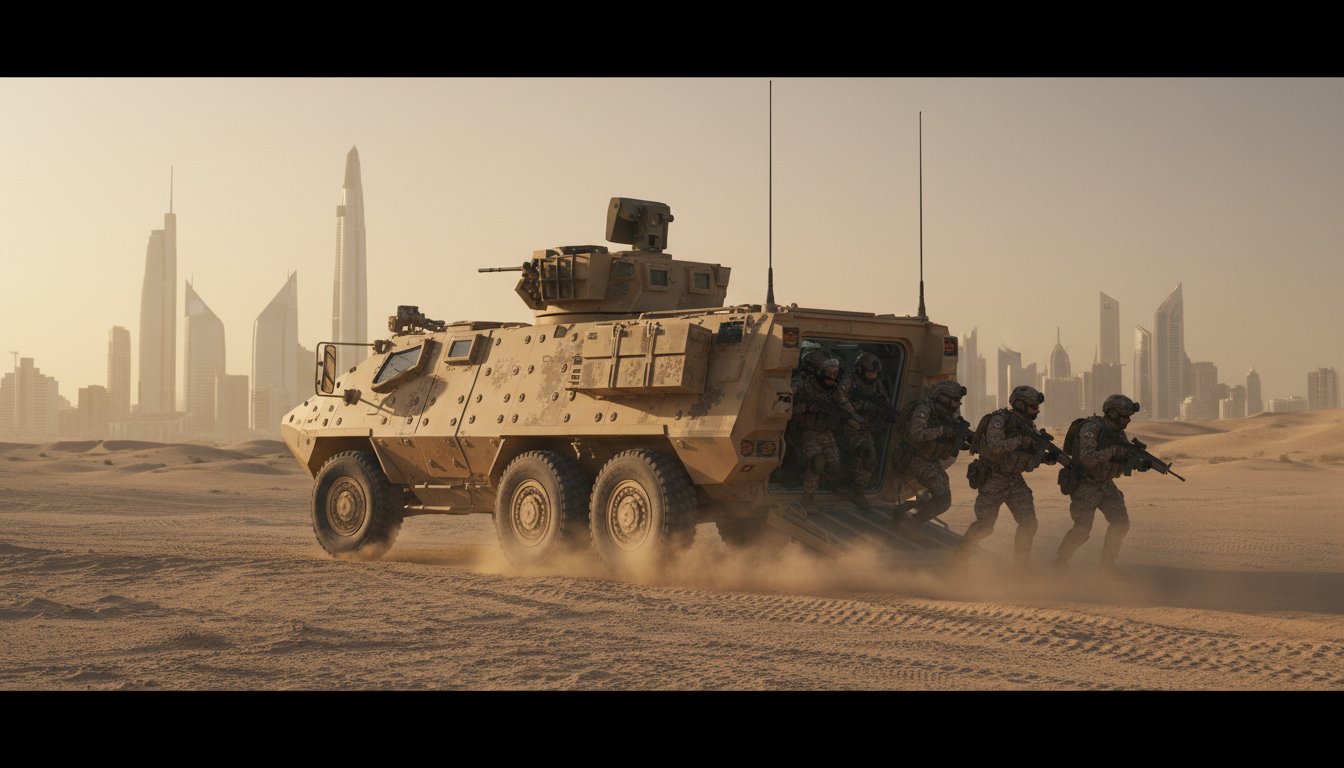
In the complex world of defense hardware, the lines between an APC, an IFV, and an MRAP can often seem blurred. This alphabet soup of designations can obscure the unique and vital role of each platform. Yet, the foundational military armored personnel carrier remains a cornerstone of modern ground forces-a rugged and indispensable asset designed for one primary mission: getting troops to the objective safely and effectively. But what truly separates it from its counterparts, and what core capabilities define a truly advanced APC in today's demanding operational environments?
This essential guide cuts through the confusion. We provide a direct, capability-focused breakdown of the APC's core functions, from its fundamental design principles to the critical components that ensure crew survivability. You will gain a clear understanding of what defines these heavy-duty vehicles, differentiate them from similar platforms, and identify the key areas for modification and modernization. Whether for peacekeeping in challenging terrain or securing national interests in Oman, discover how the right customizations transform a standard APC into a precision, mission-specific solution.
What Defines a Military Armored Personnel Carrier (APC)?
At its core, a military armored personnel carrier is a combat vehicle engineered for a single, mission-critical purpose: to transport infantry squads safely and rapidly across the battlefield. Often nicknamed the 'battle taxi', its primary function is not to engage in direct, heavy combat but to deliver soldiers to a position where they can fight effectively. This role represents a significant evolution from early concepts of simply adding steel plates to trucks. The modern Armoured Personnel Carrier (APC) is a purpose-built platform balancing mobility, protection, and capacity to support mechanized infantry operations in complex environments.
Core Mission: Transporting Troops Under Fire
The fundamental objective of an APC is to shield its occupants from common battlefield threats. Its armor is designed to defeat small arms fire, shell fragments, and shrapnel from artillery bursts, ensuring the infantry squad arrives intact and ready for their objective. This capability enables rapid insertion into hostile territory or extraction from a compromised position, giving commanders crucial tactical flexibility. By mechanizing infantry, APCs allow ground forces to keep pace with main battle tanks and maintain momentum during offensive operations.
Key Characteristics: The Triad of Mobility, Protection, and Capacity
Every APC design is a carefully engineered compromise between three vital attributes. Understanding this triad is key to appreciating the vehicle's role:
- Mobility: APCs come in both wheeled and tracked variants. Wheeled designs typically offer superior speed on roads and lower maintenance, making them ideal for rapid deployment. Tracked designs provide exceptional cross-country performance, capable of navigating soft ground, mud, and complex terrain where wheels would fail.
- Protection: Baseline armor is generally composed of steel or aluminum alloys sufficient for ballistic protection against rifle-caliber rounds. This level of protection is a deliberate trade-off to maintain speed and transport capacity, and it leaves the vehicle vulnerable to anti-tank weapons and heavy machine guns.
- Capacity: A standard APC is built to carry a full infantry section or squad, typically ranging from 8 to 12 soldiers, along with their personal equipment, ammunition, and support weapons.
APC vs. IFV vs. MRAP: Understanding the Critical Differences
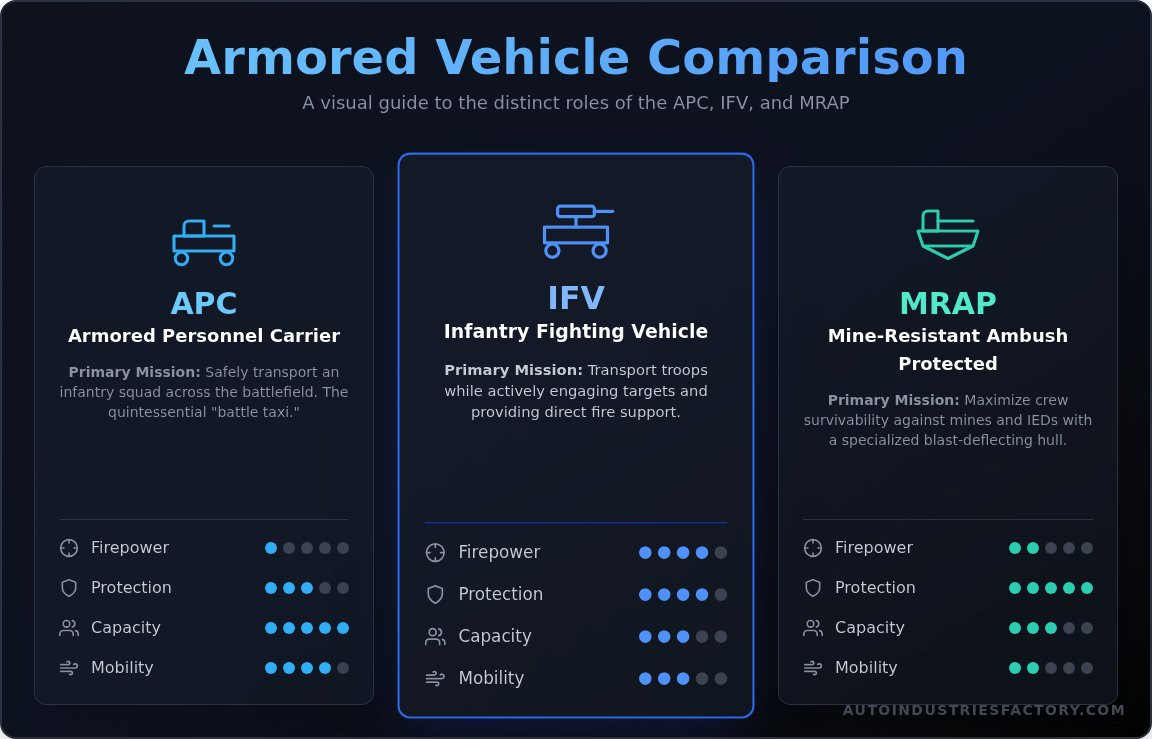
While they may appear similar, these three vehicle classes have distinct design philosophies. An Armored Personnel Carrier (APC) is a transport vehicle with light, defensive armament like a machine gun. In contrast, an Infantry Fighting Vehicle (IFV) not only carries troops but is also equipped with heavier weapons like autocannons and anti-tank missiles to actively support them in combat. A Mine-Resistant Ambush Protected (MRAP) vehicle is a specialist platform, designed with a V-shaped hull to deflect blasts from mines and IEDs, prioritizing crew survivability above all else, often at the expense of mobility or offensive power.
The Anatomy of an APC: Key Design & Engineering Components
A modern military armored personnel carrier is far more than a simple armored box on wheels. It is an advanced, integrated system of systems, meticulously engineered to achieve a critical balance between battlefield mobility, crew survivability, and operational cost. The fabrication and conversion process involves the precise integration of specialized components, each chosen to meet demanding mission parameters. Understanding these core elements reveals the complex engineering behind every effective APC.
Chassis and Drivetrain: The Foundation of Mobility
The performance of any APC begins with its foundation. Many versatile APCs are built upon proven, heavy-duty commercial truck chassis, which are then extensively modified for tactical roles. The powertrain, consisting of a high-torque diesel engine and a robust automatic transmission, is engineered to move the vehicle's significant weight at speed. Critically, a rugged, long-travel suspension system is essential for superior off-road performance across challenging terrains, ensuring the vehicle can keep pace with mechanized forces.
Armor and Survivability Systems
An APC’s primary function is protection. The hull is typically fabricated from high-hardness, military-specification (mil-spec) steel or advanced composite materials that defeat small arms fire and artillery fragments. Modern designs incorporate angled surfaces and V-shaped hulls to deflect blast energy from mines and IEDs. To counter evolving threats, many platforms are designed for modular protection. This approach, central to initiatives like the U.S. Army Modernization Strategy, allows for the rapid integration of add-on armor packages (B-kits) and internal spall liners, enhancing survivability without requiring a complete redesign.
Internal Layout and Crew Accommodations
The internal configuration is purpose-built for operational efficiency and safety. The standard layout places the driver and commander forward for optimal visibility, with the main troop compartment located in the rear. A key survivability feature is the use of blast-mitigating seats, which are suspended from the ceiling or walls to isolate occupants from chassis-transmitted blast forces. Essential features like protected vision blocks, secure firing ports, and a large, rapid-egress rear ramp or door ensure the infantry squad can safely observe, engage, and dismount under pressure.
Modern Roles and Operational Use Cases
The modern battlefield demands more than just protected transport. The true value of a contemporary military armored personnel carrier lies in its inherent versatility as a modular platform. While its primary function remains the safe delivery of troops, its robust chassis and spacious interior serve as a foundation for a wide range of mission-critical roles. This adaptability is unlocked through expert engineering and specialized conversion, transforming a standard vehicle into a purpose-built asset.
Mechanized Infantry and Border Patrol
The classic role of the APC is to move infantry units swiftly and safely across contested territory. In regions like Oman, with vast and rugged landscapes, this extends to securing long borders and conducting long-range patrols. For these duties, the vehicle's design must prioritize reliable mobility over harsh terrain, a high troop capacity, and sufficient self-defense armament to counter immediate threats, ensuring personnel are protected while maintaining a visible and effective presence.
Command & Control (C2) and Reconnaissance Platforms
The spacious hull of an APC is an ideal housing for a mobile command post. Converting an APC for C2 or reconnaissance roles involves extensive interior fabrication to accommodate advanced communications arrays, battle management workstations, and secure data links. These variants are often upfitted with retractable sensor masts, ground surveillance radar, and advanced electro-optical systems. Such a transformation demands a complete overhaul of the vehicle's electrical system to handle the high power draw and precision engineering to integrate sensitive equipment.
Medical Evacuation (MEDEVAC) and Ambulance Variants
One of the most vital conversions is the armored ambulance, designed to recover and treat casualties directly from the front line. This modification completely re-engineers the troop compartment into a mobile trauma bay, equipped with stretcher stations, advanced life-support systems, and organized storage for medical supplies. Beyond installing equipment, the conversion focuses on creating a sterile, well-lit environment and often includes suspension upgrades to ensure a smoother ride, protecting both patients and medical personnel during high-speed evacuation.
This specialized engineering demonstrates how a base military armored personnel carrier can be transformed into a life-saving asset, where the quality of the conversion directly impacts mission success and the well-being of soldiers.
Customization & Modernization: Tailoring APCs for Mission Success
A standard armored personnel carrier provides a baseline of protection and mobility, but its true operational value is unlocked through expert customization. The transformation from a base platform into a specialized, mission-ready asset requires precision fabrication, systems integration, and a deep understanding of tactical requirements. This process ensures that every vehicle is perfectly adapted to its intended role, maximizing crew effectiveness and survivability in the field. Entrusting this critical work to a specialist converter is paramount for achieving mission success.
Up-Armoring and Enhanced Protection Packages
The first priority in modernizing any military armored personnel carrier is enhancing its survivability. Our engineering approach involves multi-layered protection solutions tailored to specific threat environments. This is a highly technical process that includes:
- Appliqué Armor: The precision cutting and fitting of additional high-hardness steel or advanced composite armor plates to the vehicle's hull, significantly increasing its resistance to ballistic threats and kinetic energy penetrators.
- Cage Armor (RPG Screens): Fabricating and installing lightweight, durable stand-off screens designed to detonate shaped-charge warheads, such as those from RPGs, before they can impact the vehicle's primary armor.
- Underbody Reinforcement: Integrating specialized V-shaped blast plates and composite materials to the chassis to deflect and absorb the force from mines and Improvised Explosive Devices (IEDs), protecting the crew compartment.
Weapons and Communications Systems Integration
Effective combat operations depend on flawless communication and decisive firepower. We specialize in the seamless integration of mission-critical systems. This involves fabricating heavy-duty mounts for machine guns or advanced Remote Weapon Stations (RWS), ensuring structural integrity under the stress of firing. Our technicians install custom, ruggedized wiring harnesses to power sensitive radios, intercoms, GPS, and battle management systems, shielding them from the harsh vibrations and environmental extremes of military deployment.
Mission-Specific Interior Reconfiguration
The interior of an APC must function as an efficient workspace tailored to its crew and mission. We reconfigure and custom-build internal layouts to meet precise operational needs, whether for troop transport, command and control, or medical evacuation. This can include fabricating and installing secure ammunition racking, ergonomic command consoles with integrated displays, or certified mounting systems for medical stretchers and life-support equipment. Every component is designed for durability, safety, and rapid access. Discuss your specific mission requirements with our engineers.
Procurement and Lifecycle Considerations for Military APCs
Acquiring a military armored personnel carrier is a significant strategic investment that extends far beyond the initial purchase price. For defense ministries and government agencies in Oman, a successful procurement strategy must account for the total cost of ownership, operational readiness, and future adaptability. The most effective approach views the manufacturer not as a one-time seller, but as a long-term partner in maintaining fleet capability.
COTS Platforms vs. Purpose-Built Designs
A critical initial decision is whether to base the APC on a Commercial Off-The-Shelf (COTS) platform or a purpose-built military chassis. COTS conversions, often using proven platforms like the Toyota Land Cruiser or Nissan Patrol, offer substantial advantages:
- Lower Initial Costs: Leveraging existing automotive manufacturing scales down the initial investment in US Dollars.
- Simplified Logistics: Spare parts are widely available globally and within Oman, reducing vehicle downtime.
- Faster Deployment: Conversion timelines are often shorter than manufacturing a vehicle from the ground up.
A purpose-built design becomes necessary only when mission parameters demand capabilities that no commercial chassis can provide, such as extreme payload requirements or protection against specific, high-level threats.
The Importance of Through-Life Support and Maintenance
The operational lifespan and effectiveness of an APC fleet are directly tied to a robust maintenance and support program. Utilizing COTS-based vehicles inherently simplifies this process, ensuring that mechanics can be trained quickly and that the supply chain remains resilient. A premier fabrication partner provides more than just a vehicle; they deliver comprehensive technical manuals, spare parts lists, and dedicated support to ensure your assets remain mission-ready at all times.
Future-Proofing Through Modular Design
Modern operational environments evolve rapidly. A forward-thinking procurement strategy prioritizes modular design to ensure vehicles do not become obsolete. A modular military armored personnel carrier allows for the seamless integration of future technologies-from advanced communication suites and C4ISR systems to upgraded armor packages and new weapon stations. This approach maximizes the long-term value of the initial investment, providing a flexible platform that can adapt to emerging threats for decades. For expert guidance on developing a lifecycle-focused vehicle strategy, explore the advanced solutions at autoindustriesfactory.com.
Your Strategic Partner for Advanced Armored Solutions
The evolution of the military armored personnel carrier is a testament to the need for adaptable and resilient ground forces. As we've explored, these vehicles are no longer simple troop transports; they are sophisticated, multi-role platforms where advanced design, robust engineering, and strategic modernization are paramount for mission success. The ability to customize these platforms for specific operational threats and environments is what separates an adequate fleet from a superior one.
At Auto Industries Factory, we specialize in this critical transformation. Our expertise lies in converting proven COTS platforms into mission-ready tactical vehicles, handling every stage from advanced fabrication and armoring to complete systems integration in-house. Trusted by elite security and defense clients across the UAE and the GCC region, we deliver the rugged, reliable solutions required for the demanding operational landscape in Oman and beyond.
Ready to build a fleet that provides a decisive tactical advantage? Contact Us to Discuss Your Custom Military Vehicle Requirements and let our expert engineers design the solution your mission demands.
Frequently Asked Questions About Military APCs
What is the primary difference between a wheeled and a tracked APC?
The core difference lies in mobility and operational environment. Wheeled APCs offer superior on-road speed, lower fuel consumption, and reduced maintenance, making them ideal for rapid deployment on established infrastructure. Tracked APCs provide exceptional cross-country performance over difficult terrain like mud, sand, and snow. They distribute weight more effectively, offering a more stable platform for weapon systems and often enabling heavier armor configurations for rugged frontline operations.
How many soldiers can a typical Armored Personnel Carrier transport?
A standard Armored Personnel Carrier is engineered to transport a full infantry section. This typically ranges from 8 to 12 fully equipped soldiers, in addition to a vehicle crew of two or three (commander, driver, and gunner). The exact capacity is a critical design specification determined by the vehicle's intended role, size, and weight class. For example, the Stryker ICV carries nine infantry soldiers, while the classic M113 was designed for eleven.
What level of protection does a standard APC offer?
Baseline protection for a standard APC is designed to defeat small arms fire (typically 7.62mm rounds) and artillery shell fragments, conforming to STANAG 4569 Levels 1-3. However, modern combat demands greater survivability. Most contemporary APCs feature modular designs, allowing for the application of advanced add-on armor packages, such as composite or ceramic plates, to protect against heavy machine guns, cannon fire, and even rocket-propelled grenades (RPGs).
Can a commercial vehicle like a truck be converted into a military APC?
Yes, a commercial chassis can be converted, a process known as up-armoring. This involves extensive modification: fabricating a new armored hull, upgrading the suspension and brakes to handle extreme weight, and enhancing engine cooling. While suitable for internal security or low-threat environments, these conversions rarely match the purpose-built design, blast protection, and all-terrain mobility of a dedicated military armored personnel carrier designed from the ground up for combat.
What are the most common weapons mounted on an APC?
The most common armament for an APC is a heavy machine gun, typically a 12.7mm (.50 caliber) model, mounted in a simple pintle, a protected cupola, or a remote weapon station (RWS). For enhanced firepower, many modern APCs are equipped with RWS that can also field 40mm automatic grenade launchers or autocannons ranging from 20mm to 30mm. These systems allow the crew to engage targets effectively while remaining protected inside the vehicle's hull.
How are modern APCs protected against IEDs and mines?
Advanced engineering focuses on deflecting and absorbing explosive energy. The primary feature is a V-shaped hull, which channels the blast force away from the crew compartment. This is complemented by a high ground clearance, blast-attenuating seats that are decoupled from the floor, and specialized composite armor on the vehicle's underbelly. These combined features are critical for crew survivability in environments where IEDs and mines are a prevalent threat.
What is the process for commissioning a custom-modified APC fleet?
For clients in Oman, the process begins with a detailed consultation to define operational requirements and threat assessments. This determines the necessary protection levels (STANAG), capacity, and weapon systems. A proven regional fabricator then develops an engineering proposal, often based on a reliable commercial chassis. Following prototype design and client approval, fleet production commences, ensuring compliance with all regional defense and transport regulations before final delivery and commissioning.


