

What if the lowest conversion estimate leaves out a capability your vehicle needs to do its job? That risk is easy to miss when one proposal bundles fabrication, equipment, and integration while another prices them separately. A clear cost analysis of vehicle conversion project requirements starts with the mission, not just the visible modifications.
A budget should show what you’re paying for. A low initial figure may not include structural work, mission-specific systems, or requirements that affect how the vehicle will be used. Without a defined scope, estimates are difficult to compare fairly.
This guide explains the main cost categories, the choices that can change a project’s budget, and the trade-offs to consider before committing. You’ll learn how to compare options using consistent assumptions and prepare a focused brief for a project assessment. An ambulance conversion provides a practical example, from the vehicle platform and fabrication to systems integration. The same budgeting principles apply to police, military, and safari vehicles—as well as custom automotive projects like evaluating classic car restomods for sale where fabrication quality and modernized systems determine total value. The aim is to understand the work required in relation to the vehicle’s intended use.
Key Takeaways
- Use a cost analysis of vehicle conversion project requirements to separate the vehicle baseline, conversion work, installed systems, validation, and coordination.
- Build estimates around defined requirements and deliverables so each cost category has a clear purpose.
- Compare options using the same mission, vehicle baseline, and required capabilities, then note what each estimate includes and assumes.
- Prepare the vehicle platform, operating conditions, expected use, required capabilities, and known constraints before requesting a project assessment.
- Connect mission requirements with fabrication capabilities such as laser cutting, CNC machining, welding, and painting when assessing a specialized conversion.
What Determines the Cost Analysis of a Vehicle Conversion Project?
A useful cost analysis of vehicle conversion project requirements lays out the work needed to meet the vehicle’s mission, how that work will be carried out, and what the vehicle must support in operation. Conversion involves more than visible changes. This neutral overview of vehicle conversion illustrates how a vehicle can be transformed for a different purpose.
Separate the budget into clear components: the base vehicle, conversion and fabrication work, installed systems, project-specific validation, and coordination. This makes inclusions easier to understand and highlights where estimates rely on different assumptions.
A DIY van-build video offers a practical example of documenting conversion work and budget categories:
A conversion estimate prices a defined set of work. A complete project budget accounts for the vehicle, implementation, required checks, coordination, and expected operating needs. That distinction matters because ambulance, police, military, and safari conversions serve different missions. An ambulance scope may involve a box-type or extended-roof configuration and systems suited to its intended use. Police and military modifications may prioritize different equipment and operational functions, while safari conversions have their own requirements. Since each mission changes the work, a generic checklist won’t provide a fair comparison.
Which project requirements shape the scope?
Document the vehicle’s mission, operating environment, users, and required capacity. Separate essential functions from preferred enhancements. For example, state which capabilities the vehicle needs to perform its assigned role, then list optional additions separately. If the approved brief changes, the work and estimate may change too. Comparisons are meaningful only when each option is assessed against the same agreed requirements.
Why does the base vehicle affect the analysis?
Vehicle size, body configuration, payload capacity, and intended duty cycle influence what the conversion must accommodate. A larger body or different layout can change fabrication needs and the space available for installed systems. GMC and Toyota platforms are examples used for extended-roof ambulance conversions. The appropriate baseline depends on the project’s defined requirements. For more ambulance context, see this ambulance conversion guide.
For specialized conversions, connect the vehicle baseline to structural work, fabrication, and mission-specific systems. Auto Industries Factory LLC provides in-house laser cutting, CNC machining, welding, and painting as part of tailored conversion work. A clear starting brief helps bring these requirements together as an integrated project, rather than a list of disconnected modifications.
How to Build a Vehicle Conversion Project Cost Model
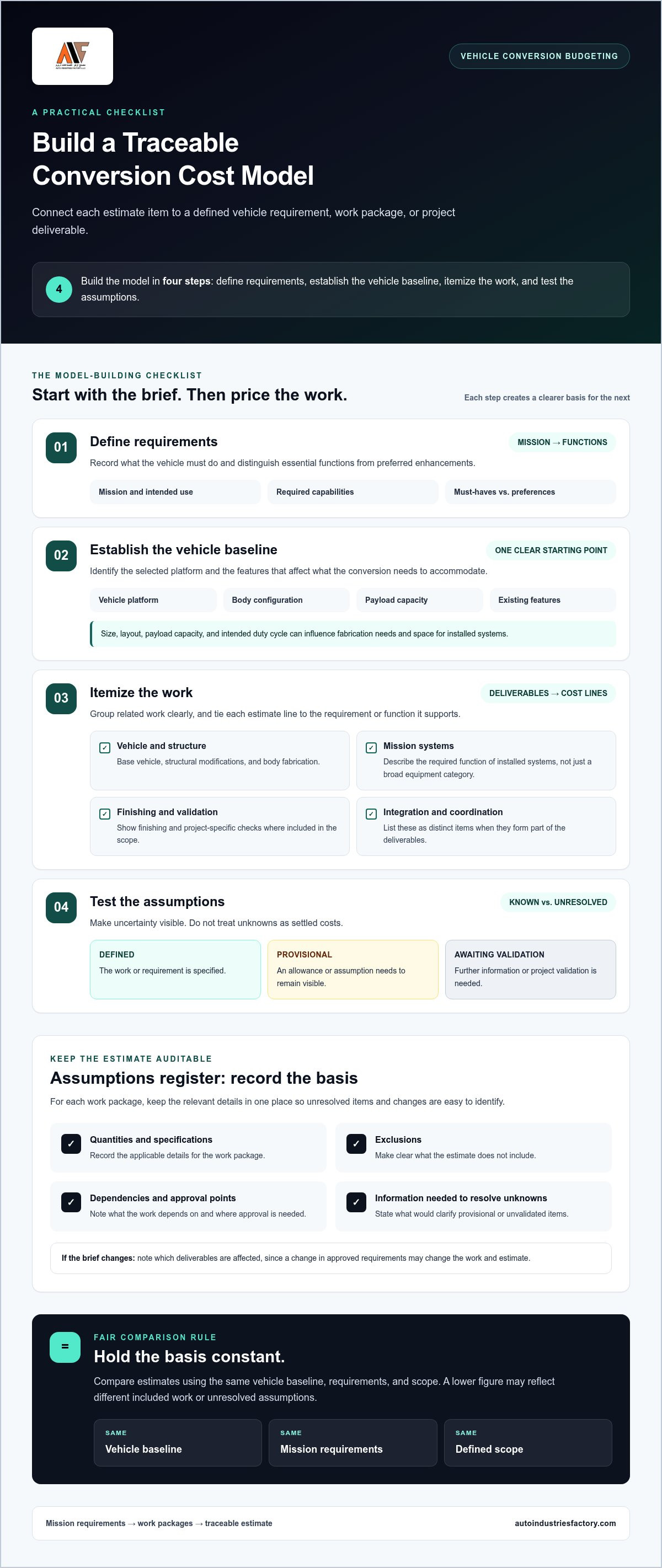
A useful cost model turns the approved brief into traceable work packages. In a cost analysis of vehicle conversion project, each estimate item should connect to a deliverable or functional requirement. This lets decision-makers see what the budget is intended to achieve.
Build the model in four steps:
- Step 1: Define requirements. Record the mission, required capabilities, and must-have functions. Separate essential requirements from preferences so optional enhancements don’t blur the core scope.
- Step 3: Itemize the work. Group tasks by deliverable, such as structural modifications, body fabrication, installed systems, finishing, validation, integration, and project coordination where included. Tie each line to the requirement it supports.
- Step 4: Test the assumptions. Mark what is defined, what is an allowance, and what depends on further information or project validation. Check whether the model meets the required function without treating unknowns as settled costs.
Estimates can only be compared fairly when they use the same vehicle baseline, requirements, and scope. A lower figure may simply reflect different included work or unresolved assumptions.
Which cost categories belong in the model?
Organize the estimate so related work is visible, without implying that every project uses the same categories or proportions. Depending on the scope, group costs under the base vehicle, structural modifications, body fabrication, systems, finishing, and validation. Show integration and project coordination as distinct items when they form part of the deliverables. For example, a fabrication line should describe the work it covers, while a systems line should state the required function rather than just name a broad equipment category. Don’t apply a universal percentage or allowance to any category.
How should assumptions and changes be recorded?
Use an assumptions register to keep the basis of the estimate in one place. For each work package, record applicable quantities and specifications, exclusions, dependencies, and approval points. Mark whether an item is defined, provisional, or awaiting validation, and state what information would resolve it. If the brief changes, note the affected deliverables. A revised body configuration, for instance, may affect materials, fabrication work, or system integration. This makes the impact visible before options are compared.
A consistent model turns a broad conversion brief into a scope that can be reviewed. Explore vehicle conversion services to see how specialized conversion and fabrication work is organized.
How to Compare Vehicle Conversion Options Beyond the Initial Estimate
A lower initial estimate isn’t automatically the better fit. Compare alternatives only when they share the same mission, vehicle baseline, and required capabilities. Then assess how the included work affects day-to-day usability, maintenance access, and integration with the vehicle’s existing systems. A thorough cost analysis of vehicle conversion project options should reveal differences in scope, not just price.
How do specification choices change the project?
A standard vehicle layout may need fewer structural changes than a mission-specific body or interior configuration. An ambulance conversion, for example, may require a box-type or extended-roof layout to meet the project’s intended use. Added electrical, medical, or communications systems can also affect installation and integration requirements—a dynamic also evident in specialized vehicle multimedia and audio upgrades, such as those provided by b-a-s-s.co.il. Compare the functions and interfaces the project needs instead of relying on a generic equipment checklist.
What should a fair estimate comparison show?
Use a table to make assumptions and operational implications visible. Keep the vehicle and mission constant across options, and record whether each feature is required, optional, or planned for a later phase.
| Requirement | Included work | Assumption | Operational implication |
|---|---|---|---|
| Mission-specific body layout | Structural changes and body fabrication stated in the estimate | Vehicle baseline and intended configuration are the same | Review how the layout supports the assigned function and user workflow |
| System integration | Installation and integration work for required systems | System needs and interfaces are defined | Consider usability, access, and compatibility with the vehicle setup |
| Validation | Listed inspection, testing, or other project checks | Steps reflect the vehicle category and destination market | Clarify what must be addressed before the vehicle enters operation |
Check that each option identifies the same deliverables, exclusions, and validation steps. Separate required functions from optional enhancements and future expansion plans. If an estimate leaves a system interface or check as an assumption, record that difference instead of treating the proposals as directly comparable. Approval and compliance implications depend on the vehicle category and destination market, so establish the relevant project requirements for that context.
For ambulance-specific context, read the professional ambulance conversion guide. Auto Industries Factory LLC connects mission-specific requirements with fabrication and conversion work. Explore its specialized vehicle conversion services.
What to Prepare Before Requesting a Vehicle Conversion Project Assessment
A clear brief gives a project-specific assessment a reliable starting point. It connects the vehicle platform and intended mission to fabrication, systems, and operating needs. It doesn’t guarantee a fixed estimate: unresolved specifications, dependencies, or later changes can affect the assessed scope.
What belongs in a clear project brief?
Describe who will use the vehicle, what tasks it must perform, where it will operate, and how often it is expected to be used. Include the vehicle platform and relevant details about its current configuration. For an ambulance conversion, explain the intended workflow and capacity needs. For a safari vehicle, describe the operating environment and required functions.
Then distinguish required capabilities from preferred features. Depending on the mission, detail relevant payload, storage, access, protection, electrical, and communications needs. Explain how proposed systems must connect with one another and the vehicle. Drawings, reference images, and existing specifications can help clarify layouts and interfaces. Include known constraints rather than leaving them implicit.
Also identify how project decisions will be made. Record priorities, who reviews specification changes, and whether any work may be phased. A phased plan should show which functions are essential at the outset and which are being considered for a later stage.
How can buyers reduce avoidable scope changes?
Rank requirements before fabrication details are finalized. When a specification changes, document what changed, why it changed, which deliverables it affects, and who approved it. This creates a clear record for reviewing impacts on materials, fabrication, or system integration, and keeps later decisions tied to the same project brief.
Use this preparation checklist before an assessment:
- Vehicle baseline: platform, body configuration, and available specifications.
- Mission and use: users, tasks, operating environment, and expected use pattern.
- Requirements: essential capabilities, preferred features, payload or access needs, and system interfaces.
- Constraints and references: known limitations, drawings, images, and existing specifications when available.
- Decision process: priorities, approval responsibilities, and any phased implementation considerations.
This information makes a cost analysis of vehicle conversion project more useful by clarifying the scope and open questions. To discuss a specialized conversion brief, discuss your vehicle conversion project with Auto Industries Factory LLC.
How Auto Industries Factory Approaches Mission-Specific Conversion Scope
Auto Industries Factory LLC approaches specialized vehicle conversion as a connected scope of requirements, fabrication, and vehicle function. Ambulance, police, military, and safari conversions are distinct project categories, each shaped by its intended mission and operating needs. The starting point is a clear brief: what the vehicle must do, which capabilities are essential, and how the conversion work supports them.
Every fabrication task should connect to a defined vehicle function. That link keeps the project scope practical and clarifies why structural changes, bodywork, or integrated systems are included.
How do in-house capabilities support an integrated scope?
Laser cutting, CNC machining, welding, and painting are in-house capabilities used in tailored conversion work. An ambulance project, for example, may involve structural and body fabrication alongside requirements for its intended configuration. Considering related fabrication activities together helps define the project as an integrated scope. Explore specialized vehicle conversion services for more details.
The same principle applies across project types. A police or military vehicle modification has a different mission from a safari conversion, so the brief should guide which fabrication tasks and systems belong in scope. This makes the cost analysis of vehicle conversion project specific to the vehicle’s purpose rather than a generic list of modifications.
What is the next step for a project buyer?
Before starting a project discussion, summarize four essentials: the vehicle platform, its mission, the functions it must perform, and the assumptions that still need review. Add relevant drawings, specifications, or reference images when available. This gives the assessment a clear basis and distinguishes defined requirements from open questions.
For background on Auto Industries Factory LLC and its capabilities, visit the company background and capabilities page. When your brief is ready, discuss your conversion project with the team.
Build a Clearer Brief for Your Conversion Project
A sound cost analysis of vehicle conversion project starts with the mission. Define the vehicle platform, required functions, operating conditions, and key assumptions before comparing estimates. Then check that each option covers the same scope, deliverables, and validation steps. This makes differences easier to identify and keeps essential capabilities distinct from optional features.
Auto Industries Factory LLC carries out specialized ambulance, police, military, and safari vehicle conversions. In-house laser cutting, CNC machining, welding, and painting support fabrication and conversion work shaped around project requirements. The guiding principle is simple: connect each modification to the function it serves.
Ready to turn your requirements into a project discussion? Discuss your vehicle conversion project with Auto Industries Factory LLC. A clear brief is a strong first step toward a conversion scope built around the vehicle’s intended role.
Frequently Asked Questions
What determines the cost of a vehicle conversion project?
The total depends on the vehicle baseline, mission requirements, and work needed to deliver the required functions. Structural changes, body fabrication, installed systems, finishing, integration, validation, and project coordination may all form part of the scope. Operating conditions and expected use also shape requirements. A useful cost analysis of vehicle conversion project scope connects each budget category to a defined deliverable instead of treating modifications as an unrelated list.
How do you calculate the cost of a vehicle conversion?
Start by defining the mission and required capabilities, then record the vehicle platform and its relevant configuration. Break the work into categories such as structural modifications, fabrication, systems, finishing, integration, and validation. Tie each estimate item to a specific function or deliverable. Record exclusions, assumptions, dependencies, and unresolved details separately. Present monetary values in AED for projects budgeted in that currency, and make project-specific requirements clear.
Why can two vehicle conversion estimates differ so much?
Estimates can cover different vehicles, missions, specifications, or amounts of work. One may include fabrication, system integration, and validation, while another may leave some of these outside its stated scope or dependent on later decisions. Assumptions about the vehicle baseline and required capabilities also affect comparability. Review each estimate against the same brief, and note differences in deliverables, exclusions, and open questions before judging the totals.
What should be included in a vehicle conversion project budget?
A project budget should show the base vehicle and the defined conversion work as separate elements. Depending on the scope, include structural modifications, body fabrication, installed systems, finishing, integration, project coordination, and validation. Also identify exclusions, allowances, dependencies, and items that still require project-specific assessment. This structure helps decision-makers see what the budget covers and which requirements need further definition, instead of relying on a single unqualified total.
Does the cheapest vehicle conversion estimate offer the best value?
Not necessarily. A lower estimate may describe less work, omit a required function, or rely on assumptions that differ from another proposal. Compare options using the same vehicle baseline, mission, and required capabilities. Consider whether the included scope supports practical operation, system integration, and maintainability. Value comes from meeting the defined needs with a clear scope, not simply choosing the smallest initial figure or assuming that a higher estimate guarantees better performance.
How can I reduce uncertainty in a vehicle conversion project estimate?
Provide a clear brief with the vehicle platform, intended mission, operating conditions, use pattern, required capabilities, and known constraints. Share relevant specifications, drawings, or reference images when available. Separate must-have functions from preferred features, and record assumptions, exclusions, dependencies, and approval points. Establish how specification changes will be reviewed and documented. The more clearly the scope is defined, the more useful a project-specific assessment can be.
Do ambulance conversions have different cost drivers from other vehicle conversions?
Yes. Ambulance conversion requirements reflect the vehicle’s intended role, selected platform, body configuration, capacity, workflow, and systems to be integrated. A box-type ambulance and an extended-roof conversion on a GMC or Toyota platform can involve different project scopes. Police, military, and safari conversions have their own mission requirements, so compare budgets only against matching functions and assumptions. Any applicable approval or compliance considerations depend on the vehicle category and destination market.


