

What if the roomiest ambulance isn’t the right one for your routes? A box type ambulance conversion can create space for a carefully planned working area, but its value depends on how well the body, access points, and vehicle integration suit your team’s day-to-day operations.
It’s not enough to list equipment and request a layout. Route conditions, crew movement, storage needs, and access all shape how the finished unit will work in service. Define these requirements early, and you can reduce the risk of a conversion that looks right on paper but creates operational compromises.
This guide explains how to assess whether a box body fits your mission, plan a practical interior, and prepare a clear project brief. You’ll also see how Auto Industries Factory LLC’s in-house design, laser cutting, CNC machining, welding, and painting capabilities support a coordinated vehicle-fabrication project, from requirements through to a finished conversion.
Key Takeaways
- Match the box body to the mission, routes, and need for a distinct patient-care workspace before settling on a vehicle format.
- Plan the compartment around crew tasks, movement, and access to supplies, not just the amount of equipment it can hold.
- Compare box and van ambulances by workflow, access, intended use, and platform requirements to understand the trade-offs.
- Build a practical project brief that separates confirmed requirements from assumptions needing technical review.
- A well-planned box type ambulance conversion turns operational priorities into a coordinated fabrication project, supported by capabilities such as laser cutting, CNC machining, welding, and painting.
What Is a Box Type Ambulance Conversion, and Which Missions Suit It?
A box type ambulance conversion is a purpose-built patient compartment fitted to a vehicle platform, rather than a patient area integrated into a van’s original body. The separate compartment creates a defined workspace that can be planned around crew tasks, equipment access, and patient movement. Whether that format suits a fleet depends on its intended service, operating environment, and day-to-day workflow, not simply on the space available.
Patient transfer, emergency response, and specialist fleet duties can place different demands on a vehicle. A transfer-focused operation may prioritize orderly access to the patient and stored supplies. An emergency-response fleet may have different priorities for crew movement and equipment organization. These are planning examples, not universal configurations; operators need to define the work the vehicle must perform.
The video below gives a visual example of a box-type ambulance conversion:
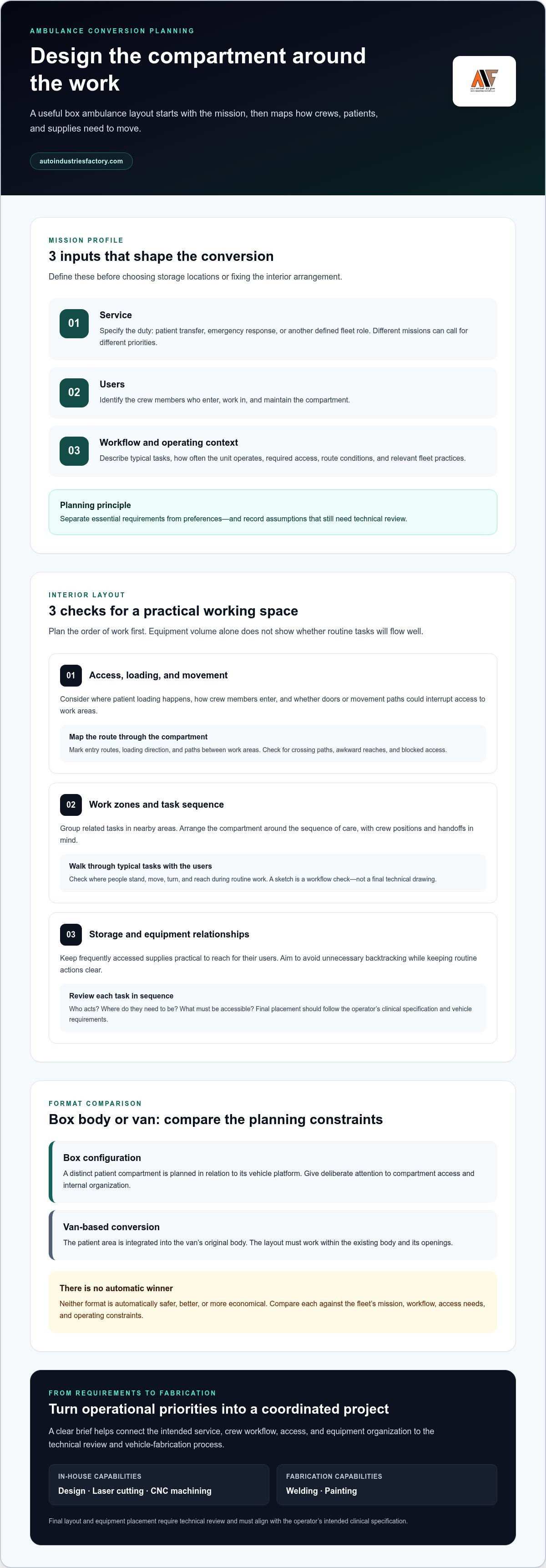
Use a mission profile to turn broad needs into practical design priorities. Record who uses the vehicle, what tasks take place inside, how often the unit operates, and what access the crew needs during loading and routine work. Note route conditions and fleet practices too. These details help distinguish essential requirements from preferences before they shape a box type ambulance conversion.
Which operating needs can a box ambulance support?
A separate patient compartment can support a planned workflow by giving key tasks and supplies a dedicated place. For example, a fleet handling recurring patient transfers may value a consistent arrangement that helps crews locate items and move through familiar steps. A specialist fleet may need a different organization to reflect its own duties. The intended service determines the configuration; the format alone doesn’t prescribe the workflow.
Before settling on a concept, map the operation in concrete terms:
- Service: patient transfer, emergency response, or another defined fleet duty.
- Users: the crew members who enter, work in, and maintain the compartment.
- Workflow: how people and supplies need to move during typical tasks.
These are starting points for a project brief, not a substitute for technical review. Auto Industries Factory LLC’s ambulance conversion services support customized vehicle-fabrication projects shaped around operational requirements.
What makes the box format different from a van conversion?
A box configuration plans a distinct compartment in relation to its vehicle platform. A van-based conversion works within an integrated vehicle body. That difference changes the planning questions: a dedicated compartment calls for deliberate decisions about its access and internal organization, while a van layout must work within the existing body and its openings. Neither format is automatically safer, better, or more economical. The right comparison is how each fits the fleet’s mission and operating constraints. For a general overview of ambulance categories, see Ambulance Types and History.
How Patient-Compartment Layout Shapes a Box Type Ambulance
A patient compartment works best when its arrangement reflects the order of work inside it. Start with the tasks crews perform, then map where people enter, where they need to stand or move, and how they reach supplies. Planning around equipment volume alone can leave a compartment crowded in the wrong places or make routine tasks require avoidable movement.
Planning principle: arrange the compartment around the sequence of care, not just the inventory it carries. For a box type ambulance conversion, that means describing common workflows before fixing storage locations, work zones, or access points. The intended clinical specification should guide those decisions, while technical review determines how they can be integrated into the vehicle.
Plan access points around loading and crew movement
Side and rear access serve different movement patterns, and neither arrangement suits every operation. Consider where patient loading takes place, how crew members enter, and whether opening a door could interrupt movement or block access to a frequently used area. Entry clearance also matters: plan for people to pass through with the space and equipment required by the intended workflow.
Map typical movements before settling the layout. A simple compartment sketch can mark entry routes, loading direction, and the path between work areas. Walk through those steps with the people who will use the vehicle. Note where paths cross, where someone must turn or reach across another person, and whether stored items remain accessible without obstructing entry. Treat this as a workflow check, not a final technical drawing.
Organize work zones, storage, and equipment relationships
Group the interior by function so related tasks can happen in nearby areas. Keep frequently accessed supplies within a practical reach for their users, and consider how one crew member hands off a task to another. The goal isn’t to eliminate movement; it’s to avoid unnecessary backtracking and keep routine actions clear. Final placement must follow the operator’s clinical specification and fit the vehicle’s technical requirements.
Before committing to a layout, review each task in sequence and ask:
- Who acts? Identify the crew member responsible for each routine step.
- Where do they need to be? Mark the working position and movement path.
- What must be accessible? Locate the relevant storage in relation to that task.
- What happens next? Check that the next action can follow without an avoidable crossing or reach.
These checks turn an abstract floor plan into a practical discussion about use. They also help separate essential workflow needs from layout preferences before fabrication begins. Auto Industries Factory LLC’s ambulance conversion services connect operational priorities with customized vehicle fabrication.
Box Type vs. Van Ambulance: Compare the Mission Before the Format
A format comparison is useful only when it reflects the work the fleet must perform. A box body and an integrated van body offer different planning conditions, but neither is the right choice by default. Compare the operational workflow, access needs, intended service, and vehicle platform together, then identify which requirements are essential and which are preferences.
Mission requirements, not body style, should decide the ambulance format. Use the comparison below to frame the discussion, then assess each option against the fleet’s actual duty cycle and patient-care needs.
| Planning factor | Box configuration | Integrated van format |
|---|---|---|
| Workflow | Can be planned around a distinct patient compartment and its intended tasks. | Must organize work within the vehicle’s integrated body and available layout. |
| Access | Access points and interior movement need to be considered as part of the compartment plan. | Entry and movement are planned around the van body’s existing openings and structure. |
| Intended use | May suit duties that require a clearly defined, separately organized work area. | May suit duties whose workflow can be accommodated within an integrated vehicle body. |
| Platform planning | Requires consideration of how the dedicated body and vehicle platform work together. | Requires planning within the selected van platform and its conversion requirements. |
Duty cycle matters. A fleet that repeats the same patient-care workflow across frequent operations may value consistency in access and task arrangement. A unit used for a narrower or different service may have other priorities. Compare the demands of a typical shift, not just an idealized vehicle walkaround. Technical review should also consider the complete vehicle system, including the platform and conversion requirements, rather than treating the patient compartment as a standalone choice.
When should a fleet consider a box configuration?
Consider a box configuration when the mission calls for a distinct patient-care workspace with its own planned workflow, access, and organization. Ask which operational task requires that separation. If the main argument is simply “more room,” define what work that space enables and how it changes crew movement. A box type ambulance conversion should be assessed alongside platform and fleet requirements, not selected on compartment preference alone.
When might an integrated van format fit better?
An integrated van format may fit a fleet whose tasks, access pattern, and intended patient-care workflow can be organized within the vehicle body. Start by mapping routine use and identifying any non-negotiable entry or movement needs. Then compare those needs with the platform and conversion requirements. For a broader view of available ambulance conversion formats, consider how each project can be tailored to its operating requirements.
Use a simple decision test: list the mission’s must-haves, compare each format against them, and record any compromises that need technical review. If a format’s main advantage doesn’t solve a defined operational need, reconsider whether it belongs in the brief. A disciplined comparison helps turn a preference into a defensible fleet decision.
Build a Clear Box Ambulance Project Brief Before Fabrication
A useful project brief turns operational needs into decisions that can be reviewed before fabrication begins. It should distinguish what the fleet has decided from what still needs technical assessment. For a box type ambulance conversion, this clarity helps keep the intended mission, compartment plan, vehicle platform, and conversion requirements aligned.
Build the brief in sequence. Keep it practical: describe actual use, record preferences clearly, and mark technical assumptions rather than treating them as settled specifications.
- Define the mission. State the intended service, operating pattern, and typical tasks the vehicle must support.
- Identify users and workflow. Describe who will work in the compartment and the key steps they need to perform.
- Record patient-care requirements. Document the operator’s clinical specification and distinguish essential needs from preferences.
- Identify the vehicle platform. Record the selected platform and the technical information available for review. Do not assume compatibility or performance from a model name alone.
- Set layout and access priorities. Note preferred entry points, movement needs, storage relationships, and any access constraints.
- List required systems and finishes. Include electrical, other onboard systems, or finish requirements only where relevant to the project.
Label each item as confirmed, preferred, or requires technical review. For example, a preferred access arrangement is not the same as an approved layout. Record open questions beside the relevant requirement so they can be resolved during project planning.
What information belongs in the initial specification?
Include the service purpose, expected operating pattern, crew workflow, and patient-care requirements. Add the selected vehicle platform and available technical information, then capture layout, access, finish, and onboard-system needs that apply to the project. Keep the specification focused on operational priorities. Mark assumptions about dimensions, payload, chassis compatibility, or system integration for technical review rather than presenting them as established facts.
Standards also need careful handling. If the brief names EN 1789, treat it as a proposed reference until its applicability to the intended market, vehicle, and project has been assessed by the appropriate technical or regulatory authority. Don’t present a standard as a UAE requirement without verifying that it applies.
How should the completed conversion be reviewed?
Use the agreed drawings and documented requirements as the review baseline. Check that the finished layout reflects the approved plan, that access works as intended, and that workmanship and installed systems match the project specification. Walk through representative operational handoffs to identify practical access or movement issues. Tie acceptance criteria to verified project requirements and applicable regulations, not informal expectations added after fabrication.
A coordinated brief supports accurate customization across planning and fabrication. Discuss your ambulance conversion project with Auto Industries Factory LLC using your documented mission and priorities as the starting point.
How Auto Industries Factory LLC Delivers a Customized Box Ambulance
A strong conversion begins with a clear brief. The operating mission, vehicle information, and priority layout needs give the fabrication project a practical direction. Auto Industries Factory LLC brings these requirements into a coordinated vehicle-conversion project, using in-house design and fabrication capabilities to shape a customized box ambulance around the documented priorities.
This approach connects the brief to the finished vehicle. Instead of treating the body, compartment arrangement, and fabrication tasks as unrelated decisions, the project can be considered as a whole. The result is a conversion planned against the operator’s stated needs, with technical details addressed as part of the project rather than assumed from a generic layout.
From operational requirements to a fabrication plan
Mission information helps guide design and fabrication decisions. A brief that identifies intended use, preferred access, and layout priorities gives the project a clearer basis for planning the body and its components. Vehicle-platform details provide important context for technical review; they shouldn’t be replaced by assumptions about compatibility, dimensions, payload, or performance.
Auto Industries Factory LLC’s in-house capabilities include design, laser cutting, CNC machining, welding, and painting. Laser cutting and CNC machining support the production of components shaped to project requirements. Welding contributes to fabrication and assembly, while painting completes the conversion’s finish. Together, these capabilities support a coordinated build without implying unverified specifications or certifications.
The purpose is practical customization. For example, a fleet can document which access and compartment priorities matter to its intended workflow, then use those priorities to inform the project’s design and fabrication decisions. The specific configuration remains tied to the agreed requirements and technical review.
Prepare to discuss your box type ambulance conversion
Bring the information that can move the project discussion forward: a mission profile, vehicle-platform details, and the layout priorities the fleet considers essential. Include preferences separately from confirmed requirements, and flag assumptions that need technical assessment. This gives the conversion project a useful starting point and helps keep decisions connected to actual operating needs.
Auto Industries Factory LLC provides specialized vehicle conversion services, including box type ambulance conversions. Share your project priorities through the box type ambulance conversion contact page to begin an enquiry. Clear inputs help establish the scope of a customized fabrication project and provide a stronger foundation for its next planning steps.
Turn Your Fleet Priorities into a Clear Next Step
The next step is to turn operational priorities into a focused conversion brief. Identify what the vehicle must support, record the layout decisions that matter most, and separate firm requirements from questions for technical review. A clear starting point helps keep the box type ambulance conversion aligned with the way your fleet intends to use it.
Auto Industries Factory LLC brings together in-house design, laser cutting, CNC machining, welding, and painting to support customized vehicle fabrication. These capabilities provide a coordinated foundation for shaping a project around its documented requirements, without relying on assumptions about the finished specification.
Bring your mission profile, vehicle information, and priority layout needs to the project discussion. Discuss your box type ambulance conversion requirements with Auto Industries Factory LLC and take the next step toward a unit planned around your operation. Clear priorities make a stronger start.
Frequently Asked Questions
What is a box type ambulance conversion?
A box type ambulance conversion adds a dedicated patient compartment to a vehicle platform, creating a separate space for the operator’s specified use. The conversion involves coordinating the compartment with the vehicle and its intended workflow. Before planning, define the unit’s purpose and the tasks it must support. This gives the fabrication project a clear basis and helps avoid treating a generic compartment arrangement as suitable for every operator.
What is the difference between a box ambulance and a van ambulance?
A box ambulance has a distinct patient compartment, while a van ambulance uses the vehicle’s integrated body for the patient area. That changes the planning context: a box layout can be planned as a separate workspace, whereas a van layout works within the van’s body and openings. For example, a fleet prioritizing a particular entry pattern should compare how each format accommodates it, rather than assuming one format is universally preferable.
Can a box type ambulance be customized for different medical missions?
Yes. A box type ambulance can be customized around the operator’s documented mission and clinical requirements. A vehicle intended for patient transfer may need different workflow priorities from one assigned to emergency response. The operator should provide the intended tasks, user needs, access priorities, and required onboard systems. These details inform the conversion plan; they don’t replace the technical review needed to assess how requirements fit the vehicle platform.
How do you choose a chassis for a box type ambulance conversion?
Choose a chassis by assessing the complete vehicle against the conversion’s intended use, not by model name alone. Provide technical information for review, including the platform configuration and the fleet’s operating conditions. The project team must assess relevant limits and compatibility, such as payload, axle capacity, and dimensions, before finalizing the body plan. These values depend on the specific vehicle and conversion, so avoid relying on generic assumptions.
What should an ambulance conversion project brief include?
An effective brief identifies the intended service, operating pattern, users, workflow, vehicle platform, layout priorities, access preferences, and required systems. It should also identify which details are confirmed and which remain assumptions for technical review. For example, label a preferred door arrangement as a preference until it has been assessed against the platform and workflow. This distinction helps keep early discussions clear and decisions traceable as the project develops.
Does a box type ambulance need to meet EN 1789?
Whether EN 1789 applies depends on the intended market, the project requirements, and the relevant authority or contract. Don’t assume that a European ambulance standard automatically governs a vehicle in the UAE. If the project brief cites EN 1789, identify it as a proposed reference and establish its applicability through appropriate technical or regulatory review before using it as an acceptance requirement. Confirm the standards that actually govern the intended deployment.
How is a box ambulance conversion reviewed before delivery?
Review the completed vehicle against the approved drawings, agreed project requirements, and applicable acceptance criteria. A practical inspection can check whether access points and compartment arrangements match the documented plan, and whether workmanship and installed systems correspond to the agreed scope. Walk through representative tasks with intended users to spot access or handoff issues. Record any findings and resolve them against verified project and regulatory requirements before accepting the vehicle.


