

A Toyota Land Cruiser hardtop ambulance may suit demanding routes, but the vehicle’s reputation is only a starting point. Patient-space layout, converted payload, equipment access and the intended duty cycle all affect whether the finished vehicle can do its job reliably.
When comparing options, weigh off-road capability against workspace, safety and long-term operating needs. This guide explains how to define a specification before purchase, compare the hardtop with relevant alternatives, and identify the details to validate for your intended country and use.
We’ll look at the LC78 hardtop alongside the LC79 box-type option, then connect platform choice to conversion layout, payload, durability and approval requirements. Auto Industries Factory converts ambulances on Toyota platforms, with in-house laser cutting, CNC machining, welding and painting. Use the guidance below to shape a vehicle-and-workspace brief with fewer unknowns before moving toward conversion.
Key Takeaways
- Start with the service mission: routes, operating conditions, crew needs and patient-care workflow determine whether a hardtop platform fits.
- Specify the Toyota Land Cruiser hardtop ambulance as a complete vehicle-and-workspace system, not a vehicle with a standard layout added later.
- Compare hardtop, van and box-type approaches by usable space, access, intended routes and operating constraints.
- Build a procurement checklist covering vehicle identification, payload, workspace, integrated systems, compliance and handover requirements.
- Match the conversion scope to the brief, including any Toyota extended-roof requirements and relevant fabrication work.
Is a Toyota Land Cruiser Hardtop Ambulance Right for Your Service?
Start with the mission, not the vehicle badge. A Toyota Land Cruiser hardtop ambulance may be a candidate for demanding routes or operating conditions, but its suitability depends on how the crew works and what the patient-care task requires. A vehicle that performs well on a route still needs to accommodate the intended crew, equipment, access and workspace.
Assess the route, crew workflow and patient-care task first, then test whether the vehicle and conversion can meet them. This separates platform suitability from conversion suitability. The vehicle has model-specific limits; the conversion determines how its available space is arranged and used. Judge both against the operating brief, not appearance alone.
Ambulance duties vary in purpose, configuration and equipment. The general overview of ambulance types and equipment can provide context, but your service’s operating brief should drive the specification. An enclosed hardtop body does not, by itself, establish whether the vehicle can support a particular care workflow or operating environment.
Which ambulance duties could suit a hardtop platform?
Map actual response patterns before deciding. Record typical routes, travel conditions, access limitations and the environments where the vehicle is expected to operate. For example, a service that regularly travels on rough or remote routes may place different demands on its platform and conversion than one focused on urban response. Treat this as a mission question, not proof that a particular model is suitable.
Next, describe the crew’s roles and patient-care sequence. Note who needs to work in the patient compartment, what tasks they perform and when equipment must be reached. The fleet’s purpose should set these requirements. A rugged appearance does not show whether the interior, payload or layout will support the work.
What should buyers establish before comparing vehicles?
Write down the operating brief so each platform is judged against the same needs. Include:
- Patient-care function: the intended role and the equipment the conversion must accommodate.
- Staffing model: crew numbers, responsibilities and movement during care.
- Workspace: required access, working positions and storage needs.
- Operating constraints: routes and terrain, site access, parking limits and acceptable downtime.
These points turn a broad preference into a practical comparison. They also reveal trade-offs early: storage may limit movement, or the vehicle’s exterior dimensions may affect access and parking at regular destinations. Decide which constraints are essential and which may be addressed through conversion choices.
Verify the exact vehicle’s model year and configuration against manufacturer documentation. Dimensions, payload, drivetrain and other limits can vary, so don’t assume figures for one Land Cruiser apply to another. Assess the conversion specification against the chosen vehicle’s documented limits and the requirements for its intended country and use. This gives you a stronger basis for comparing platforms on operational fit rather than reputation alone.
How to Specify the Toyota Land Cruiser Hardtop Ambulance Conversion
A sound conversion brief turns the service mission into decisions the vehicle and conversion team can act on. For a Toyota Land Cruiser hardtop ambulance, define four connected areas: the exact vehicle, patient-care workspace, crew workflow, and systems or equipment to integrate. Set requirements before selecting a layout. An assumed standard arrangement may not suit the tasks your team performs.
Record what is essential, what is preferred and what needs technical validation. This makes trade-offs visible early. Storage, seating and open working space compete for the same interior volume, so each choice should support a defined operational need.
Plan the patient-care workspace around real tasks
Map patient access and crew movement from entry through the expected care tasks. Identify where staff need to stand or sit, which areas must remain clear and what equipment needs to be within reach. The goal is not to prescribe an equipment package in advance. It is to make the layout support the service’s actual workflow.
Set the balance of seating, storage and working space according to intended duties and staffing. A crew model with different roles may need a different arrangement from one with fewer staff or a narrower task set. Document these needs before fixing cabinetry or other interior components.
Integrate the body, fabrication, and vehicle systems
Roof and body configuration are part of the complete vehicle specification, not cosmetic choices. Record the required interior clearances and access points, then assess the proposed structure and conversion packaging against the exact vehicle. Weight matters: the finished conversion, crew, equipment and supplies all contribute to the operating load. Compare the planned fit-out with manufacturer documentation for that model year and configuration.
Plan electrical, lighting and equipment interfaces around defined project requirements. Identify what each system must support and where components need to sit, while checking that the arrangement works with the body and patient-care layout. Don’t assume a component will fit simply because it was used in another conversion.
Fabrication capability helps translate requirements into physical components. Auto Industries Factory’s in-house capabilities include laser cutting, CNC machining, welding and painting. These processes support custom fabrication within an ambulance conversion. The scope still needs to be coordinated with vehicle limits, access, weight and intended use.
Before approval, make the brief specific: name the required work areas, access needs, storage priorities, system interfaces and vehicle documentation to review. Resolve conflicts between these requirements instead of leaving key choices until fabrication is underway. This gives the project a clearer basis for reviewing the conversion scope and developing a tailored specification.
Compare Hardtop Ambulance Requirements Before You Commit
Compare vehicle approaches against one mission brief, not different assumptions. A hardtop, van and box-type ambulance can each be assessed against the same patient-care tasks, staffing needs, routes and operating constraints. A fair platform comparison holds the mission constant and tests how each vehicle-and-conversion combination meets it.
Separate verified vehicle data from project-specific design questions. Manufacturer documentation is the source for model-year dimensions, payload and vehicle limits. Usable workspace, access arrangements and conversion scope depend on the specific vehicle and proposed fit-out, so assess them rather than treating them as guaranteed features of a body type.
Compare vehicle layouts against the same mission brief
Use the matrix to frame questions, not to assume one approach is automatically better. Record the same operational requirements for every option, then note where vehicle documentation or a conversion proposal provides evidence.
- Usable workspace: Hardtop: assess the available space for the required tasks. Van: check its usable working area against those tasks. Box type: assess the proposed compartment dimensions and layout.
- Patient access: Hardtop: map entry and movement through the compartment. Van: assess access points and crew movement. Box type: review how the proposed body arrangement supports patient and crew access.
- Intended routes: Hardtop: compare the vehicle’s documented configuration with the fleet’s routes. Van: assess the same route demands. Box type: consider the complete converted vehicle and its operating environment.
- Conversion scope: Hardtop: define changes within the existing body configuration. Van: specify the required interior and systems integration. Box type: detail the compartment, workspace and interfaces with the chassis.
- Operating constraints: For all three, assess access, parking, downtime, payload and the requirements of the fleet’s intended use.
This comparison identifies trade-offs without turning general body categories into capability claims. A larger-looking compartment does not necessarily provide usable working space, and an enclosed body does not confirm that crew movement or equipment access will suit a particular workflow. Compare the proposed, configured vehicle against measurable needs.
Check compliance, payload, and ownership requirements
Identify the ambulance standards and vehicle approval requirements that apply in the country where the vehicle will operate. For a UAE deployment, determine the applicable approval pathway for the intended use rather than assuming another market’s rules apply. EN 1789 may be relevant where the intended market or procurement specification calls for it; assess the current edition and its applicability to the project.
Review payload for the converted vehicle in its intended operating configuration. Assess the vehicle’s documented limits alongside the conversion, crew, equipment and supplies. Also consider ownership needs such as servicing arrangements, parts planning, expected duty cycle and acceptable downtime. These requirements affect procurement suitability even when the initial comparison focuses on workspace.
For a Toyota Land Cruiser hardtop ambulance, base the decision on verified vehicle information and a project-specific conversion assessment. A consistent matrix makes gaps visible before commitment and gives the specification a sound basis for the next procurement step.
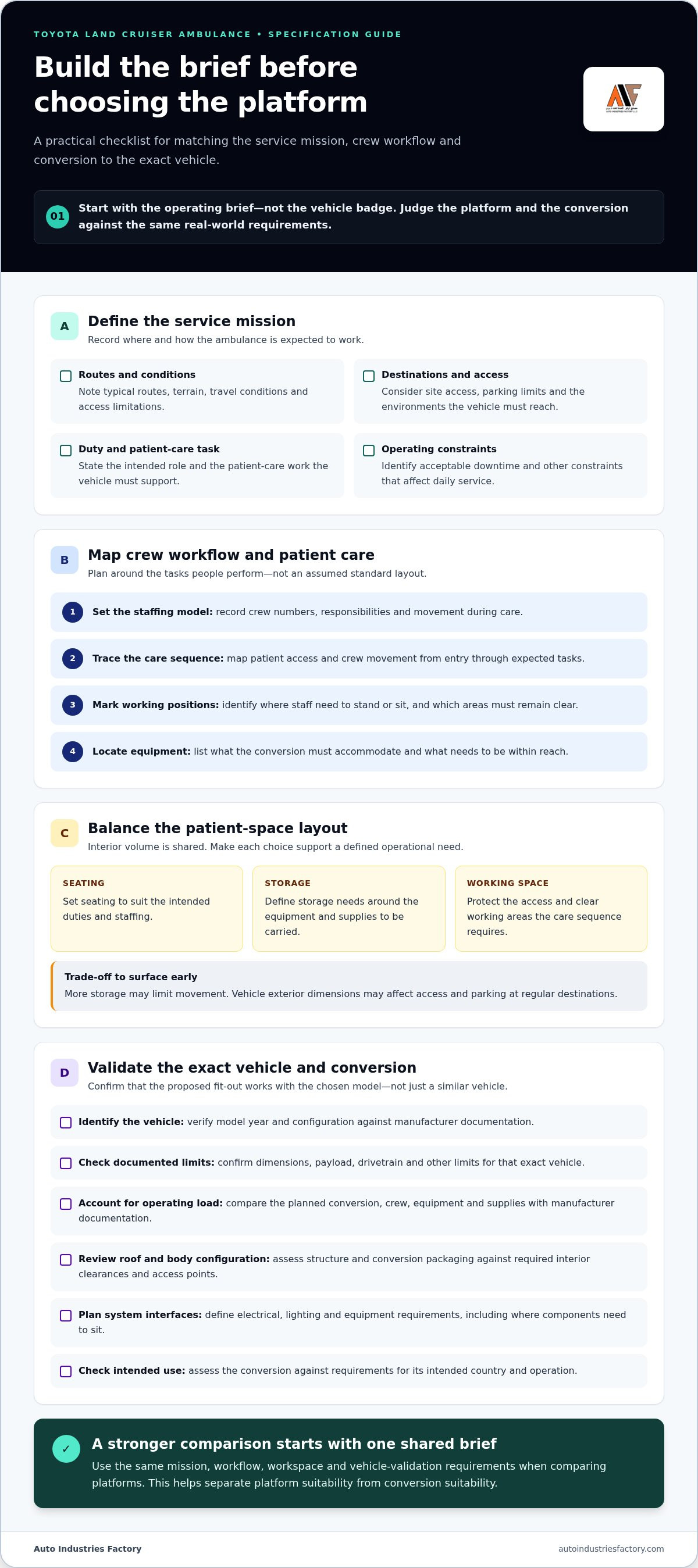
Use This Procurement Checklist for a Toyota Land Cruiser Ambulance
A disciplined procurement process separates what is documented, what the service needs and what requires technical review. Use this checklist to turn the operational brief into a defined conversion scope before approving the project.
Build a clear vehicle and service brief
Record confirmed vehicle information separately from buyer requirements and project decisions. Manufacturer documentation should establish the exact vehicle configuration and its limits. The service brief describes the work the ambulance must support. Review layout, integration and conversion choices against both.
- Define the mission. State the intended patient-care function, expected fleet use, typical routes and operating conditions. Describe the tasks the vehicle must support rather than relying on a broad label for the service.
- Identify the vehicle. Record the Toyota model, model year, configuration and relevant manufacturer documentation. Keep verified dimensions, payload and other vehicle limits distinct from estimates or assumptions.
- Describe the crew workflow. Set out staffing roles, movement through the patient compartment, access needs and key tasks. This gives the conversion scope a practical basis.
- Set workspace requirements. List working areas, seating, storage and access priorities. Specify essential systems and equipment interfaces without assuming a standard package or layout.
- Document constraints. Note site access, parking, terrain, acceptable downtime and any fleet operating requirements that affect vehicle or conversion decisions.
- Identify approval needs. Determine the ambulance standards and vehicle approval requirements for the intended country and use. Record which items need technical review before the specification is approved.
Review the conversion scope before approval
Compare the proposed layout with the brief, then review body configuration, fabrication work, vehicle integration, weight and access as a connected package. Separate confirmed manufacturer data from proposed design choices. If a requirement depends on dimensions or payload, tie the decision to documentation for the exact vehicle rather than a similar model or year.
For UAE operation, identify the relevant approval pathway for the intended use and include its requirements in the project review. Agree on project-specific deliverables and acceptance criteria before approval. These can describe the layout and access to be reviewed, the systems included, and the documentation or handover materials expected. Keep criteria specific enough to assess completion without relying on assumptions about a standard conversion.
A clear brief helps shape a tailored ambulance conversion around the selected Toyota platform and service requirements. Auto Industries Factory LLC converts ambulances on Toyota platforms, including extended-roof conversions. Share your mission brief and vehicle details to discuss a conversion scope for your Toyota Land Cruiser hardtop ambulance.
Plan a Toyota Ambulance Conversion with Auto Industries Factory
A well-prepared project brief connects the service mission to the vehicle, body configuration and conversion scope. Auto Industries Factory LLC converts ambulances on Toyota platforms, including extended-roof ambulance conversions. For a Toyota Land Cruiser hardtop ambulance, the conversion can be planned around defined operating requirements while accounting for vehicle limits and approval needs.
What to prepare for a conversion discussion
Bring the information that establishes clear priorities for the project. Identify the Toyota model and year, number of vehicles required, fleet purpose and operating conditions. Include the patient-care workflow, crew roles, desired workspace and systems to integrate. A concise brief helps distinguish essential requirements from preferences before conversion details are developed.
- Vehicle details: model, model year, configuration and available manufacturer documentation.
- Operating profile: intended use, routes, terrain, access constraints and expected fleet use.
- Workspace needs: crew movement, patient access, working areas, seating and storage priorities.
- Project requirements: required systems, applicable procurement and approval criteria, and handover expectations.
Where a requirement depends on payload or dimensions, include the relevant vehicle documentation rather than relying on figures from another model year or configuration. Keep regulatory and approval requirements specific to the country and intended use of the ambulance.
Turn the project brief into a conversion scope
Use the brief to connect the selected vehicle with its body configuration, interior layout and fabrication requirements. Each decision affects the others: roof and body choices shape available workspace, while the layout influences access, storage and system placement. Review the complete package against the vehicle’s documented limits and the fleet’s operating needs before approving the scope.
Auto Industries Factory’s in-house fabrication capabilities include laser cutting, CNC machining, welding and painting. These processes support fabrication work within a tailored ambulance conversion. The company also converts specialized vehicles for operational roles beyond ambulance applications. Its specialized vehicle experience supports an integrated approach to vehicle and workspace planning.
Set out what the conversion must deliver, how the proposed layout will be reviewed, which systems are included, and what documentation or handover materials are required. Define acceptance criteria around the actual project scope, not assumptions about a standard fit-out. This creates a clear basis for technical review and keeps the final configuration tied to the buyer’s needs.
Ready to move from requirements to a tailored project scope? Discuss your ambulance conversion brief with Auto Industries Factory and outline the vehicle, fleet purpose and workspace priorities the conversion needs to address.
Move from Specification to a Clear Project Brief
Turn your procurement notes into a brief your team can use to make decisions. Bring together the vehicle documentation, intended operating profile and patient-care priorities. Mark which requirements are essential, where you can accept alternatives, and which technical or approval questions need resolution.
This clarity keeps the Toyota Land Cruiser hardtop ambulance specification grounded in the vehicle’s documented limits and the service’s operating needs. It also gives the conversion project a practical reference point for decisions about layout, integration and acceptance criteria. A focused brief makes discussions more productive and helps prevent important day-to-day requirements from being overlooked.
Ready to take the next step? Discuss your Toyota ambulance conversion requirements with Auto Industries Factory. Bring your priorities and project details to develop a conversion scope shaped around your operation.
Frequently Asked Questions
Can a Toyota Land Cruiser hardtop be converted into an ambulance?
Yes. A Toyota hardtop can be converted into an ambulance, with the conversion planned around the exact vehicle and its intended duties. Auto Industries Factory LLC carries out ambulance conversions on Toyota platforms and offers extended-roof ambulance conversions. Before setting the scope, establish the model and year, then assess manufacturer specifications, vehicle limits and workspace requirements for the fleet’s intended operation.
What should I check before choosing a Toyota Land Cruiser ambulance?
Check the exact vehicle configuration and manufacturer documentation, then consider the complete operating setup rather than the unconverted vehicle alone. For example, compare documented payload limits with the planned conversion, crew, equipment and supplies. Also assess whether the finished vehicle’s dimensions and access suit its regular destinations. Keep verified manufacturer data separate from estimates and design decisions so technical assumptions don’t become procurement facts.
Is a hardtop ambulance suitable for every emergency-service role?
No. Suitability depends on the work the vehicle must support, not just its platform. A role requiring particular crew movement, patient access or working space may call for a different layout or vehicle approach than a role with fewer interior tasks. Set out the intended care workflow and staffing needs, then assess whether the proposed conversion can accommodate them within the selected vehicle’s documented limits.
How do I compare a hardtop ambulance with a van or box-type ambulance?
Compare each approach against the same mission brief. Assess usable workspace, patient and crew access, route requirements, conversion scope, payload and constraints such as parking or site access. Review a hardtop, van and box-type ambulance as complete vehicle-and-conversion packages. A box may appear to provide more room, but its proposed internal layout and vehicle limits still determine its practical fit.
What information should I prepare before requesting an ambulance conversion?
Prepare the vehicle make, model, year and configuration, plus manufacturer documentation where available. Describe the fleet’s purpose, routes and operating conditions, then outline crew roles, patient-care tasks, workspace priorities and systems to integrate. Include the number of vehicles required, applicable procurement or approval requirements, and expected handover documents. A short list of essential requirements and preferences helps keep the project brief clear.
Does a Toyota Land Cruiser ambulance need to meet EN 1789?
Not automatically. EN 1789 is a European road ambulance standard, and whether it applies depends on the vehicle’s intended country and use, as well as procurement requirements. For a vehicle operating in the UAE, establish the applicable approval and standards requirements for that deployment. Check the current standard and its relevance to the specific project instead of assuming the vehicle platform alone determines compliance.
Can the ambulance layout and systems be tailored to a fleet’s requirements?
Yes. The conversion scope can be developed around the fleet’s defined workflow, crew needs, workspace priorities and required systems. The layout and integration still need to be assessed against the selected model’s specifications and project requirements. Auto Industries Factory LLC converts ambulances on Toyota and GMC platforms, including extended-roof configurations on both.


