

What if the vehicle your team relies on for life-saving interventions is actually the biggest bottleneck in your emergency response? It's a common frustration for medical providers across the UAE who find that standard van interiors lack the space required for complex Advanced Life Support (ALS) procedures. You've likely felt the constraints of cramped quarters and realized that while calculating the box ambulance conversion cost is a critical part of procurement, the long-term price of inefficiency and structural failure in our harsh national climate is far higher.
We believe your fleet should be a mobile trauma room engineered for extreme reliability. This guide explores the engineering advantages and fabrication standards that make box type ambulances the superior choice for high-stakes missions. You'll discover how modular designs maximize patient volume, ensure structural integrity, and create a fleet that offers lifecycle cost efficiency. We'll examine configuration options for GMC and Toyota chassis and show how precision metalwork transforms a standard vehicle into a rugged medical powerhouse.
Key Takeaways
- Understand why the modular box configuration is essential for Advanced Life Support (ALS) missions that require superior interior volume and specialized equipment layouts.
- Discover the "Second Life" engineering concept that allows you to remount existing medical modules to significantly reduce your long-term box ambulance conversion cost.
- Learn how precision laser cutting and CNC machining ensure structural integrity and superior thermal insulation for the demanding climate of the UAE.
- Explore the "Golden Square" design principle to optimize paramedic workflow and maximize efficiency during high-pressure emergency interventions.
- Compare the technical specifications of GMC and Toyota chassis-cab platforms to select the right foundation for your high-capacity medical fleet.
What is a Box Type Ambulance? Engineering for High-Stakes Emergency Care
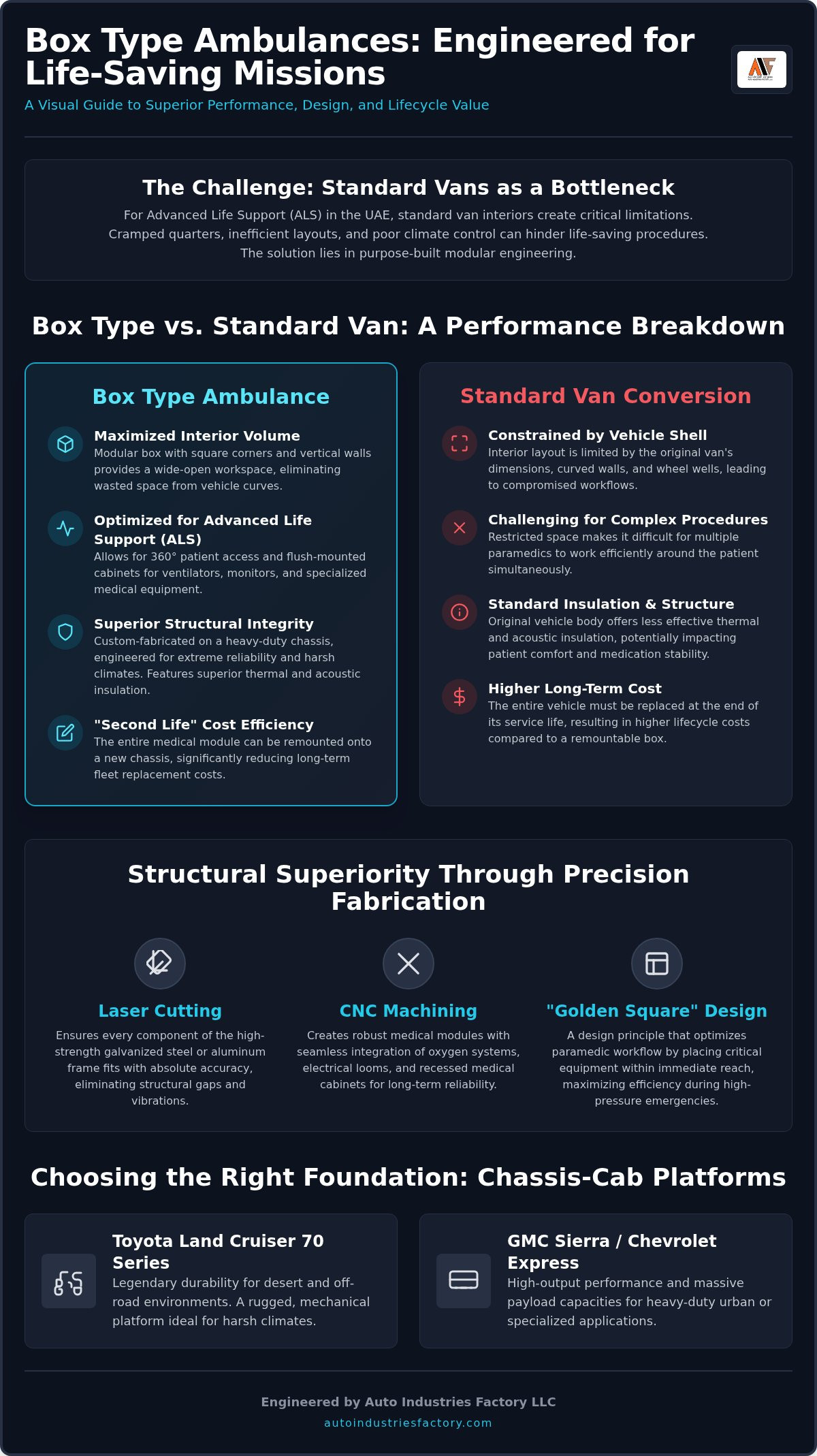
A box type ambulance, often categorized among different Ambulance Types, represents a shift from standard van modifications to dedicated modular engineering. Unlike a standard van where the medical interior is limited by the vehicle's original shell, a box type unit consists of a separate, custom-fabricated module mounted onto a heavy-duty chassis-cab. This design is the gold standard for Advanced Life Support (ALS) missions because it provides a square, wide-open workspace that maximizes vertical height and floor area. When evaluating the box ambulance conversion cost, fleet managers often prioritize the increased payload and clinical efficiency that only a modular build can offer. It isn't just about size; it's about creating a mobile trauma room that doesn't compromise on equipment accessibility.
The Anatomy of a Box-Body Conversion
The core advantage lies in the total separation between the driver’s cab and the patient compartment. This structural independence allows for specialized ambulance conversions where the box is engineered purely for medical utility. Square corners and vertical walls mean equipment like monitors, ventilators, and storage cabinets can be flush-mounted without wasting space on the curves found in standard vans. A reinforced pass-through window maintains vital communication between the driver and the medical team while providing a barrier against noise and engine heat. This layout ensures that every cubic centimeter of the compartment serves a purpose, from centralized oxygen tank housing to ergonomic seating for paramedics.
Chassis-Cab Platforms: Toyota, GMC, and Beyond
Selecting the right foundation is critical for stability and longevity. In the UAE, the Toyota Land Cruiser 70 series remains a top choice for its legendary durability in desert and off-road environments. It's built for those who need a rugged, mechanical platform that doesn't quit in harsh climates. For urban or heavy-duty applications, the GMC Sierra 3500 and Chevrolet Express offer high-output performance and massive payload capacities. These platforms support the weight of the reinforced box and advanced medical systems without compromising road handling. Engineers must carefully calculate the center of gravity and wheel-base requirements to ensure the vehicle remains stable during high-speed emergency maneuvers across diverse national terrains. A well-engineered chassis-cab combination ensures the vehicle handles the extra weight of medical supplies while maintaining a smooth ride for patient comfort.
Structural Superiority: Precision Fabrication and Material Standards
The engineering of a modular ambulance box provides a distinct advantage over standard van shells. While van walls curve inward, a box module utilizes square corners and vertical walls to maximize every millimeter of interior volume. This allows for flush-mounted medical cabinets and 360-degree patient access, which is vital for Advanced Life Support (ALS) teams. Beyond just space, the structural design incorporates superior thermal and acoustic insulation. In the extreme heat of the UAE, maintaining a stable internal temperature is a mission-critical requirement for both patient comfort and the shelf life of sensitive medications. These builds aren't just larger; they're hardened environments designed to withstand the rigors of national fleet operations.
Fabrication Excellence: From Laser Cutting to CNC Machining
Precision is the cornerstone of a reliable box ambulance. Using in-house laser cutting and CNC machining ensures that every component of the high-strength galvanized steel or aluminum frame fits the vehicle chassis with absolute accuracy. This level of precision metalwork and conversion solutions eliminates structural gaps that could lead to vibrations or mechanical failure over time. Laser-cut panels allow for the seamless integration of oxygen systems, electrical looms, and recessed medical cabinets. By controlling the fabrication process from CAD design to final welding, engineers create a robust medical module that maintains its integrity even after years of service in harsh environments.
Safety and Stability in High-Speed Response
A primary concern for high-capacity vehicles is maintaining stability during emergency maneuvers. Engineers utilize specific weight distribution strategies to keep the center of gravity low, preventing vehicle roll during high-speed cornering. This involves precision mounting of heavy medical equipment like defibrillators and ventilators to reinforced points within the box frame. Adherence to international guidelines, such as the NFPA 1917 ambulance standard, informs the placement of these structural reinforcements to protect both the crew and the patient. Structural integrity in the context of EN 1789 standards ensures the patient compartment maintains its survival space and equipment remains securely anchored during a 10g impact. When evaluating the box ambulance conversion cost, the inclusion of these integrated roll-over protection systems and crash-tested mounting points represents a vital investment in long-term fleet safety. Choosing a partner who specializes in custom fabrication for GMC and Toyota platforms ensures your unit meets these rigorous safety benchmarks without compromising on performance.
Box Type vs. Standard Van Conversions: A Performance and Lifecycle Cost Breakdown
Modular Design and Lifecycle Value
The "Second Life" concept is the most compelling reason to choose a modular build for a national fleet. A high-quality medical box, fabricated from high-strength metal, can easily outlast two or three vehicle chassis. Instead of decommissioning the entire unit when the engine reaches its limit, fleet managers can transfer the existing medical module to a new chassis. This approach follows modern ambulance design standards that emphasize modularity and long-term value.
- 15-Year Investment: A well-maintained box body can serve a fleet for over a decade, far exceeding the typical lifespan of a van engine.
- Reduced Lifecycle Costs: Remounting a box is significantly more cost-effective than purchasing a completely new van conversion every few years.
- Fleet Standardization: Using interchangeable box bodies allows for rapid deployment and simplified training, as every unit in the fleet shares an identical medical layout.
Terrain challenges highlight the modular advantage. Chassis-cab platforms like the GMC Sierra or Toyota Land Cruiser 70 series offer superior maintenance accessibility. Unlike integrated vans where the engine is tucked under a short hood, these trucks provide ample room for mechanical repairs, reducing downtime. While vans might offer slightly better maneuverability in tight urban alleys, a box type on a 4x4 chassis excels in rural and desert regions where ground clearance is non-negotiable. For organizations operating in these demanding environments, selecting a rugged platform is vital. You can find detailed insights on high-performance chassis in The Ultimate Guide to Safari Vehicle Conversions. Balancing fuel efficiency with mission capability ensures your fleet remains responsive across both city streets and open highways.
Configuring the Patient Compartment: Advanced Life Support (ALS) Capabilities
The layout of an Advanced Life Support (ALS) unit determines the outcome of critical care missions. We engineer the patient compartment around the "Golden Square," a design principle that places the paramedic in a central position with 360-degree access to the patient and essential diagnostics. This ergonomic configuration ensures that defibrillators, ventilators, and monitors are securely mounted yet immediately accessible. While these advanced integrations influence the total box ambulance conversion cost, they're non-negotiable for high-acuity transport. A well-designed workspace reduces the physical strain on medical teams and minimizes the time taken to perform life-saving interventions.
Power and oxygen management are the lifelines of any ALS unit. We install industrial-grade inverters and dedicated backup battery systems to support the continuous operation of sensitive medical electronics. External shoreline connections allow the vehicle to remain mission-ready while at the station, keeping batteries charged and climate systems primed. For respiratory support, centralized oxygen systems provide higher capacity and better safety than loose portable tanks. These systems feature integrated flowmeters and outlets positioned precisely within the clinical workspace for rapid deployment during emergencies.
Cabinetry and Storage Solutions
Custom fabrication is essential for maintaining a sterile and organized environment. We use in-house laser cutting to create medical-grade aluminum cabinetry that's easy to disinfect and resistant to the vibrations of high-speed response. Secure locking systems protect high-value pharmaceuticals and expensive equipment from unauthorized access or movement during transit. Adjustable shelving designs ensure the interior remains adaptable as your fleet's medical protocols and equipment requirements evolve over the years.
Lighting and Environmental Control
Visibility and temperature control are critical in the UAE's demanding environment. Shadowless LED lighting provides surgical-level clarity for complex procedures performed during transport. Dual-zone climate control allows the driver and the medical team to set independent temperatures, ensuring patient comfort even when external temperatures exceed 50 degrees. Integrated HEPA filtration systems further enhance safety by providing superior infection control during emergency transport. These systems work together to create a stable, controlled environment regardless of external conditions.
For a detailed technical consultation on your next high-capacity fleet build, contact our engineering team for specialized ambulance conversions.
The Auto Industries Factory LLC Approach: Custom Box Ambulance Engineering
The engineering process at Auto Industries Factory LLC begins long before the first piece of metal is cut. Every unit starts as a high-precision CAD model, allowing our engineers to simulate equipment placement and weight distribution before fabrication. We don't rely on generic templates; we design mission-specific solutions that cater to the unique demands of national emergency services. This factory-direct approach ensures that the box ambulance conversion cost is an investment in precision rather than a compromise on quality. By controlling every stage from conceptual design to the final mission-ready vehicle, we guarantee a level of structural integrity that third-party converters simply can't match.
Precision fabrication is the backbone of our workshop. We utilize in-house laser cutting and CNC machining to produce frame components with sub-millimeter accuracy. This technology allows us to create complex, interlocking structures that provide maximum occupant protection without adding unnecessary weight. Our welding standards are equally rigorous, focusing on high-stress points to ensure the box remains a rigid safety cell during high-speed response. Once the structural assembly is complete, our comprehensive painting and color change services provide a professional finish that aligns with your fleet's branding, using industrial-grade coatings that resist the abrasive effects of sand and high UV exposure common across the country.
Customization Beyond the Standard
We understand that an ambulance needs to be as rugged as it is clinical. The fabrication team at Auto Industries Factory LLC specializes in creating custom bull bars and heavy-duty rear bumpers designed specifically to protect the box body during off-road or urban maneuvers. We also integrate custom-built roof racks and external storage compartments for rescue tools, recovery gear, and hydraulic equipment. For a broader perspective on our full range of medical vehicle solutions, explore our Ambulance Conversion: The Complete Guide. These additions ensure your vehicle is prepared for the specific environmental challenges found in any national terrain.
Why National Fleets Trust Our Engineering
Reliability in the field is a direct result of engineering discipline. We've built our reputation on a commitment to technical reliability and professional-grade fabrication finishes that stand up to years of heavy use. Whether we're building on the high-performance GMC Sierra platform or the indestructible Toyota Land Cruiser chassis, our focus remains on delivering a vehicle that performs under pressure. This dedication to craftsmanship is why national fleets choose Auto Industries Factory LLC for their most critical applications. If you're looking to optimize your procurement strategy and manage your box ambulance conversion cost effectively, you can get direct access to the Auto Industries Factory LLC team for a technical consultation. We're ready to transform your operational requirements into a high-capacity medical reality.
Engineering Your Fleet for Mission-Critical Success
A box type ambulance is more than a transport vehicle; it's a modular medical environment engineered for high-acuity care. By prioritizing structural superiority and paramedic efficiency, you provide your team with the essential workspace needed for life-saving interventions. The ability to transfer these durable modules across multiple vehicle lifecycles ensures that your fleet remains modern and functional without constant reinvestment in entirely new units.
While calculating the box ambulance conversion cost is a vital step in procurement, the true value lies in long-term reliability and patient safety. We specialize in heavy-duty Toyota and GMC chassis platforms, utilizing expert in-house fabrication including CNC machining and laser cutting. With a proven track record in national medical and military vehicle conversions, we deliver rugged, professional-grade units that thrive in the most demanding environments.
Take the next step in optimizing your emergency response capabilities. Request a Technical Consultation for Your Custom Ambulance Fleet today. We're ready to engineer the robust solutions your mission deserves.
Frequently Asked Questions
What is the main advantage of a box type ambulance over a van?
The primary advantage is the significantly larger interior volume and vertical wall structure. Unlike standard vans with curved walls, the square corners of a box module allow for flush-mounted medical cabinets and 360-degree patient access. This configuration is vital for Advanced Life Support (ALS) missions where paramedics need maximum workspace to perform complex clinical procedures while the vehicle is in motion.
Can a box body be transferred to a new vehicle chassis later?
Yes, the modular "Second Life" concept allows you to remount the medical box onto a new chassis-cab once the original engine reaches its service limit. This strategy significantly reduces the long-term box ambulance conversion cost by extending the medical module's utility across two or three vehicle lifecycles. It represents a major financial advantage for national fleet managers looking for lifecycle efficiency.
Which vehicle brands are best for box type ambulance conversions?
The GMC Sierra 3500 and Toyota Land Cruiser 70 series are the preferred platforms for heavy-duty box conversions in the UAE. These chassis-cabs offer the high payload capacity and structural durability required to support a reinforced medical module. They provide the necessary stability for high-speed emergency response on both urban highways and rugged national desert terrain across the country.
What medical equipment is typically included in a box type ambulance?
Advanced Life Support units feature a comprehensive suite of life-saving technology integrated into the modular frame. Typical equipment includes:
- Advanced cardiac monitors and defibrillators
- Portable and centralized ventilators
- Electric suction units and infusion pumps
- Trauma kits and spinal immobilization gear
Is a box type ambulance more difficult to drive than a standard van?
While the wider profile requires more attention in tight urban alleys, modern box ambulances are engineered with advanced weight distribution for maximum stability. Features like reinforced suspension and low centers of gravity ensure they handle predictably at high speeds. Drivers accustomed to large vans find the transition straightforward, though specific training for the wider rear module is standard for emergency crews.
How long does the conversion process for a box type ambulance take?
A custom box ambulance conversion typically takes between four to eight months to complete from the initial design phase. This duration covers the conceptual CAD modeling, precision laser cutting of the metal frame, and the complex integration of medical systems. The total time can vary based on the availability of the vehicle chassis, which is a factor in the overall box ambulance conversion cost.
What are the maintenance requirements for a custom box body?
Maintenance focuses on the vehicle's mechanical chassis and the box's auxiliary systems. You must regularly inspect the external seals, electrical inverters, and the HVAC system to ensure the patient compartment remains sterile and climate-controlled. Because the chassis-cab is a standard truck platform, mechanical repairs are often easier and faster than those for integrated vans with cramped engine bays and limited accessibility.
Does a box type ambulance meet international safety standards like EN 1789?
Yes, professional box type ambulances are designed to meet or exceed international safety standards like EN 1789 and NFPA 1917. These standards mandate rigorous crash testing and equipment mounting strength to protect occupants during high-speed impacts. Our fabrication process uses high-strength materials and precision welding to ensure the patient compartment maintains its survival space and structural integrity under extreme stress conditions.


